Sunday, February 6, 2022

Wotton-under-Edge, Gloucestershire


Past times

Here in the UK as the 70th anniversary of Queen Elizabeth II’s accession to the throne is being marked, I thought perhaps, as I do like a public clock, it was time to post this timepiece commemorating a past jubilee. Nowadays public clocks are almost superfluous – we all carry time around with us, displayed on watches,* mobile phones, and so on, and rarely have to look up to find out what time it is when we’re walking along the street. But such features as Victorian or early-20th century clocks, if of little practical use to most people, can be something that makes an old building special, and they can be highly informative about past times and values.

So here’s a clock of 1897, on the Tolsey, a former market building, in the Gloucestershire town of Wotton-under-Edge. The clock was installed to celebrate the Diamond Jubilee of Queen Victoria in 1897. Its clear faces with Roman numerals are looking good after a restoration in 2015, and the gilded scrolls, fleurs de lys, and dates, not to mention the portrait of the queen herself and the flags with which the clock is surmounted, are still standing proud and catching the eye.

In its symbols, traditional face, and use of gilding, this clock is as typical of its era as an angular, monochrome timepiece would be of the Art Deco period, or a smart watch is today. It’s unlikely that a rash of clocks will appear on our streets to celebrate Queen Elizabeth’s Platinum Jubilee. But I hope those who are keen to mark such events can think of something as beautiful, useful and well made as this clock was when it was bolted on to the brick upper wall of the Tolsey in 1897.

- - - - -

* Men’s pocket watches were first mass produced in the second quarter of the 19th century; wrist watches, at first worn almost exclusively by women, were produced in quantity at around the same time or slightly later. Widespread wrist watch-wearing by men began in the military and became generally common after World War I.

Friday, January 28, 2022

Curry Rivel, Somerset

No gauze here

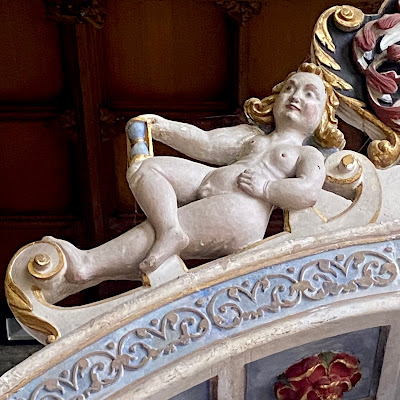
One of my favourite sketches featuring the comedians Peter Cook and Dudley Moore takes place in an art gallery. Among the pair’s most memorable remarks is something Peter Cook says about paintings of naked people in the Renaissance: ‘Of course you don’t get gauze floating around in the air these days like you did in Renaissance times. There was always gauze in the air in those days.’ Meaning that many Renaissance nudes have tastefully placed pieces of diaphanous material draped about those parts of their bodies that might otherwise cause offence, as if the gauze had just floated to rest there by accident. Indeed they do, although in some cases, the gauze was added later, as opinions about what was acceptable in images – particularly images in churches – changed.

And this was my observation when I looked at the figures on the canopy of the tomb of the brothers Marmaduke and Robert Jennings (died 1625 and 1630) in the church at Curry Rivel, Somerset. There are actually two of these reclining figures, one on each side of the coat of arms that tops the canopy so that they act as informal supporters of the arms. Their real pupose, though, is not heraldic but to hold hourglasses, symbolic of passing time and the end that hastens towards us all.

Many people are surprised or even shocked by such displays of human flesh in church. My grandparents, who would have countenanced no ‘graven images’ of any kind in any chapel where they worshipped, would have looked the other way; some Victorians would have hated such secular and classical excesses; and puritan iconoclasts of a little later in the century when this monument was built would not have liked it, although their destruction seems to have been aimed mainly at images of saints, bishops, and Jesus himself, representations that they considered ‘Popish’. My mind is broader, but that is my point: tastes and ideas change.

And that is one of the best things about so many English churches. Having been there for centuries, they bear the marks of changing tastes. It’s a shame some of those changes have brought destruction, but every remaining fragment, every surviving piece of 17th-century oddity, tells us something about altering and enduring attitudes and about where we have come from. These fragments of our past mark time – as the naked ladies of Curry Rivel are meant to do with their hourglasses – and tell us something about what we have been, and who we are.

Saturday, January 22, 2022

Rousham, Oxfordshire

A touch of the baroque, 2

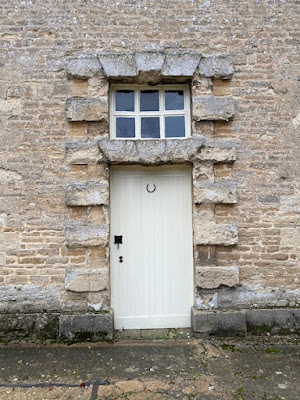
My second photograph from Rousham shows a doorway in the stable block* near the house. The stable block has a central pediment under which is a tall, narrow round-headed arch; blind windows and minimal capitals abound, giving the whole facade a heavy appearance that is relieved to a certain extent by an octagonal turret capped with an ogee cupola. The smaller doorways like the one in my picture have Gibbs surrounds – alternating long and short blocks with the long ones protruding – plus heavy lintels with prominent keystones.

Gibbs surrounds can look very refined on Georgian townhouses in London or Stamford, where they will have smoothly finished blocks. Here the effect is more rustic, because of the roughness of the stone, the simple plank door, and the plain window above. That, perhaps, is not inappropriate for a service building of a great house, and other evidence of good upkeep (such as the pristine paintwork here) makes me feel sure that the estate is keeping an eye on the stonework – this place is as well looked after as the very fancy chickens and cockerels that cluck and crow in the yard. In all it’s not, I’d say, a bad sight to greet the eye as one drives under the adjacent arch to park and emerges, ticket in hand, to enjoy a masterpiece of English landscape gardening.

- - - - -

* It’s ‘almost certainly by Kent’, Pevsner opines.

Tuesday, January 18, 2022

Rousham, Oxfordshire


 A touch of the baroque, 1 

After my recent visit to Stowe, I was inspired to revisit another favourite landscape garden, the one at Rousham in Oxfordshire. As at Stowe, the work of the architect and designer William Kent is seen here, but the garden is much smaller than at Stowe and the mark of Kent is writ large on it – in fact it’s almost as it was when Kent left it after working here in the first half of the 18th century, except that the trees are of course older and maturer.* It’s still the miniature Arcadia that it was said to be in Kent’s time. 

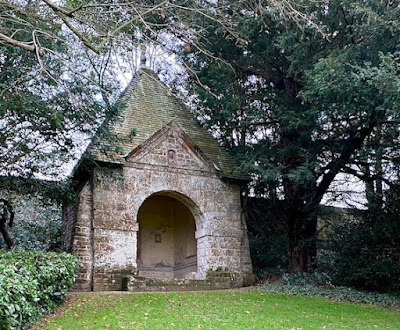
I’ve posted about this place before, but I wanted to show a detail or two that struck chords with me after my visit to the much larger garden at Stowe. One of the architects who worked at Stowe was William Kent’s predecessor Sir John Vanbrugh, a baroque enthusiast whose work there included a ‘Pyramid House’ that does not survive. Rousham, however, still has its Pyramid House, actually a gazebo designed to provide somewhere to sit and contemplate views across the landscape towards distant eye-catchers.

The Rousham Pyramid House is small, fronted with a classical arch, and with a pointed roof that gives the building its name. It’s thought to be a small homage by Kent to Vanbrugh and its chunky proportions and pyramidal roof give it a baroque air that the elder architect might well have admired if he’d lived to see it. The roof is not the only Egyptian touch: there are sloping buttresses that seem to recall the battered walls of Egyptian temples and the small carved relief in the pediment also has an Egyptian look.

There is something generous about a landscape in which structures like this, which enable one to sit, rest on one’s walk, and take in the view. In a similar way, the owners of Rousham are to be commended on the generous way in which they open their garden. There’s a fee, of course, but you buy your ticket with a minimum of fuss from a machine near where you park, and you wander around impeded only minimally by barriers or ‘keep out’ signs. While I’m at Stowe, I feel awed by the scale of everything and amazed by the sheer verve and grandeur of the buildings; at Rousham, I feel pleased I’m in an 18th-century version of a rural paradise.

- - - - -  

* Or are more recently planted replacements.

Friday, January 14, 2022

Great Malvern, Worcestershire

There is nothing like a dome

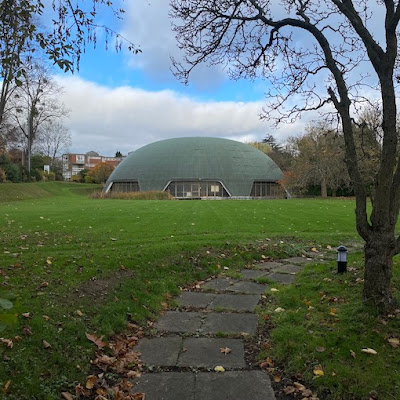
I thought I knew Great Malvern well. I visit it quite often, have inspected it beautiful, late-medieval priory, admired its splendid Victorian railway station, walked its leafy, genteel streets, trekked up – or part-way up – its hills in search of wells and views, and have poked around its secondhand bookshops in search of more things to add to my shelves. So the other day, walking down one of its streets for the first time, I looked to one side and saw the surprising structure in my photograph.

So what is it? Fortunately for me, a lottery-funded scheme to put up plaques explaining bits of Malvern’s history obliged with some information. It turns out to be something rather unusual. It is one of the very few surviving Binishells (named after their inventor, the Italian Dante Bini, and sometimes called Bini domes) in the UK. What distinguishes such a dome is the way it is built. The structure starts with a base, which takes the form of a concrete ring beam. On top of this is laid a large circular sandwich, in which the bread is two sheets of neoprene, while the filling is a mesh of expanding steel coil and a lot of wet concrete. When all this is in place and lying flat on top of the base, the builders pump air into the space between the base and the sandwich, inflating the neoprene, stretching the skin and expanding the reinforcing coil. In the case of the Malvern dome, which is 36 metres across, an hours’ pumping inflated the dome to 11 metres high. The air and stretched neoprene were then kept in this position, supported by air pressure, for three days, by which time the concrete would have set. Result: one dome, for use as a school sports hall..

In this example, eight windows were cut into the lower part of the dome once it had set solid, to provide natural light. When it was completed in 1978, the Duke of Edinburgh† came to open it, and it has been used for its original purpose ever since. Although it looks rather an interloper amongst Malvern’s greenery and mainly 19th-century architecture, its green curves are not entirely out of place among the trees. I hope it continues to be used and maintained – I know of only one other Bini shell in England, in Mildenhall, Suffolk, also a sports hall, though there may well be others. Here’s to Dante Bini and his domes.

- - - - -

* Dante Bini, architect and industrial designer, born 1932, admirer of such innovative engineers as Frei Otto and Buckminster Fuller, the latter famous for his pioneering work on geodesic domes. Bini has also been involved in designing rapidly built housing for the victims of disasters, making his designs available to others royalty-free.

† The dome is called the Edinburgh Dome in his honour.

Monday, January 10, 2022

Stowe, Buckinghamshire


Buildings in a landscape, 3

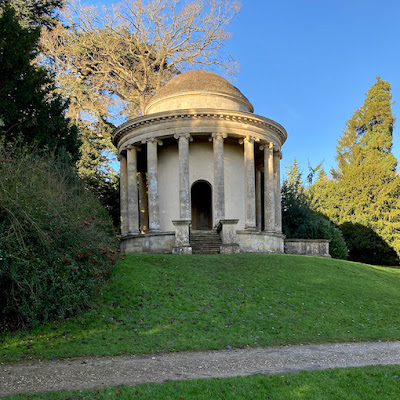
Set on a rise, looking across Stowe’s Elysian Fields towards the Temple of British Worthies (see previous post), the Temple of Ancient Virtue is circular, domed, and surrounded by 16 Ionic columns. By making the temple round, William Kent chose one of the purest, most symbolically perfect architectural forms to house a shrine to four exemplary ancient Greeks: the general Epaminondas, the law-maker Lycurgus, the philosopher Socrates, and the epic poet Homer. Viscount Cobham, owner of the house and garden when Kent was doing some of his most notable work there, chose Greeks, not ancient Romans, for his ancient heroes, because he and his Whig friends were suspicious of the ruthless empire-building Romans (who after all conquered Britain), preferring the Greeks, who invented democracy and stood high for them as founders of western civilisation.

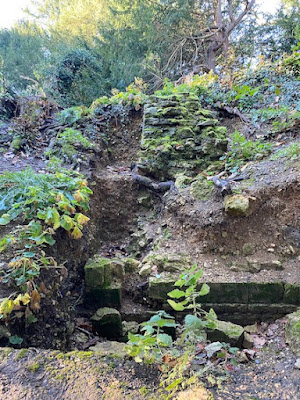
Peter Scheemakers was commissioned to create full-length statues of these great Greeks, but the originals were sold off in 1921 when the owners fell on hard times, and today the temple contains plaster replicas. This itself might be seen to symbolise the decline of the ancient virtues in the modern era, but by the 1730s, Cobham had already thought of this. Near to this temple he also commissioned a Temple of Modern Virtue. This was conceived from the beginning as a ruin and has since decayed so badly that there are only a few traces left, walls poking out of the soil here and there and promising more evidence of what once was hidden beneath the accreted earth. How pleasing that so much else in this remarkable garden has fared better, or has been sensitively restored thanks to the various efforts of Stowe School, the Stowe House Preservation Trust, and the National Trust.

Stowe: the remains of the Temple of Modern Virtue

Thursday, January 6, 2022

Mitcheldean, Gloucestershire

C + M + B

During the time I spent in the Czech Republic, I got used to seeing the letters ‘KMB’ chalked on doorways. They refer to the three magi, traditionally named Caspar, Melchior and Balthazar, although in Matthew’s Gospel, the only one of the four to mention their visit to the infant Jesus, they are not individually named. They do, however, occupy a longstanding space in Christian iconography, often appearing in Nativity scenes and in paintings, carvings and stained-glass images specifically portraying the Adoration of the Magi. I posted about a stained-glass Adoration during the Christmas period some years ago, but it is one of many in English churches.

In the Czech Republic, Epiphany is celebrated as the day of the Tři králové (Three kings), and children dressed as the three kings or magi travel the streets, collecting charitable donations. The letters K + M + B (for the Czech spellings of the names, Kašpar, Melichar and Baltazar) are chalked up on the doors of houses that the kings have visited.

I was surprised to see the initials of the magi chalked in an English church when visiting Mitcheldean last year. But apparently the idea of ‘chalking the door’ with the initials is catching on in England and other countries these days. Here it is not necessarily linked to donations to charity, but to ceremonies or prayers designed to remember the three kings, to bless the house or location, and to express one’s hopes for the coming year. I’d like to express my own hope that the new year brings my readers good things. Or, in the roughly translated words of the Czech ‘kings’: ‘We three kings are coming to you and wishing you health and happiness.’