Showing posts with label Highley. Show all posts

Monday, June 20, 2022

Highley, Shropshire

Any excuse…

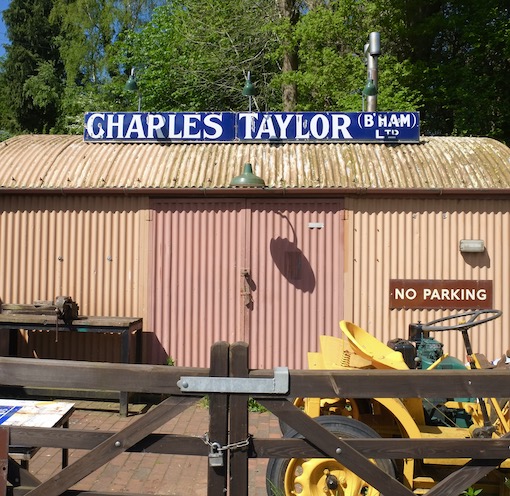
…for a bit of corrugated iron and an old advertising sign. Yes, they’re things I am particularly drawn to. I like corrugated iron because it’s adaptable, can take colours well, and can form the material of serviceable, attractive working buildings. I like old signs because I’m fascinated by the visual effects of their colours and letterforms, and also because they recall historical products and businesses, many of which have not made it into the 21st century. Both wrinkly iron and old signs are in abundance on preserved railways lines, notably the two closest to where I live, the Gloucestershire Warwickshire Railway and the Severn Valley Railway.

This shed is at Highley Station on the Severn Valley Railway, where it is used, I believe, as a workshop. The line was once part of the Great Western Railway network, so the shed is painted in the GWR’s usual muddy light brown. The enamel sign running along the top is a particularly large and handsome example of the sort of metal sign popular in the early decades of the last century. The deep blue background was often used on enamel signs and works well with white lettering, as here. The letters in the name are both bold and well proportioned, and well spaced too: I’d say it was a very effective sign.

It comes from the factory of Charles Taylor of Birmingham. Taylor’s made things like lathes and machine tools. Taylor’s started in 1860. The founder died in 1899 but the firm continued through the 20th century. The excellent Grace’s Guide records them as being prosecuted for keeping a dirty factory in 1874. However, a series of advertisements through the early-20th century suggests an increasing range, so that by 1937 they list lathes, chucks, cutting machines, jigs, vices, and sawing and bending machines among their products. They also introduced new innovations: they filed patents for improved chucks and pedal mechanisms in 1920 and 1954. Their factory was finally pulled down in 1999 and the sign was rescued and has ended up here, where the railway mounted it on top of this workshop building. It’s just the place for it to catch the eye of travellers and tourists on the Severn Valley Railway, an audience very likely to appreciate the bit of engineering history that it evokes.

Tuesday, August 4, 2020

Highley, Shropshire


Job done

These are probably the humblest of all railway buildings. They’re lamp huts or tool sheds, and these corrugated iron versions, just 6 ft wide by 9 ft long, were ubiquitous on the Great Western Railway, and no doubt on other lines too. You found them by the trackside, near stations, signal boxes, and anywhere else where lamps, tools, and other small items needed to be stored. They were cheap, utilitarian, and supplied in flat-pack form, for easy erection on a prepared base in a matter of hours. Corrugated iron made assembling these structures quick and easy. Prepare a base, order up the flat pack, assemble, add a coat or two of paint – and the job was done. Whether they were building the roof of a large train shed in a city or putting up a little shed at a country halt, the Victorians looked on corrugated iron as a marvel of the industrial age.

Usually you find these huts on their own – if you needed more space, the flat-pack building firms like Boulton & Paul of Norwich or Samuel Taylor of Birmingham could supply something larger. But here on the Severn Valley Railway at Highley there are a couple, close together, painted in GWR colours, like the little platform shelter I posted recently on the Gloucestershire Warwickshire Railway at Hailes. Most of them are admirable examples of the way heritage railways find old, worn-out structures, restore them, and give them new life.

People used to look down on corrugated iron structures, especially small ones like this. ‘It’s just a tin hut’, they’d say. ‘What’s so special about that?’ But they were economical, readily available, easier to put up than a chest of drawers from IKEA, long-lasting, and simple to customize with a coat of paint in your railway’s livery. These days, more people appreciate these qualities of corrugated iron, and more and more I notice garages, sheds, and fences in the gardens of private houses, even in the cosseted Cotswolds where I live, many of them put there by people who haven’t necessarily chosen this material because it’s cheap. From a lamp hut to a barn for your 4 x 4, this Victorian wonder material is quietly but effectively doing its job.

Saturday, February 3, 2018

Highley, Shropshire


The signs of yesteryear

In the words of Chard Whitlow, Henry Reed’s amusing parody of T. S. Eliot, ‘As we get older we do not get any younger’. As I get older, I can’t say I experience outright rudeness that often, although the world is not short of oafish behaviour, as a swift walk through any provincial town on a Friday night will reveal. I wonder, though, whether in days gone by it wasn’t worse. One certainly might think so, looking at old notices aimed at improving people’s behaviour. You didn’t have to go far before encountering a ‘COMMIT NO NUISANCE’ (low down, where an inconvenienced ‘gentleman’ might ‘aim’), an ‘ANYONE SMOKING WILL BE PROSECUTED’ (more likely at eye level), a ‘PLEASE REFRAIN FROM SPITTING’ (on buses), a ‘GENTLEMEN RAISE THE SEAT’¶ (on trains), or even an ‘ANY PERSON WILFULLY INJURING ANY PART OF THIS BRIDGE WILL BE GUILTY OF FELONY AND UPON CONVICTION LIABLE TO BE TRANSPORTED FOR LIFE’ (on bridges, in Dorset).

Oh, the signs of yesteryear. So people really had to be told not to spit on the bus or piddle in the corner? I suppose they did, oafs being as thick on the ground then as now, and hygiene being as important then as ever. So the Victorians and Edwardians got on and told them, in bold painted notices and cast-iron signs. Maybe some people even took notice of the notices. But above all, I suppose, it’s the language that marks them out, with its bracing mixture of euphemism (‘nuisance’) and dire warning (‘transported for life’).

A sign of the euphemistic sort that I’d never seen was ‘PLEASE ADJUST YOUR DRESS BEFORE LEAVING’. How can I have missed that one? Too busy admiring the plumbing in the Gents? I don’t know. I became aware of the existence of such signs years ago, reading an excellent book, The Faber Book of Parodies.* This contains not only the poem quoted at the beginning of this post, but a further go at T. S. Eliot, a sort of synoptic parody, called Sweeney in Articulo, attributed to Myra Buttle.† One section of this mock-epic concludes with a random-seeming bunch of quotations, in allusion to the allusive way in which Eliot’s The Waste Land ends. There’s one from Baudelaire, a bit of Latin, some Chinese characters, and then, mixing the highfalutin with the lowly:

‘Love thy neighbour as thyself,’
‘Couldn’t you bring better weather with you?’ and,
Above all,
‘Please adjust your dress before leaving.’

Like anything about T S Eliot, the poem has to have footnotes, and the final line is glossed, ‘Reproduced by permission of Westminster City Council’.

I was thrilled, therefore, some forty years on from reading the parody, to visit the railway station at Highley on the Severn Valley Railway§ and find, not only a ‘Paisley’ water cistern by Doulton and Co, looking like a large butler’s sink painted black, held above my head on two very sturdy iron brackets, but also this notice, a cast-iron plate with letters picked out in white on a black background. Thank you to the Severn Valley Railway for paying attention to the small things. As one must do when adjusting one’s dress before leaving…

- - - - -

¶ Jonathan Miller, in Beyond the Fringe, offered the suggestion that this might be a loyal toast.

* Dwight MacDonald (ed), The Faber Book of Parodies (Faber and Faber, 1961)

† After wondering for a minute whether ‘Myra Buttle’ might be a pseudonym of one of my Oxford tutors, Marilyn Butler, I read that Myra Buttle was a Cambridge don, a Sinologist called Victor Purcell. Anyone who likes parodies might also want to search out Myra Buttle, The Sweeniad (Secker & Warburg, 1958), which contains the Sweeney epic. 

§ Like many preserved railway lines, the Severn Valley is a good hunting-ground for sign-fanciers: it has an abundance of old enamel advertising signs.