Showing posts with label pyramid. Show all posts

Tuesday, January 18, 2022

Rousham, Oxfordshire


 A touch of the baroque, 1 

After my recent visit to Stowe, I was inspired to revisit another favourite landscape garden, the one at Rousham in Oxfordshire. As at Stowe, the work of the architect and designer William Kent is seen here, but the garden is much smaller than at Stowe and the mark of Kent is writ large on it – in fact it’s almost as it was when Kent left it after working here in the first half of the 18th century, except that the trees are of course older and maturer.* It’s still the miniature Arcadia that it was said to be in Kent’s time. 

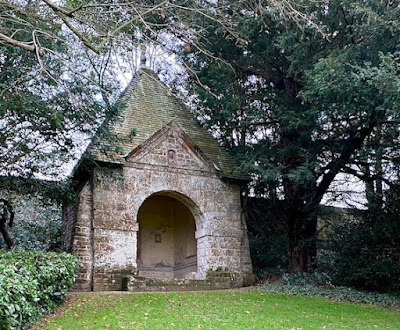
I’ve posted about this place before, but I wanted to show a detail or two that struck chords with me after my visit to the much larger garden at Stowe. One of the architects who worked at Stowe was William Kent’s predecessor Sir John Vanbrugh, a baroque enthusiast whose work there included a ‘Pyramid House’ that does not survive. Rousham, however, still has its Pyramid House, actually a gazebo designed to provide somewhere to sit and contemplate views across the landscape towards distant eye-catchers.

The Rousham Pyramid House is small, fronted with a classical arch, and with a pointed roof that gives the building its name. It’s thought to be a small homage by Kent to Vanbrugh and its chunky proportions and pyramidal roof give it a baroque air that the elder architect might well have admired if he’d lived to see it. The roof is not the only Egyptian touch: there are sloping buttresses that seem to recall the battered walls of Egyptian temples and the small carved relief in the pediment also has an Egyptian look.

There is something generous about a landscape in which structures like this, which enable one to sit, rest on one’s walk, and take in the view. In a similar way, the owners of Rousham are to be commended on the generous way in which they open their garden. There’s a fee, of course, but you buy your ticket with a minimum of fuss from a machine near where you park, and you wander around impeded only minimally by barriers or ‘keep out’ signs. While I’m at Stowe, I feel awed by the scale of everything and amazed by the sheer verve and grandeur of the buildings; at Rousham, I feel pleased I’m in an 18th-century version of a rural paradise.

- - - - -  

* Or are more recently planted replacements.

Friday, September 18, 2020

Painswick, Gloucestershire

Pointing up, standing out

Painswick, one of the most delightful of Gloucestershire’s small towns, is perhaps not as widely appreciated as Cotswold places like Broadway or Chipping Campden because a main road runs through it and the tight knot of lanes off the main street reveals no village green or market place where people can gather or sit and take in the view. But Painswick has something just as good: the most delightful churchyard for miles, a generous space well populated with beautifully carved (although now very worn) Cotswold stone tombs, interspersed with a small forest of yew trees. There are said to be 99 yew trees, attempts to grow a hundredth having ended in failure; it’s also said that it’s impossible to count them – the total is different every time. I’ve limited myself to admiring the yews without being tempted to put such legends to the test.

There must be dozens of tombs and gravestones, too, many of them dating from the 17th and 128th centuries, when Painswick was at its most prosperous because of the wool trade. Many of the grander tombs commemorate wool merchants or clothiers. One stands out as rather different. It’s this pyramid, which marks the grave not of a clothier but of John Bryan, who carved of many of the monuments in the churchyard. He died in 1787.

It’s often said that the English fascination with ancient Egyptian culture began in the early-19th century, after the invasion of Egypt by Napoleon (in 1798) and the work of Jean-François Champollion, Thomas Young and others on decoding hieroglyphic script. However, Egyptian culture held a fascination for some people in Britain well before this period, and whoever created Bryan’s tomb in the late 1780s was clearly one of these forerunners. True, Bryan’s tomb doesn’t have quite the same proportions as the ‘typical’ Egyptian pyramid – it’s taller and thinner than the Great Pyramid of Giza and its neighbours. Bryan’s pyramid is closer in shape to the pyramids built in late antiquity at Meroe on the upper Nile in Sudan, though I’ve no idea whether they were at all well known in 18th century England. Perhaps the builders just wanted to give the carver’s memorial a little extra height, so that his grave is marked with a monument that can clearly be seen among the clusters ofd lower chest and ‘tea caddy’ tombs that he helped to create.


Monday, October 1, 2012

Brightling, Sussex


Fit for a king

As promised in the previous post, here is the pyramid in Brightling churchyard, beneath which the local squire, MP. philanthropist, and folly-builder John Fuller was buried when he died in 1834. The pyramid is a substantial stone structure, some 25 ft tall and taking up a large chunk of the southern side of the churchyard. It's similar in shape if not size to the resting places of the Old Kingdom Egyptian kings, but unlike the Egyptian pyramids has an entrance on one side, allowing visitors to peer into the gloomy space within. Fuller built the tomb in 1811, so his friends and neighbours had 23 years in which to get used to the fact that he had chosen this unusual form of monument. It was after his death, however, that the local gossip on the subject seems to have taken hold – in particular a story that Fuller was entombed in the pyramid sitting down at a table with a roast chicken and a bottle of claret. Such unconventionality seemed appropriate to Fuller's larger than life character, and the idea that he was buried with his dinner appeared to fit the ancient notion that the soul would need sustenance on its way to the next world. When the pyramid was restored in 1982, however, the rumours were found to be untrue. The squire is buried in the usual recumbent fashion beneath his pyramid.

Sunday, March 25, 2012

Newell Street, London


The wisdom of Solomon

In the dappled green shade of the churchyard of St Anne’s, Limehouse (see previous post) is a 9-foot-high stone pyramid. It seems to mark no grave, has no obvious purpose, and stands there, looking mysterious. In 19th-century engravings it is shown mounted on a square plinth but now stands on the ground. On one face is the inscription, ‘The wisdom of Solomon’. The pyramid is part of a group of arcane symbols that seem to cluster around Hawksmoor’s churches – pyramids, obelisks, and other borrowings from ancient civilizations – that set them apart and contribute to the alien character of these massive buildings. The best guess about the surprising presence of this particular pyramid is that it was intended to top one of the corners of the church. No one knows for sure.

Such things arouse the interest of psychogeographers, those writers who have examined the lives of places and their effects on people’s psyches. Mappers of hidden cultural contours; those who exhume forgotten histories or find alignments between the past and the present; soakers in atmosphere; reclaimers of evocative desolation and pleasing decay.

Iain Sinclair, for example. A whole section of Sinclair’s book Lud Heat (part poetry, part prose, ‘a writing’ as that other great London visionary, David Jones, would have called it) concerns Hawksmoor’s churches. It includes a map with lines that join their sites, creating triangles and pentagrams and alignments with other highly significant sites and buildings such as William Blake’s house in Lambeth and Cleopatra’s Needle. Sinclair mines all kinds of allusions, myths, and significances from these alignments, connections that enable him to incorporate into his text references to such writers as Blake, Pepys, and Sir Thomas Browne, parallels with myths from ancient Egypt and ancient Britain, and sinister histories ranging from the plague to the murders committed by Jack the Ripper.

Who knows how significant all this is? It’s possible to make all sorts of sites connect on a map, especially if the scale of the map is small and the lines joining the points are thick, as critics of ley-line hunters have pointed out. But I’m not looking for literal truth or Ordnance Survey precision in the alignments between pyramids, obelisks, and plague pits. What is more important is that Sinclair has built absorbing and sometimes brilliant writing out of this hoard of images and myths.

And Sinclair nails Hawksmoor’s style. He says of the churches: ‘Certain features are in common: extravagant design, massive, almost slave-built, strength – not democratic. A strength that is not connected to notions of “craftsmanship” or “elegance”. They are not easy on the eye, and do not enforce images of grace. Metaphors inflate at their own risk. The mind is not led upwards to any starry nest.’ Sometimes Sinclair could almost be describing his own writing here, prose that has a strangeness and a solidity that is true to Hawksmoor’s buildings, large, ponderous, and weird as they are. Words that are arranged in a modern, collage-like fashion, and yet draw on ideas that have been around for as long as the pyramids of Egypt.

Wednesday, October 27, 2010

Wheatley, Oxfordshire


High security

Like some sort of rustic mausoleum – the pyramid of an old geezer – this little building pops up in the Oxfordshire village of Wheatley to surprise the passer-by. It’s not a mausoleum, though – there’s no churchyard hereabouts – but something that was an essential for a village of any size before the mid-19th century: a lock-up in which wrongdoers (drunks, petty thieves, kickers of buildings, and other ne’er-do-wells) could be detained overnight before being brought before the beak in the morning. They’re usually small, and built completely of masonry, usually stone, to prevent inmates from pushing tiles off the roof and climbing out.

English buildings don’t usually have roofs made completely of stone. We have stone-covered roofs here in the Cotswolds, but they’re made up of stone ‘slates’ supported on timber frames, and are far from secure. What I’m talking about here is a stone roof that’s as strong as the walls beneath it. Creating this kind of structure has led to some interesting designs, and this is one of the best: a tall hexagonal pyramid, with no distinction between the roof and walls at all.

Who came up with this unusual and arresting form? It used to be thought that the little building was designed by Vanbrugh. It’s certainly the kind of bold, uncompromising shape that Vanbrugh liked, but it’s a bit too rustic for him. The architect of Blenheim would probably have specified smooth, high-quality ashlar instead of the rougher, coursed rubble masonry at Wheatley. Perhaps too he would have made more of the doorway and designed a more elaborate moulded capstone to support the ball finial. No, this is the work of a local mason who had perhaps seen Vanbrugh’s work: apparently a man named Cooper, who built the lock-up in 1834 – more than 100 years after Vanbrugh died.

1834 is very late for a village lock-up. In 1839 the County Police Act allowed paid police forces to be set up in each county – and each force had to have police stations with cells built in. Lock-ups gradually became surplus to requirements and many were demolished. Quite a number survive, but few of them are quite as memorable as this little pyramid.