Showing posts with label Regency. Show all posts

Monday, January 19, 2026

Great Malvern, Worcestershire

Health resort

To Malvern (again) for coffee, book browsing, exercise, and architectural appreciation. Malvern is one of my favourite nearby places, and not just for its magnificent hilly scenery. It keeps on giving me food for thought architecturally, with everything from medieval tiles to a rare Bini dome. It is, as they say in the trade, ‘well bookshopped’, boasting shops selling new books, a good vendor of second hand books, and a couple of charity bookshops. And its hilly terrain means getting around gives me good exercise.

It was ever thus, or has at least been thus for a long time. Malvern is, famously, a spa town. The health-giving qualities of the water at Malvern Wells were discovered in the 16th century, but the place really began to grow in the period around 1810, in part at least as a result of the great success of the spa at Cheltenham. Various wells were exploited, hotels were built – and more. Those who came to take the waters needed other things to do to. Cheltenham offered circulating libraries, a harp and pianoforte warehouse, assembly rooms, and so on. So in Malvern, next to the pump room and baths, the grand Royal Library was built.

The library is on a corner site, and turns the corner with some style. This corner is actually a junction at which two side roads meet the main Worcester Road towards the summit of the town centre’s hill. The setting gives the end of the library great prominence, and the architect, John Deykes, exploited this to the full with a full height semi-circular bow in the classical style of 1818, when he drew up his plans. The main ground floor, actually raised slightly above the ground because the land falls away so sharply, is particularly splendid. Tall, 9-over-9 sash windows are separated by Ionic columns that support a balcony above with a balustrade of pump uprights. Above this, the upper-floor windows are set back, but echo the semi-circular shape. It’s a striking composition, and must have impressed visitors as they slogged their way up the hill.

The library building was part of the same structure as the assembly rooms, so inside it was not all about the books. As well as a reading room and an extensive lending library there was also a music library, a billiards room, and a room for card playing. The building also contained a bazaar where, according to an information board down the street, ‘anything from a Bible to a firescreen could be purchased’. All this, together with increasing numbers of shops, gave the spa visitors plenty to do, and served the town well through the Regency and Victorian heyday of the spa. When I visit today, walking, browsing, and imbibing, not to mention admiring the architecture, I feel I’m following in those 19th-century footsteps.

Wednesday, May 28, 2025

Hampton Lucy, Warwickshire


Industrial Gothic

Thomas Rickman (1776–1841) is best known today as the author of a book with the lengthy title of An Attempt to Discriminate the Styles of English Architecture from the Conquest to the Reformation, first published in 1817 and reissued many times. This work was the first to use the names Norman, Early English, Decorated and Perpendicular for the different phases of English architecture between 1066 and the beginning of the Tudor era, names that are still often used today.* Rickman stumbled into his deep interest in medieval architecture after two disastrous events in his life, the failure of his business and the death of his first wife. He took to taking long walks in the English countryside and became fascinated by the many medieval churches he saw on his travels. His studies and drawings of these buildings led to his book and to his career as a designer of buildings – houses, at least one town hall and numerous parish churches.

I visited Hampton Lucy to see St Peter’s church, built to designs by Rickman and his architectural partner Henry Hutchinson in 1822–26§ for Rev. John Lucy, a member of the family who owned the nearby country house, Charlecote Park. I found a church that’s surprisingly large for a small village and built in glowing Cotswold stone. The style is what Rickman called Decorated, the idiom of the first half of the 15th century, characterised by rich carved ornamentation and elaborate, curvaceous window tracery. The south elevation in my photographs shows the tracery of the aisle windows with its two different patterns, using a range of curvy shapes. The pinnacles and parapets above create a skyline that’s typical of Decorated carving.

The stonemasons of the 14th century, and their successors in the 19th century, handled stone beautifully. But Hampton Lucy has a trick up its sleeve. That window tracery is not stone at all – it is actually made of cast iron. Thomas Rickman, a stickler for reproducing medieval details, did not mind using ‘modern’ materials to achieve this. He developed a fruitful working relationship with at least one ironmaster,¶ which allowed him to use high quality ironwork in several of his churches. This use of one material to look like another is the kind of architectural ‘dishonesty’ that many Victorian architects and writers rejected – if it looks like stone, they’d have said, it should be stone. However, Rickman died before this kind of purism became not just fashionable but morally axiomatic. And the results here at Hampton Lucy are impressive. I’m sure most people who see the church assume that this tracery is stone, like most other window tracery, in spite of the fact that the paint is slightly paler in colour than the true masonry. Personally, I respect the craft of the stonemason,† and when one looks closely at hand-carved work, there are always minute variations between apparently ‘identical’ windows that give pleasure to those with eyes to see it. I do find, however, that 19th-century handwork is often much more mechanical in appearance than medieval carving and in this case I’m happy to find the cast-iron tracery of Hampton Lucy not only acceptable but also ingenious.

- - - - -

* I own a battered copy of Rickman’s book and admire its many engravings of medieval architecture; the book is well worth looking out for. Rickman’s four styles and their names, though not perfect for the shifting modes and evolving patterns of medieval building, are still useful.

§ The chancel was built later, after a request for a still more elaborate setting for the church’s high altar in the 1850s. Its design is by Scott.

¶ John Cragg of Liverpool, who worked with Rickman on several churches, including St George’s, Everton, which I hope to see on my next visit to Liverpool.

† Much of the stonemason’s art and craft is visible in this church, not least in the parapets and in other windows made the conventional way.
Detail showing aisle windows, Hampton Lucy

Thursday, May 30, 2024

Clifton, Bristol


Classicism, but not as we know it

‘You can park on Clifton Down,’ I was told. ‘Walk down the Promenade and Litfield Place: you’ll like some of the buildings along the way.’ Even so, I was not quite prepared for the sheer size and grandiloquence of some of the 19th-century houses in this part of Clifton. They were built for the most part for merchants, who were dripping with wealth from transatlantic trade, much of it involving slavery, and who wanted sizeable houses close to some greenery, well away from the bustle of Bristol’s city centre and docks, but near enough for convenience. There are views, too, from Clifton’s heights towards the city or the countryside.

Some of these houses are from the first third of the 19th century, like Trafalgar House, which was built in the 1830s with an enormous ‘statement’ two-storey portico. The ground floor level has a lower ceiling and shorter windows thatn the enormous sashes of the floor above, and the masonry of the portico at the bottom is treated with banded rustication. This is in line with the use of ground floors as service rooms, whereas the floor above contained the large, grand rooms, where the owner received guests in the most magnificent of surroundings. So rusticated masonry on the ground floor acts as a kind of class-marker, and this floor (or the basement where there was one) was often known as the ‘rustic’ in the 18th century. The columns on the upper part of the portico are in the plainest of all classical orders, the Tuscan, indicating a sober quality somewhat belied by the statue of the cartoon character Gromit, from the Wallace and Grommit films by Bristol’s animation company Aardman, on the balcony.

But the portico is neither entirely serious nor wholly orthodox. Whoever designed it adorned the lower level with a row of three arches, an unusual touch, which gives the architecture a sense of relaxation and unorthodoxy it otherwise would not possess. The building’s architect is unknown – suggestions include Charles Dyer, who designed other houses nearby, and Charles Underwood, who started in Cheltenham as a builder before moving to Bristol to practise as an architect. Whoever it was created a striking effect that must have pleased the house’s original owners, and pleased me as I passed by the other evening.

Tuesday, December 12, 2023

Boxford, Suffolk


Preserve, re-use, re-use again

In Boxford primarily to look at the church, my eye of course was caught in addition by other things. This small building in the middle of the village made me scratch my head. What is it? The date, 1838, took my mind back to the era of village lock-ups, and this seems to have been the answer. Two stout wooden doors would have originally provided security for a two-celled mini-prison, where wrongdoers were kept, usually just for a short period before they were either released or taken to court. Drunks would be left until they were sober, two people who had got into a fight could be locked up and separated by a solid brick wall, those suspected of more serious misdemeanours would be locked up until they went before a justice or magistrate.

Lock-ups usually featured simple and functional architecture, but here the builders allowed themselves a couple of four-centred arches and a generous brick gable to make the structure look imposing.* The bricks are the pale ones seen widely in East Anglia. When no longer needed as a lock-up, the building was used to store the village fire engine (it would have been a small, hand-pumped device). Today it’s used simply as a shelter, a nice example of an antiquated building finding a new use that makes it worth preserving as something more than a mere eye-catcher – although it certainly fulfils that function too.

- - - - -

* Although we are a fair distance from the sort of chunk prison architecture that is sometimes seen; for an example, see this one here in Bewdley, Worcestershire.

Friday, October 6, 2023

Leamington Spa, Warwickshire

The angular meander

Is there a pattern that says ‘Greece’ louder and more clearly than the ‘Greek key’? This motif takes the form of a continuous line that bends back on itself through a series of right-angles, before bending again to resume its forward course. It’s sometimes called the Greek fret, sometimes the meander, and some say its form derives from the Greek River Maeander (or Meander). It was widely used in the architecture of the Greek revival, a style popular in Britain during the decades on either side of 1800.

Here it is in the iron supports of the veranda that runs along the front of the houses in Lansdowne Crescent, Leamington. They were built in the mid 1830s to designs by local architect William Thomas. The uprights with their Greek key design ensure that the canopy above the veranda is held up securely, while also proclaiming the classical heritage of these town houses. The verandas were not so much for sitting out on – they are quite narrow – but more to provide shade for the almost south-facing rooms while also ensuring that if the floor-to-ceiling window is open, no one absentmindedly steps out and tumbles into the area below.

Soon after the residents moved in, Queen Victoria was on the throne and the fashion for elegant middle-class houses would turn from the classical to other styles – Italianate, Tudor revival, or Gothic. But the people who lived in Lansdowne Crescent in the mid-1830s (whether they were permanent residents or visitors who rented a house for the ‘season’, in order to make use of Leamington’s spa) must have delighted in their homes, which were both chic and Greek, courtesy of the angular meanders of their exterior ironwork.

Wednesday, April 5, 2023

Lydiard Tregoze, Wiltshire


For vigour

What’s this, in the park of the 18th-century house of Lydiard Tregoze, near Swindon? Not a sheep wash. Certainly not something for cleaning mud off the wheels of carts. It is, I’m reliably informed by the adjacent interpretation board, a plunge pool for humans, and it dates to about 1820, when Sir George Richard St John was Lord of the Manor. Although by this time the technology for piped water certainly existed, most country houses did not have such a convenience. What did the upper classes need piped water for, when they had a large staff of servants to bring the stuff to where it was needed? So water for washing and bathing was brought to your room by hand, and most country-house owners were happy with this arrangement.

Some houses, however, had plunge pools, either out in the open like this, or undercover in an outbuilding. Plunge pools, as the name suggests, were not for wallowing. The idea was to plunge in and out quickly and the reason for doing this was not primarily for washing, but because a dunking in cold water was deemed to be good for your health. Some went to Bath or other health resorts, some, increasingly, went to the coast to bathe in salt water, but many held that immersion in fresh water – here supplied from the nearby lake – was just as good. Madness, rickets, leprosy and asthma were among the disorders said in the Regency period to be helped by a course of plunge-pool treatments. Maybe some bathers thought that a daily dash down to the plunge pool and back would bring them increased vigour, in the same way as a cold morning bath at boarding school was supposed to do.

So it was perhaps a case of going down the steps as quickly as you could manage, ducking in a few times, and then dashing back up the steps – even faster, and shivering no doubt – and rushing indoors to be dried. Invigorating? I hope so.

Saturday, August 20, 2022

Cheltenham, Gloucestershire


Regency inventions

I must have walked along the Promenade, Cheltenham’s grandest shopping street, hundreds if not thousands of times. On many of these occasions I’ve given an admiring nod to a sequence of houses at the southern end of the street, near the Queen’s Hotel, where there is a short stretch of very large houses, set back from the street, now mostly accommodating hotels and restaurants. Several of these buildings are currently partly invisible behind the extensive tents that have been erected to enable people to dine in the fresh air, a popular feature, especially in times of pandemic, although it does get in the way of appreciating the architecture. A small price to pay, many would argue, for the survival of businesses and the enjoyment of a decent meal.

However, the architectural admirer can always look up, as I did the other week, to be reminded of the unusual capitals on these otherwise conventional houses. One of the buildings features a row of attached classical columns topped with capitals like nothing in any of the Greek or Roman orders and nothing that I’ve seen in the work of John Forbes, the probable architect. Each one has a row of – what – fronds? feathers? topped by an abacus with a simple pellet moulding. The form of the fronds may owe something to the pergamene order, an unusual antique design found at Pergamon in Turkey. However, the description in Pevsner suggests that the design is a variation on the Prince of Wales feathers. The latter are sometimes drawn in the lengthy form of these architectural feathers, especially in the badge of Edward the Black Prince, which is said to be the medieval origin of today’s device, familiar to most British people from its reproduction on the old two pence coin. That seems fitting at least for a Regency or late-Georgian building.

My second photograph shows another capital on a neighbouring house, topping a pilaster in a position on its building similar to the one described above. This too is unusual, though I suppose it is a version of the Composite Order, the Roman design that combines the spiral scrolls of the Ionic with the acanthus leaves of the Corinthian. But here the Corinthian details have been modified, with the acanthus leaves stylized into a single leaf at each lower corner, and the space in the centre of the capital occupied by a large anthemion or palmette form. Whatever we call it, it’s another example of the capacity for invention and variation in classical architecture, a cherishable bit of character above the tents and menus and diners, most of whom, no doubt, have no idea of such niceties….


Monday, December 20, 2021

Ely, Cambridgeshire


Logistics, Regency style

Although repainted and sliced off on one side, this old sign is still worth pausing to look at. It begs several questions. How did it come to be missing its right-hand edge when the windows on either side look old? How old is it? Who were Isaac Marsh and William Swan? Answering the last question gives a hint of an answer to the second, at least.

There was a Marsh and Son operating wagons out of Cambridge in 1808, but by 1814 the company is called Marsh & Swan. They covered a range of Cambridgeshire and Norfolk towns, as well as operating their service to London’s Bull Inn, Bishopsgate Street, a major destination for London coaches and for vehicles carrying goods such as the flies, vans and wagons* that Marsh and Swan operated. But by 1845, the company was called Swan and Sons. So this sign must date to the period between the 1800s and the early-1840s.

They’d be called a logistics firm today and run a fleet of trucks and they were as essential to commercial life as the companies whose trucks carry everything from food to pharmaceuticals now. However, their modern equivalents do not leave behind them such well crafted signs as this one, which compares more than favourably not only with the lettering on most lorries but also with that on the modern sign below it.

The sign-writer who restored it seems to have done a good job of recreating the letterforms and ornaments of the original. The balance of thick and thin strokes in the capital letters, the fancy curlicues on the ornamental ’T’, ‘Y’ and ‘B’ , and the decorative arrangement of the ‘and’ between the proprietors’ names – all these, I hope, will meet with well deserved admiration .

- - - - -

* Wagons or waggons were large four-wheeled horse-drawn vehicles for carrying goods. A fly was a smaller wagon, although the term could also be applied to a horse-drawn passenger vehicle – the main feature of both was the ability to travel quickly. Vans were smaller still, with a permanent covered structure.

Monday, November 8, 2021

Leominster, Herefordshire


Incidental pleasures, 1: Fan mail

Are you are a fan of fanlights? I’m sorry, but the pun seems to want to be made.* I have always admired the semi-circular fanlights of the Georgian period, noticing the satisfying, cobweb-like layout of their glazing bars, dividing the little window in a way that justifies the name. And also reflecting how the entrance hall of a house can be its darkest area, and that a generous fanlight can help bring in some welcome natural light. So I’ve done posts about fanlights more than once before.

Scrolling through my pictures looking for something else, I came across this small gem. Not semicircular at. all, and not fan-like either, but more interesting than the simple rectangular windows that were often inserted above Victorian doors. The cue for the shape comes from the door’s canopy, with its shallow segmental curve, giving the fanlight a curved top too. And the pattern of the glazing nods towards this curve with four straight glazing bars radiating outwards, forming shapes that look as if they have been inspired by the tracery in Gothic stained-glass windows. So the shapes are all ogees and cusps, making a contrast with the simple, straight-sided panes of glass in the door below.

It’s modest, but visually satisfying. I have my doubts about how much light it lets into the interior, especially with the canopy producing shade as well as shelter. But if your front door faces directly on to the street, it’s pleasant to offer the street a bit of visual uplift, something to warm the heart of the observant passer-by.

- - - - -

* If it seemed so to me at least, perhaps it’s because I’m a bit of a paranomaniac at heart.

Tuesday, September 21, 2021

Buckingham

Hunting the Hart

During our recent stop in Buckingham, the town’s White Hart Hotel was looking particularly attractive with its hanging baskets, so I paused to take the photograph above. I wanted to show not just the flowers but also some detail of the Doric porch, which acts as a platform for the statue of the eponymous white hart with the traditional gold coronet around its neck. Although the White Hart is a very common name for an in or pub in England, relatively few have a three-dimensional image of a stag as their sign. I’ve seen a number of these in my time – a splendid standing stag in Okehampton, for example, with a magnificent pair of outstretching antlers, and another high up on the White Hart Hotel in Salisbury, which can, in the right light, be dramatically silhouetted against the sky.*

The White Hart symbol became well known during the reign of King Richard II (reigned 1377–99), who adopted it as his badge. He is said to have based it on the heraldry of his mother, Joan, Countess of Kent, whom the chronicler Froissart called ‘the most beautiful woman in all the realm of England, and the most loving’. The king’s retainers and followers would have worn the badge, and it appears several times on the Wilton Diptych, the superb portrait of the ruler now in the National Gallery.

Like many White Hart Hotels (and indeed numerous other urban hotels), the one in Buckingham is early-19th century in appearance – the flat front, symmetrical facade, and classical porch are all standard features of the coaching inns of the late Georgian and Regency periods. In those days Buckingham was a good stopping point on the journey between the Midlands and London, or between Oxford and Cambridge, and the White Hart was one of several inns in the town. And it was in earlier times too – the inn’s history is said to go back further than the Georgian era. It’s still a good place to pause when making the cross country journey from Oxford to Cambridge – or, as it was for us the other day, from the hills of the Cotswolds to the flatlands of the Fens.

- - - - -

*See my Instagram account, @philipbuildings and scroll past recent posts, to see images of these.

Wednesday, August 25, 2021

Sherborne, Dorset


Surprised in Sherborne, 2

Sherborne’s Cheap Street is a very attractive jumble of architectural styles – from late-medieval timber framed structures to stone buildings from virtually every later date: a hotch-potch, mostly with recent shop fronts, but much of it given unity by the glowing stone. Even in this good company, the bow-fronted building above is outstanding. Living near Cheltenham, I’m used to stucco-covered Regency buildings decked out with classical cornices, columns and iron balconies, but even so this one made me pause. It’s small, with just a single window on the upper floor of its curvaceous facade, but what a window – the full Venetian, with a pair of rectangular sections bookending a round-topped central portion, the whole surrounded by elegant mouldings and highlights picked out in white. A neat cornice and parapet, balustraded in the centre, complete this upper floor, which rests on four stone Ionic columns that frame the modern shop window. The iron balcony is the finishing Regency touch, vital for the safety of those inside who want to open the big window, which extends down to the floor.

As with the shop front in my previous post, I wondered what this building was used for when it was first put up in the early part of the 19th century. The upper room looked to me like the spacious drawing room of a middle-class house, the sort of thing that wouldn’t look out of place in Brighton. But there was no clue to what was originally where the modern shop window is now. The answer turns out to be that the building belonged to the Sherborne Savings Bank, who erected it in 1818. 

This was the formative period for savings banks in England. These banks were set up to provide banking facilities for poorer people – those who were not normally the customers of the established banks, whose accounts did not normally bear interest at this time. Savings banks welcomed small investors, including those who could save only intermittently, as their incomes were unreliable and varied according to the seasons or the availability of work.* Although savings banks did not help the very poor, who found it impossible to save any money at all, they were attractive to those such as artisans, small farmers, shopkeepers, and domestic servants, among whom were many who had a little money to save and who liked the idea of self-help. Savings banks were not perfect: in an era before elaborate state regulation of financial institutions, some folded as the result of fraud or incompetence. But for many they played a useful role.

Whoever designed the Sherborne bank’s building did their best with what was clearly a confined site. Ideally, the sweep of the bow front should stick out over the pavement area, so that it can make an impression whichever way you approach it. But the building to the right already sticks out, so this wouldn’t have worked without invading too much pavement space. So here it sits, standing proud of one neighbour and slightly in the shadow of the other, making its impression nonetheless.

The delicate architecture of this frontage is not what I normally associate with banks. The banks I’ve admired on this blog in the past have been rather chunky buildings, with the kind of solid-looking masonry that suggests strength and security. They seem to tell you that your money will be safe here. This building is very different. It’s impressive, but in a gentler, more domestic way. Its columns and the overhang they make possible offer shelter from the rain and seem inviting. ‘Come in,’ they say, ‘and you’ll receive a warm welcome.’ The effect seems wholly appropriate for a savings bank set up for those not previously used to dealing with the estanlishged banks or money markets. It still works its charm, on one passer-by, at least.

- - - - -   

* Small investors could also entrust their money to Friendly Societies, but these had regulations – often requiring members to deposit money regularly, that did not suit those with irregular incomes. Savings banks did not have such rules. 

Friday, July 16, 2021

Much Wenlock, Shropshire

Gothick delight

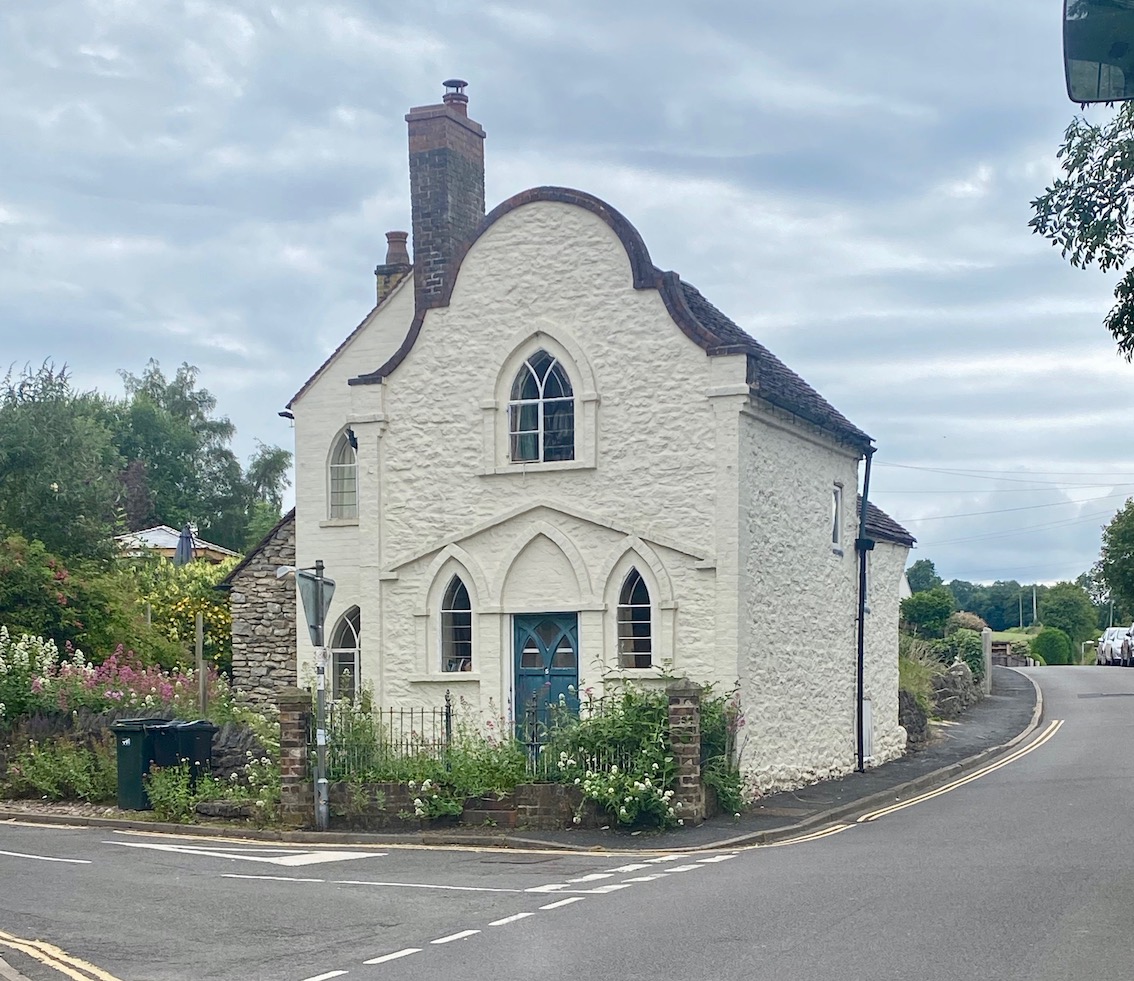
I caught sight of this house on a late-afternoon walk in Much Wenlock. I’d already noticed one or two other examples in the town of this kind of architecture – early-19th century Gothick, in which pointed windows with Y-tracery set off the facades of quite modest buildings, often in combination with other features – pilasters, pediments, curved gables – that aren’t associated with the medieval Gothic style at all. This house is a good example of the decorative mélange that can result: pointed windows in pointed recesses, pilasters running up each side of the frontage,. a sloping cornice rather like a broken pediment above the central door and its accompanying windows, and, topping it all, a striking rounded gable that steps halfway down to turn from a convex to a concave curve. All this fronts what is otherwise quite a modest structure of rubble masonry and brickwork, all painted white.

The effect of the facade belies common misconceptions: that Georgian Gothick is filigree and delicate and that ornate gables like this are confined to eastern England, where the Dutch influence on English architecture was strong. So this building has left behind the delicate filigree Gothic of Walpole’s house, Strawberry Hill, rebuilt back in the 1740s, for something that’s frankly chunky and more suited to the abilities of a provincial builder; no doubt it was also to the taste of the owners of small houses in late-Georgian Shropshire. As for ‘Dutch’ gables, they were popular in coastal Lincolnshire and East Anglia a century and more before this house was built, and were by now another idea that had become assimilated. Pointed windows and curvaceous gables were, it seems, a matter of local fashion and choice. I’m glad those choices were made here.

Saturday, January 16, 2021

Dartmouth, Devon


Summer days, 3

On one of many recent days stuck in doors, the Resident Wise Woman reflected that it was fortunate at least that we’d managed a trip to Devon and another to Aldeburgh late in 2019. The virus couldn’t take those memories away from us, even if it has deprived us of the trips we’d planned for 2020.† Drifting around the streets of Dartmouth was one of the pleasures of the Devon trip. It’s a town full of architecture pleasures, but here’s one of the more incidental ones: a house near the water and another exemplar of that seaside style I’ve been exploring in my previous two posts.

Well, partly. Actually this is a bit more sophisticated than the pretty but random-looking houses on the front at Lyme. This is Regency sophistication, and plenty of it. The house has the pale blue finish that one could find near the sea at any coastal town. But in other respects we’ve moved away from architectural casual wear and got into high fashion. That pattern of glazing in the window, with narrow panes near the edges (and there are several more of them in the storey above) is classic early 19th century. What you can’t see in my photograph is that the window also has a curving top, enhancing the Regency feel. Also very much of its time (1820s or 1830s) is the cast-iron balcony with its pattern of crosses. This balcony is an interesting combination of solidity – the ironwork looks very substantial – and fragility: the floor is thin timberwork and the brackets, as so often, seem very modest; indeed, diagonal iron rods have been fitted so that the ironwork is fixed to the wall higher up (one of these is just visible among the foliage at the left).

Then there is the doorway. This is a show-stopper. The doorcase alone is special, with its diagonal grooved decoration up the sides and across the segmental top; then a bat-wing design with oval medallion carved between the segmental curved and the fat hood. The door is also impressive, with its pattern of studs. This may be a terraced house, but its doorway make one feel as if to go in would be to enter the home of a person of consequence. For the mere passer-by it at least had the effect of lifting the spirits, something that all good seaside houses should do,.

- - - - -

† Not to mention any plans we might have had for 2021. Old Czech joke: Q: How do you make God laugh? A: Tell him your plans.

* Pevsner calls this ‘an unusual pattern-book doorcase’. Well, provincial builders did indeed lift their designs from pattern books, but wherever it comes from, this example is certainly unusual.

Friday, January 8, 2021

Lyme Regis, Dorset


Summer days, 1 

As the sleet came down in late December, I found myself looking through my files of photographs and came across a number taken near the English coast when the sun was out and the sky was blue. In one way it was good to look at images of summer days at a rather bleak moment, though in these times of confinement it’s not easy to imagine being able to jump in the car and decide, spontaneously, to head to the coat and visit somewhere like Lyme Regis. Looking at the photograph above, though, also reminded me how the houses in so many coastal places have a recognisable ‘seaside look’. What does it mean to say this, and how is it expressed, architecturally? It’s a combination of things, not all present in the picture, not all constant, for seaside houses as much as the homes in an inland town are built for different people with different needs, priorities, and budgets. But a few features of these Lyme houses can point the way to an answer. 

One thing is colour. A lot of seaside houses are finished in stucco or other render that’s painted, either white or in pastel shades. Here there are pale pink, green, and blue houses, along with the ubiquitous white. There might be several reasons for this. A lot of seaside houses were built in the 18th and, especially, 19th centuries as stays beside the sea became fashionable, first for the leisured classes, then for poorer people. Sometimes these houses were built quickly, and stucco was a way of hiding rough masonry beneath a civilised surface. This sort of finish was anyway popular in the late-Georgian and Regency periods, when many such houses were built. Lyme developed as a spa in the 18th century and was still popular when Jane Austen visited in 1804. A lot of Lyme still has a late-Georgian or Regency feel to it and these houses reflect that. As well as walls with a pale finish they have another typical seaside feature: bow windows. These curvaceous windows were very much a Regency fashion – there are lots of them in the Prince Regent’s favourite town, Brighton. They’re used at the seaside because they let in lots of light and offer good views. I think there’s also a ventilation benefit. If you want some air, but there’s a stiff breeze blowing, some part of a bow window may well be out of the line of the wind, so you can get some ventilation without having all your papers blown off the table – most advantageous to writers, as I have found.*  

So far, so practical. But it may simply be that the reason for these features, along with such elements as the fancy ironwork around the porches and the elegant fanlights with their nicely curving dripstones, is that they look good, and look good in a celebratory way. They’re meant, I think, to make you smile, to lift the spirits. This is informal beauty, too. The houses make a virtue of being asymmetrical – it doesn’t matter that they’re not the matching, carefully proportioned Georgian boxes or terraces that you might see in the ‘best’ streets in London or Bath. Again asymmetry was popular in the Regency period more general, but add all these features together and I don’t think it’s fanciful to see this as relaxed, kick-your-shoes off architecture, where sitting outside on the pavement in front of your house is acceptable, and where you won’t be scorned if you’re engaged in the idle enjoyment of summer days. 

- - - - - 

* Of course, you might be a ship-owner and have more than a passing interest in the vessels in the bay; a good view is useful for you too.

Saturday, August 1, 2020

Stroud, Gloucestershire


Facing up to it

There has been much talk recently about Britain’s past involvement in slavery. The immediate focus for this discussion has been statues of slave owners and slave traders, but in this post I want to highlight a different kind of monument: this arch in Stroud commemorates the passing of the Abolition of Slavery Act in 1833. It was built in 1834 by Henry Wyatt, a local businessman and supporter of the Stroud Anti-Slavery Society, and it formed the entrance to Wyatt’s estate on the edge of the town.

Abolition was slow in coming. Britain abolished the slave trade – the buying and selling of slaves – in 1807, but British people continued to profit from slavery, especially in the form of sugar plantations in the Caribbean.* The steady rather than swift process of abolition. was in part due to pressure from slave owners and in part to the national Anti-Slavery Society, which included, as well as famous abolitions like William Wilberforce and Thomas Clarkson, Jamaican campaigners of mixed race such as William Hill and Louis Celeste Lecesne. This society initially argued for gradual reform, starting with improving the conditions endured by slaves, followed by emancipation over an extended period, followed finally by the abolition of slavery. But by the 1830s, those who wanted abolition to come more quickly prevailed, helped by local anti-slavery groups, who sent more than 5,000 petitions to Parliament between 1828 and 1830.

Pride when this goal was finally achieved led Wyatt not only to erect this arch as a memorial to the antislavery movement, but also to build it a the entrance to his estate. It’s a grand, classical arch but it’s not designed like a Roman triumphal arch – it’s more modest than that, lacking the massive superstructure of buildings like the Arch of Titus in Rome. At first glance it looks like many an entrance arch to the grounds of a country house, now placed rather incongruously next to modern houses, but with the old entrance lodge nearby and the hills in the distance. At the top, though, there’s a plaque explaining the role of the arch ‘Erected to commemorate the abolition of slavery in the British colonies the First of August A. D. MDCCCXXXIV.’

The house, Farmhill Park, was demolished in the early-20th century, and a housing estate and a school built in the former grounds. The school, called Archway School, seems especially appropriate today. We need to understand the history of slavery and the impact it has had. Education is vital for this, as it must be if racism is to be tackled. As James Baldwin put it, ’Not everything that is faced can be changed, but nothing can be changed until it is faced.’

- - - - -  

* Please see the Comment section for further information on this.

Tuesday, May 26, 2020

Cheltenham, Gloucestershire


Mary-Ann backs

There’s an old expression, ‘Queen Anne fronts and Mary-Ann backs,’ sometimes used to describe the town houses in places like Bath and Cheltenham. It means that while the fronts are designed correctly, politely, and in a way that conforms with those around them, the rear aspects of the houses are more chaotic and heterogenous. The phrase, as far as I know, has no actual relevance to the reign of Queen Anne (who reigned from 1702 to 1714) or to the architectural style, sometimes called ‘Queen Anne’, which was fashionable towards the end of the 19th century. It is just a matter of using two similar but contrasting names to sum up the gaping aesthetic gulf that opens up between the fronts and backs of many buildings.

These examples are in Cheltenham. The front facades are elegant and Regency and arranged in a sweeping crescent – all white stucco and wrought-iron balconies. Classic Cheltenham, even though it does overlook, sadly, that necessary but scenically unfortunate interloper, the town’s bus station. Round the back it’s very different: Exposed brick or darker stucco, or concrete render, and a range of rear wings, some of which step down with roofs varying from flat (watch your felt roof, they don’t last for ever), through hipped and slated (making an attempt at elegance and certainly practical as far as rainwater is concerned), to flat and parapeted (‘Let’s sit out on the terrace and look at the view. Hang on, there’s someone taking a photograph!’).

Some of these wings were probably added or extended at different stages in the building’s history, some have always been there. The original ones say something about the way such houses were put up. Landowners very often planned out a development, and got in an architect to design facades and the basic elements of the houses. Then they leased building plots to others, who might buy just one or two plots and build the houses on them, laying them out internally, and adding rear extensions, as they liked, but following the architect’s design for the facades.

So a long terrace or crescent, although uniform at the front, often had many builders, who pleased themselves at the rear. No doubt such flexibility enabled houses to be built for a variety of different needs. The buildings might later be adapted to suit yet other requirements. And by the 20th century, the way the houses was being used changed greatly, with many split into flats or turned into offices. ‘Mary-Ann’ may have been humble, but she also had her practical side.

Sunday, March 1, 2020

Bristol


En passant

It was a case of ‘park and run’. I’d left the Resident Wise Woman at the top of Park Street, Bristol, and driven further down in search of somewhere to leave the car. On the agenda were coffee and an exhibition, so I didn’t linger long. But near my parking space was this imposing building, atop a rise of forty-odd steps. ’So that’s where it is,’ I thought: St George’s, Bristol (aka St George’s, Brandon Hill), the church by Sir Robert Smirke made redundant in 1984 and set to be turned into offices when the BBC pointed out that, with its excellent acoustics, it would make a good concert hall. I’d heard numerous broadcasts from the building but somehow had missed seeing it before.

It’s dominated at the entrance front by the large and very plain Doric portico, the columns of which turn out to be based on those of the Temple of Hephaestus in Athens, which, like St George’s, was designed to be seen from the bottom of a slope. Above the portico, Smirke set a round tower, again rather plain, as is the interior, apparently. It’s an austere building, grand in the early-19th century Greek revival manner that was fashionable in 1821, when St George’s was designed. The banners outside advertise cultural events, so presumably its success as such a venue continues. I was glad I’d stumbled across it and seen it in winter when the trees are bare – although perhaps a few leaves soften the building’s hard edges. I resolve to return for a longer look.

Monday, August 26, 2019

Chard, Somerset


Statement in stone

Chard’s impressive Guildhall was opened in 1835. The building was designed by Taunton architect Richard Carver to combine the roles of town hall and market, and was a replacement for an old building on another site. Its grand double order of classical columns – Tuscan below, Doric above – dominates this stretch of the street and the very plain classical design of Ham stone columns and pediment could perhaps look a trifle sombre. But it’s topped by a little clock tower and cupola that set a different mood – still classical in design but slightly less straight-laced – and useful, originally, as few passers-by would have worn a watch.

One can imagine this building as the heart of the town, when the market was the focus of everyone’s shopping. I can also imagine the platform on the upper floor being a perfect stage for proclamations and election speeches. Something akin to the mixture of farce and seriousness that attends the election at the memorably named Eatanswill in Dickens’s Pickwick Papers comes to mind – though perhaps in real life there would have been less of the farce… Elections or no, this facade certainly makes a statement. Few towns the size of Chard can boast such a memorable building as their town hall, set among the shops of its main street.

Wednesday, February 6, 2019

Farthinghoe, Northamptonshire


Lift up your eyes…

Here is the other monument that caught my eye in the church at Farthinghoe. It’s to George Rush, father of the two young women whose monument was the subject of my previous post, and he died aged 70 in 1803, just two years after his daughters. He was clearly a man of substance – the inscripton on the monument refers to him as ‘late Patron of the Rectory of Farthinghoe and Benefactor to the Parish’. He died, what’s more, at his house in Upper Brook Street, Grosvenor Square, London, an address almost as upmarket then as it is now. The family could clearly afford a good sculptor to do his effigy, and the man they chose was CharlesRegnart.

Regnart was the son of a carver from Flanders who settled in Bristol, but by the time this monument was made he had moved to loved, where his studio was established in Fitzroy Square. His family claimed descent from Raginhart, a Goth who had fought with Alaric when Rome was sacked. If his ancestor really did take part in the fall of the Roman empire, Charles Regnart did not work in a Gothic style. This monument is classical in sensibility, and certainly striking in its quality. The sculpture shows Rush recumbent, holding a substantial book, presumably a copy of the Bible. But he has looked up from his reading, to stare not at us, but at something beyond, at the beyond, it may be, or at the sky or ceiling at any rate. His expression doesn’t look at all sad: maybe his heirs took heart that he had found consolation or inspiration from what he was reading. It seems that he had finished the book…and that the book of life was about to be closed.

In my book, the carving is very good indeed. The face is well handled and characterful, the hands lifelike, the folds of drapery dramatically undercut. Even the book is believable – the thick leather binding, the pages delineated, some pages even slightly ruffled to tell us that this is a volume that has been used. I was very impressed indeed by this sculpture, and even though the lighting didn’t make it easy to photograph, I hope my image has captured its essence. Hats off to Mr Regnart. I hope that the family of the deceased found the monument consoling and maybe even uplifting. Over 200 years on, I was not a little uplifted myself.

Sunday, February 3, 2019

Farthinghoe, Northamptonshire


The old order, changing

I have learned, as an inveterate church-visitor, to accept that old churches have had to evolve in order to accommodate changing usage, and that such evolution continues. Many of the buildings are medieval, and since they were built churches have acquired now-common features such as vestries and organs that take up space or mean that parts of an ancient building have had to be adapted for new purposes. The locations of major fixtures and fittings – seating, pulpits, screens, the main altar – may have changed. And church buildings may have to accommodate such facilities as kitchen areas, children’s corners, and the Mothers’ Union noticeboard.

Much as I might find some of these things intrusive, in years of church-crawling I’ve learned to look around or beyond such distractions, and have found rewarding carvings in vestries, stained glass behind organs, and monuments in all sorts of places. I have benefitted from the hospitality of vicars and churchwardens, who have ushered me through locked doors to find hidden Norman doorways and Saxon crypts.* And I have occasionally quietly moved notices and bits of freestanding furniture so that I can get a better look at things, before carefully replacing them.

At Farthinghoe, I was enticed by a plinth and a bit of carved drapery poking out from beneath a pinboard containing all kinds of notices to do with the choir, the Parochial Church Council, and the Mothers’ Union. This noticeboard was set upon a table that was to one side of the drapery; to the other side was a white, formica-covered shelving unit. It didn’t feel right for me to move either of these pieces of furniture, but the noticeboard was not attached to the wall, resting only on the table, and could easily be shifted to one side. What was behind it is in my photograph.

It’s the monument of Henrietta and Catherine Rush, unmarried sisters, who both must have died in or around 1801. The accompanying tablet, of which I caught sight at the other side of the table, says that the monument was ‘erected by their afflicted father, 1801’.† Pevsner adds that the monument has been broken into two parts – two parts comprising the figure and the tablet, presumably, though I couldn’t work this out fully because I couldn’t quite see what was going on behind the furniture. But at least I could appreciate the delicate carving of the figure and urn, the pretty if rather stylised face, the folds of drapery, the fluted pattern on the urn.

If I’m occasionally irritated by the inelegant impedimenta of the working church, I console myself with the thought that this at least means that the building is used…although I also remember with sympathy the exasperated words of Pevsner, finding a church full of worshippers who made it impossible for him to examine the building properly: ‘Really, the uses some people put these buildings to...’¶ It was, of course, partly the great man’s joke about himself. So it was with a wry smile at least in part at my own expense that I carefully replaced the noticeboard, tiptoed out into the sunshine, and went on my way, grateful for what I’d seen.

- - - - -

* And sometimes at inconvenience to themselves, to help someone who had turned up out of the blue; I am humbled. On one occasion I was chilled to be shown a crypt full of human bones, a sight I have not yet found it possible to write about.

† The father, George Rush, has his own monument, another stunner, to which I will return.

¶ The remark was remembered by Pevsner’s collaborator Bridget Cherry and is quoted in Susie Harries’s excellent biography of Pevsner; see Nikolaus Pevsner: The Life, p. 541.