Showing posts with label Much Wenlock. Show all posts

Tuesday, July 27, 2021

Much Wenlock, Shropshire


Not quite doomed

We know it’s all fleeting now, don’t we? In these times of pandemic and climate change we know that things we’ve taken for granted are no longer the certainties we thought. To mourn the demise of long-distance air travel or petrol cars might seem trivial when human life itself is so fragile or when swathes of houses and alas their occupants succumb to floods and mudslides in Germany or wildfires in Australia or North America. But briefly, and because I came across it the other day, here’s a building that seems to be symbolic of the loss of a kind of ‘motoring’ that’s already long gone. It’s a garage on one of the roads into Much Wenlock, a structure of wood and corrugated iron that cannot have cost much to build but must have serviced cars and small commercial vehicles for decades.

The main body of the building is a large workshop, with glazed sides to admit plenty of light – at the front it has a bright blue door to the right, behind the furthest petrol pump, big enough to admit a car or largish van. This side of the door is a lean-to containing a small shop full of old cans, oily rags and Ferodo fan belts, and next to the shop, also under the lean-to roof, is a trio of petrol pumps. These represent three generations of pump: an early slender-topped pump,* a later tall one with an analogue, clock-face style dial probably dating to the 1940s or 50s, and in the centre one (of the 1970s perhaps) with a mechanical digital display in which slowly turning numerals register the amount of petrol and the cost. None of these have their globes to show the brand of fuel on sale, and all have flaking paint but look restorable.

From the well painted but slowly vanishing lettered sign to the humblest rusting file inside, this garage is a bit of motoring history, testimony to thousands of fill-ups, oil changes, and repairs. Clearly, as the paint flakes and the corrugated iron on the roof acquires another layer of rich iron oxide patina,† its decline continues as it becomes another vanished thing people once took for granted. And yet. The day after I took this photograph I passed by again to discover that someone had come along and wrapped those three pumps in a protective tarpaulin. To what end? To help preserve them in situ ahead of a restoration job? Or in preparation for a move to a place where they’d be cared for? I don’t know. But perhaps it’s a lesson not to assume too much. Not quite everything that seems to be going is necessarily rotting away. Let’s cling on to that.§

- - - - -

* I’m not sure of the exact dates of these pumps; I’ve seen ones similar to this early one dated to the 1920s.

† Iron oxide patina. Yes, that’s rust to most of us.

§ The best book on the architecture of motor vehicles is Kathryn A Morrison and John Minnis, Carscapes, (Yale UP, 2012); for a brief treatment of the small out-of-town garage see also Llyn E Morris, The Country Garage (Shire, 1985)

Saturday, July 24, 2021

Much Wenlock, Shropshire

Made to measure?

Wall boxes are quite a common feature of Britain’s streetscapes. They’ve existed since the 1850s and provided the Post Office with an economical way of providing letter boxes in places where a smaller capacity than that of the familiar free-standing pillar box was sufficient. Country road junctions, small rural Post Offices, and town sites away from the busy centre are all places where one still sees wall boxes, some, like this one in Much Wenlock, survivors from the Victorian period. There are various designs, mostly very simple, featuring the monogram ‘VR’, a lockable door with a plate for displaying collection times, and a slot for the letters. According to Jonathan Glancey,* many Victorian examples have had their slots widened to accommodate the larger envelopes that came in during the 20th century – this one may have a widened slot, although any tell-tale joins have been masked by generations of red gloss paint.

What struck me about this box was the way it’s set into the wall. Rather than being flush with the brickwork in the usual way, it sticks out and is framed by neat, curved bricks. I assume that this is because the wall is not thick enough to fit the full depth of the box, which would stick out into the interior otherwise.† If the building were a Post Office, space might be made inside, but this one isn’t, so the brickwork makes space on this street side. A robust solution, ensure that the people of this part of Wenlock could get their letters in the post with a minimum of effort. And judging by the recent ‘Priority Postbox’ label beneath the slot, presumably they still do.

- - - - -

* Jonathan Glancey, Pillar Boxes (Chatto and Windus, 1990)

† If anyone knows better, I’d be interested to hear.

Wednesday, July 21, 2021

Much Wenlock, Shropshire

A house in a day?

This house in Much Wenlock is called Squatter’s Cottage. The implication is that it was built by a squatter, who put up a dwelling on common land, taking advantage of a right that a person had to erect a house on a common, provided that the building could be constructed in a day. There was a condition to this right that was no doubt designed to limit the take-up: your completed 24-hour house had to include a working chimney. So while it was possible, at a push, to put up a wooden house in a day, adding a safe masonry chimney in the same time-frame was difficult. But not, it seems, impossible. Typically, the body of the house would start timber-framed, but in time, once the builder had settled in, would be rebuilt or enlarged in brick or stone. Perhaps, too, the chimney regulation was interpreted loosely, so that a timber-framed house with a ‘smoke bay’ at one end was accepted, so long as there was a fire burning there within 24 hours.

However these feats of construction were achieved, there is plenty of evidence of squatter’s cottages being built in both England and Wales. They are often found in small clusters on commons – I’ve already posted about an example of this at Hollybush, near Malvern in Worcestershire. Shropshire, it seems, had its share. This one is on the edge of a town and the visible part at least retains in its stone structure the compact simplicity that must have prevailed from the beginning. There might have been two rooms on the ground floor; there clearly is a room in the roof space too. And a solid brick chimney does its vital work at one end.

Such cottages were a result of rural poverty in its many forms. The enclosure movement, which saw landlords dividing up big open fields and common land into smaller fields and taking them over, deprived many country dwellers of the land they needed to grow crops and pasture an animal or two so that they could feed themselves. Squatting and taking over a small patch of common land offered a solution for many. It could offer independence: a place to grow food, a route out of reliance on a landlord to charge an affordable rent, and a way of avoiding the wage labour under appalling conditions that faced many country people who migrated to the city in search of a job in a factory. Such houses might seldom be noticed today, but in the period of social upheaval that existed between the 16th and 19th centuries, they could be a lifeline.*

- - - - -

* See Colin Ward, Cotters and Squatters: Housing’s Hidden History (Five Leaves, 2002) for a good account of the history of the squatting movement.


Friday, July 16, 2021

Much Wenlock, Shropshire

Gothick delight

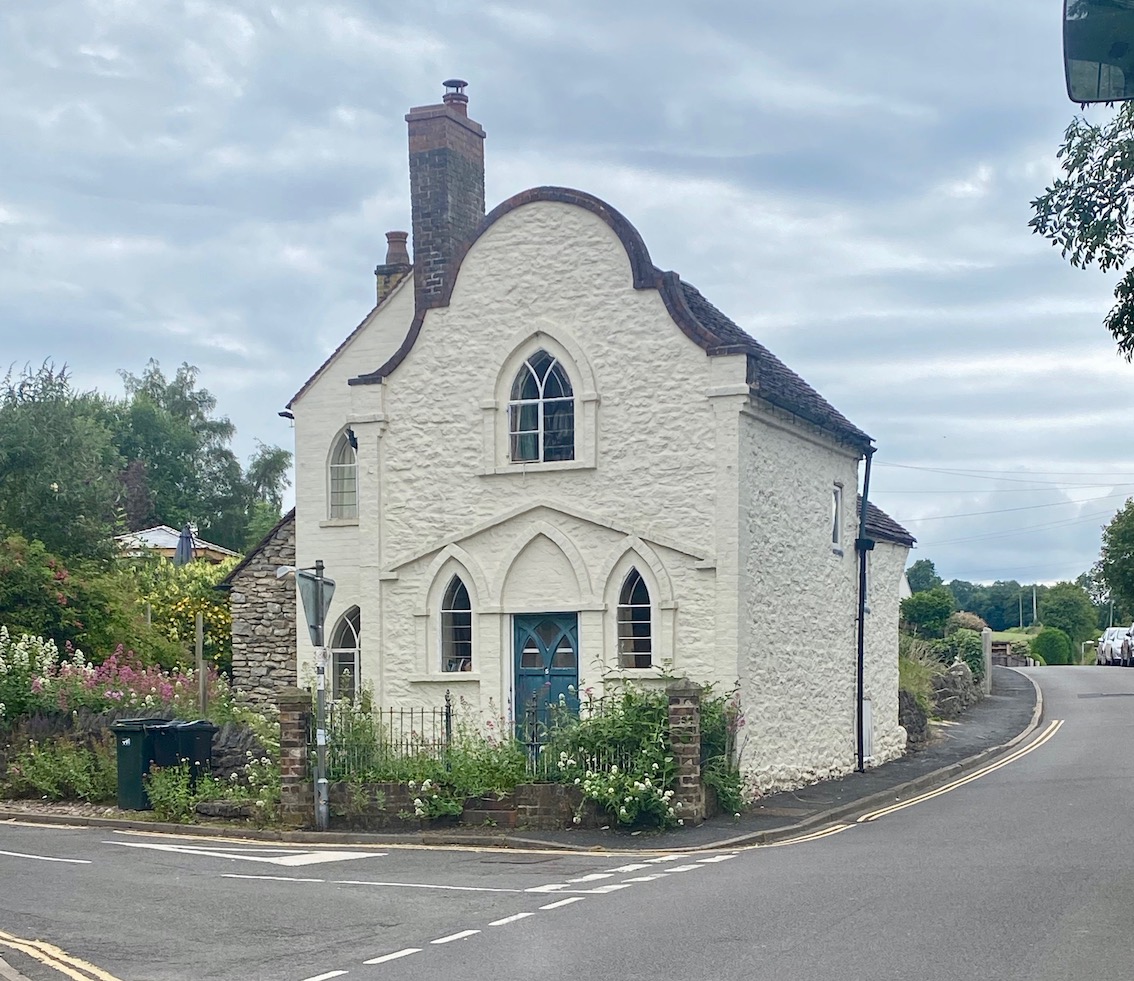
I caught sight of this house on a late-afternoon walk in Much Wenlock. I’d already noticed one or two other examples in the town of this kind of architecture – early-19th century Gothick, in which pointed windows with Y-tracery set off the facades of quite modest buildings, often in combination with other features – pilasters, pediments, curved gables – that aren’t associated with the medieval Gothic style at all. This house is a good example of the decorative mélange that can result: pointed windows in pointed recesses, pilasters running up each side of the frontage,. a sloping cornice rather like a broken pediment above the central door and its accompanying windows, and, topping it all, a striking rounded gable that steps halfway down to turn from a convex to a concave curve. All this fronts what is otherwise quite a modest structure of rubble masonry and brickwork, all painted white.

The effect of the facade belies common misconceptions: that Georgian Gothick is filigree and delicate and that ornate gables like this are confined to eastern England, where the Dutch influence on English architecture was strong. So this building has left behind the delicate filigree Gothic of Walpole’s house, Strawberry Hill, rebuilt back in the 1740s, for something that’s frankly chunky and more suited to the abilities of a provincial builder; no doubt it was also to the taste of the owners of small houses in late-Georgian Shropshire. As for ‘Dutch’ gables, they were popular in coastal Lincolnshire and East Anglia a century and more before this house was built, and were by now another idea that had become assimilated. Pointed windows and curvaceous gables were, it seems, a matter of local fashion and choice. I’m glad those choices were made here.

Sunday, March 16, 2014

Much Wenlock, Shropshire


Curves

Almshouses. There are little rows of them all over England, the result mostly of acts of local charity that have helped house the poor, the needy, and the old for hundreds of years. Their architecture ranges from the simple to the ornate and often has a touch of the Gothic about it, with pointed, ecclesiological arches over windows and doorways reminding one perhaps of the houses’ origins in Christian charity, and sometimes alluding to their antiquity – some almshouse charities go back hundreds of years, to the medieval period. Sometimes, these Gothic touches are probably just there to make the buildings stand out, to indicate that these little buildings are different from the run of the mill of houses built by local landlords or developers.

These almshouses in Much Wenlock probably date from around 1800 and their touch of Gothic is provided by the distinctive double-curved ogee arches above the windows and doors. Ogees first became fashionable in the 14th century, as part of the ornate kind of Gothic architecture that the Victorians called Decorated Gothic. But there’s nothing else Decorated Gothic about these houses. They’re rather plain brick buildings and the simple wooden doors and white-framed windows don’t make any concessions to the curved arches above them – the doors and windows are resolutely rectangular and the gaps between them and the arches are filled with plain white plastered panels. Oddly enough, the white panels catch the eye and make the arches more obvious. They’re like signs or reminders that tell us that these are almshouses, and they’re that little bit different, and proud of it too.

Wednesday, May 1, 2013

Much Wenlock, Shropshire


Solid

Talk about purposeful. If ever there was one, this is a building that knows what it's about. Blue bricks as hard and solid as when they were laid in the 19th century. Pointed windows and doorways with arches so slightly curved as to be almost straight – no messing about with the Gothic revival here. Quoins and dressings in a pale brick that looks as hard and forbidding as the blue. Drain pipes rising right next to the front door. Solid little crenellations around the flanking wall. Iron-studded front door that looks as if it would take a battering.

All of this makes it unsurprising that this embodiment of solidity and security is a police station. Oddly enough the name stone above the doorway has some slightly ornamental touches – mixed in with some very plain letters (E and I) are a couple of rather fancy ones (A and O). One can almost see the carver starting to give way to ornament before relenting and signing off with a very plain N and the usual Victorian full point. Soft? Not on your life.