Showing posts with label almshouses. Show all posts

Monday, February 12, 2024

Ewelme, Oxfordshire


God’s House

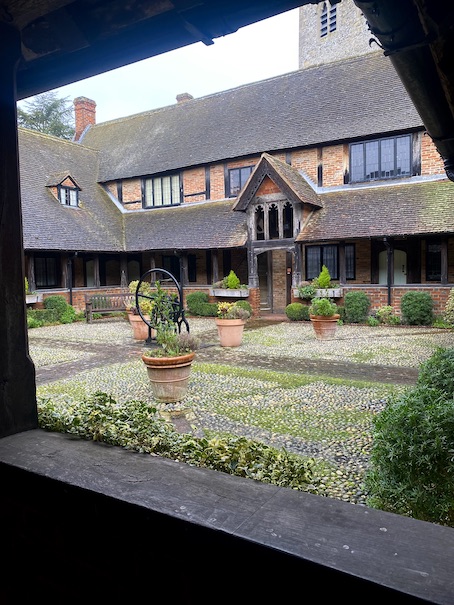
Alice de la Pole (1404–75), granddaughter of the poet Geoffrey Chaucer and Countess of Salisbury then Duchess of Suffolk, was a member of England’s rich and powerful upper class, who had several homes. Her favourite was at Ewelme, in Oxfordshire. Her house has gone, but the church, school, and almshouse she built remain, standing in a tight cluster above the river valley where the village grew up. The almshouse is one of the most beautiful medieval domestic buildings, consisting of dwellings for 13 residents (originally all men), who, in return for their accommodation, were tasked with praying for the souls of Alice and her family, thereby easing their benefactors’ passage through Purgatory into Heaven. In other words, this foundation was a chantry. Henry VIII abolished chantries, but in this case, although the prayers for Alice’s soul ceased, the almshouses themselves remained.

The dwellings are arranged around a quadrangle, which can be entered through several doors, one close to the church, others giving access to the gardens. My first photograph shows a magnificent brick doorway, complete with stepped gable, gothic cusped arch, and buttresses. Its a grand piece of architecture, reminding one of the building’s importance to Alice de la Pole and evoking its serious purpose as a chantry, but the houses themselves, visible to the left, are architecturally quite modest.

This combination of modesty and elaboration is also seen in the quadrangle (below). Here the structure of the building is revealed as a timber framework with brick infill, with access to the individual doors via a lean-to covered cloister onto which the nearby church tower looks down. In the middle of each range is an opening leading to the central cobbled courtyard, and lovely carved wooden Gothic arches top each of these openings, an appealing bit of decoration and visual punctuation. The resulting combination of the domestic and the holy is summed up in the name of the building: God’s House. It’s worth a pilgrimage.
Wednesday, April 29, 2020

Louth, Lincolnshire


Indoors, outdoors

I’ve mentioned in previous posts that one of the pleasures of blogging is receiving additional information about the buildings in my posts. Here is a case in point. When I posted a picture of these almshouses in Louth, back in 2014, I mentioned that a great aunt of mine had lived in one of them at the end of her life. So these are buildings I recall seeing as a small boy, before I knew anything about their architect – the prolific Fowler of Louth, lover of the Gothic style, restorer of churches, and builder of hospitals and schools as well as houses. In my post, I expressed the hope that these tiny Bede Houses (they’re apartments, really) had by now been modernised, as the accommodation they offered was very basic. 

Not so long ago, a reader found this post and left a comment, telling me that his aunt had been a warden for the Bede Houses in the late-1970s and that the accommodation was indeed modernised at around that time. A major part of this was the provision of modern bathrooms, in most cases added in an extension at the back of the building, and also by the removal of one dwelling to give room for some bathrooms that wouldn’t fit in the extension. It’s great to learn that the charm of the Victorian buildings has been preserved while also giving the occupants much better facilities. I have friends who are trustees of almshouses in another old building, and I know how difficult it can be to modernise while maintaining architectural integrity and character. 


Another thing I recall from visits to my great aunt long ago, was that in the summer, quite a bit of the life of the occupants was lived outdoors. There were benches in the courtyard, and plenty of space for those who wanted to get some fresh air and chat to their neighbours. It is good too, looking at my photographs, that there still seem to be pleasant flowerbeds as well as space for sitting and exercise. Here’s hoping that it won’t be too long before outdoor socialising will be possible once more.

Tuesday, October 23, 2018

Harrogate, Yorkshire


Yorkshire philanthropy, Yorkshire grit

Last week I spent an enjoyable couple of days in Harrogate, speaking at the excellent Raworth’s Harrogate Literature Festival and spending a lot of time just standing and staring at the architecture. As someone who grew up Cheltenham and has a particular affection for Bath, both spa towns, I’ve always liked the spa town of Harrogate too – though I’ve not been there for years. I was struck by the stone: Harrogate is a stone town, like Bath (and unlike Cheltenham, where the buildings are predominantly stucco). But whereas Bath’s local stone is creamy limestone, the builders of Harrogate used mainly sandstone from the surrounding area, the various millstone grits with picturesque names (Follifoot Grit, Addlethorpe Grit, Upper and Lower Plompton Grit, and Libishaw Sandstone) that give the place its characteristic look. These stones vary in colour from grey to brown, and many look darker than the southern limestones typical of places like Bath. They’re also often finished less smoothly – sometimes rock-faced, sometimes with a flat face but with the chisel’s tool marks left very much visible.

The other thing that marks Harrogate out from those other two great spas is its date. In contrast to Georgian Bath and Regency Cheltenham, Harrogate came into fashion in the second half of the 19th century, so much of its architecture is Victorian. This building, for example, is of dark stone in a mix of masonry finishes – mainly rock-faced stone for the walls, with smooth ashlar around the windows and doors. The trefoiled upper windows and the clock tower with its short spire take their cue from the Gothic style, as is not unusual for for almshouses of the Victorian period. They were built in 1868 by textile manufacture George Rogers, whose business was in Bradford but who had a close connection to Harrogate and intended as houses for elderly people from either place.
Rogers's emblem of hard work, the bee and its hive, is placed above the central doorway. Bees must be in evidence, too, in the courtyard’s lovely garden, which was still showing a little colour in the late-October warmth. That garden, together with the architectural flourish of the spire, suggest that a decent environment was (and is) being valued here, not just a necessary minimum. Victorian values weren’t all bad.

Tuesday, October 24, 2017

Chipping Norton, Oxfordshire


Cornish in Oxon

I thought I knew the Oxfordshire market town of Chipping Norton well but, as so often with places we visit frequently, there’s always another side street or two to explore, and I was delighted to find these 17th-century almshouses in Church Street.* You can see that we’re in the Cotswolds here: those stone walls and the broad gables built as upward extensions of the front wall are very Cotswold, as are the dripstones above the upper windows.

There’s a datestone that tells us that the almshouses were ‘The work of Henry Cornish. Gent. 1640’. Cornish died in 1649 and left these eight houses as dwellings for eight poor widows, together with an endowment providing 20 shillings a year for the building’s maintenance and 2 shillings weekly for bread to be given to the widows. I don’t know much about Henry Cornish, but one source suggests that he was an opponent of the royal taxation that pushed England towards the Civil War and was imprisoned by the royalists for his views and bailed out by his nephew, William Diston, who’s remembered in the name of Diston Street, around the corner from the almshouses.

Of course what attracted me to this building was, as so often, the fact that it’s attractive. The stone walls set back from the street behind a lawn have an air of tranquility. I hope it’s as pleasant a place to live in as it looks from the outside, and that many have benefitted from Cornish’s bequest and the way he acted on the instruction inscribed above the gateway: ‘Remember the poor’.

- - - - -

* Church Street: yes, I have visited Chipping Norton’s late-medieval church before, but managed to approach it from another angle, without going along Church Street.

Tuesday, September 13, 2016

Bredon, Worcestershire


Added extra

Bredon is in South Worcestershire. The low-lying apple-growing country of Evesham is not far away, but neither are the Cotswold uplands – Bredon Hill is a Cotswold outlier, and shares the limestone geology of the main Cotswold range. It’s not surprising, then, that the Reed Almshouses in Bredon combine the brick of the vale (seen in the walls round the back and the chimneys) with a Cotswold stone front to the courtyard. This stone front, with its mullioned windows, dormers, and shallow arched doorways could be on the Cotswolds – and, with those arches could date from the Tudor period, although in fact it’s a building of the 1690s.

But what’s that small freestanding building with the big brick chimney and the interesting little louvre at the top? It had me scratching my head: it doesn’t look like extra flats or houses, it’s too elaborate for a shed, and has too many windows for a dovecote. It turns out to be a laundry, built in 1871, by Bodley and Garner, no less, when they restored the almshouses. George Frederick Bodley was one of the greatest Victorian architects, known especially for fine Gothic Revival churches. He had a long working life, a lot of it in partnership with Thomas Garner. They designed churches, buildings in Oxford and Cambridge, and country houses. but clearly did not spurn smaller jobs.

I don’t know if the laundry is still used for its original function, but it’s an attractive and practical addition, a tribute to the almshouse authorities, who seem to have wanted to provide the residents with convenient facilities as well as a pleasing environment. A nice example of a small structure acting as a memorable focus – both to the building it serves and to the street as a whole.

Sunday, March 16, 2014

Much Wenlock, Shropshire


Curves

Almshouses. There are little rows of them all over England, the result mostly of acts of local charity that have helped house the poor, the needy, and the old for hundreds of years. Their architecture ranges from the simple to the ornate and often has a touch of the Gothic about it, with pointed, ecclesiological arches over windows and doorways reminding one perhaps of the houses’ origins in Christian charity, and sometimes alluding to their antiquity – some almshouse charities go back hundreds of years, to the medieval period. Sometimes, these Gothic touches are probably just there to make the buildings stand out, to indicate that these little buildings are different from the run of the mill of houses built by local landlords or developers.

These almshouses in Much Wenlock probably date from around 1800 and their touch of Gothic is provided by the distinctive double-curved ogee arches above the windows and doors. Ogees first became fashionable in the 14th century, as part of the ornate kind of Gothic architecture that the Victorians called Decorated Gothic. But there’s nothing else Decorated Gothic about these houses. They’re rather plain brick buildings and the simple wooden doors and white-framed windows don’t make any concessions to the curved arches above them – the doors and windows are resolutely rectangular and the gaps between them and the arches are filled with plain white plastered panels. Oddly enough, the white panels catch the eye and make the arches more obvious. They’re like signs or reminders that tell us that these are almshouses, and they’re that little bit different, and proud of it too.

Sunday, May 5, 2013

Wantage, Berkshire*


Look down

I'm always telling people to look up, but this time the opposite advice is the order of the day...

While photographing some sash windows in Wantage, I catch the eye of an elderly gentleman. 'Interested in photography, are you? There's a camera club here.' I politely explain that I'm not local and anyway, my interest is more architectural than photographic. 'Ah. In that case, you should take a look at the almshouses over there.'

And I'm directed to the Stiles Almshouses: solid, brick, unpretentious, and with a weathered stone plaque telling me that they were built by an Amsterdam merchant,† of all people, in 1680, which makes them the earliest datable brick building in this admirably brickish town. I thank my companion, but he encourages me to look further, to push open the door, and cast my eyes down. And what I see takes my breath away: a floor made partly of sheep's knucklebones, a serviceable if knobbly substitute for stone cobbles no doubt contemporary with the rest of the building.


A similar floor was found last year by archaeologists excavating the site of the Curtain, the London theatre that hosted Shakespeare's company before they decamped to the more famous Globe. In those days they knew how to knuckle down and cobble together a hard-wearing floor.

- - -

*Wantage is now in Oxfordshire, but I use the traditional English counties because they reflect the usage in Pevsner's invaluable Buildings of England books – and because I like them.

- - -

†There's more about the founder of the Almshouses and the plaque above the door in the Comments section – click on the word COMMENTS below.

Thursday, February 5, 2009

Frome, Somerset


Blue boys and asylum maids

This striking structure is in the charming Somerset town of Frome, a place where the gaze is often diverted from important things like the architecture to such distractions as shops selling a diverting range of local produce, and the stream that runs down the middle of the main street. But here’s one building that caught my eye.

There was an almshouse here from the 1460s onwards, but in 1728 a free school was added to the charitable institution, and this very upright, look-at-me, town-hall-like Georgian building was put up to house it. It’s known as the Blue House, because the boys wore blue coats, as charitable schoolboys often did in those days, and the façade has statues of both an almswoman and a schoolboy.

To one side there are two other statues depicting women, which come from the Keyford Asylum, which was pulled down in 1956. So now this corner of Frome is a repository of local history, a symbol of charitable pride – as well as still providing flats for the elderly. None of which can be a bad thing, especially when housed in such an uplifting building.


The maids from the asylum