Showing posts with label chantry. Show all posts

Monday, February 12, 2024

Ewelme, Oxfordshire


God’s House

Alice de la Pole (1404–75), granddaughter of the poet Geoffrey Chaucer and Countess of Salisbury then Duchess of Suffolk, was a member of England’s rich and powerful upper class, who had several homes. Her favourite was at Ewelme, in Oxfordshire. Her house has gone, but the church, school, and almshouse she built remain, standing in a tight cluster above the river valley where the village grew up. The almshouse is one of the most beautiful medieval domestic buildings, consisting of dwellings for 13 residents (originally all men), who, in return for their accommodation, were tasked with praying for the souls of Alice and her family, thereby easing their benefactors’ passage through Purgatory into Heaven. In other words, this foundation was a chantry. Henry VIII abolished chantries, but in this case, although the prayers for Alice’s soul ceased, the almshouses themselves remained.

The dwellings are arranged around a quadrangle, which can be entered through several doors, one close to the church, others giving access to the gardens. My first photograph shows a magnificent brick doorway, complete with stepped gable, gothic cusped arch, and buttresses. Its a grand piece of architecture, reminding one of the building’s importance to Alice de la Pole and evoking its serious purpose as a chantry, but the houses themselves, visible to the left, are architecturally quite modest.

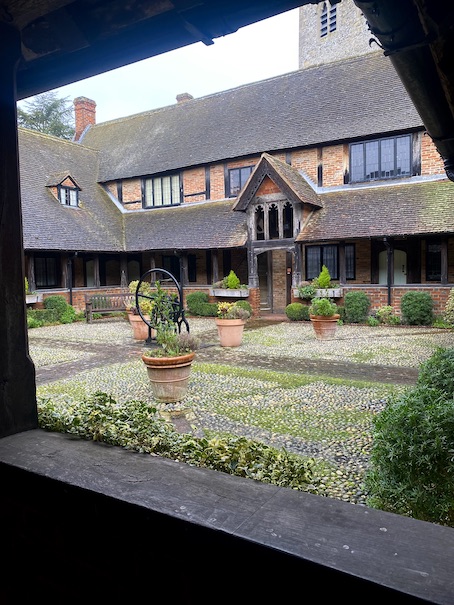
This combination of modesty and elaboration is also seen in the quadrangle (below). Here the structure of the building is revealed as a timber framework with brick infill, with access to the individual doors via a lean-to covered cloister onto which the nearby church tower looks down. In the middle of each range is an opening leading to the central cobbled courtyard, and lovely carved wooden Gothic arches top each of these openings, an appealing bit of decoration and visual punctuation. The resulting combination of the domestic and the holy is summed up in the name of the building: God’s House. It’s worth a pilgrimage.
Monday, June 8, 2009

Buckingham


Life and soul

The 1981 Shell Guide to Buckinghamshire describes Buckingham as ‘A small, quiet, ancient country town of stone and brick buildings with red-tiled roofs, in a tight loop of the Great Ouse’. I was pleased to see that the centre of Buckingham still answers to this description, and that the interest spreads out from the impressive market place (with gaol and Town Hall) to the neighbouring streets. Up a narrow road off the Market Place is this medieval survivor, the Chantry Chapel.

Chantries were medieval institutions, set up to provide priests to celebrate Mass involving prayers for the souls of those who set up the chantry and for others nominated by them. Chantries were widespread in the Middle Ages, often based in chapels within parish churches, but they were suppressed in the 16th century, ultimately because they were linked with the Catholic doctrine of Puragtory.

Many chantries disappeared without leaving any architectural trace, but this chantry chapel survived by beginning a new life as Buckingham’s Latin School. The building now belongs to the National Trust and in its most recent incarnation houses a secondhand bookshop that is open two days a week. Opinions will differ as to whether this is a good use for the building, but clearly the chapel doesn’t fit into the familiar Trust template (tasteful paint finishes, tea rooms, gift shops selling pot pouri) so often used in its country houses. At least the chapel’s Gothic windows (including the lovely round one) and still older crisply carved Norman doorway, are well maintained and continue to enliven the townscape in this quiet side street.

Wednesday, April 29, 2009

Ewelme, Oxfordshire


Stepping westwards

Alice de la Pole of Ewelme was the grand-daughter of the poet Chaucer and the wife of William de la Pole, who was made Duke of Suffolk in 1448 for his loyalty to the House of Lancaster. It was said that the couple, when not at court or at the de la Pole estate in Suffolk, lived much at Alice’s home village, bringing with them East Anglian retainers whose descendants still live in the area. They probably brought Suffolk craftsmen with them too, because when they rebuilt the church in the 1430s in a rich mixture of flint, stone, and brick, an East Anglian layout was adopted, with wooden screens rather than masonry used to divide the various parts of the building's interior.

One of the treasures of Ewelme church is a font cover built like a staggering spire of wooden tracery. This too looks just like an import from East Anglia, where there are a number of such tall and intricate covers, connected like this one to a pulley, so that they may be raised when the font is needed for a baptism.


In the year William was made Duke, the couple established a chantry, a foundation under which two priests and thirteen poor men were to pray for their souls and celebrate Mass at Ewelme. The priests and poor men were accommodated in an almshouse that William and Alice built near the church and the beautiful south-east chapel of the church was set aside as the place where the cycle of Masses and prayers could be said.

Alice's tomb, now sited in a space between this chapel and the chancel of the church, was installed just before she died in 1475/76. It is one of the most impressive of all 15th-century tombs, with a lifelike alabaster effigy of the deceased, a cadaver beneath (staring at a picture of the Annunciation), a host of angels above, and a row of standing figures – many still with their original painted colour.

Those traces of colour, making vibrant this reminder of mortality, was just one thing that made this building special when I visited it the other day. As the flag flew in the brisk breeze at the back end of April (the Chaucerian month) and the sun blazed through the windows, a group of ringers came to put the bells through their paces, adding music to colour to bring the place sonorously alive.