Showing posts with label cafe. Show all posts

Sunday, October 1, 2023

Leamington Spa, Warwickshire

Tea in the park

Visiting Leamington Spa recently, I was particularly struck by the decorative ironwork on many of the buildings. Much of this was from the town’s Regency heyday – the iron balconies that resemble those in Cheltenham and Brighton, although in many cases with different designs. One example from a later period, however, stands out: the ironwork that makes the Aviary Café in Jephson Gardens so special.

Several of the structures in this beautiful urban park have a serious memorial purpose. This paragon of ornamental park structures is different. It was built in 1899 simply to house tea rooms – there’s an Edwardian-looking photograph online showing elegantly dressed people relaxing in front of the café amid a small copse of umbrellas that shade outdoor tables from the sun. At some point in the 20th century, the café closed and was turned into an aviary, but by the last decades of the 20th century this had closed and the building fell into disuse and disrepair. As part, I believe, of a millennium project to enhance the park, it was restored and turned back into a café, in which form it still seems to be thriving.

At the front, the roof is held up by slender iron columns, allowing it to overhang and shelter a narrow porch or veranda, which now houses several small café tables. Look up, and you see the splendour – several metres of intricate iron latticework filling the spandrels, cornices, and the space beneath the central gable. Look closely, and you see multifoil arches, patterns of circles and scrolls, and iron finials at the ends of the eaves and at the gable’s peak.

The whole thing is a showpiece of the Victorian metalworker’s art and the epitome of the ornamental public park building of the period. It’s up there with the best bandstands and other pleasure buildings, with decoration that at once enhances the view and catches the eye, beckoning us in to sample the delights within. To my mind, it’s a small architectural triumph.


Tuesday, March 1, 2016

Bristol


Café and curves

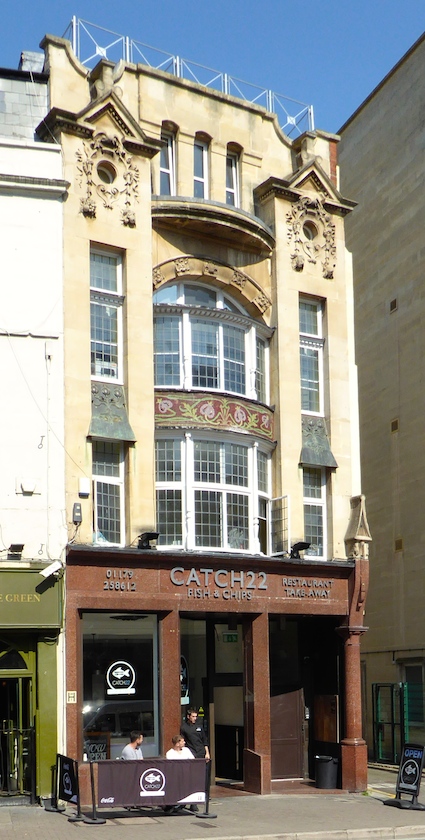
The Resident Wise Woman and I have a habit of parking in Park Street in Bristol and either climbing up the hill to browse in the Oxfam bookshop or going a bit further to find something to eat or drink. One day I wandered down the hill to College Green and, turning my back on the cathedral and library to my right, had a look above some of the shop fronts. This one stood out in particular: a study in turn-of-the-century classicism with a hint of baroque. There’s a mix of traditional details (the little pediments trailing stone carving down the wall) and elements that could only be from this period: above all the windows – the shallow bow; the segmental (curve-topped) window just above it; the tall, narrow openings right at the top; and those tiny round windows (oils de boeuf) below the pediments. All these are features straight from the school of turn-of-the-century English design.

But there’s something more. A mosaic frieze of stylized plant forms running in a band across the bow window. The pale-green stems twist and turn in curves that are more art nouveau, as if whoever designed this frontage wanted a hint of the continent, a breathe of French air, to enliven the building. On either side of this frieze are perhaps the best bits of all, a pair of lead canopies, flaring slightly and adorned with art nouveau pomegranate reliefs. The stems here form those multiple curves doubling back on themselves (‘whiplash curves’, in design-speak) that are so redolent of French and Belgian art nouveau. Such curves are not that common in England, but you find them occasionally on shop fronts that wanted to look highly fashionable between 1890 and 1910.
This little gem of a building was built as the Cabot Café. The architects were La Trobe and Weston, but the art nouveau decoration was created by the owner’s daughter, Catherine Hughes. Pevsner sources the mosaic from an 1891 bookbinding design by Charles Ricketts. He further observes that there are traces of the original interior inside, although these certainly weren’t in evidence when I peered through the door. I must return, buy myself fish and chips, and investigate further.

- - -

In previous posts I’ve noted a full-blown art nouveau shop front in Cambridge and a hint of one in Leamington Spa.

Monday, September 7, 2015

Page Street, London


Revisiting: The Regency Cafe

In London SW1 the other day I passed a building I posted nearly seven years ago. I was never very happy with the photograph I took then, on a dull day, with my mobile phone. So here’s a better one, showing some of those simple cut-out letters more closely. Back then, I wrote that the café, established in 1946, was very much evocative of the 1940s ‘back-end of Art Deco’ style, while also looking forward to the clean modernism of the 1950s, a style that café designers of that period liked. I’d not want to change much of that, except to say that the number of such cafés surviving in any number is still on the decline. So it’s pleasing that this one is still there.

It’s not only still there, but apparently still thriving. As I looked through the window the place was packed. So I didn’t go in for a coffee. So another thing I said in my earlier post must stand: I hope when next I’m passing I’ll have time to go in and try it.

Monday, April 16, 2012

Leicester


Gobblery

The histories of architecture are full of the big names, the people who changed the course of the art and transformed our towns and countryside: the Wrens, Vanbrughs, and Gilbert Scotts. Less well known are the local practitioners, architects who did important work in a particular town or area but are generally unsung outside their local patch: men like Watson Fothergill of Nottingham, the Jearrads of Cheltenham, and Arthur Wakerley of Leicester. Wakerley was a prominent figure in his city – a Liberal, councilor, and mayor. He served as president of Leicester’s Society of Architects and as president of the Temperance Union. His many buildings in the city range from a synagogue to a number of factories, from a hotel to streets of affordable housing.

The Turkey Café in Granby Street is one of his smaller buildings, but its central position, unusual style, and rich decoration make it one of his most noticeable. Wakerley designed it in Art Nouveau style in 1900, with the odd-shaped arches and colour scheme indicating a certain Oriental influence. The decoration was done by Doulton’s W J Neatby, the ceramic artist who worked on the Royal Arcade in Norwich and the Everard Printing Works in Bristol, both previously noticed on this blog. Wakerley devised a complex façade enlivened with multifoil arches, big windows, and a bowed central section. Neatby covered the walls in green and white tiles, adding a dazzling multicoloured turkey at the very top and two three-dimensional ceramic turkeys at entrance level. He picked the café’s name out in curvaceous Art Nouveau style lettering.


When the building opened in 1901 cafés were enjoying a heyday. Leicester boasted several cafés, establishments that were celebrated by the temperance movement that Arthur Wakerley embraced. Cafés were also favoured by women. At a time when pubs were rowdy, male preserves, women lacked places that they could go safely on their own or with women friends. Cafés and tea shops (the famous ABCs run by the Aerated Bread Company, for example, and the Lyon’s Corner Houses that came slightly later) filled this gap. Many Edwardian cafés were richly decorated buildings, marketed as modern, hygienic, and chic. Leicester’s Turkey Café, with its dazzling façade, fitted this bill, and did so with considerable style.


For more about W J Neatby, see my post here.

Tuesday, November 25, 2008

Page Street, London


Full English

Before I leave Page Street, here’s the other building I noticed as I made way to Tate Britain. The Regency Cafe (‘established 1946’) still has the black tiles and white lettering that must have gone up just after the end of the Second World War. It smacks a little of the ‘back end of Art Deco’ that cafe designers liked to use at around that time, but looks forward too to the clean modern lines of the 1950s. Just the thing, in fact, to represent the mix of post-war optimism, Italian flair, down-to-earth food, and good coffee that made the English ‘caff’ what it once was and, occasionally, still is.

Inside this resilient survivor there’s some original wall tiling to set off some classic posters, plus a lot of later formica-topped tables and plastic chairs. We’re in archetypal cafe territory, in other words: a lived-in place that looks as if it’s been delivering a hearty breakfast and decent coffee since the time when muffins were always toasted and barristas stood up in court not behind counters. I hope when next I’m passing I’ll have time to go in and try the place for myself.