Showing posts with label library. Show all posts

Wednesday, March 11, 2026

Manchester, Kennedy Street


Venice in the North

Drawn along Manchester’s Kennedy Street by the sight of an interesting looking pub, I followed my nose and ended up in front of one of the most surprising bits of 19th-century Venetian Gothic architecture I’d seen in a long while. The least Venetian part of the facade, the stone band about three-quarters of the way up, is the most informative. It bears the words ‘MANCHESTER LAW LIBRARY’, which are emblazoned across the building to tell us the place’s original purpose: it was, in fact, one of the first specialised law libraries outside London when it opened in 1885. It must have been a boon to local solicitors and barristers who needed to look up a bit of obscure law. It continued in its original use until relatively recently.

The architect was Manchester man Thomas Hartas, a young architect for whom this was his first major commission – and, alas, his last since he died in his early thirties, about a year after it was built. The front is virtually completely covered in Gothic tracery – a mixture of tall, cusped windows and roundels expressed as quatrefoils or divided up into a number of flower-like tracery patterns. At the centre is an oriel window, which lights the large first-floor space that made up the library’s reading room. 

The facade is divided vertically into three bays, each made up of trios of windows. These bays are separated by stone uprights that project towards the street, making them more substantial, as they must need to be to support this lace-like frontage and the floors behind. Within, there are no doubt various columns and load-bearing walls that hold the structure together, as well as helping to bear what would have been a considerable weight of shelved books.

As the light began to fail on the winter afternoon when I took my photograph, the interior lights shone out, revealing ceilings and supporting arches within. Back in the 1880s, the effect of the whole building lit up at night must have been striking: a beacon of law and of Venetian architecture, although no canal laps in front or behind and this mock-Venetian palace is book-ended by more conventional Victorian office buildings. A welcome sight, now and then.

Monday, January 19, 2026

Great Malvern, Worcestershire

Health resort

To Malvern (again) for coffee, book browsing, exercise, and architectural appreciation. Malvern is one of my favourite nearby places, and not just for its magnificent hilly scenery. It keeps on giving me food for thought architecturally, with everything from medieval tiles to a rare Bini dome. It is, as they say in the trade, ‘well bookshopped’, boasting shops selling new books, a good vendor of second hand books, and a couple of charity bookshops. And its hilly terrain means getting around gives me good exercise.

It was ever thus, or has at least been thus for a long time. Malvern is, famously, a spa town. The health-giving qualities of the water at Malvern Wells were discovered in the 16th century, but the place really began to grow in the period around 1810, in part at least as a result of the great success of the spa at Cheltenham. Various wells were exploited, hotels were built – and more. Those who came to take the waters needed other things to do to. Cheltenham offered circulating libraries, a harp and pianoforte warehouse, assembly rooms, and so on. So in Malvern, next to the pump room and baths, the grand Royal Library was built.

The library is on a corner site, and turns the corner with some style. This corner is actually a junction at which two side roads meet the main Worcester Road towards the summit of the town centre’s hill. The setting gives the end of the library great prominence, and the architect, John Deykes, exploited this to the full with a full height semi-circular bow in the classical style of 1818, when he drew up his plans. The main ground floor, actually raised slightly above the ground because the land falls away so sharply, is particularly splendid. Tall, 9-over-9 sash windows are separated by Ionic columns that support a balcony above with a balustrade of pump uprights. Above this, the upper-floor windows are set back, but echo the semi-circular shape. It’s a striking composition, and must have impressed visitors as they slogged their way up the hill.

The library building was part of the same structure as the assembly rooms, so inside it was not all about the books. As well as a reading room and an extensive lending library there was also a music library, a billiards room, and a room for card playing. The building also contained a bazaar where, according to an information board down the street, ‘anything from a Bible to a firescreen could be purchased’. All this, together with increasing numbers of shops, gave the spa visitors plenty to do, and served the town well through the Regency and Victorian heyday of the spa. When I visit today, walking, browsing, and imbibing, not to mention admiring the architecture, I feel I’m following in those 19th-century footsteps.

Monday, September 30, 2024

Stamford, Lincolnshire

Lincolnshire Tuscan

‘Blimey,’ I thought. ’Somebody’s been looking at St Paul’s church, Covent Garden.’ The church, if you don’t know it, is one of the few surviving buildings designed by Inigo Jones and Stamford Library has a portico that’s very similar to Jones’s original. Those are columns of the Tuscan order, the simplest of the five architectural orders of ancient Rome, and the pediment, like the one at Covent Garden, is plain and empty and about as simple as you can get, with a ‘dentil course’, widely spaced, either made up of the ends of supporting timbers or suggesting their presence.

Why such plain Tuscan architecture for a library? Not, I thought, in some kind of tribute to great Tuscan poets (Dante and Petrarch, for example). But when I researched the building, I found that it didn’t start life as a library at all. What you can see in the photograph was originally the entrance to a market and shambles,* built to designs by local architect William Daniel Legg† in 1804–8 and converted to make the front of a library in 1906. Those windows and the walls that surround them are additions of the latter phase.

So the Tuscan portico was no doubt a simple and relatively inexpensive choice to create a strong statement at the market entrance – an entrance that’s easy to see from a distance among the shops that surround it. It stands out, while providing a generous central span to allow not only people but also goods to pass in and out with ease.There’s no fancy ornament to get damaged by barrows or carts, just good plain building. It’s a landmark on the street. And now it’s a library, its stand-out design is still valuable in what I’m sure is a much valued community asset.

- - - - -

* A shambles, in this sense, is a row of stalls selling meat, or a row of butchers’ shops often built on the site of former market stalls.

† Casewick Hall, the stables of Panton Hall, and Vale House in Stamford itself are among Legg’s Lincolnshire works. He also designed some gate lodges for Burghley House near Stamford.

Monday, May 30, 2022

Hastings, Sussex


Palace of the people

When I saw this building a bell rang in my memory. I’d noticed it before and admired it, but had forgotten for a moment what it was. The lettering on the front quickly reminded me: ‘Brassey Institute’. This time I let my eyes linger on its architectural details. I also tried to look at it as a whole, but this isn’t easy because the Victorian gothic pile is so crowded around by other buildings, and on such a narrow street, that it’s difficult to take in, and hard to photograph.* But here’s an image of much of the street front, to give you an idea of its mass of gothic detail – pointed arches, loggias, a landmark tower, and enough windows to make at least some of the rooms inside pleasantly light in spite of the densely packed buildings round about. And what is it for? Victorian institutes were usually multi-purpose buildings with some kind educational and community use. The Brassey Institute was built in the late-1870s to provide a library, assembly room, and school of art and science.

The name comes from the man who founded and paid for the building, Thomas Brassey. Brassey was the son of another Thomas, who amassed enormous wealth from the railways. Beginning as a surveyor, the earlier Brassey was involved in the construction of vast parts of Britain’s (and indeed the world’s) railway network and in the building of everything from steamships to sewers. He began to put up a palatial house near Hastings, but died before it was completed, leaving his son Thomas to complete the project. Thomas Junior, later Sir Thomas Brassey, became MP for Hastings and a notable philanthropist. His first wife Annie was a pioneering photographer, whose work is now being appreciated after being in the shadow of the achievements of her male relations. The Brassey Institute is an example of the way many of the Victorian newly rich put some of their money back into the places where they lived.

The architect Brassey commissioned for the institute was Walter Liberty Vernon. Although not one of the most famous Victorian architects, Vernon was clearly a man of great ability. Several features of this facade show the influence of the Gothic style of Venice: the large windows, the design of some of the arches, the small balcony on the left, the loggia on the upper floor – all are ‘Venetian’ features. Venetian Gothic was much in the air in the late-19th century. John Ruskin had published The Stones of Venice back in the 1850s and two decades on, the style was favoured by some Victorian architects as a form of Gothic they could adapt to domestic and civic buildings (leaving English or French Gothic for churches), lending a palatial aspect to public buildings. Vernon showed himself at home in the style, and he would be better known in Britain if he had not emigrated to Australia (for his health – he had athsma) in the 1880s. He produced for Hastings a building that is still used and valued, as the home of the town’s main public library.

- - - - -  

* The church in the left is Holy Trinity, designed by the Victorian architect S. S. Teulon, and the windows visible in my photograph give a hint of his ornate style.

Monday, February 14, 2022

Petersfield, Hampshire

Reading matters

Even though I no longer use them very much (having more than enough books of my own to read) I am very much in favour of public libraries. It’s partly that I’m thankful for the way my local library helped me when I was a boy hungry for knowledge growing up in a household with few books. There all the books were. There seemed to be books about everything, and all the classics of English literature (and other literatures). And it was all free. Paradise.

Today, arguably, it’s different. Everything’s online, isn’t it? Well, no. And anyway not everyone has access to a computer. And not everyone knows how to find information. And for all kinds of good reasons many people still prefer to read a novel in a real volume with paper pages. One of my nieces worked for a while in a small branch library here in the Cotswolds and was amazed how many people needed her help to find things out – everything from the biographical details of an English poet to how to apply for a council tax rebate. ‘I’m a social worker, too, apparently,’ she told me. Libraries are still essential.

But what did people do before 1850, when the British Parliament passed an act enabling local authorities to levy a rate to pay for public libraries? Here’s one answer. They went to privately run libraries, which were owned by local businesses (or, less commonly, by private organisations such as the still wonderful London Library, where you pay to be a member, as I did when I lived in London).

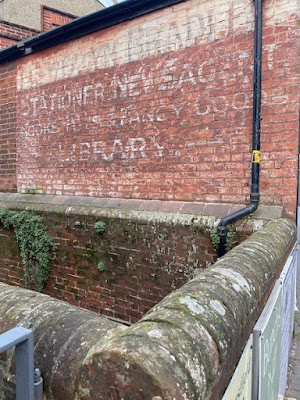
Most towns did not have a vast bibliographical treasure house like the London Library but they often had a private library run perhaps by a local stationer, where they could pay to borrow books. Boots the chemist had libraries in their large shops, too. And many of these privately run libraries survived well into the. last century because people liked them and they might have different books form those at the local public library. Here’s a ghost sign in Petersfield, advertising a local stationery business owned by one Llewelyn Bradley. Alongside the writing materials and newspapers there were also reading materials that you could borrow. Bradley was born in 1877 and probably sold up in the 1930s, after which the business – still with its library – was known as Austin’s.* An online source refers to a picture of c. 1955 but after that the trail goes cold, so I don’t know how long it survived. But there it was, another bit of history for which we have to thank a ghost sign, which, on the building at least, is the only bit of reading matter now offered hereabouts. No doubt the people of Petersfield were thankful for it, while it lasted.

- - - - -

* Austin’s, with its books, toys and ‘fancy goods’, is said to have been the inspiration for the children’s book The Little Wooden Horse, by Ursula Moray Williams.


Friday, July 6, 2018

Lutterworth, Leicestershire


Local interest

I know some people who would scoff or at best smile tolerantly if I said I’d made a point of going to Lutterworth. A similar admission about a trip to Kidderminster once elicited a snort of disbelief from an acquaintance. These are places off the tourist trail – and places in addition that the road network has made it easy not to stop at. But I know from experience that I can find something of interest in any English town, and that somewhere engraved in my consciousness is the maxim embossed on the cover of Jonathan Meades’s book Museum Without Walls: ‘There is no such thing as a boring place’.

So I expected a bit more than Pevsner’s somewhat dismissive comment that most of the town centre was rebuilt in the first half of the 19th century ‘predominantly in a debased neo-Greek style’. Here’s something later, a detail of the Reading Room, built in 1876, near the churchyard gate. A decorative bargeboard breaks out into an eruption of turned spindles above two carved panels that give the date and purpose of the building amid sprays of flowers.

None of this represents the height of sophistication, but it’s interesting and heartening that the Mechanics’ Institute built a reading room for their members in 1876, and lavished a bit of care on its construction. This was a time when, since the 1850 Libraries Act, local authorities were allowed to levy an extra charge on the rates to pay for a public library for their town. But few did, in part because because the provision only allowed for funds for the building – books had to be paid for separately, which posed an additional challenge of fundraising that many places could not rise to.

Mechanics’ Institutes sometimes filled this gap, and offered lectures and discussion groups as well as reading rooms. They were a boon to workers who wanted to supplement what education they’d been given, which was usually basic at best. Lutterworth has long had its own public library and the old reading room is now used as a museum. And so it fulfils another important cultural function, helping to enhance the town and to reflect the aspirations of those who founded the original Mechanics’ Institute.

Wednesday, August 7, 2013

Wantage, Berkshire


Not too novel

In a quiet side street in Wantage, this shop front has insinuated itself into a terrace of 19th century red brick. If you'd told me that there was as Art Deco frontage in this red-brick street, with white paint, a black panel, and the rest, I might have imagined an intrusion. But the Wantage Novel Library is well mannered and far from intrusive, thanks to the discreet geometrical patterns of its glazing and, above all the lettering.

It was the lettering that caught my eye. Its proportions (the narrow L, B, and E), the small serifs, and the careful spacing suggest the influence of ancient Roman capitals – inscriptions on monuments such as Trajan's Column or various triumphal arches. Not that this is a direct imitation of a Roman script, of course – how could it be when it relies so much on the letter W, for which the Romans had no use? But the spirit is there, and the forms of these letters are subtly different from many English architectural letters, which can be wonderfully classical but tend to be broader in proportion.

A sign like this must have been the perfect prelude to the literary delights of the Wantage Novel Library, which was presumably a commercial subscription library of a sort no longer common in this age of peering at Kindles and prodding at iPads. Though this is hardly a triumphal arch or a monumental column, the letters do the building proud.

* * *

There is much information on architectural lettering, together with examples of Roman lettering and photographs of modern architectural letters in all their variety in Nicolete Gray, Lettering on Buildings (The Architectural Press, London, 1960)

* * *
A note on English county names An observant reader has pointed out that Wantage is in Oxfordshire, not Berkshire. This seems a good time to point out that I normally use the traditional, pre-1970s county boundaries, which put the town in Berkshire. I do so because I'm attached to these old ways of delineating our local areas and the rich history that they represent. I also find the old counties useful because the invaluable series of architectural guides known as The Buildings of England, started by Nikolaus Pevsner and continued, revised, and expanded since his death, also use these boundaries. (I also have to say, though, that the building in this post, The Wantage Novel Library, is not, so far as I can see, included in the excellent Berkshire volume [edited by Geoffrey Tyack, Simon Bradley, and Nikolaus Pevsner] of The Buildings of England.)

Wednesday, April 15, 2009

High Holborn, London


French dressing
Now I’ve got my discontent about the current state of our public libraries off my chest, I’ll get back to what this blog is really about, which is sharing buildings that I like. This building was once St Giles’ Library, and it’s one of the many public buildings put up in London during the building boom of the late-19th and early-20th centuries. By 1894, when St Giles’ Library was built, Victorian architects had revived virtually every past European style and British cities were full of Gothic revival churches, Classical public buildings, and houses built in a style copying the Tudors or Jacobeans.

With the old St Giles’ Library the predominant effect is created by the rich carved decoration in the French Renaissance style. This kind of extravaganza of curvaceous plant forms, cartouches, scrolls, and faces, is yet another of the styles the Victorians revived. The architect of this building is said by Pevsner to be W. Rushworth. I’ve not been able to find out anything about him, but he was clearly adept at the kind of ornament fashionable on the other side of the Channel in the 16th century. But with an added British touch. Amongst the Francophile curves and medallions, in pride of place in the lower part of the oriel, Rushworth placed a bust of Shakespeare – just to remind us where we are.

Wednesday, April 8, 2009

Lichfield, Staffordshire


Palace of the book

Before the mid-19th century there were no public libraries in the sense that we have them today. Apart from those belonging to private individuals or universities, most libraries charged the public a fee to borrow books. Such commercial libraries flourished with the rise of the novel in the 18th and 19th centuries, and the middle classes flocked to the circulating libraries to get the latest Henry Fielding or Fanny Burney. Those amongst the poorer classes who could read were excluded.

This state of affairs exercised those who campaigned for social reform, especially the Chartists, who, as well as agitating for electoral reform and building land colonies, set up reading rooms that were run on a cooperative basis. It wasn’t just the Chartists who did this. The early-19th century saw numerous societies and institutes for working people who, in return for a small annual payment, could attend lectures and borrow books. In Lichfield a Reading and Mutual Instruction Society was set up for just this purpose in 1850, and it soon had over 100 members.

This kind of thing worried the establishment – if the lower orders got hold of too much education, they might rebel, and then where would we all be? But by 1850 parliament passed the Public Libraries Act, allowing local councils to levy a halfpenny rate to fund local libraries and museums. Not many councils rushed to do this, but one of the first was Lichfield, whose Free Library and Museum opened in this Italianate building in 1859.

There was a catch with the halfpenny rate, though. The council could use it t build a library but not to buy books. The money for those had to come from somewhere else, a problem that stymied a few library projects before they got off the ground. In Lichfield, the Reading and Mutual Instruction Society wound itself up and donated its books to the new library. And so, in the city of Dr Johnson and David Garrick, everyone had access to books, and this grand building seems to express pride that literature is available to all.