Showing posts with label Petersfield. Show all posts

Monday, March 14, 2022

Weald and Downland Museum, Sussex


Drying not dying

A building like this has a very special effect on me. It’s large, but in a way it’s insubstantial because there are no walls: just oak posts and a roof of tiles. It provides a lot of shelter from the rain – but for what, or whom? The answer takes us back to 1733, when it was built in Petersfield, Hampshire. It’s a shelter for stacking newly moulded bricks, so that the clay could dry and harden before the bricks were taken to the kiln for firing. Bricks in this raw state are known in the trade as ‘green bricks’, although their colour at that stage would be the hue of the clay of which they’re made. And the story of this building’s use takes us back to the 18th century, not just because of the date of this particular example, but also because by the 19th century, hand-made bricks were starting to die out, to be replaced by mechanically made bricks, which could be produced in vast numbers and at speed.

This brick-drying shed at the Weald and Downland Museum was reconstructed on this site in 1988. Hand-made bricks did not completely die out in the 19th century. The one in Petersfield carried on until World War II, there still being demand for good quality hand-made bricks in contexts where the locality or building requires something with the look and texture of traditional local brickwork. Petersfield itself has many Georgian and later buildings that it would be sacrilege to repair or add to using hard-edged, standard-issue mass-produced bricks from somewhere outside the region; so the demand continues. But some traditional brickworks could not compete with the cheap prices of the big producers, while others closed during the war because the blackout demanded their open-topped kilns, burning through the night, showed no light. That was the case with the one at Petersfield.

About 80 feet long, the drying shelter is big enough for the brick-maker to set up his bench at one end, so he could shape the bricks, one by one, before an assistant (often a family member in the old days) could stack them nearby. Today, the museum uses the bulk of the space for an exhibition about brickwork, surely a good use for this modest but large-scale structure that stands among the other working buildings, from the carpenter’s ’shop to the pug mill, on the site at West Dean, which for my money is one of the best collections of vernacular buildings anywhere.

Monday, February 14, 2022

Petersfield, Hampshire

Reading matters

Even though I no longer use them very much (having more than enough books of my own to read) I am very much in favour of public libraries. It’s partly that I’m thankful for the way my local library helped me when I was a boy hungry for knowledge growing up in a household with few books. There all the books were. There seemed to be books about everything, and all the classics of English literature (and other literatures). And it was all free. Paradise.

Today, arguably, it’s different. Everything’s online, isn’t it? Well, no. And anyway not everyone has access to a computer. And not everyone knows how to find information. And for all kinds of good reasons many people still prefer to read a novel in a real volume with paper pages. One of my nieces worked for a while in a small branch library here in the Cotswolds and was amazed how many people needed her help to find things out – everything from the biographical details of an English poet to how to apply for a council tax rebate. ‘I’m a social worker, too, apparently,’ she told me. Libraries are still essential.

But what did people do before 1850, when the British Parliament passed an act enabling local authorities to levy a rate to pay for public libraries? Here’s one answer. They went to privately run libraries, which were owned by local businesses (or, less commonly, by private organisations such as the still wonderful London Library, where you pay to be a member, as I did when I lived in London).

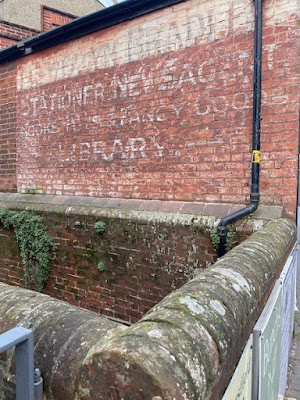
Most towns did not have a vast bibliographical treasure house like the London Library but they often had a private library run perhaps by a local stationer, where they could pay to borrow books. Boots the chemist had libraries in their large shops, too. And many of these privately run libraries survived well into the. last century because people liked them and they might have different books form those at the local public library. Here’s a ghost sign in Petersfield, advertising a local stationery business owned by one Llewelyn Bradley. Alongside the writing materials and newspapers there were also reading materials that you could borrow. Bradley was born in 1877 and probably sold up in the 1930s, after which the business – still with its library – was known as Austin’s.* An online source refers to a picture of c. 1955 but after that the trail goes cold, so I don’t know how long it survived. But there it was, another bit of history for which we have to thank a ghost sign, which, on the building at least, is the only bit of reading matter now offered hereabouts. No doubt the people of Petersfield were thankful for it, while it lasted.

- - - - -

* Austin’s, with its books, toys and ‘fancy goods’, is said to have been the inspiration for the children’s book The Little Wooden Horse, by Ursula Moray Williams.