Showing posts with label Sherborne. Show all posts

Wednesday, August 24, 2022

Sherborne, Dorset

The full nine yards

The interesting variations on Classical capitals in my previous post jogged my memory of something I’d seen last summer in Sherborne, Dorset. It’s a corner building, dating from some time at the end of the 19th century, designed as either s short row of shops or as a single shop. I’m inclined to suspect the latter: one large shop, owned by someone with a penchant for elaborate decoration. It was originally a single-storey structure, but within that limited scope its builder threw the decorative kitchen sink at it. A series of plate-glass windows are framed by pairs of attached shafts, each supporting floral capitals and, above that, a richly moulded entablature with some carving above the capitals. Higher up still are rectangular terminations that would probably have acted as finials before the upper floor was added. The lintels above the windows are carved too.

The capitals are a mass of flowers and fruit – so much of it that the vegetation spills into the middle, completely filling any space between the pair to link the area above the twin columns with leaves and blooms. Most shop owners did not run to anything this lavish carved in stone. Late Victorian shop fronts are more often made of wood, or occasionally cast iron, and these less costly materials can look highly decorative and eye-catching. Whoever built this wanted something a cut – or two – above the average. Later owners preferred a more more modern front on the more prominent end facade of the building, but the long range that faces on to the side street is still there, reminding us of what the Victorians could do when they tried. The full nine yards, as they say – and a little more still.

Note See the Comments section for interesting extra information about this building, which began as a draper's shop before developing into a department store. Thank you to my readers and commenters.

Wednesday, August 25, 2021

Sherborne, Dorset


Surprised in Sherborne, 2

Sherborne’s Cheap Street is a very attractive jumble of architectural styles – from late-medieval timber framed structures to stone buildings from virtually every later date: a hotch-potch, mostly with recent shop fronts, but much of it given unity by the glowing stone. Even in this good company, the bow-fronted building above is outstanding. Living near Cheltenham, I’m used to stucco-covered Regency buildings decked out with classical cornices, columns and iron balconies, but even so this one made me pause. It’s small, with just a single window on the upper floor of its curvaceous facade, but what a window – the full Venetian, with a pair of rectangular sections bookending a round-topped central portion, the whole surrounded by elegant mouldings and highlights picked out in white. A neat cornice and parapet, balustraded in the centre, complete this upper floor, which rests on four stone Ionic columns that frame the modern shop window. The iron balcony is the finishing Regency touch, vital for the safety of those inside who want to open the big window, which extends down to the floor.

As with the shop front in my previous post, I wondered what this building was used for when it was first put up in the early part of the 19th century. The upper room looked to me like the spacious drawing room of a middle-class house, the sort of thing that wouldn’t look out of place in Brighton. But there was no clue to what was originally where the modern shop window is now. The answer turns out to be that the building belonged to the Sherborne Savings Bank, who erected it in 1818. 

This was the formative period for savings banks in England. These banks were set up to provide banking facilities for poorer people – those who were not normally the customers of the established banks, whose accounts did not normally bear interest at this time. Savings banks welcomed small investors, including those who could save only intermittently, as their incomes were unreliable and varied according to the seasons or the availability of work.* Although savings banks did not help the very poor, who found it impossible to save any money at all, they were attractive to those such as artisans, small farmers, shopkeepers, and domestic servants, among whom were many who had a little money to save and who liked the idea of self-help. Savings banks were not perfect: in an era before elaborate state regulation of financial institutions, some folded as the result of fraud or incompetence. But for many they played a useful role.

Whoever designed the Sherborne bank’s building did their best with what was clearly a confined site. Ideally, the sweep of the bow front should stick out over the pavement area, so that it can make an impression whichever way you approach it. But the building to the right already sticks out, so this wouldn’t have worked without invading too much pavement space. So here it sits, standing proud of one neighbour and slightly in the shadow of the other, making its impression nonetheless.

The delicate architecture of this frontage is not what I normally associate with banks. The banks I’ve admired on this blog in the past have been rather chunky buildings, with the kind of solid-looking masonry that suggests strength and security. They seem to tell you that your money will be safe here. This building is very different. It’s impressive, but in a gentler, more domestic way. Its columns and the overhang they make possible offer shelter from the rain and seem inviting. ‘Come in,’ they say, ‘and you’ll receive a warm welcome.’ The effect seems wholly appropriate for a savings bank set up for those not previously used to dealing with the estanlishged banks or money markets. It still works its charm, on one passer-by, at least.

- - - - -   

* Small investors could also entrust their money to Friendly Societies, but these had regulations – often requiring members to deposit money regularly, that did not suit those with irregular incomes. Savings banks did not have such rules. 

Sunday, August 22, 2021

Sherborne, Dorset


Surprised in Sherborne, 1

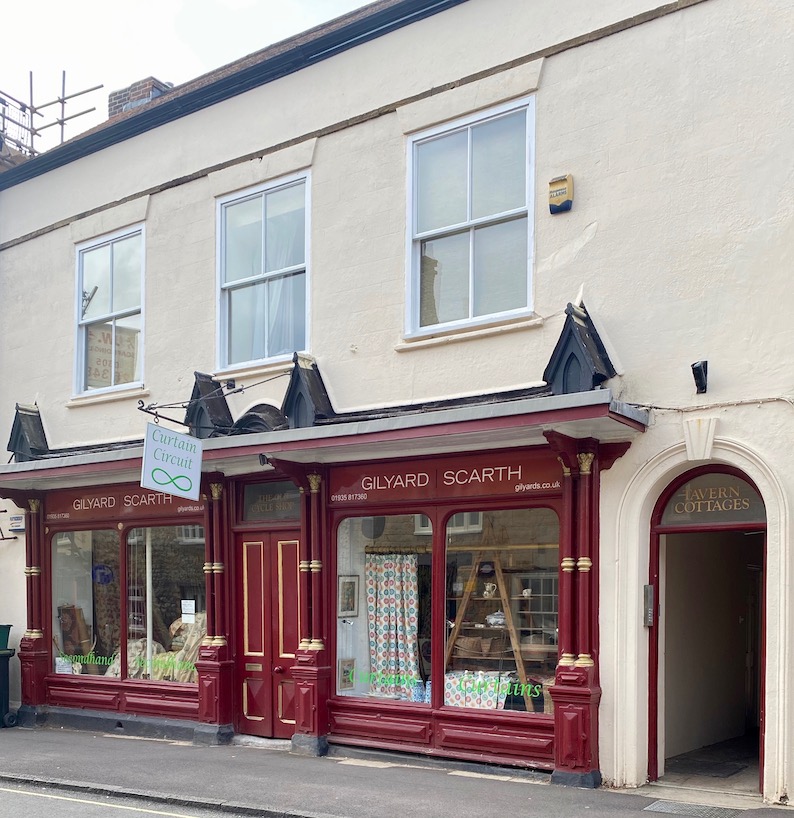
Ever since I wrote a book linked to a television series about the history of Britain’s high streets, I’ve been interested in the architecture of shops, and when I visit a town I’m often agreeably surprised to find old shopfronts still intact and fronting valued local businesses. This frontage in Sherborne was one that caught my eye. It looked to me late Victorian and the array of paired columns, wooden panelling, generous overhang, and slightly Gothic gablets poking out on top seemed to be from the more showy end of the retail spectrum. What could it have been, I wondered to myself: a high-class grocer’s, or maybe something more outré such as an oil and colour merchant or a specialist in well made leather goods? A sign painted on to the glass above the door gave a clue to a business that had been here once: ‘The Old Cycle Shop’. Could that have been the original business?

Not at all, it turns out. The other clue is above the doorway to the right, with its sign saying ‘Tavern Cottages’. A place of refreshment, then? Yes, but not the alcohol-selling place one would expect. This building began life in 1881 as the Sherborne Coffee Tavern. The late-19th and early-20th centuries saw a vigorous anti-alcohol movement. In churches and chapels there were sermons warning against the effects of the ‘demon drink’, campaigners and some nonconformist preachers persuaded people to ‘sign the pledge’ not to touch the stuff, and both campaigners and canny business people founded places where pub-goers could find alternative entertainment – from temperance billiards rooms to coffee taverns.

Coffee had been widely drunk since the 16th century and had gradually evolved from the costly luxury chosen by a few to an inexpensive drink enjoyed by many. Back in the 18th century, coffee houses had been popular among the professional classes in Britain’s large cities. Lawyers, medics, and even writers had their coffee house of choice, where they’d go to drink coffee, read the newspapers, meet friends, and discuss the day’s news. But coffee taverns were never as popular as their ancestors of the Georgian period, perhaps because they were mostly started by middle-class reformers who wanted to encourage the working class to stop drinking and give up the unruly habits of the drunk. The intended customers weren’t keen, and many coffee taverns closed after a few years.

Sherborne’s coffee tavern was bought in the 1890s by a local man, Edwin Childs, who moved his bicycle sales and repair business there. Childs prospered – this was, after all, the heyday of the bicycle – and by the early-20th century was also repairing cars. As the car business expanded, he first converted the shop, removing the big windows, and eventually put up a purpose-built garage elsewhere in the same street. Subsequently the attractive 1880s shop front was restored, and it still looks well in its dark red paint with details picked out in gold, an asset to Sherborne’s rich and varied streetscape and a survivor in an age when a liking for both wine and coffee no longer seems some kind of contradiction.

Monday, April 11, 2011

Sherborne, Gloucestershire


Tin among the trees

Regular readers of this blog will have noticed that I’m a fan of corrugated iron, which I like because it can be bent to form interesting shapes and because its undulating surface looks good in the sun. I hope I’ve shown by now, in posts about corrugated iron "tin churches" and other buildings, that this is not a substance that should be consigned to the bottom of the hierarchy of building materials, and that can be at home in both farm and village, by both road and railway.

I didn’t expect, though, to find a corrugated iron building in a quiet valley in the Cotswolds, fitting in amongst the water, grass, and trees. And I have to admit that I’d been along the road that passes this small boathouse many times before I even noticed it. In a way, that’s the point. This unassuming green building is in part designed to blend into its surroundings. But its builders took the trouble to give it a curving, pagoda-style roof, so once you do notice it, there’s that extra touch to admire. As I did one evening recently, as, interrupted by only the occasional quack from the water, the sun slid silently down behind the trees.

Wednesday, August 27, 2008

Sherborne, Gloucestershire


Limestone is one of the most versatile of England’s traditional materials. It runs in a band from Lyme Bay in Dorset to a point north of Filey in Yorkshire, a belt of stone that has given us some of our most memorable buildings – the terraces of Bath, the cottages of the Cotswolds, the church spires of Northamptonshire. Where I live in the Cotswolds nearly everything in some buildings is made of oolitic limestone - roofs, walls, window frames, floors, pavements. For centuries, Cotswolders came into the world to the sound of water boiling in a stone fireplace, and left it to be buried in a grave marked with a headstone made of the same oolite.

Everyone who has been to the Gloucestershire Cotswolds has seen houses like this – stone walls, stone roofs, dormer windows, and probably a stone garden wall and roses around the door too. The one I show above is in a village full of them. But if you look closely at it you’ll see something slightly unusual.

The doorway of this cottage has a rounded top with zigzag carving around it and the semi-circular stone above the door is carved with crosses. In other words, this house has a church doorway – and that zigzag carving reveals that it’s a Norman church doorway dating to the 12th century. What’s more, Pevsner informs us that there’s another Norman doorway around the back. If there had been one doorway, I'd have guessed that it had been moved to the site from somewhere else. But a pair of church doorways suggested to me when I first saw this house that the building began life as a place of worship before being converted (perhaps in the 19th century) for residential use – there’s another, still functioning, parish church in the village. Now a reader with a connection to the village (to whom many thanks for the information) has put me right. Apparently the foundations of a former church are still visible in the field opposite: the doorways were moved across the road.

Here in the Cotswolds we’re apt to get a bit blasé about our stone buildings. They’re everywhere and it’s easy to let them become part of the background, ignoring their details, their colour, and their beauty. Surprises like this one remind us to keep our eyes open. And as we look, to prepare to be amazed.