Showing posts with label stucco. Show all posts

Monday, July 10, 2023

Devizes, Wiltshire

Boot’s Corner

One result of spending some time thinking and writing about the history of shops is that one becomes aware of the way different multiple stores liked to design their shop fronts – the light oak window frames of W. H. Smith, the muted, modernised neo-classicism of Marks and Spencer, and so on. Among the best of the bunch were a number of Boot’s branches in town centres, which were often placed on corner sites and sometimes adorned with statues of famous historical figures with a local connection. When I looked up at the corner of St John’s Street and Wine Street in Devizes, it wasn’t long before I guessed I was looking at a former branch of Boot’s.

In the 19th century, Boot’s began to diversify their range beyond the company’s core pharmaceutical products, taking in everything from cosmetics to photographic processing. As a result, they needed larger stores, often with room for an upper sales floor. They also chose corner positions to take advantage of higher footfall and shop windows facing in two different directions. The Devizes branch was one such corner shop, with the added feature of a round tower to emphasize the building and turn it into something of a landmark.

Then there were the portrait busts in roundels on the upper walls. Some of the more spectacular Boot’s stores (for example, in Newcastle, Derby, and Bury St Edmunds), boasted full-length statues. The Devizes branch, in a smaller town, made do with busts, but they’re still impressive. The busts form part of a decorative scheme involving very fancy window surrounds, running even to putti beneath the top-floor windows, and pilasters that extend up the full height of the building. The busts, set in garlands, are at the tops of the pilasters. The two busts in my photograph portray Hubert de Burgh and Edward I. Hubert de Burgh, Earl of Kent in the early 13th century, fought alongside Richard I during the third crusade, encouraged King John to add his seal to Magna Carta and became chief Justiciar of England. However, his enemies brought about his removal from office and he found himself imprisoned – in Devizes Castle, which is how his portrait came to be displayed on the walls of the Boot’s store in the town. The reason for Edward I’s presence here may be that the town sent two representatives to this king’s 1295 parliament, the so-called Model Parliament, because it set the precedent of boroughs sending two representatives to Westminster; for some historians, this makes the Model Parliament the first such representative assembly in England’s history.

One gets the impression, looking at the decoration on this building’s facade, that it was built to last and that Boot’s intended to occupy the store for an extended period of time. Although they no longer do, the facade remains as a reminder of the times when retailers put real effort into the design and construction of their shops, making the country’s numerous ‘Boot’s Corners’ a pleasure to look at.

Wednesday, August 25, 2021

Sherborne, Dorset


Surprised in Sherborne, 2

Sherborne’s Cheap Street is a very attractive jumble of architectural styles – from late-medieval timber framed structures to stone buildings from virtually every later date: a hotch-potch, mostly with recent shop fronts, but much of it given unity by the glowing stone. Even in this good company, the bow-fronted building above is outstanding. Living near Cheltenham, I’m used to stucco-covered Regency buildings decked out with classical cornices, columns and iron balconies, but even so this one made me pause. It’s small, with just a single window on the upper floor of its curvaceous facade, but what a window – the full Venetian, with a pair of rectangular sections bookending a round-topped central portion, the whole surrounded by elegant mouldings and highlights picked out in white. A neat cornice and parapet, balustraded in the centre, complete this upper floor, which rests on four stone Ionic columns that frame the modern shop window. The iron balcony is the finishing Regency touch, vital for the safety of those inside who want to open the big window, which extends down to the floor.

As with the shop front in my previous post, I wondered what this building was used for when it was first put up in the early part of the 19th century. The upper room looked to me like the spacious drawing room of a middle-class house, the sort of thing that wouldn’t look out of place in Brighton. But there was no clue to what was originally where the modern shop window is now. The answer turns out to be that the building belonged to the Sherborne Savings Bank, who erected it in 1818. 

This was the formative period for savings banks in England. These banks were set up to provide banking facilities for poorer people – those who were not normally the customers of the established banks, whose accounts did not normally bear interest at this time. Savings banks welcomed small investors, including those who could save only intermittently, as their incomes were unreliable and varied according to the seasons or the availability of work.* Although savings banks did not help the very poor, who found it impossible to save any money at all, they were attractive to those such as artisans, small farmers, shopkeepers, and domestic servants, among whom were many who had a little money to save and who liked the idea of self-help. Savings banks were not perfect: in an era before elaborate state regulation of financial institutions, some folded as the result of fraud or incompetence. But for many they played a useful role.

Whoever designed the Sherborne bank’s building did their best with what was clearly a confined site. Ideally, the sweep of the bow front should stick out over the pavement area, so that it can make an impression whichever way you approach it. But the building to the right already sticks out, so this wouldn’t have worked without invading too much pavement space. So here it sits, standing proud of one neighbour and slightly in the shadow of the other, making its impression nonetheless.

The delicate architecture of this frontage is not what I normally associate with banks. The banks I’ve admired on this blog in the past have been rather chunky buildings, with the kind of solid-looking masonry that suggests strength and security. They seem to tell you that your money will be safe here. This building is very different. It’s impressive, but in a gentler, more domestic way. Its columns and the overhang they make possible offer shelter from the rain and seem inviting. ‘Come in,’ they say, ‘and you’ll receive a warm welcome.’ The effect seems wholly appropriate for a savings bank set up for those not previously used to dealing with the estanlishged banks or money markets. It still works its charm, on one passer-by, at least.

- - - - -   

* Small investors could also entrust their money to Friendly Societies, but these had regulations – often requiring members to deposit money regularly, that did not suit those with irregular incomes. Savings banks did not have such rules. 

Sunday, August 22, 2021

Sherborne, Dorset


Surprised in Sherborne, 1

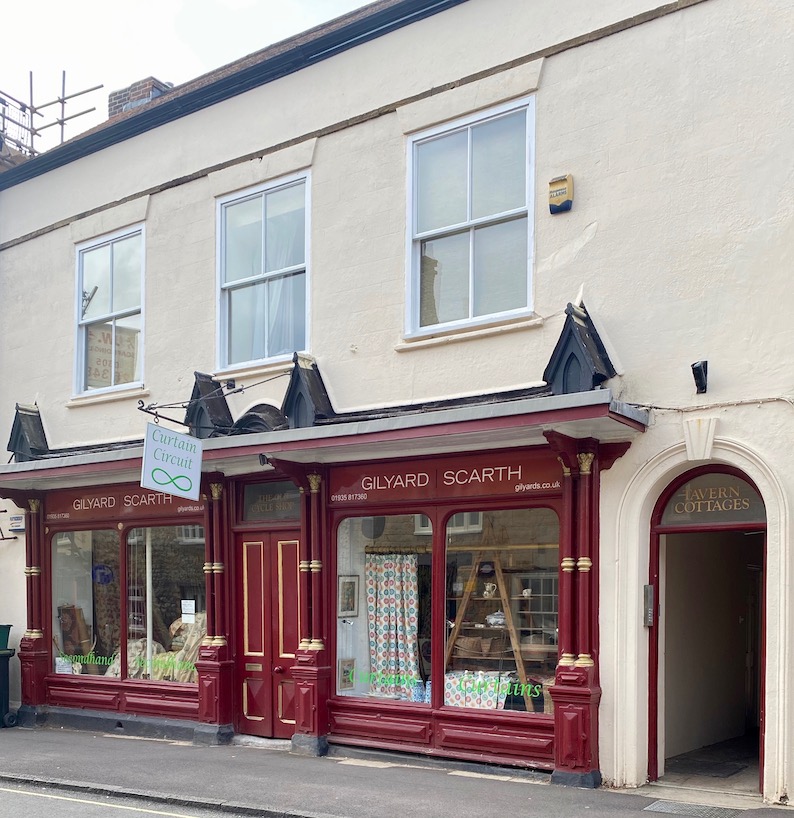
Ever since I wrote a book linked to a television series about the history of Britain’s high streets, I’ve been interested in the architecture of shops, and when I visit a town I’m often agreeably surprised to find old shopfronts still intact and fronting valued local businesses. This frontage in Sherborne was one that caught my eye. It looked to me late Victorian and the array of paired columns, wooden panelling, generous overhang, and slightly Gothic gablets poking out on top seemed to be from the more showy end of the retail spectrum. What could it have been, I wondered to myself: a high-class grocer’s, or maybe something more outré such as an oil and colour merchant or a specialist in well made leather goods? A sign painted on to the glass above the door gave a clue to a business that had been here once: ‘The Old Cycle Shop’. Could that have been the original business?

Not at all, it turns out. The other clue is above the doorway to the right, with its sign saying ‘Tavern Cottages’. A place of refreshment, then? Yes, but not the alcohol-selling place one would expect. This building began life in 1881 as the Sherborne Coffee Tavern. The late-19th and early-20th centuries saw a vigorous anti-alcohol movement. In churches and chapels there were sermons warning against the effects of the ‘demon drink’, campaigners and some nonconformist preachers persuaded people to ‘sign the pledge’ not to touch the stuff, and both campaigners and canny business people founded places where pub-goers could find alternative entertainment – from temperance billiards rooms to coffee taverns.

Coffee had been widely drunk since the 16th century and had gradually evolved from the costly luxury chosen by a few to an inexpensive drink enjoyed by many. Back in the 18th century, coffee houses had been popular among the professional classes in Britain’s large cities. Lawyers, medics, and even writers had their coffee house of choice, where they’d go to drink coffee, read the newspapers, meet friends, and discuss the day’s news. But coffee taverns were never as popular as their ancestors of the Georgian period, perhaps because they were mostly started by middle-class reformers who wanted to encourage the working class to stop drinking and give up the unruly habits of the drunk. The intended customers weren’t keen, and many coffee taverns closed after a few years.

Sherborne’s coffee tavern was bought in the 1890s by a local man, Edwin Childs, who moved his bicycle sales and repair business there. Childs prospered – this was, after all, the heyday of the bicycle – and by the early-20th century was also repairing cars. As the car business expanded, he first converted the shop, removing the big windows, and eventually put up a purpose-built garage elsewhere in the same street. Subsequently the attractive 1880s shop front was restored, and it still looks well in its dark red paint with details picked out in gold, an asset to Sherborne’s rich and varied streetscape and a survivor in an age when a liking for both wine and coffee no longer seems some kind of contradiction.

Saturday, May 3, 2014

Warwick


Warwick in progress

In Warwick recently, I thought I’d walk a little way out of the town centre to have a look at the gas works, a building of 1822 that was said to be one of the oldest and best preserved early gas works in the country. I found that the builders were in, but that I could still make out the outline of the original building above their bright blue protective fencing.

To say that the gas works is preserved is true, up to a point. The gas holders, once contained in the octagonal towers at either end, are long gone, but the walls that contained them are still there, together with the connecting office building in between, so that one can get a good idea of the front of the original building. The whole is stuccoed and the facade has those concentric semicircular arches that Regency builders so liked. Gothic glazing bars are being replaced in the windows, those in the tower originally being false.

The original builders seem to have gone to a lot of trouble to wrap their gas works in elegant clothing – it’s all a far cry from the more familiar exposed gasometers, all girders and rust, that have an attraction all their own. The result is that the building, now it is a gasworks no more, can have other lives. It was converted to offices, but is now being made over once more to provide housing, with a scheduled completion time of spring 2015. It seems a good solution for a building that has outlived its original use but whose facade and exterior form is certainly worth preserving. A worthwhile work in progress.


Thursday, January 16, 2014

St Leonards, Sussex


Sun-warmed surfaces

Rain and deadlines are keeping me indoors these days, so I have looked through my stock of photographs to find an interesting building or two, preferably illuminated by the summer sun and warmed by the memories of former days.

Some mid-Victorian villas seemed to fit the bill. They were built in around 1860 to designs by Decimus Burton, son of the James Burton who had begun to build St Leonards as a new town in 1828. This bit of the town is leafy, well to do, and stuccoed. The houses have an agreeably period feel – tall sash windows with neat moulded surrounds and tiny brackets to the sills, a deep bracketed overhang to the roof, a bright white finish, and lovely cast-iron balconies that pick up, as it were, where Regency Brighton and Cheltenham leave off. The finishing touch is the sinuous outline of the ogee-shaped canopies above each balcony, just the thing to keep the midday sun off the tops of the big windows. And, to catch the light in a still more interesting way, these canopies have a corrugated covering. Is it corrugated iron? Or some other material? It doesn't really matter. It does the bendy thing just as corrugated iron does, and lends its textured effect to set off the flat white finish of the walls. And it works. Rain or shine.

- - -

There's an interesting account of the residents of this street and the adjacent area here. This page points out that many of the households were made up entirely or almost entirely of women, the heads of households frequently being well-to-do widows or spinsters.

Sunday, March 11, 2012

Fulham High Street, London


Still there – just

It must have been in the 1970s, when Philip Larkin’s Oxford Book of Twentieth Century English Verse came out, that I first read and was moved by a poem by P J Kavanagh called ‘The Temperance Billiards Rooms’. In it, the poet remembers how he used to walk past the Temperance Billiards Rooms with his wife, who died tragically young. Aged just 33, the poet salutes the Billiards Rooms alone. He makes the building stand for continuity, in this moving poem about carrying on after a disaster: ‘it just goes on, as I do too I notice’. But it’s also fragile (‘something so uneconomical’s sure to come down’) and so is the grieving poet. It’s a touching poem, and Kavanagh’s description of the place, ‘in red and green and brown, with porridge-coloured stucco in between and half a child’s top for a dome…it’s like a Protestant mosque!’ has a melancholy humour.

I wonder if this is Kavanagh’s building. It’s now a pub (The Temperance), is repainted a rather sorry dark grey and is offering special deals on cocktails. There’s still a dome, still bits of stucco decoration, still stained glass in red and green, still the hall to the right which must have contained the billiard tables. If it’s not the building in the poem, it’s one very like it. Designed in 1910 by Norman Evans, it was one of several such buildings, built for Temperance Billiard Halls Ltd in northern England and the suburbs of London. Their art nouveau glass and decoration, and the chance of a game of billiards, were meant to attract punters away from the temptations of the demon drink, part of a movement that began in the middle decades of the 19th century and saw a late resurgence in 1900–1910. As late as 1908 there was a bill in Parliament to reduce the number of licenses to sell alcohol and ban the employment of women in pubs, a bill that was vigorously supported by temperance campaigners, and equally loudly decried by others, especially those, such as the Barmaids’ Political Defence League, who stood up for the barmaids who were to lose their jobs. The bill was defeated in the end, and the temperance movement declined.

This billiards hall, at any rate, is still there, although the dark paint spoils what looks it had. It’s also fiendishly difficult to photograph, hemmed in by road signs, wires, aerials, railings, and continuous traffic along the Fulham High Street. The best I could do was to include one of the most interesting vehicles that went past as I stood outside, a Mercedes Benz 280SL that takes us just about back to the 1960s, when Kavanagh wrote his poem. Like him, I’m glad the building is still there, although I cannot, like the poet, say that there are, ‘for all I know men playing billiards temperately in there’.

* * *

For more about architecture and temperance, see Andrew Davison’s essay ‘”Worthy of the Cause”: The Buildings of the Temperance Movement’ in Geoff Brandwood (ed), Living, Leisure and Law (Spire Books, 2010).

For P J Kavanagh’s account of his loss, see P J Kavanagh, The Perfect Stranger (1966)

Monday, December 6, 2010

Portland Place, London


Stucco unstuck

Back in the shiny 1980s, I remember standing in front of a London building site on which a new office block was going up. I was with an architect of my acquaintance, and the building was none of his doing. He contemplated the sheets of shiny cladding with which the building was being covered. ‘I call them fall-offs,’ he said. ‘Because they fall off.’ We bemoaned the terrible times, but we were both well aware that bits of buildings have been falling off for centuries. Take Liardet’s patent stucco, for example.

From the 17th century onwards, the type of plaster known as stucco was widely used to cover the outsides of buildings to create a finish that looked like the finest stone – at a fraction of the cost. As well as providing a smooth render for walls the material was also well suited for the production of moulded decorations – reliefs, swags, heads, and all the other motifs with which builders and architects, especially the classical architects of the 18th century, loved to adorn the facades of the best houses.

Robert Adam and his less famous brothers were among the most enthusiastic users of stucco. By the time the Adams were designing buildings several recipes of stucco had been developed, but the brothers favoured a specific one, an oil-based stucco devised by a Protestant clergyman from Lausanne called John Liardet. Liardet’s stucco, was an oil-based material – it contained boiled linseed oil instead of the water used in other mixes, and this was said to make the plaster more readily workable.


The Adams were enthusiastic about Liardet’s recipe, and acquired the exclusive right to use it – it seemed to be ideal to produce the delicate reliefs and other decorations that they liked so much. These details from a pair of houses in Portland Place show the kind of effect that the Adams created with Liardet’s stucco in the years after they made their business arrangement with him in the 1770s. The reliefs echo on this exterior wall the cameo-like panels showing classical figures, flowers, swags, and other designs that Robert Adam, especially, used to decorate his interiors.

The Portland Place decorations are rare survivors – and in fact are probably restorations rather than survivors in the strict sense. This is because soon after these houses were decorated with Liardet’s stucco in 1778, a problem emerged. The stuff turned out to have a far from tenacious attachment to the walls, and stucco was soon sliding off buildings and landing on pavements and in areas, At least one of the brothers’ clients, Lord Stanhope, pursued them for compensation, and the use of this kind of stucco was abandoned. By the end of the 18th century, more stable stuccos were available and one kind of fall-off, together with its hapless inventor, was consigned to the footnotes of architectural history.