Showing posts with label seaside. Show all posts

Wednesday, April 16, 2025

Bexhill-on-Sea, East Sussex

Multifaceted

My liking for small, unusually shaped buildings meant that I was immediately drawn to this one, an octagonal structure near the sea at Bexhill. I wasn’t at first sure exactly what it was – a café? a meeting-place? a seaside shelter? It turns out that it is known as the Bexhill Coronation Bandstand, and was commissioned by the 8th Earl de la Warr in 1895, as part of various improvements that he made to the town, most of which his family owned. The listing description, however, suggests that it may originally have been a seaside shelter and became a bandstand later – apparently it is described as a bandstand on a photograph of 1927 and there are other early photographs of musicians playing inside it. The window back then looked slightly different, openable and with less woodwork, to let the sound out to listeners on the surrounding paved areas. Musicians still sometimes play in front of the bandstand, but these days it’s a multi-use building fulfilling all kinds of needs. When I was there, it seemed that its main purpose was to shelter people who were enjoying an ice-cream and admiring the view.

The structure looks good after its recent restoration, and its colourful paintwork is just the kind of thing that seems right for the seaside. Some of the decorative touches hint at an Indian source – the horseshoe arches of the window frames and the repeating star-like motifs that run along the lower walls. This reflects a number of buildings nearby in a similar, Mughal-inspired style, which I’ll cover in a separate post. But the bandstand is not a purely Mughal-style building. The roof tiles are typically Sussex in appearance, and the wavy bargeboard beneath them are the sort of thing one sees on ornamental buildings of many different styles Seasides need buildings like this, structures that provide a bit of decoration and a dash of the unusual. This one manages to achieve this by finding a middle way between the tawdry and the dull. Hoorah!

Monday, March 15, 2021

Aldeburgh, Suffolk


 A convenient place of refuge

I was born in Lincolnshire, and therefore know what it’s like to walk along a beach in winter in a howling easterly wind, when you have mixed feelings if the top of your ice cream is blown away because the weather was really too cold for you to be grazing on such delights. A cup of good hot strong tea is more to the point. East-coast seasides need some shelters, so you can drink your tea or just get out of the wind, and they know this just as well at Aldeburgh, Suffolk as they do in Skegness, Lincs (famously ‘so bracing’) or anywhere else.

This shelter is not far from the Moot Hall in my previous post and that bit of patterned brick nogging, low down between the timber uprights, is a sort of homage to genuinely old buildings like the Moot Hall. I suppose this shelter is 20th-century – maybe it was built in the interwar period, although the nogging, with its pristine pointing, looks like a recent repair, and the whole thing could be post-war.* But its age doesn’t matter. It’s not unsightly, incorporates public lavatories, and provides a useful refuge. Good enough for me.

- - - - -

* However, looking at old photographs, there doesn’t seem to be anything on the site of the shelter in 1910. Another image labelled ‘interwar’ includes it.


Tuesday, January 19, 2021

Dartmouth, Devon


Summer days, 4

For my final post in this short series about seaside buildings, here’s a very different structure on the Quay in Dartmouth. The hotel has been a vital feature of coastal towns since seaside holidays became popular in the 19th century, but many coastal hotels have a longer history, as stopping places for travellers and visitors alike. This one, far older than the 19th century, has the pale coloured walls of my previous coastal buildings, but there the resemblance ends.

The Royal Castle Hotel began life in 1639 as a pair of merchants’ houses. They had timber-framed fronts, although some of the cross walls are stone. By 1736 one of the houses was an inn, called the New Inn, and later during the 18th century the two houses were combined to form a single property, by now called the Castle. There was a major remodelling in 1840, with internal upgrades and a renewal of the front that faces the water. This was probably when the timber frame was plastered over – it’s still there underneath, as shown by the fact that the first and second floors both protrude slightly from the storey above, a fashion that was popular in 1639 but had died out by the following century. The elaborate faux fortification – crenellations and turrets – that make up the parapet may well date from the time of the remodelling and there may or may not have been something similar there when the inn was renamed the Castle.

At a quick glance, the Royal Castle Hotel looks very much of a piece – white facade, sash windows, battlements, gilded lettering. But it’s actually the creation of several separate phases of building and upgrading, over nearly 400 years. Like so many old buildings that look as if they’ve been the same for centuries, this one has been – in architectural terms at least – continuously changing to meet seaside and wider needs and fashions, metaphorically on the move.

Saturday, January 16, 2021

Dartmouth, Devon


Summer days, 3

On one of many recent days stuck in doors, the Resident Wise Woman reflected that it was fortunate at least that we’d managed a trip to Devon and another to Aldeburgh late in 2019. The virus couldn’t take those memories away from us, even if it has deprived us of the trips we’d planned for 2020.† Drifting around the streets of Dartmouth was one of the pleasures of the Devon trip. It’s a town full of architecture pleasures, but here’s one of the more incidental ones: a house near the water and another exemplar of that seaside style I’ve been exploring in my previous two posts.

Well, partly. Actually this is a bit more sophisticated than the pretty but random-looking houses on the front at Lyme. This is Regency sophistication, and plenty of it. The house has the pale blue finish that one could find near the sea at any coastal town. But in other respects we’ve moved away from architectural casual wear and got into high fashion. That pattern of glazing in the window, with narrow panes near the edges (and there are several more of them in the storey above) is classic early 19th century. What you can’t see in my photograph is that the window also has a curving top, enhancing the Regency feel. Also very much of its time (1820s or 1830s) is the cast-iron balcony with its pattern of crosses. This balcony is an interesting combination of solidity – the ironwork looks very substantial – and fragility: the floor is thin timberwork and the brackets, as so often, seem very modest; indeed, diagonal iron rods have been fitted so that the ironwork is fixed to the wall higher up (one of these is just visible among the foliage at the left).

Then there is the doorway. This is a show-stopper. The doorcase alone is special, with its diagonal grooved decoration up the sides and across the segmental top; then a bat-wing design with oval medallion carved between the segmental curved and the fat hood. The door is also impressive, with its pattern of studs. This may be a terraced house, but its doorway make one feel as if to go in would be to enter the home of a person of consequence. For the mere passer-by it at least had the effect of lifting the spirits, something that all good seaside houses should do,.

- - - - -

† Not to mention any plans we might have had for 2021. Old Czech joke: Q: How do you make God laugh? A: Tell him your plans.

* Pevsner calls this ‘an unusual pattern-book doorcase’. Well, provincial builders did indeed lift their designs from pattern books, but wherever it comes from, this example is certainly unusual.

Tuesday, January 12, 2021

Southwold, Suffolk


Summer days, 2

This bit of seaside domestic architecture made me pause, and took me back. It’s years since I saw the film Mary Poppins (in fact, I was a child when I saw it), but I seem to recall that near the beginning there’s an old telescope-wielding sea captain watching the clouds from a balcony high on the roof of his house. ‘The wind is changing,’ he says, and the wind soon brings to our eyes Mary Poppins herself, floating on her umbrella, to create enjoyable disruption to the ordered life of the Banks family. An old sea captain who liked watching the clouds of the ships could do a lot worse than a balcony like this.

It sits atop a house near the sea at Southwold, and would be ideal for such a character. I’ve no idea how it got there – whether it was a perch for a ship-owner or merchant of days gone by who needed to keep an eye on the traffic out at sea, or a watchman’s post, or simply a modern jeu d’esprit, a place to sit out or admire the view. However it got there, it’s a diverting bit of seaside architecture that sums up the way in which coastal houses often celebrate the meeting of indoors and outdoors. Balconies, verandas, terraces, look-out points, big windows or French windows from which you step straight out of your living room into the garden or even on to the sea front – all these things abound at the seaside. If spas like Cheltenham are the places for cast-iron balconies, seaside towns are the place for wooden railings, painted white or in pastel shades, whether simply designed like the ones here or with more complex timberwork.

There’s a sense, in making ornate railings or in having a balcony at all in a place where, as here, you need a special staircase to reach it, that builders and owners have made that extra effort to make the place really special. And that life is lived partly on show – we can see you up there, almost as clearly as you can see us – so the building at least is good to look at. Oh yes: people go to the seaside for the sun, the sea, the fresh fish, for sailing (even for crazy golf). But also for things like this.

Friday, January 8, 2021

Lyme Regis, Dorset


Summer days, 1 

As the sleet came down in late December, I found myself looking through my files of photographs and came across a number taken near the English coast when the sun was out and the sky was blue. In one way it was good to look at images of summer days at a rather bleak moment, though in these times of confinement it’s not easy to imagine being able to jump in the car and decide, spontaneously, to head to the coat and visit somewhere like Lyme Regis. Looking at the photograph above, though, also reminded me how the houses in so many coastal places have a recognisable ‘seaside look’. What does it mean to say this, and how is it expressed, architecturally? It’s a combination of things, not all present in the picture, not all constant, for seaside houses as much as the homes in an inland town are built for different people with different needs, priorities, and budgets. But a few features of these Lyme houses can point the way to an answer. 

One thing is colour. A lot of seaside houses are finished in stucco or other render that’s painted, either white or in pastel shades. Here there are pale pink, green, and blue houses, along with the ubiquitous white. There might be several reasons for this. A lot of seaside houses were built in the 18th and, especially, 19th centuries as stays beside the sea became fashionable, first for the leisured classes, then for poorer people. Sometimes these houses were built quickly, and stucco was a way of hiding rough masonry beneath a civilised surface. This sort of finish was anyway popular in the late-Georgian and Regency periods, when many such houses were built. Lyme developed as a spa in the 18th century and was still popular when Jane Austen visited in 1804. A lot of Lyme still has a late-Georgian or Regency feel to it and these houses reflect that. As well as walls with a pale finish they have another typical seaside feature: bow windows. These curvaceous windows were very much a Regency fashion – there are lots of them in the Prince Regent’s favourite town, Brighton. They’re used at the seaside because they let in lots of light and offer good views. I think there’s also a ventilation benefit. If you want some air, but there’s a stiff breeze blowing, some part of a bow window may well be out of the line of the wind, so you can get some ventilation without having all your papers blown off the table – most advantageous to writers, as I have found.*  

So far, so practical. But it may simply be that the reason for these features, along with such elements as the fancy ironwork around the porches and the elegant fanlights with their nicely curving dripstones, is that they look good, and look good in a celebratory way. They’re meant, I think, to make you smile, to lift the spirits. This is informal beauty, too. The houses make a virtue of being asymmetrical – it doesn’t matter that they’re not the matching, carefully proportioned Georgian boxes or terraces that you might see in the ‘best’ streets in London or Bath. Again asymmetry was popular in the Regency period more general, but add all these features together and I don’t think it’s fanciful to see this as relaxed, kick-your-shoes off architecture, where sitting outside on the pavement in front of your house is acceptable, and where you won’t be scorned if you’re engaged in the idle enjoyment of summer days. 

- - - - - 

* Of course, you might be a ship-owner and have more than a passing interest in the vessels in the bay; a good view is useful for you too.

Monday, June 8, 2020

Summer Books: 1


Kathryn Ferry: Seaside 100
Published by Unicorn Publishing


What do you think of when you think of the British seaside? Sandcastles? Donkeys? Ice cream? Punch and Judy? Fish and chips? Bathing belles? What do I think of? All of the above, plus beach huts, grand hotels, bandstands, lidos, Clevedon Pier and the De La Warr Pavilion. There could be a hundred things, the features that sum up the seaside and embody its history, and they’re all here, given a couple of pages each, in Kathryn Ferry’s new book, Seaside 100.

They make a varied bunch, but they hang together because of their common theme. And although the book’s one hundred short sections make it look a bit like a selection box that you can dip in and out of, they actually build into a historical picture of the seaside, from its beginnings with the health resorts, bathing machines, and excursion trains of the 18th and 19th centuries to the conserved piers, art galleries, and seafront sculptures of today.

There is a great deal of research crammed into this short book, but its author’s learning is worn lightly and her text is liberally sprinkled with well chosen pictures that lend visual atmosphere as well as being informative in themselves – old railway posters, historic images of holiday camp chalets, or the Blackpool illuminations, or pierrots. I found myself often surprised by what I was learning – about 18th-century seaside voyeurs looking at bathers through telescopes, about the ubiquity of bedbugs in lodging houses, about the varied designs of bathing machines, or about the early history of seaside donkeys or suntan lotion. I was pleasurably reminded, too, of things I’d forgotten, like the way in which lodging house guests used to bring their own food, which the landlady cooked for them, or how the first railway-carriage buildings were not bungalows but Victorian fishermen’s net stores. And I was grateful to Kathryn Ferry for answering questions I’d never asked. Who did write ‘I do like to be beside the seaside’, for example. It was one of those tunes I’d just taken for granted (like the circus clown’s anthem, ‘The Entry of the Gladiators’*). Now I know the answer.

Many readers of this blog are British, and people for whom the seaside is part of their childhood and heritage. Such readers will find much to entertain, amuse, and enlighten them in Seaside 100. So too will anyone with an interest in seaside architecture, and that includes amusement arcades and ice cream parlours as well as the buildings that are now regarded as the sophisticated legacy of seaside modernism – streamlined lidos, apartment blocks that look like ocean liners, Morecambe’s Midland Hotel, and, yes, Bexhill’s De La Warr Pavilion. There is more to be said of these buildings than Kathryn Ferry has room for here, but she ensures that they take their place in this attractive survey of what makes the seaside distinctive. If like me you live far from the sea and want a breath of fresh salty air and seaside history, I’d recommend ordering this book, getting in some social distanced fish and chips from your local take-away, and soaking up the atmosphere. If you're by the sea already, the book will add to your enjoyment too.

- - - - -

* And, for that matter, who wrote ’The Entry of the Gladiators’? Bouncing Czech march and polka king Julius Fučik, that’s who. Thanks to the musician-friend who told me. But he didn't write ‘I do like to be beside the seaside’. Get hold of Kathryn Ferry’s book to find out about that song.

Tuesday, January 28, 2020

Aldeburgh, Suffolk


Sea views
I suppose I'm not the first person to notice that there have evolved, over the years, certain styles of house that seem especially at home at the seaside. I’ve noticed before the pastel shades that people like to paint buildings and beach huts in towns like Lyme Regis, and how resorts such as Brighton favour houses with big bow windows to let in plenty of light and offer good views – sea views preferably, but any view of a pleasant street or a garden is better than none. At Aldeburgh and other towns on the east coast, there seems to be a preponderance of bay windows and white-painted wooden balconies.

In a house like this you can sit out and watch the sea, or the comings and goings on the path below, or if you don’t want to sit out, you can safely throw the French windows open to let in fresh air, the sounds of people enjoying themselves on the sea front, and the salty smell that pervades the atmosphere. There may be no front garden, but you can enjoy a sense that the whole sea front is your garden. Places like Aldeburgh have been the scene of such enjoyable idling since the early-19th century. There is much, of course, for the architectural idler to admire. I was struck, when taking in these houses, by the curvaceous gable revealed when you look from this angle. If that seems a little Dutch, this coast has long had contact with the Low Countries, and both bricks and some of the architectural styles that went with them across the sea were imported to East Anglia before local brick-making was reestablished on a large scale.

Nowadays most people come to Aldeburgh for recreation, and most of the town’s businesses seem connected one way or another with tourism. But as you walk along the beach, notice boats pulled up on the shingle and see a tarred and weatherboarded shop selling fresh fish,* you’re reminded that this was once a thriving fishing port and there is still some fishing here. So sea views must once have been useful to those looking out for the arrival of boats with their catches. If I mourn the decline of these local fishing industries (as I also do of those in my native Lincolnshire), I’m grateful that towns like Aldeburgh still thrive.

- - - - -

* Or enjoy some of the excellent fish and chips available here.

Monday, September 19, 2016

Aldeburgh, Suffolk


More light!

Along the Suffolk coast I noticed them, but they are everywhere in coastal towns in England: houses with bay windows and balconies. The balconies are an obvious asset: a place to sit and enjoy the view if your energy, and the weather, discourage you from making it all the way to the beach. Here at Aldeburgh, on houses only a few yards from the shore, there seems little excuse for them – but people like their own private sitting space, so why not?

The bay windows, of course, need no excuse. They add another dimension to a room and, above all, they let in extra light. And in England, where the sky is often cloudy, we need as much light as we can get. In this location they’re especially effective, and bay windows have been popular in seaside towns since the Regency period – and pretty popular in other places too.* The coast hereabouts runs roughly north-south, meaning that these houses have a view roughly eastwards. That makes them wonderfully sunny in the morning. But with simple flush windows they’d be a bit dingy the rest of the time. The canted bay windows catch the sun as it moves round to the south through the middle of the day admitting more light. You can see where the light is coming from in my picture, taken at around 2 pm on a summer’s day.

Add a nice coat of plaster to protect the walls from salt spray and a pastel shade of paint to cheer everything up and you have as good a coastal house as you could want. Just the thing to contemplate before turning one’s gaze eastwards on the endless blue of the sea and sky.

- - - - -

* Actually some Tudor buildings, especially grand houses, have them, but they became widely used in the Regency period.

Sunday, August 18, 2013

Lyme Regis, Dorset


Lyme flavoured

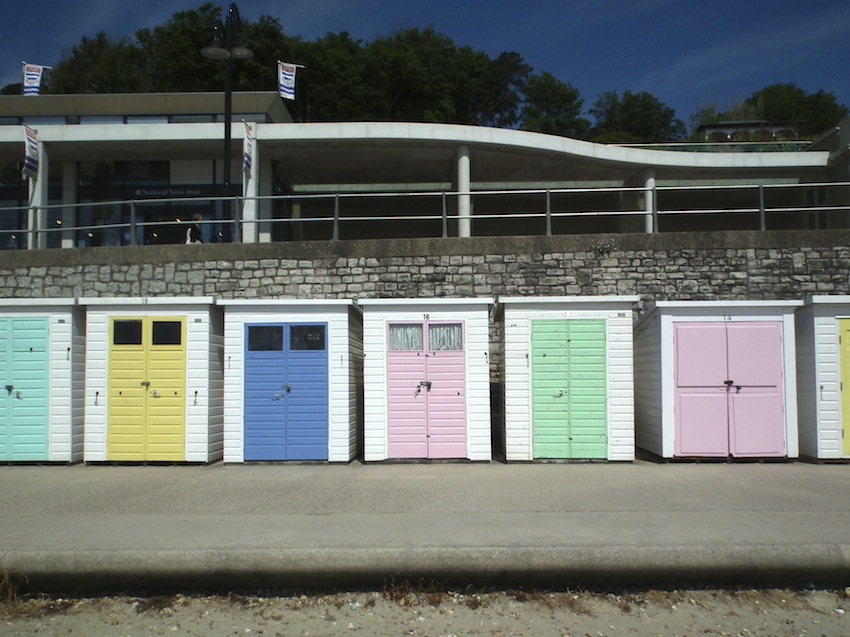
Small, colourful wooden buildings sitting on the boundary between land and sea, beach huts have been with us since the end of the 19th century. They have their origins in the movable 'bathing machines', the sheds-on-wheels that could be pulled out into the sea to give the Victorians the ability to change and to bathe in privacy. Since then, stationary beach huts have become a familiar sight at seaside resorts all over Britain. Prized by owners for their convenience and by passers-by for their appearance, beach huts are much loved.

The huts are often brightly coloured and usually have gables and pitched roofs, but these simple examples with mono-pitch roofs caught my eye as I walked along the beach at Lyme. I admired the paint colours too – pastel shades that are gentler and more subtle than the seaside norm. Especially appealing are those with pink, green, and yellow doors, shades that reminded me of the strawberry, mint, and vanilla bands of Neopolitan ice cream. Simple, clean, and stylish: perfect for a sunny day at the seaside.

Saturday, October 9, 2010

Hastings, East Sussex


The fire on Hastings Pier

This post is to offer my condolences to my friends in Hastings for the damage caused to Hastings Pier in this week’s fire.

Hastings Pier, designed by Eugenius Birch, the doyen of British pier engineers, was opened on 5 August 1872, which was Britain’s first-ever bank holiday. It is one of seven remaining piers designed by Birch, and its cast-iron columns and wooden deck sit on screw piles, patented by Birch, which anchor the structure in place. Much of this basic substructure remains. The buildings on top have been much altered over the years, both because of damage caused by an earlier fire (in 1917) and to reflect the changing uses of the pier – from a combination of promenade and landing stage for paddle steamers to the home for a host of entertainments (music hall, theatre, slot machines, bingo, rock concerts, and so on and on).

The pier’s recent history has been troubled. Storm damage has led to periodic closures and there has been widespread concern about the neglect of the structure by its offshore owners. The Hastings Pier & White Rock Trust (HP&WRT) was formed to raise money to restore the pier and to return it to community ownership. Huge progress had been made, including an agreement by the local council to use compulsory purchase powers to buy back the pier, when this tragedy struck.

The people of Hastings are right to care about their pier. It is a wonderful Victorian structure of enormous historical interest, evoking the brilliance of Victorian engineering and the verve with which the Victorians embraced the English saeaside. It also represents the memories of countless locals and visitors who have enjoyed variety performances, plays, rock concerts, winnings, strolls, and views of the sea here for more than 130 years. Assessment of the damage is now underway and, with the HP&WRT still working to raise funds, there’s a chance people will continue to enjoy the pier. Go to their website to check out their progress and donate.

Thanks to Ann Kramer for the photograph.