Thursday, August 15, 2024
Peckforton, Cheshire
The image of an elephant with a castle on its back is an ancient one. The Romans famously used war elephants that could carry soldiers and medieval manuscripts show elephants with howdahs that take the form of castles, with turrets and narrow windows. Few Europeans back then had actually seen an elephant and some of the illustrations are very fanciful, but the 13th-century English king Henry III had an elephant in his collection of animals at the Tower of London, a gift from his French counterpart Louis IX. Today, we’re most likely to know the Elephant and Castle from the signs of pubs and from the name of the eponymous area of South London, with its pub sign, shopping centre, and underground station.
Inn signs bearing elephants with castles would have been found in the 19th century too, and antiquarians would have been familiar with their use in heraldry. Uses like these may have given the Victorian stonemason John Watson the inspiration for the large stone elephant and castle that he carved in Peckforton, Cheshire. The first documentary evidence for this carving comes from 1860 and says that the work was made about two years before. Why did he carve it? Did it have any practical use? What was the inspiration? No one knows the answer to these questions. There’s a story that the castle was originally a beehive, but this seems highly unlikely – any beekeeper would find it hard to climb up and get the honey and the windows were originally glazed, making access difficult for keeper and bees alike. I think it’s just a rather large garden ornament that could have been inspired by a coat of arms or an inn sign – or perhaps by the carving of the same subject in the choir stalls of Chester Cathedral.
There’s something joyous about the sheer size of this garden sculpture. I wonder how many people turn off the A534 to find it in the village of Peckforton? I’m rather glad that I did.
Saturday, August 10, 2024
Wells, Somerset
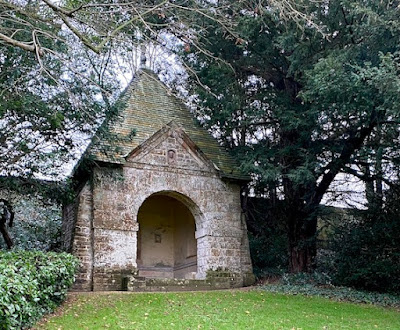
I’ve peeped through the entrance archway to the bishop’s palace at Wells more than once, but never visited the palace itself or its garden. The other day, it seemed high time I had a closer look, and I was confident that there would be architectural as well as horticultural interest within. Not least fascinating to me were such things as the back view of the palace and the defensive walls. On an altogether smaller scale, I was drawn to this rose-covered stone building. As I spotted it in the distance, I wondered what it might be, quickly ruling out a gazebo (the windows seemed too small) or a posh potting shed (not in the right place).
A helpful interpretation board enlightened me. It’s all about water management. An underground channel from the well pool in the grounds fills a sizeable tank, and the resulting head of water creates enough pressure to feed the water supply for the palace and an outlet in the city’s market place, providing a fresh water supply for local residents. That, at least, was how it worked in 1451, when the then Bishop of Bath and Wells, Thomas Beckynton or Beckington, granted this boon to the town. Nowadays, the people of Wells get their water through pipes to each house, just like the rest of us. Back then, it must have been a huge benefit to both convenience and health to have a supply of fresh, clean water a short, bucket-carrying walk away from your house. The wells of Wells being prolific, there was often enough surplus water for the butchers on the market place to flush away the sanguinary drippings of their trade.
Naturally, the bishop provided a seemly home for the water tank, so it didn’t intrude too much into his garden. A simple square building with a hint of the ornamental to the cusped windows has done the job for centuries. Those with sharp eyes (click on the image to enlarge it) will spot the ornamental finial at the apex of the roof. It’s said to depict the bishop’s favourite hunting dog.
Thursday, July 6, 2023
Stourhead, Wiltshire
The other day I did a Google image search of ’Stourhead’ and eight of the first ten pictures it produced featured the Pantheon, the garden’s great domed and porticoed temple. For many, the Pantheon is the climax of the garden, a visual focus whether viewed from near or far; seen across the lake from the end of the garden nearest the house, it is a goal for anyone about to walk around Stourhead’s glorious landscape.
‘Pantheon’ means a temple dedicated to all the gods, not just one deity as was the norm in the classical world. The Stourhead version is modelled loosely on the much larger Pantheon in Rome, one of the best preserved of all Roman buildings. The Roman Pantheon has a large dome and a portico with eight massive Corinthian columns. Stourhead’s version is smaller and its portico has six columns and unlikle the Roman prototype does not stretch right across the front of the building. This leaves room for a large niche at either end of the facade, containing a statue of a deity, Bacchus, god of wine, on one side, Venus, goddess of love, on the other. To be more precise, the love goddess appears in the form known as Venus Callipygos, Venus of the beautiful buttocks. Apart from her physical appeal, Venus is probably here because she was the mother of Virgil’s hero Aeneas – when laying out the garden, Henry Hoare made several allusions to Virgil’s epic, The Aeneid, although the scholarship in this case was in part an excuse for the male gaze to linger over an image female beauty.
For many, the point of the Pantheon is what it looks like from the outside and how it enhances its garden context. But of course the building also has an interior and a use – the family held supper parties there and used it as the setting for picnics. These forays away from the dining room in the house took place in a stunning interior. Beneath the coffered ceiling of the dome are panels of classical scenes in relief, but the walls of the circular building are dominated by a series of seven large niches containing statues of deities. The most famous is a Hercules by Michael Rysbrack but for a change I show his statue of Diana, goddess of the hunt. The others are: Livia Augusta, a Roman empress (she was Virgil’s patron and her statue at Stourhead is an ancient one, acquired by Hoare from another collector); the ancient Greek hero Meleager; Flora, goddess of fertility, flowers, and gardens; Isis, the Egyptian mother goddess (also worshipped by the Romans); and St Susanna (a saint connected to the city of Rome). Livia is an ancient Roman statue, acquired by Hoare from another collector. They seem a miscellaneous collection, but several have garden or country connections, a couple are heroes like Aeneas, and Livia has a close link to Virgil; they also, in different ways, reflect Hoare’s interest in collecting and in commissioning art. Like so much at Stourhead, they also embody Hoare’s liking for a mix of scholarship and the pleasures of beauty, nature, food, and wine. I’ll drink to that.
Saturday, July 1, 2023
Stourhead, Wiltshire
The great indoors
I’ve visited several gardens this summer. Lest anyone think this represents time off from historic architecture, my recent posts about Painswick and Warwick will be proof of the opposite – gardening, from Renaissance Italy to Victorian England, is also a chance to build more not less and gazebos, summerhouses, temples and sheds abound. So garden visiting is not all about the great outdoors; the great indoors has its role to play too. In England, garden buildings might be ornamental but are also practical – they provide shelter from the wind and rain; in warmer climes (how quaint that phrase seems now), they also provide welcome shade and cool.
One kind of structure that afforded a retreat from hot weather in Italian Renaissance gardens was the grotto. A subterranean, cave-like grotto, with water trickling through, is just the thing on a baking hot day. When Henry Hoare, cultured banker and owner of Stourhead, laid out his famous landscape garden, he was particularly pleased with his grotto, and was not above taking a dip in its pool: ‘A souse in that delicious bath and grot, filld with fresh magic’ pleased him greatly. He called it an ‘Asiatick luxury, and too much for mortals, or at least for subjects’ – after a session in the grotto, Henry Hoare felt like a king.
Stourhead’s grotto is also an example of the way in which visiting a landscape garden can be a journey of discovery and surprise. We enter a dark passage, lined by rough-hewn stones – the atmosphere is of something dark and mysterious. But on our journey through we encounter, as well as the expected cool flowing water, two classical figures. One is the River God, who is probably meant to represent Tiber, the god of Rome’s river – ancient Rome being a key inspiration for the gardens at Stourhead. The god points us on our journey. The other figure is the nymph whose grotto this is. She reclines in a lighter space, lit by a skylight from above. This figure, recumbent by her pool, is probably meant to evoke the nymph and grotto in the Aeneid, where the Aeneas and Queen Dido of Carthage fall in love. An inscription from Virgil’s epic is from this part of the poem; translated, it reads: ‘within, fresh water and seats in the living rock, the home of the nymphs’. Another inscription, in the floor in front of the pool, imagines the words of the nymph: ‘Ah spare my slumbers, gently tread the cave And drink in silence or in silence lave’. This is not Virgil but a translation by Alexander Pope of a 15th-century poem. The lines remind us that this magical space, in which the statue and the cascading water are caught in light from above, was also seen as eminently practical. Drink, or bathe, or sit and take your ease…then continue on your journey…
Monday, June 5, 2023
Painswick, Gloucestershire
Welcome to the Eagle House
The Eagle House is a building on the edge of Painswick Rococo Garden and is one of those that the garden’s restorers had to reconstruct in part. The building is in two storeys – a lower section with a large Gothic archway and an upper level which is a small hexagonal pavilion, generously supplied with pointed Gothic windows that give views over the gardens. The good views from this cliff-top, eyrie-like structure form one reason for the building’s name; the other reason is that an eagle did live in it for a while, during the 19th century.
A drawing by Thomas Robins from the 1750s gave the restorers the best clues as to how to rebuild the upper storey, which had perished some time after the eagle’s period in residence. The present design, with the hexagon peeping up from above the row of stone battlements that top the arch below, follows Robins’s drawing closely. Archaeology revealed not only the foundations of the upper storey but also some fragments of its structure, including pieces of plaster in the pink colour used for the finish. The Gothic windows, the unusual hexagonal shape, the lightness of the upper section, and the pink colour are all features associated with the Rococo manner that give the garden its current name.
‘Allow me,’ said Mr Gall. ‘I distinguish the picturesque and the beautiful and add to them, in the laying out of grounds, a third and distinct character, which I call unexpectedness.’
‘Pray, sir,’ said Mr Milestone, ‘by what name do you distinguish this character, when a person walks round the grounds for a second time?’
Mr Gall bit his lips, and inwardly vowed to revenge himself on Miletsone, by cutting up his next publication.
Poor Mr Gall, being taken to task for, admittedly, being rather pompous about something light-hearted. For that, to my mind, is the point of gardens like this. They are a world away from the philosophical gardens of the period, in which buildings are freighted with moral or political meanings – Stowe is a wonderful example of this kind of outlook. The Rococo Garden seems to be above all about pleasure and delight, and is no worse for that.
Friday, June 2, 2023
Painswick, Gloucestershire
In 1984 Lord and Lady Dickinson, owners of the Painswick House estate, decided to restore the 18th-century garden in a hidden valley behind the house. The area had been neglected for years, the garden abandoned, and part of the site eventually made over to a commercial conifer plantation. Restoration meant clearing decades of rubbish, working out what remained of the original structures, no doubt uprooting any remaining conifers, and repairing (and sometimes reconstructing) garden buildings. This was a huge undertaking and would have been impossible were it not for a painting (and drawings) of the garden in its mid-18th century prime by local artist Thomas Robins.
What has emerged over the decades since 1984 is a garden in the Rococo taste, with walks, pools, vistas, a wooded glade, a kitchen garden, a vineyard, planting with species available in the 18th century, and numerous pavilions and other architectural structures. Some of the buildings were restored to something close to their 18th-century state, some were rebuilt completely following the Robins pictures, for some a compromise was achieved, with certain structures restored to a state similar to the way they were in the 19th century.
One of the most striking buildings is the Red House, which sits at one end of the garden, at a point where formal beds and clipped hedges give way to a riot of natural vegetation and wild flowers. It is not only a belter of an eyectacher, but also exemplifies some of the key features of the Rococo. These are: asymmetry, the interesting use of colour, scrolls and curlicues, rich ornamentation, playfulness, and eclecticism of style (the building owes much to Gothic, but the roofline of the right-hand room takes a concave form derived from Chinese sources). This building of the 1740s adopts a fancy and fanciful kind of Gothic detailing with an ogee (double-curved) gable, deep cusped ogee canopies to windows and doorway, large finials, upside-down trefoil-shaped openings, exaggerated buttress-like stone uprights with concave-slopes to the gables. This is similar to the kind of Gothic used by Horace Walpole at his Twickenham house, Strawberry Hill, at around the same time as the Rococo Garden was begin constructed.
A further Rococo feature of the Red House is the way in which the two wings are set at a slight angle, another piece of asymmetry that seems odd until one realises that the two rooms face two different paths that converge here, one leading along the edge of the garden, the other heading towards its centre. So whichever path you take to approach the Red House, one of its wings acts as a focal point: the building is ingeniously integrated into the plan of the garden.
Painswick Rococo Garden, as it’s now known, is a unique example of a Rococo garden in England. To those interested in architecture, it offers half a dozen small delights like the Red House. For those whose main interest is the horticultural side of things, the place is stunning in the snowdrop season (it has one of the best collections of snowdrops anywhere), delightful in the late spring when we visited (though we were a little late to see the bluebells at their best), and its wooded sections must be beautiful in autumn too. But the point is not to separate buildings and plants, but to appreciate how well they are integrated. The effect is a triumph of 18th-century design and 20th-century restoration.
Monday, May 22, 2023
Warwick
Imagine you’re the owner of a small business in an English town centre in around 1860, say a grocer or a cabinet-maker. You sell goods from your premises on the High Street and you and your family live above the shop. Out the back is a small yard, devoted to storing items related to your business; there is no garden. You’d like a garden, but maybe you can’t afford to buy a house away from the centre of town – or maybe you don’t want to. What do you do?
The Victorians had an answer: a detached garden, somewhere in town, an easy walk away from where you live. A landowner would set aside an area of land, divide it into plots, and let the plots to locals; sometimes plots were also available to buy. In the 19th century most English towns had these garden plots – for growing flowers and relaxing in, not the still-familiar allotments, which are mainly for growing fruit and vegetables. Now there are hardly any left: the move to the suburbs in the early-20th century made them redundant. But one English town, at least, has hung on to a set of detached gardens, and they’re now run as a visitor attraction. This is Hill Close Gardens in Warwick.
Hill Close Gardens fell into neglect and dereliction in the 20th century, and the local council bought the land, hoping to build on it. But many people thought that it would be worth restoring the gardens and opening them to visitors and school parties, so that people could learn about this almost forgotten kind of gardening. A group of volunteers set about clearing up the site, restoring the garden buildings, replanting plots, and pruning trees – and raising money not just to help the restoration but also to fund a visitor centre and build a greenhouse to raise more plants. Hill Close Gardens is now a small gem, with about 15 plots, cultivated as they would have been over 100 years ago, several with their original brick summer houses, where the owners would relax and admire the flowers or the blossoming trees. The hexagonal summer house in my photograph was here by 1866 and may have been built by the first person to buy this plot, the publican of the White Swan in the town. The summer house has been beautifully restored, with replacement windows following the design of the originals (using evidence including pieces of broken glass on the site). It’s topped with a charming weather vane, which also reminds us where we are.
The gardens themselves display a variety of flowering plants, herbs, and many old fruit trees (about 70 varieties of apples, pears and plums, apparently). As well as the horticultural delights, some of the sheds and summer houses also have displays of the kinds of tools that would have been used by the original owners – spades, rakes, ingenious Victorian cultivators, lawnmowers like the Suffolk Viceroy and the Ransome’s Lion. When the lawn was mowed, the apples picked, or the latest specimens planted out, the owners must have found Hill Close Gardens a beautiful and relaxing place to spend an hour or two. It still is.
Tuesday, January 18, 2022
Rousham, Oxfordshire
A touch of the baroque, 1
After my recent visit to Stowe, I was inspired to revisit another favourite landscape garden, the one at Rousham in Oxfordshire. As at Stowe, the work of the architect and designer William Kent is seen here, but the garden is much smaller than at Stowe and the mark of Kent is writ large on it – in fact it’s almost as it was when Kent left it after working here in the first half of the 18th century, except that the trees are of course older and maturer.* It’s still the miniature Arcadia that it was said to be in Kent’s time.
I’ve posted about this place before, but I wanted to show a detail or two that struck chords with me after my visit to the much larger garden at Stowe. One of the architects who worked at Stowe was William Kent’s predecessor Sir John Vanbrugh, a baroque enthusiast whose work there included a ‘Pyramid House’ that does not survive. Rousham, however, still has its Pyramid House, actually a gazebo designed to provide somewhere to sit and contemplate views across the landscape towards distant eye-catchers.
The Rousham Pyramid House is small, fronted with a classical arch, and with a pointed roof that gives the building its name. It’s thought to be a small homage by Kent to Vanbrugh and its chunky proportions and pyramidal roof give it a baroque air that the elder architect might well have admired if he’d lived to see it. The roof is not the only Egyptian touch: there are sloping buttresses that seem to recall the battered walls of Egyptian temples and the small carved relief in the pediment also has an Egyptian look.
There is something generous about a landscape in which structures like this, which enable one to sit, rest on one’s walk, and take in the view. In a similar way, the owners of Rousham are to be commended on the generous way in which they open their garden. There’s a fee, of course, but you buy your ticket with a minimum of fuss from a machine near where you park, and you wander around impeded only minimally by barriers or ‘keep out’ signs. While I’m at Stowe, I feel awed by the scale of everything and amazed by the sheer verve and grandeur of the buildings; at Rousham, I feel pleased I’m in an 18th-century version of a rural paradise.
- - - - -
* Or are more recently planted replacements.
Wednesday, December 29, 2021
Stowe, Buckinghamshire
Buildings in a landscape, 1
Stowe is one of the biggest and most magnificent of English landscape gardens. It’s a 400-acre masterpiece that bears the stamp of great 18th-century gardeners such as Lancelot ‘Capability’ Brown, who sculpted terrain using earth and water and trees to create scenery that was deemed to be more ‘natural-looking’ than the formal gardens that were fashionable in earlier ages. These landscapes were punctuated by dozens of buildings, statues and other monuments that formed focal points for vistas. And at Stowe, men of the calibre of William Kent, James Gibbs and Sir John Vanbrugh all contributed to the architecture.
This array of talent was at the service of the estate’s owners, the Temple family, and of these, Sir Richard Temple (1675–1749), who inherited Stowe in 1697 and was made 1st Viscount Cobham in 1718, was probably the most important. It was he, building on work done by his predecessors, marshalled the talent and provide the funds to create the gardens largely as we know them and to commission the buildings that are one of its major glories still. As is well known, Cobham chose and influenced the architecture to reflect his philosophical and political views, and these views were determinedly Whig, and drew on the ideas of the Enlightenment and of authors from Francis Bacon to Alexander Pope.
To be a Whig in the 18th century meant, so Cobham argued, supporting the British constitutional monarchy, opposing notions of absolute monarchy propounded by the Stuarts and their supporters, and standing up for political freedom and liberty. Cobham saw Whig virtues embodied in certain British heroes, some historical, some contemporary, some people of action, some contemplatives. Many of these qualities were, it was said, embodied in figures such as Elizabeth I, William Shakespeare, John Locke, and John Milton, whose busts are displayed in the Temple of British Worthies, one of the buildings at Stowe.
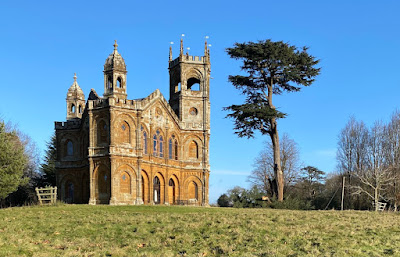
Another large building in the garden is the Gothic Temple, designed by James Gibbs and part of a campaign of building and gardening that took place at Stowe in 1739–42. Unlike the Temple of British Worthies, the Gothic Temple’s connection to Whig values is less obvious. It’s easy to see it as an exception (most of the architecture in the garden is classical) and interesting as a piece of self-conscious Gothic on a large scale that predates Horace Walpole’s house Strawberry Hill, so often cited as the structure that kick-started Britain’s Gothic revival.
But from Cobham’s point of view, the Gothic Temple could be seen as symbolising virtues that Whigs valued highly. For him, Gothic meant vigour, hardihood, and a love of liberty, and was valuable as a style with north-European roots, standing at a remove from the ‘southern langour’ symbolised (allegedly) by, say, baroque buildings. It is, from this standpoint, thoroughly Whiggish.* And the building is certainly there to stand out, catch the eye, and stimulate thought and conversation. It’s huge, it’s unusually triangular in plan†, it occupies a prominent, elevated site, and is the only one of Stowe’s structures to be built of glowing orange ironstone. One might ask, seeing it for the first time, ‘Whatever is that?’¶ I’ve tried to suggest the sort of answer its creator might have given to this question.
- - - - -
* Although of course looking at it another way, none of these virtues belong exclusively, or even at all, to Gothic any more than they do to other artistic styles. I am simply trying to describe what Cobham and his Whig friends found in the style.
† Had Cobham or Gibbs got Sir Thomas Tresham’s earlier Triangular Lodge in Northamptonshire in mind?
¶ Nowadays it is also a holiday home, restored and managed by the Landmark Trust.
Monday, October 18, 2021
Bridport, Dorset
Bridport’s Unitarian chapel was built in the 1790s after a group split from an existing independent congregation in 1742. The then minister, Thomas Collins, refused to affirm the divinity of Christ, leading some 200 people to leave and set up their own congregational chapel elsewhere in the town. Those who remained continued under Collins’ ministry, and in 1974 they agreed to build a new chapel, then called the New Meeting, the building that survives today.
The building is a standard 18th-century chapel, with symmetrical front, round-headed windows, hipped roof, and central porch, the latter given a touch of elegance by its semi-circular shape and Ionic columns. But the most distinctive thing about it today is its position, set back from the street and fronted with greenery and flowers. It’s hard to imagine a better setting for a chapel in the middle of a town. The congregation invites passers-by to sit and enjoy the green space, where they can find rest, relaxation, and, perhaps encouraged by the gentle cooing of the doves, spiritual enrichment.
The doves have their own miniature building, which can be seen on the left in my photograph. It’s ornate, octagonal, and painted the same white as the bricks of the chapel’s facade. The occupants perched obligingly and eyed me as, taking welcome relief from Bridport’s busy main street, stopped to take the photograph. Christians have long used the dove as a symbol of the Holy Spirit. Unitarianism rejects the Trinitarian notion of the deity, so have no place for that symbol. However, doves have long been linked with peace and purity, and few, in this tranquil setting, would take issue with that.
Sunday, February 28, 2021
Badsey, Worcestershire
I’ve always been vaguely aware that the Vale of Evesham had more than its fair share of those marginal buildings that people categorise as sheds, shacks and huts, buildings that are small, often made by their owners, and constructed of a cheap, easy to work material such as wood or corrugated iron. I first thought of this kind of building looking at roadside shacks and stalls from which fruit and vegetables were sold in season. The Vale of Evesham was one of England’s foremost market-gardening areas and driving out there in summer, one would often see makeshift signs advertising strawberries, plums, or ‘fresh local grass’ – this being West of England shorthand for asparagus. Much fruit and many veg are still grown in the Vale, but the advent of ‘pick your own’, the disappearance of many small farms and smallholdings, and the growth of supermarkets have made these stalls less common than they were. They’re still there though and still a good place to buy whatever it is that’s ripening.
But there’s another building type, similarly modest, home-made, and unsung: the hovel. A hovel (or ‘ovel’ in the traditional parlance) was a shed that a market gardener would build on his land, where they could store produce, keep tools and other equipment – from canes and stakes to sacks – that was needed from time to time, and shelter if the weather turned bad. Hovels were small, but a bit bigger than many garden sheds. Growers were often tenants, but would build such a structure on the land they rented because of a tradition that allowed one to the right to claim compensation for improvements made to the land while you were cultivating it.
Growers needed a shed or hovel because they usually lived in a village some way away from their land. So they needed storage and somewhere to sit down for a rest and a packed lunch. These days, when every small farmer has a car or a van or both, hovels are less useful, and many have been left to rot and rust away. But a few survive like this one in Badsey. It was always a rather superior example, being built in part of durable brick, but with an addition in corrugated iron and another add-on that I think is mainly wooden. A few buildings like this are being restored, preserved, and used to show people something of the history of this important local agriculture. Eritage ovels? A little self-conscious perhaps, but if it helps impart some historical awareness, by no means a totally bad thing.
Saturday, January 23, 2021
Sticklepath, Devon
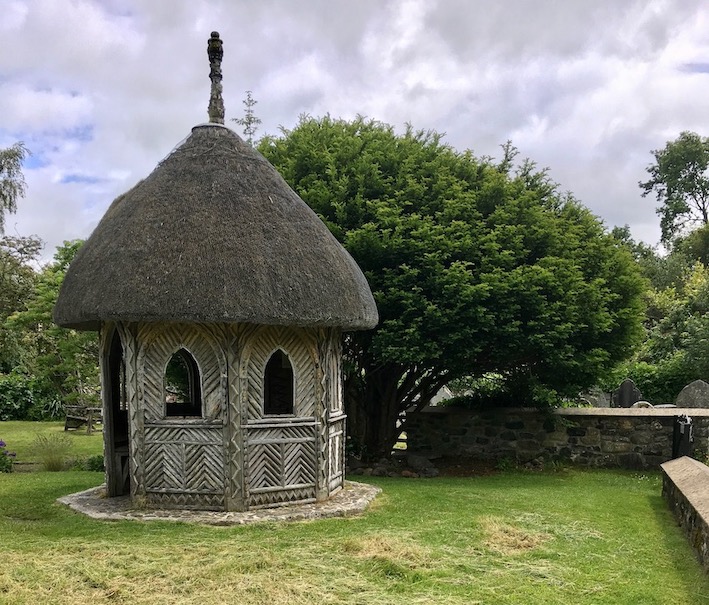
Here’s just the sort of thing for a mid-19th century garden-owner to relax in after a few hard hours digging or weeding. It’s a thatched wooden summerhouse designed in a sort of picturesque rustic Gothic.† Based on a tough wooden framework filled in with boards, the decorative effect has been enhanced by adding further narrow strips of wood arranged in patterns of diagonals and chevrons. Round the pointed Gothic windows these patterns go, and across the panels below them, and up the posts as well, to produce something much more striking that the off-the-peg tongue-and-groove board that wooden garden buildings usually have to show for themselves today. The thatched roof tops the design, suggesting the charming octagonal thatched cottages and gate lodges so popular at in the late-18th and early-19th centuries as the influence of the Picturesque movement spread across the country. It must have looked at home at a time when stumperies* were fashionable (the late-1850s onwards) but would work in a modern garden too.
Who created this modest extravaganza? So often, with small buildings like this, we simply don’t don’t know. But in this case we do, thanks to a helpful notice inside. The summerhouse was built by Thomas Pearse, serge-maker of Sticklepath, for his garden, where it remained for about a century. In 1974, a member of the Pearse family, Mrs C. N. Jeavons, presented it to the Finch Foundry, and it was moved to its present location between the foundry buildings and the Quaker burial ground. Pearse, a local worthy from a nonconformist background, bought the burial ground for the village when its Quaker owners wanted to sell it, and set up a trust to run it. It became non-denominational and Pearse himself is buried there. How fitting, though, that this public-spirited man should have this additional memorial, a useable and attractive shelter that marks a bit of village history – and also exemplifies a stage in the history of architecture and design.
- - - - -
† I posted about a similar summerhouse, glimpsed over a garden wall, here.
*A stumpery was an ornamental garden feature rather like a rockery, but with chunks of tree stump, root, and other pieces of wood instead of rocks. The first recorded stumpery was installed in the garden at Biddulph Grange, Staffordshire, in 1856.
Saturday, December 5, 2020
Cirencester, Gloucestershire
Framed by trees
Cirencester Park is one of the most remarkable ornamental landscapes in England. It’s one of the few surviving large-scale 18th-century parks laid out before the fashion for the less formal landscape garden developed with such success by Lancelot ‘Capability’ Brown. At Cirencester, a large tract of countryside was transformed by Lord Bathurst. Essentially it is a wooded landscape into which a series of avenues has been cut. The longest of these avenues stretches some five miles, from the park gates in the town to a distant vanishing point. This broad grassy ride is one avenue of many, some of which are much narrower. They are arranged at different angles and intersect with others at clearings, and at strategic places Bathurst placed monuments and buildings, to provide visual focal points and in some cases to enable walkers to take shelter, or to pause and rest.
My photograph shows one such building, the Hexagon, a six-sided stone shelter. Visual interest is provided by the way the design emphasises the stones that surround each of the six arches. Not only do these stones stand slightly proud of the rest of the structure, they’re also pitted and roughened in a treatment known as vermiculation, a word meant to suggest that the surface resembles something that has been eaten away by worms. The plain roof topped with a ball finial is effective enough, but Bathurst at one point intended to make the little building still more striking with a cupola. My use of the phrase ‘Bathurst intended’ was deliberate – the earl was the designer of this building, dabbling in architecture to some purpose, like numerous nobles ands gentlemen of the day.
For many, the main joy of Cirencester Park is the opportunity it gives to walk through stretches of landscape, admiring the mature trees and enjoying the chutzpah of landowners like Bathurst who created what were in effect vast works of land art using the medium of woodland and greensward. The earl’s penchant for classical pavilions, statue-bearing columns, and faux-medieval fortifications is an added bonus. To which one can add gratitude to the current earl, who opens the park throughout the year, so that anyone can walk there, without charge, in return for the observance of a few sensible rules. It’s a gesture worthy of his extravagant 18th-century predecessor.
Thursday, February 20, 2020
Rousham, Oxfordshire
After my recent dovecote post, I remembered one more dovecote that couldn’t resist sharing with my readers. This is the one close to the great house at Rousham. The little building, tucked away in a walled garden, is unregarded in a place that’s full of interesting architecture: Rousham’s gardens have few rivals in this respect, and because they’re not vast and always open, the impressive array of garden buildings and sculpture is not difficult to see. This dovecote is in marked contrast to the small-scale but grand classicism and gothicism of the garden structures. It’s a country building in the vernacular tradition, with local stone walls and a stone-tiled roof. ‘Dovecote of 1685, with a conical roof with hipped dormers’ is about all Pevsner feels the need to say about it.
But look at the lovely louvre* at the top, with its lead-covered ogee top (mirroring a similar ogee cupola on the nearby stable block), and its neat wooden bars, with wider spaces at the bottom to let the birds in and out. I don’t think there are birds living in it now, but this culminating louvre (being wooden it’s presumably a modern replacement) seems to me a perfect finishing touch. Its artful design seems typical of the place: whenever I’ve visited, Rousham has given me the impression of a place that’s well cared for by the family who own it – and who’ve lived there since the house was built in 1635, fifty years before this charming structure was first erected across the walled garden next to their house.
- - - - -
* Louvre is the accepted term for the a turret- or lantern-like structure at the top of a roof, open in some way to let out smoke from a hearth or to admit the inhabitants of a dovecote.
Tuesday, March 27, 2018
Rousham, Oxfordshire
The foolish and the wise
The use of the word ‘folly’ in my previous post set some readers scratching their heads. What is a folly, exactly? That’s a good question, and one that has had many people stumped. A folly is a building without a practical purpose, some say. But what do we call a practical purpose? A house has a practical purpose, so does a mill, so does a garden shelter that protects people from a sudden shower of rain. But can an ornamental arch have a practical purpose – if it can also be a shelter, for example? And is a purely ornamental role enough for us to pigeonhole it as a folly? If the word ‘folly’ implies foolishness of some sort, we’re on difficult ground straight away: ‘where is the line drawn between foolishness and good sense?’ asks Stuart Barton.* Where indeed?
In what is perhaps the best book on follies, Gwyn Headley and Wim Meulenkamp look at it another way. ‘A folly is a misunderstood building,’ they say.† Why would anyone build a tower on a hill, or construct a concrete zoo in their garden, or spend a lifetime tunnelling under Liverpool? The people who did these things had their reasons, but we may very well not know what those reasons were. We have lost touch with the purpose of the building, which may have been practical, or may have seemed so to its creator. So we simplify matters by calling the results ‘follies’.
The writer and illustrator Barbara Jones, in another very good book on the subject, admits that defining a folly is tricky, and offers instead a list of qualities that such buildings often share.§ Follies are produced by people who have money, security and peace; they are most often Gothic (or Gothick) in style; they have much to do with their creator’s mood and emotions; they are fragile; they are very personal; they rely a lot on their setting; the relate to the Romantic movement in literature and painting; their great age was the 18th and 19th centuries. In bringing together these various qualities, Barbara Jones doesn’t get us any closer to a definition, but she at least evokes the mood of many of these structures – and that is a step towards understanding them, at least.
Some 18th-century gardens, like the one at Rousham in Oxfordshire, are full of what people have called follies. A number of these are actually very useful buildings that have a bit of extra adornment added on to them. In my photograph above, the building in the middle distance falls into this category.¶ It is known as the Temple of the Mill, and it is a mill with a fancy ornamental Gothic bit (quatrefoil window, pinnacles, flying buttresses) built on one end. Nowadays it seems to be used as a house. But it also serves as a picturesque feature in the landscape. It’s both useful and amusing.
In the far distance, on the hillside in front of the trees, is the Rousham Eye-catcher. It simply consists of a wall with three arches in it. It is designed to look like part of a ruined building of some kind, and acts as a focus for the viewer’s gaze when admiring the scenery from Rousham’s enchanting garden. It might also offer a little shelter from a stiff breeze, but its principal function is to enhance the view, to give people something to look at, just like Scheemakers’ striking, indeed somewhat disturbing, sculpture in the foreground, which shows a lion attacking a horse.
That’s purpose enough for me, and enough to make me doubt that the term ‘folly’ is really very helpful at all.**
- - - - - -
* Stuart Barton, Monumental Follies, Lyle Publications, 1972
† Gwyn Headley and Wim Meulenkamp, Follies, Grottoes and Garden Buildings, Aurum Press, 1986, reprinted1999
§ Barbara Jones, Follies and Grottoes, Constable & Co, 1953, reprinted with revisions 1973
¶ It may be clearer if you click on the photograph to enlarge it.
** Thanks however, to those who raised the question and sent me off to do some interesting reading and rereading.
Thursday, July 11, 2013
Shugborough, Staffordshire
'Get a cat' again
In a post a couple of years ago I recalled the lovely story in Patrick Leigh Fermor's Mani: Travels in the Southern Peloponnese about a Greek ship's captain whose boat was troubled with rats. The captain called in a priest, who duly carried out the rituals for casting out vermin – chants, incense, holy water, the lot. As the clergyman prepared to take his fee and depart, he assured the seaman that he would have no trouble now: the rites always worked. 'One more thing,' the priest added. 'Get a cat.' And Paddy remarks: 'Since then the phrase "getting a cat" means, in maritime circles, making surety doubly sure.'
My original post on this theme was about a church in Gloucestershire that got a cat and memorialized the creature in the churchyard. Now here is another of the remarkable garden structures at Shugborough, a monument to what may have been a genuine maritime feline. According to one account of the monument, this is a memorial to a family pet. But another story says that it commemorates the cat that accompanied Admiral George Anson on his ship the Centurion in 1740–44, when Anson undertook an expedition to the Pacific with the aim of seizing a Spanish treasure ship.
Anson's expedition was so poorly planned that one wouldn't have given it a chance. There were eight ships and the motley crew of 1,000 included 259 Chelsea pensioners (average age just under 70) and 210 untrained recruits. Ill winds and navigational errors played havoc with the expedition. At one point they mistook a fleet of Spanish warships for cargo vessels and had to make a hasty retreat. Disease killed hundreds of the men, supplies ran low, and at least one ill-repaired vessel simply broke up. Anson and his remaining 200 men pushed on, finally found a (heavily armed) Spanish galleon, attacked it, and relieved it of its cargo of treasure. Limping into the Chinese port of Canton, for a rest presumably, they found the place on fire and had to lend a hand putting out the flames. They eventually sailed home and Anson's share of the treasure helped rebuild Shugborough.
By the time he got home, Anson had circumnavigated the globe. I like to think that the cat did too, and that it is remembered with this imposing monument of the late 1740s, in its tranquil glade, surrounded by shrubs and a sea of green grass.
Sunday, March 10, 2013
Cirencester, Gloucestershire
Pope's seat
Allen, 1st Earl Bathurst (1684–1775) was part of the circle at the heart of English high culture in the 18th century. He was a friend of the poet Alexander Pope, and the fact that one of Pope's celebrated poems is the Epistle to Bathurst has ensured him a place in the history of poetry. One thing that helped cement the friendship of Pope and Bathurst was an interest in gardening and the layout of country parks.
Next to his house in Cirencester, Bathurst laid out a remarkable park – the first park in which long straight rides extend through trees, crossing at rond points like the directional lines engraved on old maps and charts. The whole thing goes on for miles, with the ranks of mature trees stretching into the distance and the rides leading to distant vistas – the central ride aligns perfectly with the tall medieval tower of Cirencester parish church.
The current Earl Bathurst keeps this extraordinary place open to the public, so that walkers and horse riders can enjoy the landscape. Dotted here and there are interesting structures – a lodge with a round tower, a monument to Queen Anne with the monarch's statue atop a tall column, a hexagonal pavilion, and this tiny classical building, Pope's seat.
Pope's seat is at first glance a fairly standard bit of Georgian classicism with pediment, niches, and urns. But just as Pope's poetry, apparently so demure in its couplets, can leave seemliness and predictability far behind, so this little building bucks the trend somewhat. Those rusticated stones breaking into the bottom of the pediment; the irregular urns; the rather jazzy banded masonry all make this building stand out. It was just the thing to give shelter to a poet who wanted to rest and admire the view. Just the thing for us too.
Saturday, July 21, 2012
Rousham, Oxfordshire
A house and its garden
I first saw Rousham when I was a teenager, and I can remember being somehow surprised by the house. There seemed to be something hard and uncompromising about it, and I wasn't quite sure why I reacted in this way. Looking again at Rousham's 17th-century south front the other day, I think I was reacting not to the stone walls, the pale colour of which warms up beautifully in the sun, but to the windows. What I didn't know back then was that these were originally glazed with small octagonal panes, which were replaced with much larger sheets of plate glass during a 19th-century restoration project. Rousham is a house dating from the 1630s and, apart from the plate-glass windows, one other alteration is visible in my photograph of the south front. About 100 years after the house was built, William Kent was employed to redesign the gardens. Kent also made some changes to the house, including adding the crenellations that top the walls – if you look closely at the picture you can see a slight change in the colour of the stonework towards the top.
So today the front of the house reveals a 17th-century building that has changed with the times, and which still looks impressive in its green frame of trees. And at Rousham, the trees are very much the point. This place is rightly famous for William Kent's work in its garden, an arcadian landscape of conifers and hardwoods, paths and glades by the River Cherwell, punctuated by temples, a grotto, classical statues, cascades, and streams. I've posted about this remarkable garden before. It is one of the best places in Britain to go to savour the atmosphere and architecture of the Georgian landscape garden. From the Venus Vale to the serpentine rill, from statues of Bacchus to the Dying Gaul, it is an enchanting garden, all set against a background of varied greens, displaying real a lightness of touch. Curving paths and distant vistas lead the visitor through a series of spaces, and often, as one contemplates a temple or a statue, there is the sudden realization that, in a gap between trees, another view is beckoning. In Arcadia indeed.
Rousham: behind the statue a triangle of light leads the eye towards another glade.
Thursday, December 16, 2010
Croome, Worcestershire

Winter blooms
Croome is historically important because it is the first major work of the great landscape gardener and architect Lancelot Brown, known as ‘Capability’ Brown because of his habit of assuring prospective clients that their grounds had great ‘capabilities’ for improvement. At Croome, Brown designed both the house and the park, although his work was supplemented in the house by Robert Adam, who worked on the interior, and James Wyatt, who designed some of the ‘eyecatchers’ around the edges of the park.
The park itself, created for the 6th earl of Coventry from 1747, was designed to feature a river, imitating the nearby Severn, and a large curvaceous lake with an island. Stately trees punctuate the views, as do a fascinating selection of garden buildings, including a grotto, guarded by a Coade stone statue of Sabrina, goddess of the Severn. Some of the buildings were designed by Brown, some by Adam, and James Wyatt added several of the more distant eyecatchers, including a ruined ‘castle’ that I included in an earlier post.
I was planning to do a post about Brown’s grotto at Croome, but on the frosty afternoon I walked around the park the other day the statue of Sabrina was swathed in wrapping, put to sleep as it were for the winter under a protective puffy green duvet, as were the other statues and urns dotted about the park. So instead, here’s a building called the Temple Greenhouse, which was designed by Adam.
Today it looks more like a temple than a greenhouse, because the windows that were once fitted between the columns have been removed. So it can no longer contain exotic plants, but still makes a noble feature in Croome’s landscape. Adam included symbolic sculptures to complement the vegetation that once filled the greenhouse: overflowing cornucopias and this brimming basket of flowers. These vigorous reliefs are full of life, with a variety of blooms turned this way and that, and leaves twisting, as it were, in the breeze. They bring a welcome bit of summer to the frosty winter landscape.

* * *
Croome Park is owned by the National Trust, and there are some stunning photographs of it here. The house, Croome Court, is owned by the Croome Heritage Trust, and is leased to the National Trust, which is managing its restoration.
Sunday, June 6, 2010
Rousham, Oxfordshire

English Elysium
Rousham House, built in the 1630s and altered by William Kent in the mid-18th century, is set in a 25-acre garden that is one of the most enchanting in England. Close to the house are formal walled gardens that evoke the Stuart period when the house was first built, but beyond these, a remarkable landscape garden extends towards the countryside, a series of spaces at once very English and very Classical that is the work of Kent at his best.
Vistas open out towards the countryside, an arched ‘ruin’ forming a focal point on a distant hill. Paths lead from lawns down slopes and into woods, where there is a surprise around every corner. One’s route curves past statues of Roman gods and dying gladiators. Glades appear, with more statues and grottoes. Water trickles through rills or into pools. Temples and classical gazeboes cling to slopes or are framed by trees or laurels.
The imagery is from ancient Rome. A statue of a lion mauling a horse and another of a dying Gaulish gladiator evoke the ‘games’ of the arena. Venus presides over her own fertile watery vale (above). An imposing six-arched building is called the Praeneste, after a temple site outside Rome. All this links 18th-century Britain with the glory of the Roman empire – and with its gods, since in one version of the British origin myth, Britons are descended from the Roman hero Aeneas, who is in turn a son of Venus.
But for all this weight of meaning, Kent arranged this garden with a gentle touch. One’s impression on walking around it, poking about in its corners, and enjoying a picnic on its lawn, is of a beautifully arranged series of delightful spaces – spaces, moreover, that are very well cared for. Rousham has been in the same family since the house was built in the 1630s. We’re lucky that they’ve looked after their inheritance so well.
Dying Gaul, detail