Showing posts with label temple. Show all posts

Thursday, July 6, 2023

Stourhead, Wiltshire

The great indoors, 2

The other day I did a Google image search of ’Stourhead’ and eight of the first ten pictures it produced featured the Pantheon, the garden’s great domed and porticoed temple. For many, the Pantheon is the climax of the garden, a visual focus whether viewed from near or far; seen across the lake from the end of the garden nearest the house, it is a goal for anyone about to walk around Stourhead’s glorious landscape.

‘Pantheon’ means a temple dedicated to all the gods, not just one deity as was the norm in the classical world. The Stourhead version is modelled loosely on the much larger Pantheon in Rome, one of the best preserved of all Roman buildings. The Roman Pantheon has a large dome and a portico with eight massive Corinthian columns. Stourhead’s version is smaller and its portico has six columns and unlikle the Roman prototype does not stretch right across the front of the building. This leaves room for a large niche at either end of the facade, containing a statue of a deity, Bacchus, god of wine, on one side, Venus, goddess of love, on the other. To be more precise, the love goddess appears in the form known as Venus Callipygos, Venus of the beautiful buttocks. Apart from her physical appeal, Venus is probably here because she was the mother of Virgil’s hero Aeneas – when laying out the garden, Henry Hoare made several allusions to Virgil’s epic, The Aeneid, although the scholarship in this case was in part an excuse for the male gaze to linger over an image female beauty.

For many, the point of the Pantheon is what it looks like from the outside and how it enhances its garden context. But of course the building also has an interior and a use – the family held supper parties there and used it as the setting for picnics. These forays away from the dining room in the house took place in a stunning interior. Beneath the coffered ceiling of the dome are panels of classical scenes in relief, but the walls of the circular building are dominated by a series of seven large niches containing statues of deities. The most famous is a Hercules by Michael Rysbrack but for a change I show his statue of Diana, goddess of the hunt. The others are: Livia Augusta, a Roman empress (she was Virgil’s patron and her statue at Stourhead is an ancient one, acquired by Hoare from another collector); the ancient Greek hero Meleager; Flora, goddess of fertility, flowers, and gardens; Isis, the Egyptian mother goddess (also worshipped by the Romans); and St Susanna (a saint connected to the city of Rome). Livia is an ancient Roman statue, acquired by Hoare from another collector. They seem a miscellaneous collection, but several have garden or country connections, a couple are heroes like Aeneas, and Livia has a close link to Virgil; they also, in different ways, reflect Hoare’s interest in collecting and in commissioning art. Like so much at Stourhead, they also embody Hoare’s liking for a mix of scholarship and the pleasures of beauty, nature, food, and wine. I’ll drink to that.

Monday, January 10, 2022

Stowe, Buckinghamshire


Buildings in a landscape, 3

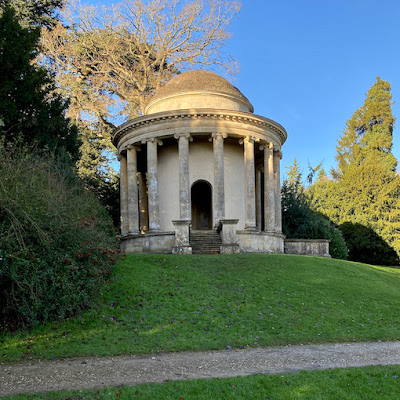
Set on a rise, looking across Stowe’s Elysian Fields towards the Temple of British Worthies (see previous post), the Temple of Ancient Virtue is circular, domed, and surrounded by 16 Ionic columns. By making the temple round, William Kent chose one of the purest, most symbolically perfect architectural forms to house a shrine to four exemplary ancient Greeks: the general Epaminondas, the law-maker Lycurgus, the philosopher Socrates, and the epic poet Homer. Viscount Cobham, owner of the house and garden when Kent was doing some of his most notable work there, chose Greeks, not ancient Romans, for his ancient heroes, because he and his Whig friends were suspicious of the ruthless empire-building Romans (who after all conquered Britain), preferring the Greeks, who invented democracy and stood high for them as founders of western civilisation.

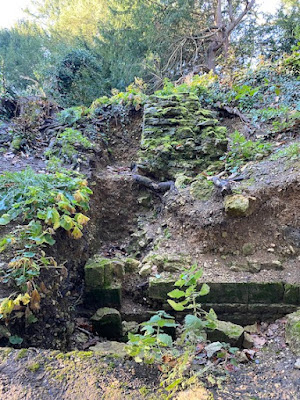
Peter Scheemakers was commissioned to create full-length statues of these great Greeks, but the originals were sold off in 1921 when the owners fell on hard times, and today the temple contains plaster replicas. This itself might be seen to symbolise the decline of the ancient virtues in the modern era, but by the 1730s, Cobham had already thought of this. Near to this temple he also commissioned a Temple of Modern Virtue. This was conceived from the beginning as a ruin and has since decayed so badly that there are only a few traces left, walls poking out of the soil here and there and promising more evidence of what once was hidden beneath the accreted earth. How pleasing that so much else in this remarkable garden has fared better, or has been sensitively restored thanks to the various efforts of Stowe School, the Stowe House Preservation Trust, and the National Trust.

Stowe: the remains of the Temple of Modern Virtue

Monday, January 3, 2022

Stowe, Buckinghamshire


Buildings in a landscape, 2

The many buildings and monuments in the landscape garden at Stowe are beautifully positioned, to catch the eye, to form the climaxes of vistas, or simply to enhance the landscape features around them. One of the most effectively placed of all is the Temple of British Worthies, the exedra or semi-circular structure designed by William Kent to display a series of busts of figures who were among the heroes of the garden’s owner, Richard Temple, Viscount Cobham. Sited in the part of the garden known as the Elysian Fields, the building is positioned close to a stretch of water that is actually a narrow lake but is called the River Styx. The water catches its reflection and draws the viewer to cross a nearby bridge and take a closer look.

The inhabitants of this English Elysium are portrayed in sixteen busts (eight by John Michael Rysbrack, eight by Peter Scheemakers) and represent the Whig philosophy that Cobham himself espoused (see previous post). Each bust is accompanied by a text rather like a citation for a Nobel prize that explains the virtues of the particular worthy, in each case bringing out the particular qualities or ideas of the individual that bear most on the values that Cobham espoused – love of liberty, the primacy of human reason, opposition to Roman Catholicism, and so on. Thus John Hampden opposed ‘an arbitrary Court, in Defence of the Liberties of the Country’; Queen Elizabeth I ‘destroy’d the Power that threaten’d to oppress the Liberties of Europe’; William III ‘preserv’d the Liberty and Religion of Great Britain’; King Alfred ‘crush’d Corruption’, and so on. Other worthies, such as Isaac Newton, William Shakespeare, and Alexander Pope and praised in more general terms for their understanding of nature and humankind.

All this is very specific – it doesn’t take one long, equipped with a transcript of the texts (the original inscriptions are rather worn) to work out the ideas behind this curious pantheon in which the Black Prince and Cobham’s contemporary Sir John Barnard are neighbours to Locke and Newton. However there’s a curious and very British twist to all this. Resting in the heart of the temple, beneath the pyramidal roof of the centrepiece, are the remains of one Signor Fido, a much mourned companion of Cobham, who ‘neither learnt not flatter’d any Vice’ and who ‘doubted none of the 39 Articles’. This very British worthy was not a man but a greyhound.

Such changes of perspective might make us smile, but they remind us too that there are more ways than one of appreciating such a monument. This in turn should also encourage us to take a step back from all the seriousness and actually look at the building, and remember what drew us to it in the first place. Set in its landscape, on a bright winter's day, it simply looks really good.


Saturday, July 21, 2012

Rousham, Oxfordshire


A house and its garden

I first saw Rousham when I was a teenager, and I can remember being somehow surprised by the house. There seemed to be something hard and uncompromising about it, and I wasn't quite sure why I reacted in this way. Looking again at Rousham's 17th-century south front the other day, I think I was reacting not to the stone walls, the pale colour of which warms up beautifully in the sun, but to the windows. What I didn't know back then was that these were originally glazed with small octagonal panes, which were replaced with much larger sheets of plate glass during a 19th-century restoration project. Rousham is a house dating from the 1630s and, apart from the plate-glass windows, one other alteration is visible in my photograph of the south front. About 100 years after the house was built, William Kent was employed to redesign the gardens. Kent also made some changes to the house, including adding the crenellations that top the walls – if you look closely at the picture you can see a slight change in the colour of the stonework towards the top.

So today the front of the house reveals a 17th-century building that has changed with the times, and which still looks impressive in its green frame of trees. And at Rousham, the trees are very much the point. This place is rightly famous for William Kent's work in its garden, an arcadian landscape of conifers and hardwoods, paths and glades by the River Cherwell, punctuated by temples, a grotto, classical statues, cascades, and streams. I've posted about this remarkable garden before. It is one of the best places in Britain to go to savour the atmosphere and architecture of the Georgian landscape garden. From the Venus Vale to the serpentine rill, from statues of Bacchus to the Dying Gaul, it is an enchanting garden, all set against a background of varied greens, displaying real a lightness of touch. Curving paths and distant vistas lead the visitor through a series of spaces, and often, as one contemplates a temple or a statue, there is the sudden realization that, in a gap between trees, another view is beckoning. In Arcadia indeed.

Rousham: behind the statue a triangle of light leads the eye towards another glade.