Showing posts with label landscape garden. Show all posts

Thursday, July 6, 2023

Stourhead, Wiltshire

The great indoors, 2

The other day I did a Google image search of ’Stourhead’ and eight of the first ten pictures it produced featured the Pantheon, the garden’s great domed and porticoed temple. For many, the Pantheon is the climax of the garden, a visual focus whether viewed from near or far; seen across the lake from the end of the garden nearest the house, it is a goal for anyone about to walk around Stourhead’s glorious landscape.

‘Pantheon’ means a temple dedicated to all the gods, not just one deity as was the norm in the classical world. The Stourhead version is modelled loosely on the much larger Pantheon in Rome, one of the best preserved of all Roman buildings. The Roman Pantheon has a large dome and a portico with eight massive Corinthian columns. Stourhead’s version is smaller and its portico has six columns and unlikle the Roman prototype does not stretch right across the front of the building. This leaves room for a large niche at either end of the facade, containing a statue of a deity, Bacchus, god of wine, on one side, Venus, goddess of love, on the other. To be more precise, the love goddess appears in the form known as Venus Callipygos, Venus of the beautiful buttocks. Apart from her physical appeal, Venus is probably here because she was the mother of Virgil’s hero Aeneas – when laying out the garden, Henry Hoare made several allusions to Virgil’s epic, The Aeneid, although the scholarship in this case was in part an excuse for the male gaze to linger over an image female beauty.

For many, the point of the Pantheon is what it looks like from the outside and how it enhances its garden context. But of course the building also has an interior and a use – the family held supper parties there and used it as the setting for picnics. These forays away from the dining room in the house took place in a stunning interior. Beneath the coffered ceiling of the dome are panels of classical scenes in relief, but the walls of the circular building are dominated by a series of seven large niches containing statues of deities. The most famous is a Hercules by Michael Rysbrack but for a change I show his statue of Diana, goddess of the hunt. The others are: Livia Augusta, a Roman empress (she was Virgil’s patron and her statue at Stourhead is an ancient one, acquired by Hoare from another collector); the ancient Greek hero Meleager; Flora, goddess of fertility, flowers, and gardens; Isis, the Egyptian mother goddess (also worshipped by the Romans); and St Susanna (a saint connected to the city of Rome). Livia is an ancient Roman statue, acquired by Hoare from another collector. They seem a miscellaneous collection, but several have garden or country connections, a couple are heroes like Aeneas, and Livia has a close link to Virgil; they also, in different ways, reflect Hoare’s interest in collecting and in commissioning art. Like so much at Stourhead, they also embody Hoare’s liking for a mix of scholarship and the pleasures of beauty, nature, food, and wine. I’ll drink to that.

Saturday, July 1, 2023

Stourhead, Wiltshire


The great indoors

I’ve visited several gardens this summer. Lest anyone think this represents time off from historic architecture, my recent posts about Painswick and Warwick will be proof of the opposite – gardening, from Renaissance Italy to Victorian England, is also a chance to build more not less and gazebos, summerhouses, temples and sheds abound. So garden visiting is not all about the great outdoors; the great indoors has its role to play too. In England, garden buildings might be ornamental but are also practical – they provide shelter from the wind and rain; in warmer climes (how quaint that phrase seems now), they also provide welcome shade and cool.

One kind of structure that afforded a retreat from hot weather in Italian Renaissance gardens was the grotto. A subterranean, cave-like grotto, with water trickling through, is just the thing on a baking hot day. When Henry Hoare, cultured banker and owner of Stourhead, laid out his famous landscape garden, he was particularly pleased with his grotto, and was not above taking a dip in its pool: ‘A souse in that delicious bath and grot, filld with fresh magic’ pleased him greatly. He called it an ‘Asiatick luxury, and too much for mortals, or at least for subjects’ – after a session in the grotto, Henry Hoare felt like a king.

Stourhead’s grotto is also an example of the way in which visiting a landscape garden can be a journey of discovery and surprise. We enter a dark passage, lined by rough-hewn stones – the atmosphere is of something dark and mysterious. But on our journey through we encounter, as well as the expected cool flowing water, two classical figures. One is the River God, who is probably meant to represent Tiber, the god of Rome’s river – ancient Rome being a key inspiration for the gardens at Stourhead. The god points us on our journey. The other figure is the nymph whose grotto this is. She reclines in a lighter space, lit by a skylight from above. This figure, recumbent by her pool, is probably meant to evoke the nymph and grotto in the Aeneid, where the Aeneas and Queen Dido of Carthage fall in love. An inscription from Virgil’s epic is from this part of the poem; translated, it reads: ‘within, fresh water and seats in the living rock, the home of the nymphs’. Another inscription, in the floor in front of the pool, imagines the words of the nymph: ‘Ah spare my slumbers, gently tread the cave And drink in silence or in silence lave’. This is not Virgil but a translation by Alexander Pope of a 15th-century poem. The lines remind us that this magical space, in which the statue and the cascading water are caught in light from above, was also seen as eminently practical. Drink, or bathe, or sit and take your ease…then continue on your journey…

Monday, January 10, 2022

Stowe, Buckinghamshire


Buildings in a landscape, 3

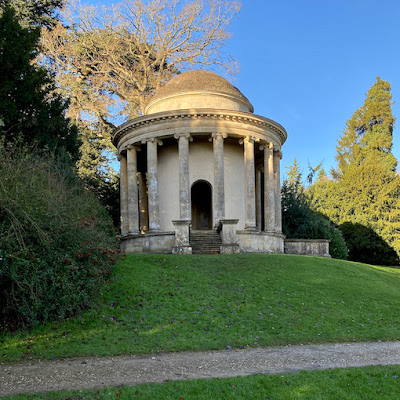
Set on a rise, looking across Stowe’s Elysian Fields towards the Temple of British Worthies (see previous post), the Temple of Ancient Virtue is circular, domed, and surrounded by 16 Ionic columns. By making the temple round, William Kent chose one of the purest, most symbolically perfect architectural forms to house a shrine to four exemplary ancient Greeks: the general Epaminondas, the law-maker Lycurgus, the philosopher Socrates, and the epic poet Homer. Viscount Cobham, owner of the house and garden when Kent was doing some of his most notable work there, chose Greeks, not ancient Romans, for his ancient heroes, because he and his Whig friends were suspicious of the ruthless empire-building Romans (who after all conquered Britain), preferring the Greeks, who invented democracy and stood high for them as founders of western civilisation.

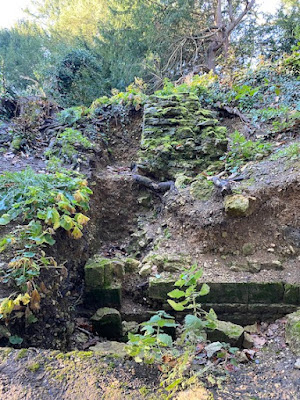
Peter Scheemakers was commissioned to create full-length statues of these great Greeks, but the originals were sold off in 1921 when the owners fell on hard times, and today the temple contains plaster replicas. This itself might be seen to symbolise the decline of the ancient virtues in the modern era, but by the 1730s, Cobham had already thought of this. Near to this temple he also commissioned a Temple of Modern Virtue. This was conceived from the beginning as a ruin and has since decayed so badly that there are only a few traces left, walls poking out of the soil here and there and promising more evidence of what once was hidden beneath the accreted earth. How pleasing that so much else in this remarkable garden has fared better, or has been sensitively restored thanks to the various efforts of Stowe School, the Stowe House Preservation Trust, and the National Trust.

Stowe: the remains of the Temple of Modern Virtue

Monday, January 3, 2022

Stowe, Buckinghamshire


Buildings in a landscape, 2

The many buildings and monuments in the landscape garden at Stowe are beautifully positioned, to catch the eye, to form the climaxes of vistas, or simply to enhance the landscape features around them. One of the most effectively placed of all is the Temple of British Worthies, the exedra or semi-circular structure designed by William Kent to display a series of busts of figures who were among the heroes of the garden’s owner, Richard Temple, Viscount Cobham. Sited in the part of the garden known as the Elysian Fields, the building is positioned close to a stretch of water that is actually a narrow lake but is called the River Styx. The water catches its reflection and draws the viewer to cross a nearby bridge and take a closer look.

The inhabitants of this English Elysium are portrayed in sixteen busts (eight by John Michael Rysbrack, eight by Peter Scheemakers) and represent the Whig philosophy that Cobham himself espoused (see previous post). Each bust is accompanied by a text rather like a citation for a Nobel prize that explains the virtues of the particular worthy, in each case bringing out the particular qualities or ideas of the individual that bear most on the values that Cobham espoused – love of liberty, the primacy of human reason, opposition to Roman Catholicism, and so on. Thus John Hampden opposed ‘an arbitrary Court, in Defence of the Liberties of the Country’; Queen Elizabeth I ‘destroy’d the Power that threaten’d to oppress the Liberties of Europe’; William III ‘preserv’d the Liberty and Religion of Great Britain’; King Alfred ‘crush’d Corruption’, and so on. Other worthies, such as Isaac Newton, William Shakespeare, and Alexander Pope and praised in more general terms for their understanding of nature and humankind.

All this is very specific – it doesn’t take one long, equipped with a transcript of the texts (the original inscriptions are rather worn) to work out the ideas behind this curious pantheon in which the Black Prince and Cobham’s contemporary Sir John Barnard are neighbours to Locke and Newton. However there’s a curious and very British twist to all this. Resting in the heart of the temple, beneath the pyramidal roof of the centrepiece, are the remains of one Signor Fido, a much mourned companion of Cobham, who ‘neither learnt not flatter’d any Vice’ and who ‘doubted none of the 39 Articles’. This very British worthy was not a man but a greyhound.

Such changes of perspective might make us smile, but they remind us too that there are more ways than one of appreciating such a monument. This in turn should also encourage us to take a step back from all the seriousness and actually look at the building, and remember what drew us to it in the first place. Set in its landscape, on a bright winter's day, it simply looks really good.


Wednesday, December 29, 2021

Stowe, Buckinghamshire


Buildings in a landscape, 1

Stowe is one of the biggest and most magnificent of English landscape gardens. It’s a 400-acre masterpiece that bears the stamp of great 18th-century gardeners such as Lancelot ‘Capability’ Brown, who sculpted terrain using earth and water and trees to create scenery that was deemed to be more ‘natural-looking’ than the formal gardens that were fashionable in earlier ages. These landscapes were punctuated by dozens of buildings, statues and other monuments that formed focal points for vistas. And at Stowe, men of the calibre of William Kent, James Gibbs and Sir John Vanbrugh all contributed to the architecture.

This array of talent was at the service of the estate’s owners, the Temple family, and of these, Sir Richard Temple (1675–1749), who inherited Stowe in 1697 and was made 1st Viscount Cobham in 1718, was probably the most important. It was he, building on work done by his predecessors, marshalled the talent and provide the funds to create the gardens largely as we know them and to commission the buildings that are one of its major glories still. As is well known, Cobham chose and influenced the architecture to reflect his philosophical and political views, and these views were determinedly Whig, and drew on the ideas of the Enlightenment and of authors from Francis Bacon to Alexander Pope.

To be a Whig in the 18th century meant, so Cobham argued, supporting the British constitutional monarchy, opposing notions of absolute monarchy propounded by the Stuarts and their supporters, and standing up for political freedom and liberty. Cobham saw Whig virtues embodied in certain British heroes, some historical, some contemporary, some people of action, some contemplatives. Many of these qualities were, it was said, embodied in figures such as Elizabeth I, William Shakespeare, John Locke, and John Milton, whose busts are displayed in the Temple of British Worthies, one of the buildings at Stowe.

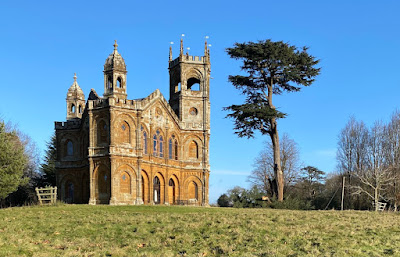
Another large building in the garden is the Gothic Temple, designed by James Gibbs and part of a campaign of building and gardening that took place at Stowe in 1739–42. Unlike the Temple of British Worthies, the Gothic Temple’s connection to Whig values is less obvious. It’s easy to see it as an exception (most of the architecture in the garden is classical) and interesting as a piece of self-conscious Gothic on a large scale that predates Horace Walpole’s house Strawberry Hill, so often cited as the structure that kick-started Britain’s Gothic revival.

But from Cobham’s point of view, the Gothic Temple could be seen as symbolising virtues that Whigs valued highly. For him, Gothic meant vigour, hardihood, and a love of liberty, and was valuable as a style with north-European roots, standing at a remove from the ‘southern langour’ symbolised (allegedly) by, say, baroque buildings. It is, from this standpoint, thoroughly Whiggish.* And the building is certainly there to stand out, catch the eye, and stimulate thought and conversation. It’s huge, it’s unusually triangular in plan†, it occupies a prominent, elevated site, and is the only one of Stowe’s structures to be built of glowing orange ironstone. One might ask, seeing it for the first time, ‘Whatever is that?’¶ I’ve tried to suggest the sort of answer its creator might have given to this question. 

- - - - -

* Although of course looking at it another way, none of these virtues belong exclusively, or even at all, to Gothic any more than they do to other artistic styles. I am simply trying to describe what Cobham and his Whig friends found in the style.

† Had Cobham or Gibbs got Sir Thomas Tresham’s earlier Triangular Lodge in Northamptonshire in mind?

¶ Nowadays it is also a holiday home, restored and managed by the Landmark Trust.