Oh, pioneers! or, Ten years a blog
At the Amara Awards ceremony* last year, one of the other bloggers I was talking to asked how long I’d been blogging. ‘Over nine years now,’ I replied. ‘Nine years?’ she said. ‘Then you’re a pioneer!’ And now, in July 2017, it’s ten years. Ten years, a thousand posts, hundreds of thousands of readers.
I didn’t feel quite like a pioneer when I started out. The Resident Wise Woman had just begun blogging about our parallel life in the
Czech Republic. There were quite a few other blogs around too, focusing on everything from politics to recipes, but not too many design or architectural blogs, and nothing doing quite what I wanted to do. The architecture blogs, for example, were most often about new architecture, and many blogs were just unadulterated opinion, much of it highly critical of whatever the blogger was writing about. I wanted to do something different – to be more appreciative, to cover historic architecture, to highlight buildings that were worth preserving, and to point out things that other people might not have noticed.
So, in a way, yes, I
was a pioneer. And in a particular sense, in that I deliberately didn’t model my blog on what other people were doing, just saw that a blog might be a way of writing short pieces about buildings that I liked and that struck me, short pieces that might entertain a few friends and help me to remember some of the things I’d seen.
Preserving
I am exercised, then, by the desire to preserve, to notice things that are fragile, and make a record of them – not necessarily before they fall down but before my memory of them fades. The poet Philip Larkin wrote memorably about how his main motivation for writing poems was to preserve transient experiences. There is something of that behind what I do. I’m not claiming any other sort of literary comparison with Larkin (for all that a generous friend has called some of my better posts ‘prose poems’), far from it. But I do recognise Larkin’s urge to preserve experiences. My blog posts themselves are preserved, archived for as long as Google is prepared to store them on its servers, and they can all be searched using the search box at the top of the screen, or accessed using the ‘blog archive’ links in the right-hand column.§
And, of course, I want to preserve historic architecture too. At least two architectural features noticed on the English Buildings blog (a striking civic heraldic
gate pier and a remarkable Victorian
shop sign) have disappeared since I posted about them; another, a piece of relief sculpture, has been carefully moved to save it from destruction. I’m also happy to dwell on memorable examples of preservation, such as the tiny
church at Inglesham in Wiltshire (hich only exists at all thanks to William Morris) or the extraordinary Oxfordshire village of
Great Tew (much of which was falling to pieces when I first saw it in the 1970s, but which is now thriving and beautiful).
Beginning
I’ve written before how I began blogging exactly two years after the July 2005 London bombings, which punched holes in several of London’s underground stations, destroyed a London bus, and killed 52 people, including a valued colleague. July 2007, the month I began blogging, was the month of the great
floods in my home county of Gloucestershire, which brought further danger and destruction. People often talk of society’s lucky ones ‘giving things back’ and in a way, this blog is like that, giving back appreciation in the wake of destruction. It’s also, I suppose, giving back in the sense that it’s writing for no payment by someone who makes his bread as an author.
So I began – in Tenbury Wells in Worcestershire, as it happens – writing down impressions of what I’d seen and posting them, together with a photograph or two (rarely more than one or two) for each post. I found that what interested me especially were buildings that weren’t ‘great architecture’. Not the big cathedrals and country houses that we mostly read about in architecture books, but the smaller buildings, or the unfashionable ones. Not the ‘good examples’ of architectural styles but the oddities and unclassifiable structures – privies, prefabs, sheds, shacks, small churches, architectural weirdos like Tenbury’s peculiar spa buildings (nineteenth century, prefabricated, and also wonderfully conserved in recent years) shown in the photograph above.
One thing I realised pretty quickly was that I’m not interested in architecture alone. Actually the adjuncts to architecture – carvings, painted signs, terracotta ornament, the crafts (from sculpture to stained-glass making) allied to architecture – these interest me as much as the architect’s work of creating spaces, ‘volumes’, plans, and elevations. And the settings of buildings and how they contribute to the character of a place and are part its history – Pope’s famous lines about consulting the genius of the place are often in my mind. I’m interested in all this, then, but not to the exclusion of architecture. I can get excited about a perfect Palladian facade, a medieval cathedral, or a great Picturesque landscape garden too. But I often try to find an unusual angle, an unregarded detail, or a different approach to such subjects when they appear on this blog. So you will find among my posts not only the beautiful dying gladiator (or dying Gaul) statue in the famous landscape garden at
Rousham, Oxfordshire, but also the sculpted sign of the
Dying Gladiator pub in Brigg, Lincolnshire: high art and low, nurturing one another and offering food for appreciation, to be enjoyed equally, as I enjoy both claret and beer.
Viewing
And so it has continued. Roughly two posts a week, on everything from palaces to plotlands, for ten years. As I have work and commitments outside this blog, my blogging has had to be concerned mostly with places that I visit as part of the rest of my life. That means mostly places south of a line from the Humber to the Mersey. I am sorry that the North has had short shrift, but that is how it has had to be if the blog is not to take over my life.
It’s my perspective, then, and the places about which I blog get seen through the sometimes distorting lens of my interests. In Bath I am as likely to admire an
Italianate villa or a
cast-iron pissoir as the Georgian terraces and crescents for which the place is famous; in Brighton I might seem to ignore the celebrated Pavilion while lavishing praise on, say, some post-war
relief carvings. There is more to say about this individual perspective and the surprises it can produce (an effect that I call ‘the shock of the view’), but for now, I’ll add simply that the web is full of images of the Royal Crescent and the Royal Pavilion; I can add to what’s there by concentrating on my more out-of-the-way interests.
Connecting
What I have done seems to interest many of my readers and give them pleasure. If you’re reading this, you’re part of a much larger bunch than the group of friends I wrote for at the beginning. I feel grateful, because it means a lot to me that people read what I write. I am nurtured by the connections I’ve made with readers and have been nourished beyond my dreams by the information I’ve received via the Comments button and through emails. Over the years I have been pleased to find out more from readers about
fin de siècle sculptors, round Norfolk church towers, the locations used in the television series
Foyle’s War, shifting county boundaries, and all kinds of buildings, from pubs to petrol stations. There is more to be said about this, too, but the main thing to say, for now, is ‘Thank you’ – to
all my readers, whether you have left feedback or not.¶
Persevering
When I began I had no idea how long I’d be able to carry on. Would I run out of steam after six months, a year, two years? Five years, at the most, seemed enough; I had no thought that the blog would continue as long as it has. For now, I resolve to persevere with it. I can’t promise I’ll continue at the rate I’ve done in the past.† But I hope, if there’s a running-down of energy, that I’ll slow down rather than stop. I’m not ready to toast the next ten years, but I’ll raise a glass (see my picture in the right-hand column) to, in the words of the great Alan Bennett, keeping on keeping on.
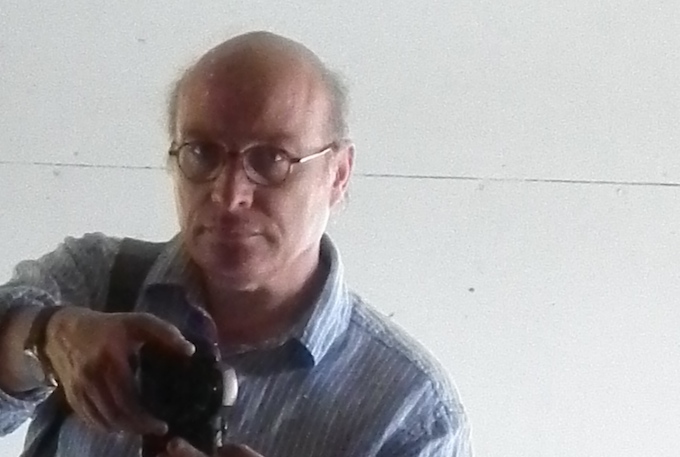
Reflecting: your author, reflected in one of the mirrors inside a showman’s living van at Avoncroft Museum
- - - - -
* I won the Amara Award for the best architecture blog twice, in 2015 and 2016. ‘Do they have term limits?’ asked a friend, thinking of the rules that forbid, say, a US President from serving more than two consecutive terms. Not as such, but Amara have decided to concentrate on their core interests, especially blogs covering interior design, so are not having an architecture award this year. I continue to wish them well, and remain grateful to the readers who nominated me and the judges who gave me the awards.
§ Another way of using the blog is via the links headed ‘About English Architecture’ in the right-hand column. These links take you to very short introductions to the architecture of England in different periods, and from these short texts there are links to some of my posts that act as examples of the kind of architecture of each period
.
¶ A word too of appreciation and gratitude to the friends who have started their own blogs in my wake. I have been particularly inspired, stimulated, amused, and educated by the blogs of three of my friends: Neil Philip’s blog
Adventures in the Print Trade (a treasure house of art appreciation and history); novelist
Joe Treasure’s reflections on literature and current events (with a transatlantic perspective that’s especially valuable in these interesting times); and Peter Ashley’s blog
Unmitigated England, his series of revealing sideways glances at ‘a country lost and a country found’. All these bloggers are published authors who also do other things (lots of other things in some cases), and this shows, in the quality of their writing and the richness of what they say.
† I
plan some book reviews and some retrospective posts this anniversary month, then back to the usual stuff, but perhaps at a rate nearer to one post per week than the twice-weekly postings I’ve managed in the past.