Showing posts with label Britten. Show all posts

Thursday, March 11, 2021

Aldeburgh, Suffolk


Being moved in Aldeburgh

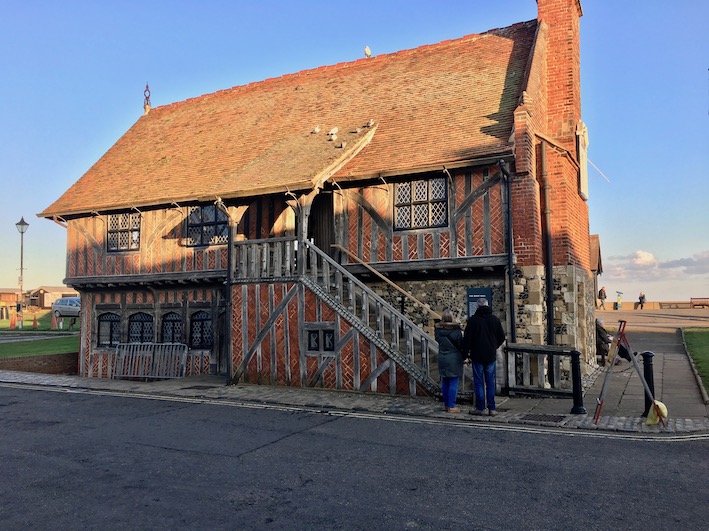
The couple of times I have been in Aldeburgh, I’ve wished the sun was on this side of the Moot Hall, better to show off the beautiful timberwork of the staircase – and I’ve resolved to return another time, earlier in the day, when this west-facing wall would be in better light. The next time was to have been November 2020, but Covid put paid to that. So when I look back at my Aldeburgh photographs, they have a special poignancy and bring with them thoughts of ‘maybe later this year…maybe next’.

The Moot Hall has other resonances for me. First, built in c. 1520 and altered in 1654, it’s a glowing example of Tudor and Stuart timber-framing, stonework and brickwork. There was a restoration in the 1850s, when a lot of the brick nogging* was replaced (the lower floor nogging and the gable end are mostly Victorian, the upper floor 17th century). The external staircase was restored in the 19th century too – but very much as it would have been. It’s not hard to imagine the people of Tudor or Stuart times holding their market downstairs and having town meetings in the upper room. Back then it would also have been even more of a local landmark than it is now, a village hub right on the beach, as close to the sea as the lives of nearly every Aldeburgh citizen would have been.

The Moot Hall is also one of the settings of Benjamin Britten’s opera Peter Grimes, the work that marked his comeback to Britain after a spell in the USA – and which changed the direction, decisively and beneficially, of English opera. The opera’s Prologue is set in the Moot Hall and the work’s plot and music are soaked with the sea – the fate of Peter Grimes and his doomed apprentices is bound up in the sea, and Britten’s music resonates with it, evoking storms and calms alike.† The composer himself, an Aldeburgh resident for much of his life, must have seen the sea most days, looked at it, listened to it, swam in it – and it shows in his music.

A building like this must have many meanings for those who look at it. I’ve simply described what it means – personally, architecturally, musically – to me. They’re the reasons, if you like, why it moves me. Ian Nairn, one of England’s greatest writers about buildings and places, said that in writing his book about London he wanted simply to record, ‘what has moved me, from Uxbridge to Dagenham’.§ That’s one of my aims, when I write this blog, though one can only dream of matching Nairn’s aim with his insight.

- - - - -

* Nogging is the architectural term for brickwork that is used to fill the spaces between the wooden posts and beams of a timber frame. The bricks are sometimes laid in an ornamental pattern, as they are here.

† One way to appreciate this sea-music, especially if you don’t like opera, is to listen to the four orchestral Sea Interludes (‘Dawn’, ‘Sunday Morning’, ‘Moonlight’, and ‘Storm’) that are played during the opera and can be performed separately from it. There are performances on YouTube, including this one.

§ One of my blog posts on Nairn is here.


Friday, November 29, 2019

Snape, Suffolk


Was it for this the clay grew tall?

Another memorable visit we made when in Aldeburgh for the poetry festival was to Snape Maltings, five miles up the road from Aldeburgh itself. We went to Snape not for the music for which it is now so famous but for the architecture, for a coffee, and for an exhibition which made a deep impression on us both. The architecture is on such a large scale that I managed to drive past the entrance, in anticipation of yet more wonders of brick, slate, and weatherboarding. But I soon managed to turn round, park, and take in this complex site – there are about seven acres of buildings, apparently.

The place owes its scale to Newson Garrett, son of the Garrett engineers of my previous post. Newson Garrett bought the site in part because of its position on the Alde estuary: there was a port of some significance in the Victorian period. By the early 1850s he was in the business of malting, and was shipping huge tonnages of malt to breweries around the country, especially to those in London. Garrett throve, and the business continued for just over 100 years, finally running out of steam in the 1960s. That left a large group of vacant buildings – maltings, storage buildings, offices, and so on – in the middle of what was a mainly agricultural area of Suffolk. A local farmer, George Gooderham, bought the site and began to find uses and users for the buildings, and then Benjamin Britten turned up.

Britten lived at Aldeburgh and had been running the Aldeburgh Festival since 1948. The festival’s concerts took place in local churches and halls, but such was the quality of the events – featuring a galaxy of Britten’s starry colleagues from all over the world, as well as premiers of many Britten pieces – that these venues were often far from ideal. Britten and his partner Peter Pears quickly saw the potential of the big malthouse at the heart of the site: it would make an ideal concert hall. The maltings was converted by Derek Sugden of Arup Associates, who kept as much of the building as he could and refrained from embellishing what was left. The structure is visible inside in the form of bare brick walls and the framework of the enormous roof. Outside it’s also all about the roof, which sweeps dramatically down almost to the ground in a manner that would take my breath away if it wasn’t so familiar from Britten record sleeves. As is well known, the triumph of the concert hall turned quickly to a disaster when the structure caught fire in 1969, but the work of restoration was redone and one of the most successful concert halls of its time has continued to flourish.

Also apparently flourishing are numerous shops, eateries, and art galleries dotted around the Maltings site. We visited quite a few of these, and what stuck in our mind was the exhibition War Requiem by Maggi Hambling, in the Dovecote Gallery. This compact installation, in a single room plus mezzanine, consists of a couple of dozen paintings by Hambling portraying human heads (the victims of war) and devastated landscapes, done in oils with Hambling's characteristic thick impasto. These are hung in the most spartan of settings – a windowless room with walls lined with plywood. The Lacrimosa movement of Britten’s War Requiem* plays through concealed loudspeakers. This is bleak stuff, which I’ll not attempt to describe further. I merely want to add that we found it utterly compelling. The exhibition has closed now, but has been shown before in other venues, and may reappear: if you have the chance to see it, here or elsewhere, go.†

- - - - -

* Containing a setting of Wilfred Owen’s poem ‘Futility’, from which my heading is a quotation.

† There’s more on the exhibition here.

Friday, December 20, 2013

Aldeburgh, Suffolk, and Oxford


A memory

On December 4, 1976, as the nights drew in after that memorable summer, E, a much-loved mentor, came to visit me in the room I was occupying in my last undergraduate year at university. She wanted to make sure I was settled, I think, in this important final year. Once we'd drunk the ritual tea and exchanged the expected gossip, the conversation turned to music, which had been at the centre of much of E's life. I wanted to play her a few tracks from a recording I'd just bought, of Britten's Les illuminations, and once E had got over the shock that the singer was a soprano and not the expected Peter Pears, we sat back and enjoyed the whole disc. It felt like a true connection between listeners, performers, and composer. As E pointed out, the work had been premiered by a female singer, after all, even if Pears had made the work his own in the subsequent decades. Further reflections followed. We recalled a performance of Les illuminations that we'd both attended in which the singer's pronunciation of Rimbaud's French text undermined the final bars – his parting 'Assez eu' sounded impure and guttural, more like 'assez eugh'. If we laughed about that, over our second cup of tea, I was also told that Britten was very ill now and it was likely that the stream of music that had been steadily flowing for so long would be stayed. Then E went home, and I turned back to whatever it was I was supposed to be reading.

And we would no doubt have forgotten our quiet listening to Britten's song cycle had it not been for the fact that a few days later we opened our respective newspapers and learned that Britten had died that very day. A coincidence of course, but coincidences are patterns, and they stick in the memory, and haunt us, rather like the patterns of music. The patterns mean that I remember that afternoon, that I have a clearer image in my mind than I would otherwise have of the rather dingy North Oxford room I was living in then, and that I recall a shared experience with someone who meant lot to me.

As far as the steady flow of music went, we learned that the tide was not quite out. The composer's third string quartet was premiered at Aldeburgh about two weeks after Britten's death. Its distinctive musical textures – often described as 'spare' because frequently only one or two instruments are playing at once – may in part be due to the composer's partly paralysed right hand. But however they got there, the sounds he produces are a distillation of his late style, deeply absorbing, and a profound example of creativity triumphant in the face of illness and death. The long last movement, entitled 'La serenissima', has been seen as death-defying. Taking a cue from its title I also see in its glittering sounds a reflection of Turner's late Venetian paintings, as if the composer, his inspiration illuminated one final time, is looking towards the light.

* * *


'Assez vu….assez eu….assez connu….' Estonian soprano Aile Asszonyi in 'Départ', the final movement of Britten's Les illuminations.