Showing posts with label Farmcote. Show all posts

Monday, December 10, 2018

Farmcote, Gloucestershire


History in the hills

For my third reprise in this busy month, I offer a place I’ve actually already posted about twice. This multiplicity is an indication not that it’s somewhere of great architectural richness, because the building I’m focusing on is modest to say the least. It’s because the place means a lot to me: for the atmosphere (especially for the quietude that surrounds it), for the layers of history visible in and around and beneath it, and for memories associated with it. So here’s Farmcote once more, ten years on from when I first wrote about it. I called that original post The End of the Road...

Take the steepest and narrowest of the roads leading out of the town where I live, a route that rises rapidly up the Cotswold escarpment. Turn left along a narrower lane that leads up again through remote country dotted with the odd farm and racehorse stable and bounded with fields where the brown ploughed soil reveals thousands of fragments of Cotswold limestone. Turn off once more up an even smaller lane that passes sheep pastures and offers glimpses from the high hills northwards and westwards towards Worcestershire and Wales. And at the end of the track you reach Farmcote, a tiny, isolated hamlet consisting of a few stone houses and a church.

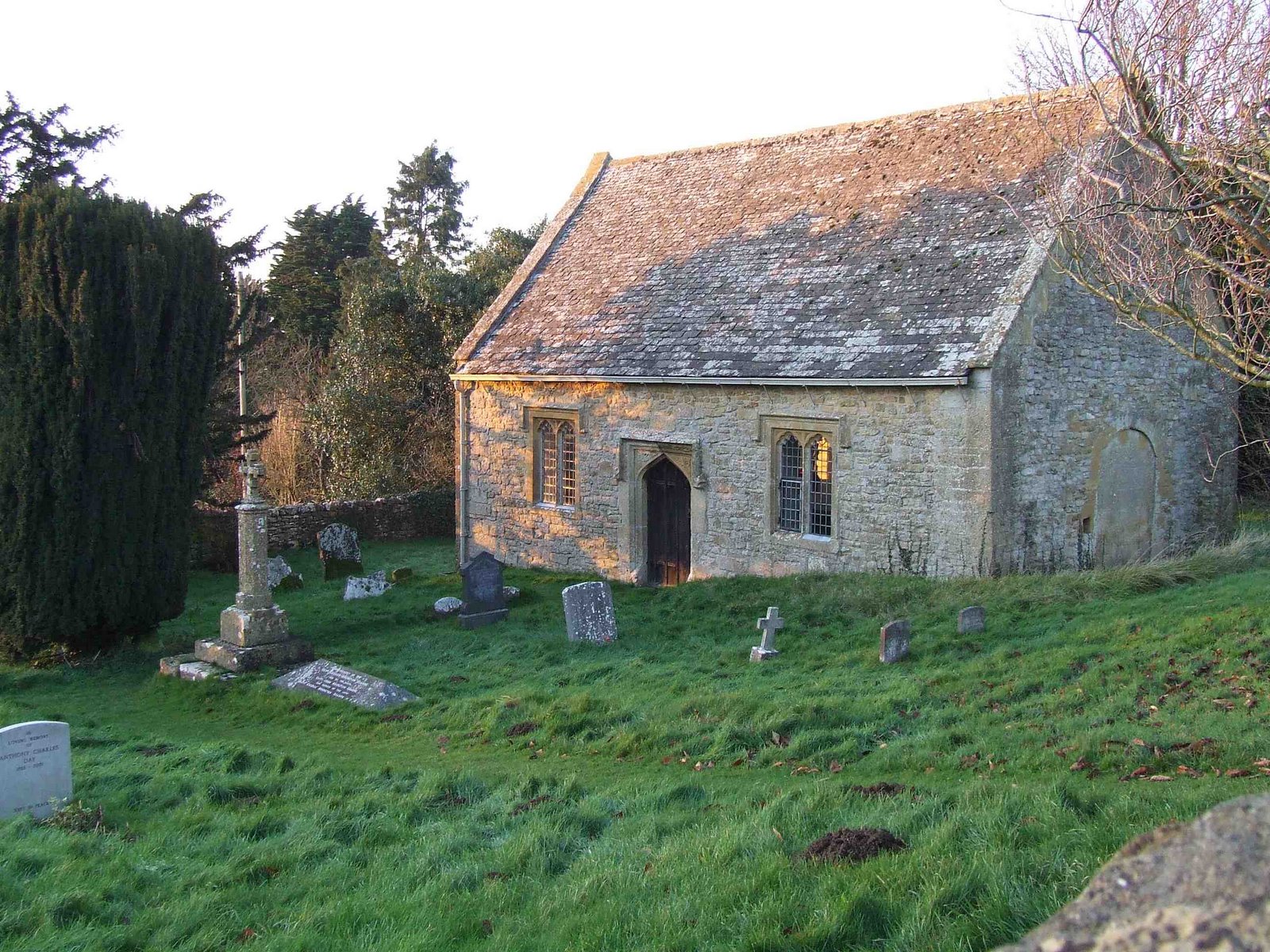
From this angle, St Faith’s, Farmcote, could almost be a Tudor building – the windows and doorway are probably early-16th century and the furnishing inside is a satisfying mixture of Tudor and Jacobean. But in the end wall is a blocked archway indicating that this building was once bigger. Small as it is, the arch would have led to a demolished chancel, and the stonework of the arch is unmistakably Saxon. People have worshipped here for over a thousand years.

The evening light is often beautiful on this west-facing slope. When I first came here is was dusk, and I felt I needed a candle to see the medieval roof timbers and Jacobean furniture. Today there was more light, but it was fading as the sun began to drop behind the next hill. The farm dogs were quiet. The only thing moving was some smoke from a nearby chimney. Restored by the silence I crept back to the car, and drove off, making as little noise as I could.


Monday, May 8, 2017

Farmcote, Gloucestershire


Ancient peace

Modern life, even here in the country, involves a lot of noise. Traffic, tractors, chainsaws, guns, the sounds of restoration, the crashes and bangs gleefully made by the people (known as the ‘clanky men’ in our house) who collect the glass bottles we put out for recycling. It’s part of life, and I accept it for what it is – and put on noise-cancelling headphones, or head for the hills. If it’s the hills, you will not be surprised to learn that it’s often some tranquil architectural setting where I end up. Often a church. Churches have more uses than the purely or conventionally religious ones. Churches: places to be quiet in and maybe even to ‘grow wise in’ (Philip Larkin*). Or graveyards: ‘Personally I have no bone to pick with graveyards’ (Samuel Beckett, naturally†). I have posted before about a couple of local favourites, Elkstone, a cherished Norman building, and Farmcote, partly Saxon, partly Tudor. Both attract me back, partly for the architecture, partly for the quiet.
Going back, there is always something different to see or learn. At Farmcote, talking to a local resident, I learned that the unassuming building in my second photograph started life as one of the farm buildings of the great Cistercian abbey of Hailes, just over the hill from here; a granary I think. It shouldn’t be a surprise. All over these hills the Cistercians must have run sheep and grown crops. Any building of great age in an outlying farm around here might have some medieval origin involving the monks. Their abbey may be in ruins, but their presence is still palpable, as palpable as that of the sheep, still ubiquitous on the Cotswolds, who break the rural silence with that gentle baaing noise of their own.

* ‘Church Going’
† Oh, it is mean not to quote just a little more: ‘Personally I have no bone to pick with graveyards, I take the air there willingly, perhaps more willingly than elsewhere, when take the air I must.’ Samuel Beckett, First Love, with an unfailing eye, and nose, on the word ‘must’.

Thursday, April 12, 2012

A few old favourites

It is well over a year since I last did a “round-up” of favourite posts from this blog, with the aim of interesting readers who are new here and would like to explore further. A comment on my previous post, about military airfields and the hangars at Hullavington in Wiltshire, reminded me of a particular aspect of my posts that has pleased some readers: the way in which they are as much about atmosphere and sense of place as they are about architecture.

How buildings define or enhance or affect the character of a place is a huge subject, and one that can only be touched on in a short blog post. But it’s one I’m often aware of as I encounter buildings, and there are some posts where I think I’ve managed to evoke the relationship between place and building in ways that seem to strike chords with readers. These are very personal posts that chronicle my reactions and memories of a some very diverse buildings and places. They range from thoughts about how nature and architecture interact on the site of a ruined castle to a brief account of the relationship between buildings, lives, and businesses in one tiny, and formerly seedy, London block. Links to these and a few other posts follow.

Restored by silence and fading light: visiting an isolated Saxon church at Farmcote on top of the Cotswolds.

The greening of a ruin: picking a way through the stones and vegetation at Wigmore Castle.

It’s brains you want: ghost signs and why they matter. Looking at a crumbling piece of the sign-writer’s art in Gloucester.

Strangers on the shore: evocative hulks shoring up the bank of the River Severn at Purton.

Coming home: thoughts on buildings as landmarks, in particular a ruined barn at Burford.

Soho revived: uncovering pythons, lap-dancers, and secret passages in Moor Street, London.

An image of the country village: constructing perfection at Great Tew, and a brief addendum on the one-time decay of the village, from which it has recovered.

Saturday, December 6, 2008

Farmcote, Gloucestershire


The end of the road

Take the steepest and narrowest of the roads leading out of the town where I live, a route that rises rapidly up the Cotswold escarpment. Turn left along a narrower lane that leads up again through remote country dotted with the odd farm and racehorse stable and bounded with fields where the brown ploughed soil reveals thousands of fragments of Cotswold limestone. Turn off once more up an even smaller lane that passes sheep pastures and offers glimpses from the high hills northwards and westwards towards Worcestershire and Wales. And at the end of the track you reach Farmcote, a tiny, isolated hamlet consisting of a few stone houses and a church.

From this angle, St Faith’s, Farmcote, could almost be a Tudor building – the windows and doorway are probably early-16th century and the furnishing inside is a satisfying mixture of Tudor and Jacobean. But in the end wall is a blocked archway indicating that this building was once bigger. Small as it is, the arch would have led to a demolished chancel, and the stonework of the arch is unmistakably Saxon. People have worshipped here for over a thousand years.

The evening light is often beautiful on this west-facing slope. When I first came here is was dusk, and I felt I needed a candle to see the medieval roof timbers and Jacobean furniture. Today there was more light, but it was fading as the sun began to drop behind the next hill. The farm dogs were quiet. The only thing moving was some smoke from a nearby chimney. Restored by the silence I crept back to the car, and drove off, making as little noise as I could.