Showing posts with label Great Tew. Show all posts
Saturday, March 18, 2017
Village England
Then and now
I have been known to complain that buying books online is never quite the same as visiting a traditional, bricks and mortar bookshop. Online, you get what you search for – and I’m grateful that the search engines, again and again, turn up just what I’m after. In a real shop, on the other hand, you are more likely to browse and make surprise discoveries – and that can be even more interesting and enriching than getting what you expect.*
The other day, however, my expectations were confounded when I received something I’d bought online that was indeed a surprise. Having read a reference somewhere to a publication called The Observer’s Village England (1979), I looked online and found myself a secondhand copy. I expected a book to arrive, but what I got was actually a series of pull-out extracts from the Observer newspaper’s colour magazine, which had been collected together and preserved in a leatherette† binder. It amounts to a book, but the way it displays its origins makes it more interesting and pleasurable to handle.
Each section concerns a region of England, and contains a series of entries on villages and small towns, together with short pieces by various writers, mostly well known at the time, about particular places that they know well: the playwright Ann Jellicoe on Dorchester; the poet P J Kavanagh on Cirencester; the historian W G Hoskins on Uppingham; and so on. The series is subtitled ‘A guide to the best villages and small towns in the country’, and this emphasis on quality plays in its favour. It means the editors could be selective, not trying to include everything but featuring places with something special to offer, whether it was architecture, scenery, a pub, good shops with local produce, whatever. One of the pleasures is the photographs, by people like Roger Mayne§ and Alain le Garsmeur, many of which include people – either the proprietors of notable shops or people going about their rural business thatching or shoeing horses. There is an extraordinary picture of a boy riding a bicycle on the grass in front of Oakham Castle, the greensward populated with wooden chairs – apparently he was practising for an obstacle race.
It also tells us the state of things in 1979. I’ve not yet read deeply into the collection to see exactly what has changed where, but I’m already noticing differences on my own patch of England – Gloucestershire and the Cotswolds. The gorgeous thatched village of Great Tew in Oxfordshire was still dilapidated in 1979, with broken windows and holes in the thatch, even in some of the inhabited houses…just how I remember it back then. Cirencester was still a major centre for the Cotswolds and was a working town then as it is now. Stroud was not singled out as a good place to visit as it would be now. And so on.
Julia Butcher’s cover illustration (above) sums it up. If her image of Village England is idealised (immaculate white houses, cricketers, swans) it also stands for some of the things that are, as the subtitle says, ‘the best’. It’s a beautifully composed image – the reflection of the bridge, the pub, the Jolly Farmer paired with a real jolly farmer (or cow hand anyway) driving his cattle across the bridge. It’s redolent of summer (the swallows and the cricketers, even if they don’t seem to have fielded a full eleven). And it’s fill of interesting details like the windmill in the distance. Village England. I’m glad I found it.
- - - - -
*I sometimes try to create architectural surprises of a similar nature on this blog.
† The sort of material used back then to encase reprints of the classics, ‘tooled’ in mock-gold. A phrase I remember from the advertising was something like, ‘Bound in luxurious red Skivertex’, stuff that must have been mass produced by the mile, to adorn, if that is the word, sets of Dickens, Russian novels, or the complete works of Shakespeare. Autre temps, autre livres.
§ Roger Mayne was married to Ann Jellicoe and they created the Shell Guide to Devon together. There’s an exhibition of Mayne’s work currently at London’s Photographer’s Gallery.
Friday, June 3, 2016
Great Tew, Oxfordshire
Narrow gateway, wide world
Just opposite the vicarage in my previous post is this grandiose gateway, through which one walks along a path to the parish church. You may well feel that there’s something odd about this structure. It seems vastly out of proportion to the low wall on either side of it, and the opening itself looks disproportionately narrow in relation to its height. I think the reason for this is that the gateway has been moved from elsewhere – probably one of the entrances to Great Tew Park – and rebuilt on a smaller, narrower scale to serve as this eye-catching prelude to the churchyard.
What remains is certainly imposing, and the ornament is very much redolent of the first half of the 17th century, when Inigo Jones and his followers were starting to introduce their disciplined and scholarly form of classicism to Britain. The masonry is carved with horizontal bands of vermiculation – the ornamental motif that is supposed to create the effect of the stone having been eaten away by worms – and each pier has a large niche topped with an arch in the form of a shell. Above each niche is a smaller oval indentation. The lintel is carved with festoons of fruit on either side of a central keystone. The use of banded vermiculation reminds me a little of the much more elaborate gateway in London’s Embankment Gardens, another 17th-century gateway that has lost its original purpose and that looks stranded but still magnificent in its current setting.
This carving from perhaps the 1620s takes us back to a time when the manor house at Great Tew was owned by one of the most remarkable figures of the time, Lucius Cary, who became 2nd Viscount Falkland and subsequently Chancellor to Charles I. One of my readers (see the Comments section to the post on the vicarage) has already mentioned Falkland, who invited to Great Tew a stellar group of his contemporaries, men who relished the intellectual discussions on offer, gatherings compared by contemporaries to those convened by Erasmus.* Many of those present came from Oxford (only about 12 miles away), but Falkland had friends from further afield too. In his Brief Life of Falkland, John Aubrey mentions some of the period’s most celebrated writers who were guests at Great Tew: ‘For learned Gentlemen of the Country, his acquaintance was Mr Sandys, the Traveller and Translator; Ben. Johnson [sic]; Edmund Waller, Esq.; Mr Thomas Hobbes, and all the excellent of that peaceable time.’ Falkland, says Aubrey, was not a great writer himself, quoting Dr Earles who said that ‘he wrote not a smoth verse, but a great deal of sense’.
Falkland died young, when the peaceable times had ended and he was fighting for the king at Newbury. It was said that he threw his life away, riding rashly into the fray when he need not have done so, and various reasons have been suggested for this, from his pessimistic analysis of his side’s chances in the war, to his deep grief at the death of the woman he loved.
Whether or not he actually had it built, this gateway, with its design that seems at home here but derives from a wide world of culture and scholarship, is no doubt the sort of thing Falkland would have appreciated. His house has been rebuilt and he has only a modest, 19th-century monument in the church, but such architectural fragments as this can act as his memorials.
- - -
*It was Clarendon who made the comparison, and he also compared Falkland to Cicero, the great Roman consul, philosopher, orator, and letter-writer, who was as it happens an important character for Falkland’s friend Ben Jonson too.
Tuesday, May 31, 2016
Great Tew, Oxfordshire
Small mercies
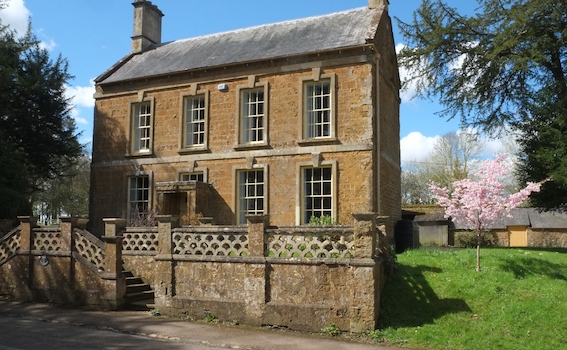
This vicarage is a pleasant architectural surprise on the way to the church at Great Tew, different from, but complementary to, the thatched cottages that make up much of the village – although a vicarage on the way to a church is hardly a surprise. The house was originally built in 1696 and has been altered and expanded several times since, notably in the early-19th century, when such features as the bold surrounds to the windows were added. Actually these bands of limestone are not quite as bold as they might appear in the photograph, because when you look at them closely, there are very narrow roll mouldings around the insides of the surrounds, reducing and softening their bulk in a rather pleasing way.
The porch to the off-centre doorway is another touch from the early-19th century. This was the period in which the village of Great Tew was being landscaped and transformed – probably by the gardener and designer John Claudius Loudon – into an ideal Picturesque village (for more on this, see one of my earlier posts). I know some of my fiends will be irritated by this off-centre door, lamenting the fact that this building is not in the beautifully symmetrical mode of classical English houses. But maybe it works in terms of the internal layout and anyway I rather like it. No doubt that’s my perverse appreciation of ‘All things counter, original, spare, strange,’ as Gerard Manley Hopkins has it, coming into play.*
The ornamental wall in front of the house is hardly ‘spare’, although it is dappled, in a sort of fish-scale pattern. This works well. The lower, solid part of the wall retains the rising ground behind, while the fish-scale patterned part acts as the stone equivalent of a garden fence, defining the boundary and letting light through at the same time. This wall is probably early-19th century too and manages to combine strength and delicacy in a single structure. A small architectural mercy. Glory be to God for it…or to its architect and builder anyway.
- - - - -
*See Gerard Manley Hopkins, ‘Pied Beauty’ (‘Glory be to God for dappled things…’).
Monday, June 3, 2013
Great Tew, Oxfordshire
Backward glance (3): Not quite what it seems, not quite what it seemed
The third of my backward glances, taken because my current personal circumstances are limiting my travels in search of English buildings, pitches me back to the Cotswolds, the part of England where I grew up. What follows is actually a reprise of two connected posts about the Oxfordshire village of Great Tew.
Many people will know Great Tew as one of the most picture-postcard-perfect limestone villages, chocolate-box England. It's the sort of place that brings out the worst in the cliché-mongers who write about the English countryside, the kind of language that John Russell, many years ago, referred to as 'the strange sexual-anthropomorphic idiom of English country-writers, in which villages nestle, valleys girdle, and rivers are said to have issue'. The nestling here is done by warm stone cottages among greenery and it is the kind of place to trick us into the illusion that it has always been this way…
Great Tew is all like this – thatched roofs, glowing, almost toffee-coloured ironstone walls, evergreen trees and hedges, all tucked neatly away in deepest North Oxfordshire. It’s archetypal rural England, the kind of village that’s been here for hundreds of years, growing organically and acquiring more patina with each century. But that’s not quite the story. The village is actually the creation of the early-19th century, when the estate was remodelled and the village became a star feature in the landscape. Thatched roofs were fitted or repaired, Gothic details added to the cottages, trees and hedges planted. The result is an uncanny combination of model estate village and old England. It’s not known for sure who masterminded the transformation, but the brain behind it might well have been landscape-gardener, writer, and horticulturalist J C Loudon. Loudon managed the estate for a few years and established a model farm. Whoever it was distilled the essence of the English village and left it in this North Oxfordshire valley.
My first post left something unsaid, something about my earliest experience of Great Tw, when I went there as a teenager in the early 1970s. Then the place was a far cry from idyllic. Half of it seemed to be falling down. Something had gone wrong, badly wrong…
Several people responded to my post about Great Tew with memories of how the place used to be about thirty years ago – neglected, with tattered thatch, broken windows, and a few tenants hanging on amongst the dilapidation. I seem to remember that the Sunday Times of the Harold Evans era featured it in a piece about shamefully unmaintained villages left to go to ruin by their landlords. When I went there in the 1970s the plight of the residents was dire. It seemed to take one back to the debunking essays of Robertson Scott (England's Green and Pleasant Land was the ironic title of his most famous book) that showed country life in the early 20th century for what it really was – cold, hard, and painful for many. And yet the place had an eerie quality evocative of another time that no spruced-up picture-postcard village could ever have had. The lost domain.
As far as I can remember, when I made that first visit there were already being efforts made to repair some of the houses and to put the village back on a sound footing. But the overwhelming impression was one of desolation. I knew that country life could be hard (memories of my grandparents in rural Lincolnshire involved bringing in pails of water from a spring, cooking on a coal range, oil lighting, and so on). But this was a far harder life. It jolted me into realization that country life was often far from idyllic and that warm stone could form a home to cold realities.
The photograph of the dilapidated cottage comes from TrekEarth, here, with thanks to Liberal England for the original link.
Labels:
cottage,
Great Tew,
house,
J C Loudon,
Oxfordshire,
Regency,
ruin,
stone
Thursday, April 12, 2012
A few old favourites
It is well over a year since I last did a “round-up” of favourite posts from this blog, with the aim of interesting readers who are new here and would like to explore further. A comment on my previous post, about military airfields and the hangars at Hullavington in Wiltshire, reminded me of a particular aspect of my posts that has pleased some readers: the way in which they are as much about atmosphere and sense of place as they are about architecture.
How buildings define or enhance or affect the character of a place is a huge subject, and one that can only be touched on in a short blog post. But it’s one I’m often aware of as I encounter buildings, and there are some posts where I think I’ve managed to evoke the relationship between place and building in ways that seem to strike chords with readers. These are very personal posts that chronicle my reactions and memories of a some very diverse buildings and places. They range from thoughts about how nature and architecture interact on the site of a ruined castle to a brief account of the relationship between buildings, lives, and businesses in one tiny, and formerly seedy, London block. Links to these and a few other posts follow.
Restored by silence and fading light: visiting an isolated Saxon church at Farmcote on top of the Cotswolds.
The greening of a ruin: picking a way through the stones and vegetation at Wigmore Castle.
It’s brains you want: ghost signs and why they matter. Looking at a crumbling piece of the sign-writer’s art in Gloucester.
Strangers on the shore: evocative hulks shoring up the bank of the River Severn at Purton.
Coming home: thoughts on buildings as landmarks, in particular a ruined barn at Burford.
Soho revived: uncovering pythons, lap-dancers, and secret passages in Moor Street, London.
An image of the country village: constructing perfection at Great Tew, and a brief addendum on the one-time decay of the village, from which it has recovered.
How buildings define or enhance or affect the character of a place is a huge subject, and one that can only be touched on in a short blog post. But it’s one I’m often aware of as I encounter buildings, and there are some posts where I think I’ve managed to evoke the relationship between place and building in ways that seem to strike chords with readers. These are very personal posts that chronicle my reactions and memories of a some very diverse buildings and places. They range from thoughts about how nature and architecture interact on the site of a ruined castle to a brief account of the relationship between buildings, lives, and businesses in one tiny, and formerly seedy, London block. Links to these and a few other posts follow.
Restored by silence and fading light: visiting an isolated Saxon church at Farmcote on top of the Cotswolds.
The greening of a ruin: picking a way through the stones and vegetation at Wigmore Castle.
It’s brains you want: ghost signs and why they matter. Looking at a crumbling piece of the sign-writer’s art in Gloucester.
Strangers on the shore: evocative hulks shoring up the bank of the River Severn at Purton.
Coming home: thoughts on buildings as landmarks, in particular a ruined barn at Burford.
Soho revived: uncovering pythons, lap-dancers, and secret passages in Moor Street, London.
An image of the country village: constructing perfection at Great Tew, and a brief addendum on the one-time decay of the village, from which it has recovered.
Saturday, January 19, 2008
Great Tew, previsited

Several people responded to my post about Great Tew with memories of how the place used to be about thirty years ago – neglected, with tattered thatch, broken windows, and a few tenants hanging on amongst the dilapidation. I seem to remember that the Sunday Times of the Harold Evans era featured it in a piece about shamefully unmaintained villages left to go to ruin by their landlords. When I went there in the 1970s the plight of the residents was dire. It seemed to take one back to the debunking essays of Robertson Scott (England's Green and Pleasant Land was the ironic title of his most famous book) that showed country life in the early 20th century for what it really was – cold, hard, and painful for many. And yet the place had an eery quality evocative of another time that no spruced-up picture-postcard village could ever have had. The lost domain.
The photograph comes from TrekEarth, here, with thanks to Liberal England for the original link.
Friday, January 4, 2008
Great Tew, Oxfordshire

Great Tew is all like this – thatched roofs, glowing, almost toffee-coloured ironstone walls, evergreen trees and hedges, all tucked neatly away in deepest North Oxfordshire. It’s archetypal rural England, the kind of village that’s been here for hundreds of years, growing organically and acquiring more patina with each century. But that’s not quite the story. The village is actually the creation of the early-19th century, when the estate was remodelled and the village became a star feature in the landscape. Thatched roofs were fitted or repaired, Gothic details added to the cottages, trees and hedges planted. The result is an uncanny combination of model estate village and old England. It’s not known for sure who masterminded the transformation, but the brain behind it might well have been landscape-gardener, writer, and horticulturalist J C Loudon. Loudon managed the estate for a few years and established a model farm. Whoever it was distilled the essence of the English village and left it in this North Oxfordshire valley.
Subscribe to:
Posts (Atom)