Peacock and Pippet
I hope this blog has brought some interest and pleasure to my readers this year and that some at least of the pleasure has come from unexpected sources. I like to think that quite a lot of what I bring you is out-of-the-way stuff, buildings that are little known outside their immediate neighbourhood and passed over by the standard architectural histories. My subjects interest me for all sorts of reasons but the ones I like best are notable aesthetically while also throwing some light on the past – on social, industrial, or commercial history.
So this year we’ve had, among other things, village lockups, in which quirky architectural form embodies past notions of crime and punishment; factories, in which low-cost, utilitarian architecture survives (sometimes by the skin of its teeth) to tell the stories of past industries; and shop fronts, in which former fashions in display reveal something about the ways in which retailers liked to catch the attention of customers. All very revealing and often surprising too.
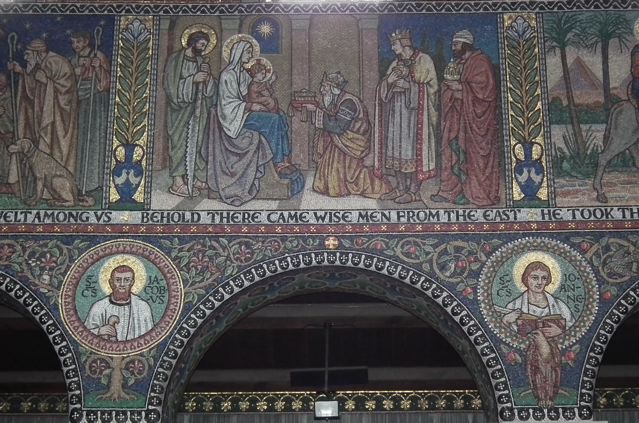
Christmas, though, is a time when surprises come in traditional packaging. This fact came into my mind when I was looking at a building that combines tradition with surprise: a 20th-century Byzantine-style church…in Droitwich. The Catholic Church of the Sacred Heart and St Catherine of Alexandria, designed by Barry Peacock, is based on the form of early Christian basilicas. The long nave, with its rows of seven arches, its small apse housing the high altar, its carved capitals, and, above all, its mosaic decoration, shows the influence of the great early churches of Constantinople and, especially, Ravenna.
Most of the mosaics were designed by Gabriel Pippet and executed by mosaicist Maurice Josey. Their subjects are various – one group tells the story of St Richard de Wyche, Droitwich’s saint; another depicts scenes from the life of the Virgin, including the Annunciation, the Nativity, and the Flight into Egypt. There are also portraits of saints and fathers of the Church – St Catherine’s mosaic in the apse of her little chapel is especially good. The details in these mosaics are beautiful. Interweaving plants and little groups of birds fill the gaps between the figures and narrative panels. Gold tesserae glitter. Even on a dull day in Droitwich, this lovely work of the 1920s catches the light like the mosaics of Ravenna in the Italian sunshine.
Season's Greetings to all my readers.

St Catherine, Church of the Sacred Heart and St Catherine of Alexandria, Droitwich


