Showing posts with label nativity. Show all posts

Tuesday, December 23, 2025

Berwick, East Sussex


A Bloomsbury Nativity

I wish my readers a happy Christmas with this unusual church wall painting, the 20th-century Nativity scene in the church at Berwick, not far to the west of Eastbourne in East Sussex. Commissioned in 1941, the paintings in the church are the work of Bloomsbury Group artists Duncan Grant, Vanessa Bell (the sister of Virginia Woolf), and Quentin Bell. They’re remarkable for being the only complete set of murals by major 20th-century artists in an English parish church.

Vanessa Bell’s Nativity scene is striking for its bold, direct style, although there’s something sombre about it – the colours are not as bright as in many of her works and the facial expressions are contemplative rather than joyous. The seriousness of the work no doubt relates to the story itself – the birth of Jesus is to be celebrated, but we know that his life on Earth will end in a brutal execution. Perhaps this quality in the painting also reflects the fact that the artist had lost not only her sister Virginia (who had taken her own life earlier that year) and her son, Julian, who was killed in the Spanish Civil War. Some say that she has painted the infant Jesus with similar features to those of Julian when he was a baby; the model for Mary was Vanessa’s daughter, Angelica. The sitters for the other figures were local farm workers and servants, so thet painting is steeped in the artist’s family and people she knew.

It is also very English (I am not only thinking of the clothes worn by many of the characters), and redolent of the local Sussex countryside in particular. The barn is probably based on one in the area; the view out looks towards the beautiful downland scenery that helped draw Virginia and Leonard Woolf, Vanessa and Clive Bell, and Duncan Grant to this part of the world. The lamb in the foreground is a Sussex lamb; the produce is in a Sussex trug; even the shepherds’ crooks are based on a local design.*

We are so used to plain whitewashed church walls punctuated with monuments and, just occasionally, a fragmentary medieval wall painting, that for many the extraordinary paintings in Berwick church must be something of a shock. As well as this Nativity, there’s an Annunciation, a Crucifixion, a Supper at Emmaus, a Christ in Glory, and much else. But I can’t help thinking that this location, this church, was right for a cycle of paintings by these British artists at the time of World War II. In spite of the solemnity, there is colour, optimism, renewal, and the faith in the future that must accompany the undertaking of any major project. They needed these things then, and we need them now. 

Season’s Greetings.

- - - - -

* I am indebted to the Berwick church website, and to its guidebook, for much of this information.


Thursday, December 21, 2023

Huish Episcopi, Somerset


With my best wishes

Casting around for something seasonal to post, I found this picture in my files. I’ve actually posted it before, but so long ago that I doubt anyone reading this now will remember it from back then. It’s a stained glass window designed by Edward Burne-Jones and made in the workshop of William Morris and it shows the Nativity scene in the stable at Bethlehem. As well as being a prominent member of the Pre-Raphaelite Brotherhood, Burne-Jones was also a founder member of Morris’s firm and the window is one of many wonderful examples of their bringing together of art, craft and design.

The host of angels, crowding beneath the roof of the stable and into the foreground, focus their gaze on Mary and Jesus. Mary is recumbent, as she often is in ancient images of the scene, and so she and the child form a long centre band across the window, with angels above and below. On the left-hand side of the picture, the Magi wait to present their gifts. I like everything about this window, from the colours and the composition to the tenderness with which the mother holds her baby and the way in which the heads of the figures in the side panels lean in towards the holy family. I hope you like it too.

Have a happy Christmas and may the new year bring peace, not least to the part of the world where this scene took place.

- - - - -  

Note You may be able to see a little more detail if you click on the photograph.

Thursday, December 23, 2021

Long Melford, Suffolk


Adoration

Holy Trinity church, Long Melford, is one of those vast East Anglian churches of the 15th century for which the term ‘awe-inspiring’ is for once quite appropriate. The craftsmanship of its masons and of the other workers who constructed it, the wealth of the local merchants and others that made it possible, the sheer size of a building that serves what is now a small Suffolk town – all make us pause. Not only that, but in this case the identities of the principal patrons are known and in many cases inscribed into the stones of the church. ‘Pray for ye sowlis of William Clopton, Margy and Margy his wifis*, and for ye sowle of Alice Clopton and for John Clopto’, and for alle thoo sowlis’ yt ye seyd John is bo’nde to prey for,†’ reads the inscription over the North porch. Several others have their inscriptions too, and some of these inscriptions are dated, so we know that work was underway in the 1480s and 1490s.

However, my photograph shows a panel of alabaster that must have survived from the church that existed before Holy Trinity got its costly rebuild. It has been dated to the late-14th century, which makes it very early for an alabaster sculpture, and it shows the Adoration of the Magi. It may be a lone survivor from an altarpiece, in which case it’s a marvel that it has escaped destruction. Most images of this kind were destroyed during the Reformation period, particularly when England’s religion turned to an austere variety of Protestantism during the reign of Edward VI. But this panel was removed from whatever position it occupied and was hidden beneath the chancel floor, where it was rediscovered in the 18th century.

There’s much to like in this relief of the Holy Family and the Magi. Mary reclines – a traditional pose much used by the artists of the Byzantine empire, and also in the Christian west. On her lap is a standing, unbabelike Jesus; again, medieval depictions of babies often use this convention, often portraying them almost as miniature adults. He reaches out his hand to the leading Magus to accept the gift, and the giver hastily removes his crown. The other two Magi look on – or do they? They have the hieratic, abstracted expressions and poses characteristic of a certain strain of medieval statuary. There are lovely touches to the left of the panel. A woman (a midwife?) plumps up Mary’s pillow. And the animals in the stable get a look in too: a pair of heads peep from low down beneath the head of the couch.

I find this panel a delight, and I offer it to my readers with season’s greetings and the very best of wishes for the coming year.

- - - - -  

* He seems to have had two wives who happened to share the same name.

† In other words, he is asking us to pray not only for his own soul but for certain others for whom he has promised to pray.

Friday, December 23, 2011

Droitwich, Worcestershire


Peacock and Pippet

I hope this blog has brought some interest and pleasure to my readers this year and that some at least of the pleasure has come from unexpected sources. I like to think that quite a lot of what I bring you is out-of-the-way stuff, buildings that are little known outside their immediate neighbourhood and passed over by the standard architectural histories. My subjects interest me for all sorts of reasons but the ones I like best are notable aesthetically while also throwing some light on the past – on social, industrial, or commercial history.

So this year we’ve had, among other things, village lockups, in which quirky architectural form embodies past notions of crime and punishment; factories, in which low-cost, utilitarian architecture survives (sometimes by the skin of its teeth) to tell the stories of past industries; and shop fronts, in which former fashions in display reveal something about the ways in which retailers liked to catch the attention of customers. All very revealing and often surprising too.

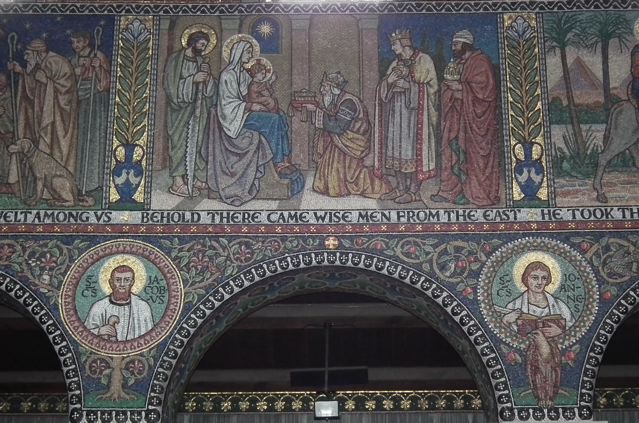
Christmas, though, is a time when surprises come in traditional packaging. This fact came into my mind when I was looking at a building that combines tradition with surprise: a 20th-century Byzantine-style church…in Droitwich. The Catholic Church of the Sacred Heart and St Catherine of Alexandria, designed by Barry Peacock, is based on the form of early Christian basilicas. The long nave, with its rows of seven arches, its small apse housing the high altar, its carved capitals, and, above all, its mosaic decoration, shows the influence of the great early churches of Constantinople and, especially, Ravenna.

Most of the mosaics were designed by Gabriel Pippet and executed by mosaicist Maurice Josey. Their subjects are various – one group tells the story of St Richard de Wyche, Droitwich’s saint; another depicts scenes from the life of the Virgin, including the Annunciation, the Nativity, and the Flight into Egypt. There are also portraits of saints and fathers of the Church – St Catherine’s mosaic in the apse of her little chapel is especially good. The details in these mosaics are beautiful. Interweaving plants and little groups of birds fill the gaps between the figures and narrative panels. Gold tesserae glitter. Even on a dull day in Droitwich, this lovely work of the 1920s catches the light like the mosaics of Ravenna in the Italian sunshine.

Season's Greetings to all my readers.


St Catherine, Church of the Sacred Heart and St Catherine of Alexandria, Droitwich

Thursday, December 23, 2010

Huish Episcopi, Somerset


Season's greetings

The more medieval parish churches I visit, the more I’m struck by the way their architecture and decoration varies form region to region. Often this is a matter of building materials, but just as frequently it’s a question of some local preference for a specific kind of feature or visual effect. And sometimes, this preference produces work of such quality that it stands out from the crowd – the graceful stone spires of Northamptonshire, the extraordinary decorative carving of the small Romanesque churches of Herefordshire, the woodwork – screens, font covers, angel-crowded roofs – of East Anglia are all memorable examples. So are the wonderful late-medieval towers of Somerset, of which Huish Episcopi is one of my favourite examples.

These tall and elaborate towers, built in the 15th century, dominate town centres and sometimes surprisingly small villages. They mostly follow a similar pattern, on which the masons played subtle variations. There is a large window above the doorway; above that, storeys are separated by bands of carving, and the upper levels have openings that look like windows but contain pierced stonework to allow the sound of the bells to carry. There are sometimes niches for statues. The tower is crowned with a lace-like openwork parapet and slender pinnacles. The tower at Huish Episcopi has all these features, arranged in a beautiful balance, so that we look up in admiration. The 100-foot tower is rather big for the church it crowns, but, no matter, it takes the breath away.


The interior of this church has one treasure from a later era that also stops visitors in their tracks. This is the stained-glass window of the Nativity, designed by Edward Burne-Jones and produced in the workshop of William Morris. Crowded round with onlooking and music-making angels, Mary reclines on the straw of the stable, cradling the infant Jesus in her arms. The Magi wait on the left to present their gifts. It’s an unusual composition, dominated by the pale robes and pinkish wings of the host of angels, topped by the stable roof and the hint of a starry sky, and the elongated figures are very much of their time. If the recumbent Mary seems odd to our eyes, she has a long pedigree: there are examples of this posture in Nativity scenes in medieval stained glass in Chartres and Cologne, worthy sources of inspiration for a window in this noble building crowned with its wonderful tower.

I hope you’ve enjoyed the blog this year. Season’s greetings to you all.

* * * *

Note: A commenter has pointed out that the Mary is often portrayed in a recumbent posture in Byzantine art. There are a couple of examples here.

Sunday, December 23, 2007

All Saints, Margaret Street, London


This nativity image is from All Saints, Margaret Street, one of the masterpieces of the architect William Butterfield. The church is a typical Butterfield building in polychrome brick, and is full of the sort of beautiful fittings and decorations that provided an appropriate setting for the kind of worship favoured by the Victorian Tractarian movement. The building was finished in 1859, but in the 1870s Butterfield returned to design scenes and figures to be painted on tiles in the North aisle. The stars shine down on a very Victorian tiled stable. The Gothic revival came early to Bethlehem and Our Lord, of course, merits only the best when it comes to quatrefoils, columns, and canopies. Season’s Greetings.