Showing posts with label lookers' huts. Show all posts

Wednesday, May 4, 2022

New Romney, Kent

On the Marsh, 1

Driving across Romney Marsh in Kent, near the border with Sussex, you cross a flat landscape, characterized by pasture, occasional drainage channels, and isolated, scattered settlements. Here and there the emptiness is relieved by a small medieval church and here and there you spot tiny buildings in fields, like stone or brick sheds. Too small to be houses or barns, they’re lookers’ huts, a unique phenomenon of the marsh, and one that might have vanished completely had it not been for the interest of a few enthusiasts.

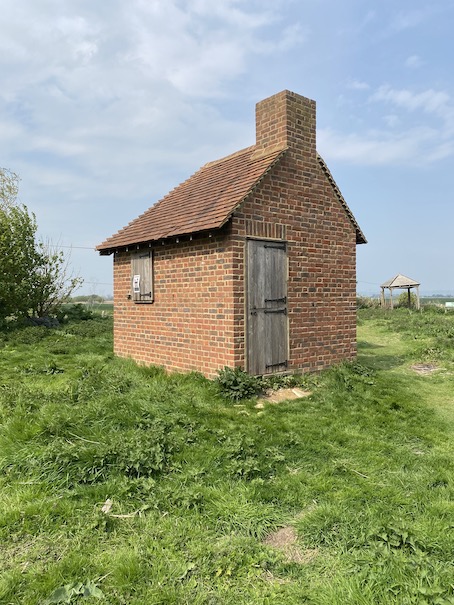
The lookers owed their existence to the economic changes that occurred after the Black Death in the mid-14th century. The plague killed a vast number of people (estimates vary between a half and one-third of the population), and the remaining landlords on the marsh bought up small landholdings that no longer had owners or tenants and combined them into larger estates. Here they ran sheep in extensive flocks, and they employed ‘lookers’ to tend them. Lookers worked over a large area, and needed a base where they could store equipment and food, and that would sometimes provide a bed for the night. Hence their huts, which were basic in the extreme (one window, a door) but also had a chimney so that the looker could keep warm in the winter. The lookers’ huts that survive today are not as old as the 14th century – I’d guess most of them are 19th century.

The huts were useful all the year round and vital during the lambing season, when the sheep needled to be constantly checked and cared for, and during shearing, the shepherd’s other time of intensive hands-on work. By the early-20th century, agriculture and then transport were transformed, and there was no longer a need for lookers or their huts. Although robust, many of these buildings, left to decay, have now gone. Around 20 remain, some well maintained, others in ruins. The example in my photograph is a reconstructed looker’s hut at the Romney Marsh Visitor Centre, outside New Romney. It’s there to explain the story of the lookers and their buildings and, as long as a few huts remain in situ, to answer the inevitable questions of observant tourists, who want to know why these tiny structures were sited in the middle of Kentish fields.

- - - - -

For an account of the similar ‘hovels’ of Worcestershire, see my earlier post, here.

Wednesday, September 14, 2011

Romney Marsh, Kent


Another look at the lookers' huts

Just over a year ago I posted about the lookers' huts of Romney Marsh in Kent, those small and simple buildings used for shelter by the shepherds of the marsh. Mark Duncan, the photographer who over the last few years has been making memorable images of these modest buildings, has a new exhibition of the results. The show marks the construction of a new looker's hut – the first to be built in many decades.

I was attracted to Mark Duncan's photographs because of their concentration on these unregarded buildings – plain, brick-built structures, just big enough for the looker and his tools and belongings and for a stove to keep him warm in the chill of the lambing season. But I also admire these pictures because they capture the special atmosphere of the place. Romney Marsh, flat, remote, dotted with churches, weather-boarded houses, and poplars, has caught the eye of many artists, from John Piper to Derek Jarman. Mark Duncan's photographs, with their big skies and their variety of weather conditions and light, capture the place as well as any.

* * *

Mark's exhibition is at the Romney Marsh Visitor Centre, New Romney, from 15 September to 9 October.

There is more about the exhibition here.

Friday, August 27, 2010

Dymchurch, Kent


The lookers and their huts

The flat landscape of Romney Marsh is dotted with a number of small buildings that most of us would hardly give a second glance. Tiny, brick-built, with a pitched roof and a chimney at one end, these are the lookers’ huts that provided shelter for those who looked after sheep on the marsh and who needed to be near their flocks for weeks on end – especially during the lambing season. Although they’re not elaborate pieces of architecture, these huts are important because they were a vital part in the lives of ordinary people for many generations over a period of around 200 years.

Once there were hundreds of lookers’ huts, but now only 12 survive intact. Changes in farming and lifestyle have meant that many have disappeared and, because most of them were in isolated positions they often found no new use. As a result they were seen as superfluous and many were knocked down; others succumbed to time or vandals.

If the remaining lookers’ huts are not to go the way of the rest, wiping out a unique piece of history, they need advocates, and they have a powerful one in Mark Duncan, who has made it his mission to photograph all the remaining huts. Now there is an exhibition of some of his photographs of the huts, highlighting those that are most at risk. I for one hope that Duncan’s exhibition succeeds in its aim to raise awareness of these very special structures and their role in the lives of generations of lookers who worked beneath the endless open skies of Romney Marsh.

* * * *

Giving Up The Ghost, an exhibition of photographs by Mark Duncan, is at the Romney Marsh Visitor Centre, Dymchurch Road, New Romney, Kent, from 28 August to 25 October. There is more about it, with examples of Mark Duncan’s photographs, here.

The photograph above is by Mark Duncan.