Showing posts with label Romney Marsh. Show all posts

Saturday, May 14, 2022

St Mary in the Marsh, Kent


On the marsh, 2

Of the many churches on Romney Marsh, St Mary in the Marsh is now one of my favourites. Standing alone except for a pub and a small group of houses, it signals its presence with a lovely splay-footed spire, on which the shingles make the transition from the the upper steep slope of the spire to the lower splay with a satisfying curve. From a little nearer one can see a small church of grey stone and the red roof tiles so common in Kent and Sussex, mostly built in c. 1300. On either side of the porch, though, are two large later windows each with two round-headed lights and a dripstone in the shape of a shallow arch – the hybrid form of design is a feature of that late Gothic (but without pointed arches) that antiquarians used to sneer at and call ‘debased’. These two windows are said to have been inserted in around 1800. On making their acquaintance, I was inclined to ignore the antiquarians’ sneers and to like them, and to reflect that their clear glass should make for a pleasant, light interior.

And so it proves. Inside, the church is whitewashed, paved with quarry tiles, furnished with box pews, and topped with crown-post roofs. These elements suggest that there has been no Victorian restoration and that nothing much beyond discreet repair has been done to the building since the insertion of those two large windows. The arms of George III, vigorously painted on canvas, no doubt by a local artist, adorn the north aisle. The result is both beautiful and, as we stood there on a quiet spring afternoon, it exuded an atmosphere of spirituality that made one happy to be present.

Wednesday, May 4, 2022

New Romney, Kent

On the Marsh, 1

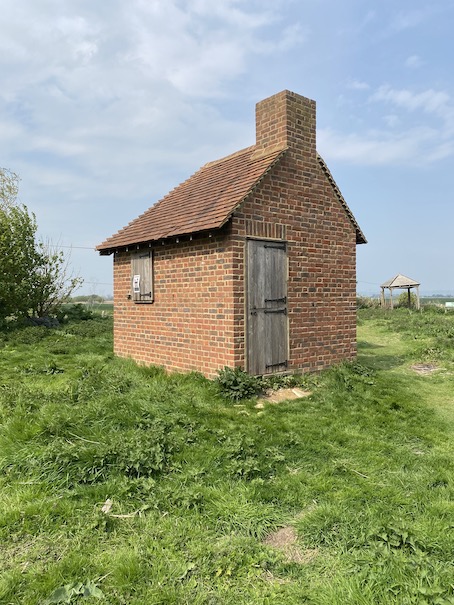
Driving across Romney Marsh in Kent, near the border with Sussex, you cross a flat landscape, characterized by pasture, occasional drainage channels, and isolated, scattered settlements. Here and there the emptiness is relieved by a small medieval church and here and there you spot tiny buildings in fields, like stone or brick sheds. Too small to be houses or barns, they’re lookers’ huts, a unique phenomenon of the marsh, and one that might have vanished completely had it not been for the interest of a few enthusiasts.

The lookers owed their existence to the economic changes that occurred after the Black Death in the mid-14th century. The plague killed a vast number of people (estimates vary between a half and one-third of the population), and the remaining landlords on the marsh bought up small landholdings that no longer had owners or tenants and combined them into larger estates. Here they ran sheep in extensive flocks, and they employed ‘lookers’ to tend them. Lookers worked over a large area, and needed a base where they could store equipment and food, and that would sometimes provide a bed for the night. Hence their huts, which were basic in the extreme (one window, a door) but also had a chimney so that the looker could keep warm in the winter. The lookers’ huts that survive today are not as old as the 14th century – I’d guess most of them are 19th century.

The huts were useful all the year round and vital during the lambing season, when the sheep needled to be constantly checked and cared for, and during shearing, the shepherd’s other time of intensive hands-on work. By the early-20th century, agriculture and then transport were transformed, and there was no longer a need for lookers or their huts. Although robust, many of these buildings, left to decay, have now gone. Around 20 remain, some well maintained, others in ruins. The example in my photograph is a reconstructed looker’s hut at the Romney Marsh Visitor Centre, outside New Romney. It’s there to explain the story of the lookers and their buildings and, as long as a few huts remain in situ, to answer the inevitable questions of observant tourists, who want to know why these tiny structures were sited in the middle of Kentish fields.

- - - - -

For an account of the similar ‘hovels’ of Worcestershire, see my earlier post, here.

Wednesday, September 14, 2011

Romney Marsh, Kent


Another look at the lookers' huts

Just over a year ago I posted about the lookers' huts of Romney Marsh in Kent, those small and simple buildings used for shelter by the shepherds of the marsh. Mark Duncan, the photographer who over the last few years has been making memorable images of these modest buildings, has a new exhibition of the results. The show marks the construction of a new looker's hut – the first to be built in many decades.

I was attracted to Mark Duncan's photographs because of their concentration on these unregarded buildings – plain, brick-built structures, just big enough for the looker and his tools and belongings and for a stove to keep him warm in the chill of the lambing season. But I also admire these pictures because they capture the special atmosphere of the place. Romney Marsh, flat, remote, dotted with churches, weather-boarded houses, and poplars, has caught the eye of many artists, from John Piper to Derek Jarman. Mark Duncan's photographs, with their big skies and their variety of weather conditions and light, capture the place as well as any.

* * *

Mark's exhibition is at the Romney Marsh Visitor Centre, New Romney, from 15 September to 9 October.

There is more about the exhibition here.

Thursday, September 2, 2010

Brookland, Kent


Odd things in churches

Doing the previous post about the lookers’ huts of Romney Marsh reminded me of my last trip to the Marsh a couple of years ago, in the company of friends and marshophiles from Hastings (you know who you are and how grateful I am for your hospitality). A favourite building from that trip was St Augustine’s church at Brookland, with its extraordinary detached belfry shaped like an overgrown candle-snuffer.

Brookland church also has some curious contents – a set of late-18th century weights and measures, a chest said to come from the Spanish Armada, and the odd item shown in the photograph above. What could it be? If you think it looks rather like a sentry box, you’re quite close. It’s apparently designed to provide shelter for a priest taking a funeral service in the churchyard when wind and rain are whipping across the Marsh. The name for this miniature portable building is a hudd or hud, obviously the same word as ‘hood’, although I can’t find a reference in the OED to the term being used in this way.

The funeral hudd is a piece of plain and practical joinery that is just about light enough to trundle out into the churchyard when needed and has just enough space for a person to stand up in. I’m not sure when it was made or when it was last used – it seems redolent of Georgian clergymen wanting to keep their wigs dry, or slightly later ones keeping the mud off their cassocks. Maybe Jane Austen’s Mr Collins would have used a hudd – though he might have worried that it concealed him from the watchful gaze of his patron. Lady Catherine De Bourgh.

Friday, August 27, 2010

Dymchurch, Kent


The lookers and their huts

The flat landscape of Romney Marsh is dotted with a number of small buildings that most of us would hardly give a second glance. Tiny, brick-built, with a pitched roof and a chimney at one end, these are the lookers’ huts that provided shelter for those who looked after sheep on the marsh and who needed to be near their flocks for weeks on end – especially during the lambing season. Although they’re not elaborate pieces of architecture, these huts are important because they were a vital part in the lives of ordinary people for many generations over a period of around 200 years.

Once there were hundreds of lookers’ huts, but now only 12 survive intact. Changes in farming and lifestyle have meant that many have disappeared and, because most of them were in isolated positions they often found no new use. As a result they were seen as superfluous and many were knocked down; others succumbed to time or vandals.

If the remaining lookers’ huts are not to go the way of the rest, wiping out a unique piece of history, they need advocates, and they have a powerful one in Mark Duncan, who has made it his mission to photograph all the remaining huts. Now there is an exhibition of some of his photographs of the huts, highlighting those that are most at risk. I for one hope that Duncan’s exhibition succeeds in its aim to raise awareness of these very special structures and their role in the lives of generations of lookers who worked beneath the endless open skies of Romney Marsh.

* * * *

Giving Up The Ghost, an exhibition of photographs by Mark Duncan, is at the Romney Marsh Visitor Centre, Dymchurch Road, New Romney, Kent, from 28 August to 25 October. There is more about it, with examples of Mark Duncan’s photographs, here.

The photograph above is by Mark Duncan.

Tuesday, July 8, 2008

Brookland, Kent


Brookland has one of the most extraordinary churches on Romney Marsh, a place where several remarkable churches punctuate broad, windswept vistas of sky and greenery. The most unusual feature of the church is the one you see first, as you arrive: the belfry. This is wooden, shingle-clad, octagonal, and, as Pevsner rightly says, like three candle-snuffers stacked one on top of another. It is also detached from the main structure of the church.

A few other Kent churches have spires with a similar profile, but none a detached monster like this. What is it doing here? A good guess would be that the ground hereabouts isn’t very firm and the builders were unwilling to risk a heavy stone tower, which might have subsided and collapsed. The ancient arches of the church interior certainly lean a lot. A lightweight wooden structure was probably a safe option and the belfry seems to be as old as the church – the lower timbers of the octagon are apparently 13th century while the upper ones were added or renewed some 200 years later.

The church itself is as interesting as the belfry. A wooden porch leads into a large space, with two rows of outward-leaning arches (late-13th to early-14th century) lit by windows full of clear glass. Highlights in this light, spacious interior include a lead font (on which figures illustrate the Signs of the Zodiac and the Labours of the Months) plus 18th-century furnishings such as a large two-decker pulpit and box pews. The church escaped the more extreme restoration activities of the Victorians, and is still packed with interest, a wonderful tribute to the ingenuity of medieval carpenters and to the parishioners who have cared for it for more than 700 years.