Wooden leg, or, Odd things in churches (19)
How odd to find the effigy of a medieval leg leaning against one of the piers in the aisle of Hereford cathedral. It’s the leg of Sir Richard Pembridge, a knight from the county, who died in 1375 having fought at the battles of Crecy and Poitiers. He was made a Knight of the Garter by Edward III and his tomb, which was made of alabaster, included his garter insignia on the left leg, in the correct position; there was, in accordance with the custom of the order, no garter on the right leg.
During the 17th century the effigy’s right leg was damaged* and a replacement leg, made out of wood, was made and fitted to the monument. However, this replacement was carved with a garter. During the 19th century, the Archdeacon of Hereford, Lord Saye and Sele, had a new leg made in the correct material, alabaster, and without the garter. This replaced the wooden leg, putting everything right with the monument.
At this point, the wooden leg was removed and passed into private hands until, much later, its owner gave it back to the cathedral, where it was displayed, standing very gamely by the pier and indeed securely attached to it, lest it wander from its home once more. Here it remains, to interest visitors and to tell this curious story of a mistake rectified. You really never know what you are going to find in churches and cathedrals.
- - - - -
* This may have been something to do with the Civil War.
Showing posts with label odd things in churches. Show all posts
Tuesday, July 28, 2026
Tuesday, June 4, 2024
Rock, Worcestershire
For many of us, weathercocks are almost synonymous with churches. It was back in the 9th century that Pope Nicholas I decreed that a cockerel should be displayed at the uppermost point of every parish church, a reminder of the fateful triple crowing of the cock that signalled Peter’s betrayal of Christ. The practice of putting a rooster on every church long ago fell into neglect (if it was ever universal), but hundreds of churches still have weathercocks, combining the function of symbol with that of practical use. Know the wind direction and you’re part of the way to forecasting the weather. ‘If that cock’s pointing down the street and there’s a dark cloud over the hill,’ said an old gardener from our neighbourhood, ‘It’ll be raining here in an hour.’ He was right, and such knowledge is useful not only to gardeners but also to the farmers and farm workers who were for centuries the mainstays of the rural economy.
Nothing odd, then, about weathercocks on churches. But a weathercock inside a church is decidedly odd. And yet, what do you do with a rooster that has to be taken down from the tower? Throw him away or send him for scrap metal to be melted down? Maybe there’s a better way. Doesn’t it make sense to set him up inside the church, where his symbolic function survives and he represents a bit of church history? Or perhaps you should keep him safe, against the day when funds can be found to re-erect him on the tower, where he belongs.
Whatever the motivation for keeping this weathercock indoors, I was pleased to see him here, where he provided a few minutes’ distraction from Romanesque carvings and other delights in the church at Rock. Close-up, in spite or perhaps because of the repairs, bolts and rivets, he’s revealed as an appealing bit of folk sculpture, perhaps the proud work of a local blacksmith. The details of the head are sketched by way of telling cuts in the metal: eye, bill, comb, crest. The body is surprisingly slim, making me wonder if weathercocks (and maybe actual roosters) got plumper in more recent years. The tail is splendidly broad, its pattern of holes suggesting feathers and presumably leaving enough metal to catch the wind. In a collection of folk art like the wonderful one at Compton Verney, this would be a star exhibit. Here, in its rightful local setting, it’s a delight.
Saturday, September 4, 2021
Puddletown, Dorset
Here comes the Sun, or, Odd things in churches (14)
People who look carefully at old buildings will know all about the Sun Fire Office. It was an insurance company, founded in 1710, and it’s still going in a different form. It’s familiar to devotees of old houses because the company’s clients used to fix a metal plaque bearing the company name and symbol (the Sun in splendour, naturally) to the fronts of their houses. Then when the Sun sent out their fire-fighters, they would know you’d paid for the service and would attack the blaze with whatever equipment they had.
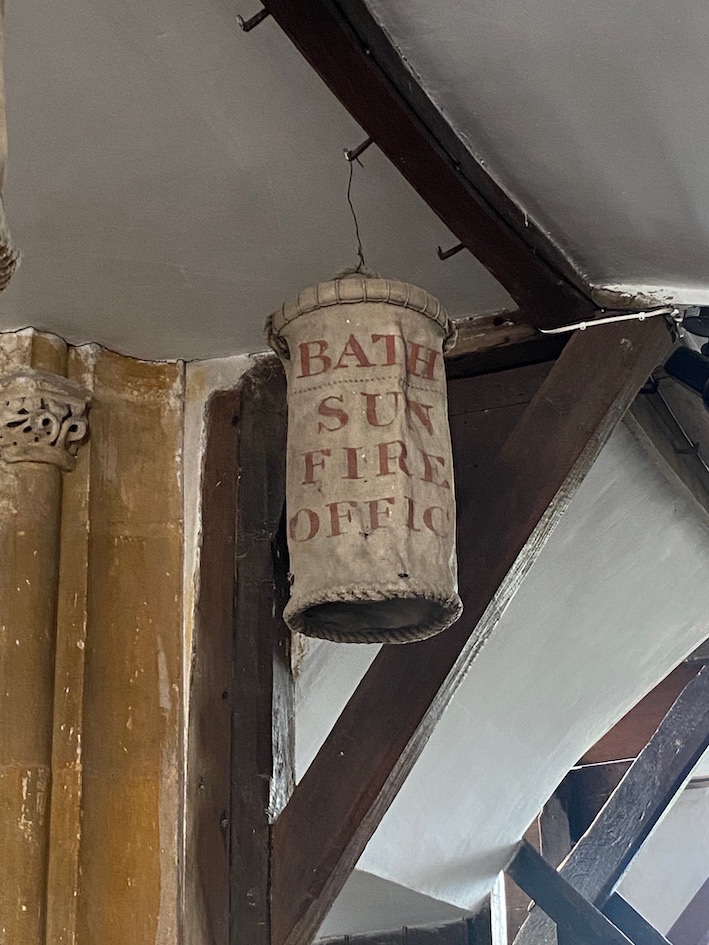
One aid to fire-fighting was provided by fire buckets filled with water or sand. One often sees bright red metal ones hanging on the platforms of stations on preserved railway lines. But back in the days when the Sun Fire Office first started, canvas buckets were also in use. I’d never seen these in a church before, but at Puddletown several remain, hanging from hooks under the west gallery. There are many more hooks than buckets, so perhaps originally there were more. More would be a good idea, as they’re not very large and a couple would not go very far when extinguishing a fire of any size larger than a smouldering pipe left in an absent-minded church warden’s pocket. These fire buckets now go on an informal list I keep in my head of fire-fighting equipment I’ve spotted in churches – fire hooks for removing burning thatch and the occasional rare hand-pumped fire engine are also included. All a far cry from today’s enormous fire engines with their turntables and ladders, but as welcome in extremis as their diesel-powered descendants can be today.
People who look carefully at old buildings will know all about the Sun Fire Office. It was an insurance company, founded in 1710, and it’s still going in a different form. It’s familiar to devotees of old houses because the company’s clients used to fix a metal plaque bearing the company name and symbol (the Sun in splendour, naturally) to the fronts of their houses. Then when the Sun sent out their fire-fighters, they would know you’d paid for the service and would attack the blaze with whatever equipment they had.
One aid to fire-fighting was provided by fire buckets filled with water or sand. One often sees bright red metal ones hanging on the platforms of stations on preserved railway lines. But back in the days when the Sun Fire Office first started, canvas buckets were also in use. I’d never seen these in a church before, but at Puddletown several remain, hanging from hooks under the west gallery. There are many more hooks than buckets, so perhaps originally there were more. More would be a good idea, as they’re not very large and a couple would not go very far when extinguishing a fire of any size larger than a smouldering pipe left in an absent-minded church warden’s pocket. These fire buckets now go on an informal list I keep in my head of fire-fighting equipment I’ve spotted in churches – fire hooks for removing burning thatch and the occasional rare hand-pumped fire engine are also included. All a far cry from today’s enormous fire engines with their turntables and ladders, but as welcome in extremis as their diesel-powered descendants can be today.
Tuesday, March 20, 2018
Llandinabo, Herefordshire
Church woodwork, or, Odd things in churches (10)
I have made it part of the business of this blog to bring you the odd, the unusual, and the unexpected, and I’ve found that English churches sometimes contain the most unexpected things of all. Over the years we have had a fire engine, a ducking stool, and, particularly dear to me, Milner’s Patent Fire-resistant Safe. I didn’t expect to find anything odd at Llandinabo, a church I’d passed quite a few times before I got round to stopping there. I’d read that there was some interesting woodwork – a fine screen – in the church, but, just for fun, here’s a very different kind of woodwork that I also found.
There seemed to be nothing to tell me who’d made this matchstick model of the church, which stands on a window ledge inside the building it reproduces. It’s painstaking, reasonably accurate, and a joyous bit of English, or Welsh, eccentricity. (Llandinabo is in England, but, as the name signals, it’s not too far from the Welsh border.) The modeller has caught the pierced roof ridge tiles, the timber-framing of the bellcote, and the openwork wooden porch, although he (I feel sure it was a he) had trouble with reproducing the exact pointed shape of the Gothic windows. But never mind. Anyone who can get this far deserves an alpha for effort as far as I’m concerned. I was reminded of the Eccentric Corner at the South Bank exhibition of the Festival of Britain where, apparently, there was a violin made of matchsticks, which Laurie Lee (exhibition caption writer) picked up and played quite successfully.
Of course, in the world of matchstick modelling, this is very modest stuff. A quick online search reveals people who have spent years making models of complex buildings like Notre Dame in Paris. There’s a particularly good one of Llandaff Cathedral, made by one Bill Tucker. Hats off to people with patience!
Monday, November 24, 2014
Leominster, Herefordshire
Rough justice, or, Odd things in churches (8)
It’s time for another of my odd things in churches, and this one is particularly odd.
The ducking or cucking stool was an instrument of punishment, used in the Middle Ages and later, generally for to those who spread malicious rumours or tradespeople who gave short weight. The term ‘cucking stool’, literally ‘defecating stool’, refers to a chair, sometimes in the form of a commode, fitted with wheels and trundled around the town with the guilty person on board. The aim was to humiliate the malefactor, humiliation being a key part of punishment in the medieval and early modern periods (as with the use of stocks and pillories). A ducking stool took the punishment a step further by incorporating an arrangement of beams so that the person could be dunked in a river or lake.
The town where I live has a street called Duck Street because it was the site of the local ducking stool, which has long vanished. One place where a ducking stool can still be seen is Leominster Priory, where it is kept parked against a wall, looking as if it could easily be trundled out of the church to duck any criminal deemed to need the soggy treatment. According to the information displayed with the Leominster stool, it was last used in 1809, ‘when a woman, Jenny Pipes, alias Jane Curran, was ducked in one of the adjacent streams’.
The ducking stool was often used to punish women. Langland, in Piers Plowman, refers to it as a punishment for wyuen (women), and it is commonly written about as a way of dealing with ‘gossips’ and ‘common scolds’ and dousing the fire in their mouths. In the words of an old poem quoted on a poster next to the Leominster stool:
No brawling wives no furious wenches,
No fire so hot but water quenches.
A sexist punishment, then, in part at least. But I wouldn’t want to have been a butcher who gave gave short weight on the sides of meat.
Leominster: the entire machine
Saturday, August 16, 2014
Hoarwithy, Herefordshire
Oasis, or Odd things in churches (9)
There are certain churches that I like to return to every now and then. They are mostly small and often remote or in villages that are off the beaten track in places like Herefordshire or Gloucestershire. They are usually old and quiet and though (as with Abbey Dore or Kilpeck) they may be architectural treasures, it is often atmosphere and peace as much as architecture that occupy me – these qualities take me back, for example, to Dunitsbourne Rouse or Inglesham, places where the combination of isolation and layers of history suggest that they have been oases of calm for hundreds of years.
Hoarwithy, J P Seddon’s great Byzantine-revival church in Herefordshire, is starting to become another of these places. There is not much to beat the way its square sandstone pyramid-topped tower rises out of the landscape, so that, if you look the right way, you can imagine yourself in Tuscany or the Veneto talking not of a bell-tower but of a campanile. Mosaics, tessellated flooring, carved capitals, and hanging lamps fulfil the promise inside.
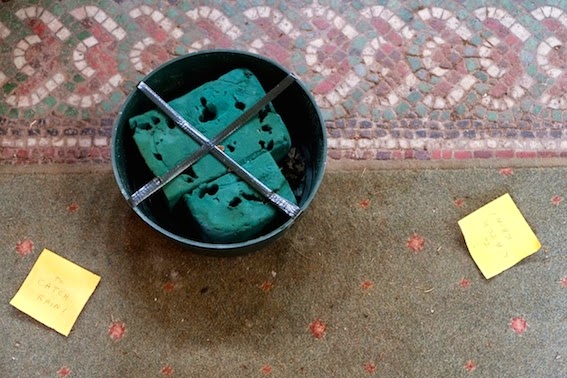
But then, on my most recent visit, there was this small shock. A flower vase placed carefully on the floor of the nave, with yellow Post-It Notes nearby. ‘TO CATCH RAIN!’ say the notes. The building has already undergone some major repairs to the tower stonework recently, so one hopes, given the small size of the bowl full of water-absorbing material, that the roof has only a minor leak, and that the parish will soon be able to get the problem put right.
I nearly called this post ‘Sad things in churches’, because it is sad, when buckets and vases have to be pressed into service to catch rain. But as I sat in the nave and pondered this state of affairs and savoured the quiet, I remembered that the water-absorbing floral foam in the vase is also known by the name of Oasis. Reminded once more of those oases of calm, I hoped that dryness would be restored as soon as possible, stuck a donation in the alms box, and went, quietly, on my way.
- - -
My earlier post about this church, here, provides some more architectural detail, and a couple of different photographs.
Sunday, June 22, 2014
Ripple, Worcestershire
A trough, but for what, or whom? or, Odd things in churches (6)
In the church porch at Ripple stands this curious shallow stone trough. When I first saw it I didn’t know quite what to make of it and at first took it as something displaced from a garden. Before I could wonder which plants might look good in it, though, I caught sight of a nearby label, which says that the trough is ‘traditionally’ said to have been used as a container for food for lepers or others with infectious diseases. The idea was that the trough would be placed by the roadside, away from houses, at a point where those with leprosy could come and collect food left by the charitable. Later, when it fell out of use, the trough was moved to the church for preservation.
I don’t know how much store to set by this tradition. I’ve not come across anything quite like this before, though there’s a tendency to explain certain architectural features of churches (leper squints, leper windows, and so on) by linking them to the needs of those whose infectious condition prevented them from entering the church building. I’m not sure how much actual evidence there is for these connections. Meanwhile, the stone trough of Ripple is doing sterling service as an umbrella sand. Here’s to versatility.
Saturday, May 17, 2014
Cirencester, Gloucestershire
Exit, pursued by a hare, or, Odd things in churches (5)
It started with cows. The first CowParade was held in Chicago in 1999. Artists – established or unknown, amateur or professional, young or old – decorated fibreglass cows, which were then placed at strategic places in the city. After a time on display, the cows were corralled in one place and auctioned, funds being donated to charity. Since then there have been CowParade events in many cities all over the world, from New York City to Prague, Istanbul to Rio.
CowParade, a brand owned by CowParade Holdings Corporation, has raised more than $20 million for charity through the auction of cows bearing the work of more than 5,000 artists. Cows are much liked and, with their gentle curves and generous flanks, have proved fulfilling artistic canvases. But there have also been local endeavours, quite separate from CowParade but very much in its spirit. Bath, taking its cue from the presence of the pig in its foundation myth, held an event called King Bladud’s Pigs in 2008. Now comes Cirencester, with hares. Hares because there’s a wonderful hare on a Roman mosaic discovered on a dig in the town in 1971 – it’s now the symbol of the excellent Corinium Museum. The March Hare Festival is not on a huge scale, but Cirencester is no Chicago – 25 hares are scattered around the town, their decoration ranging from ancient Egyptian in style to modernist-inspired, and hare-spotting has become a favourite pastime for locals and tourists alike. Promoting tourism, indeed, is one of the aims of the project, but money from the eventual sale of the hares will be used for environmental and educational projects in and around the town.
So that’s how this hare comes to be in Cirencester’s glorious late-medieval parish church. This particular hare was decorated by the designer and television personality Laurence Llewelyn-Bowen. At first glance, it seems as if the flamboyant Mr Llewelyn-Bowen has produced a rather muted design, in a restrained palate. But look more closely (click on the image to enlarge it) and one discovers that the découpé images applied to the hare are somewhat provocative. More redolent of the boudoir than the church, they’ll cause a few raised eyebrows – and even more smiles. Sonnez la cloche!
Saturday, April 26, 2014
Ross on Wye, Herefordshire
Kyrle’s green shoots, or, Odd things in churches (4)
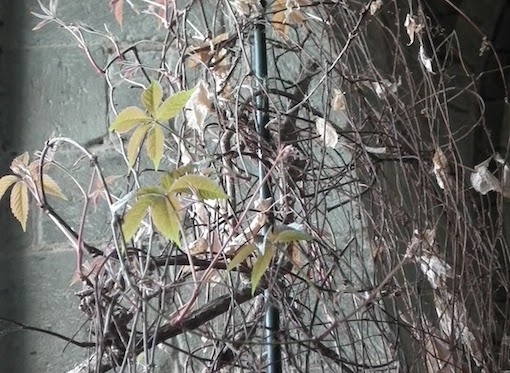
Although one is used to seeing creepers and climbing plants of all sorts growing up the outer walls of buildings, it’s unusual to find them inside, but that’s what happens near the window at the east end of the north aisle in the parish church at Ross. These indoor creepers owe their presence to an ancient tradition.
In 1684, John Kyrle, who, known as the ‘Man of Ross’ had made numerous benefactions to his town, planted some elm trees in the churchyard. Some time later, after Kyrle had died, some shoots from one of the trees grew up through the floor of the north aisle and the parishioners, thinking it a good omen that a tree planted by the great man should be entering the church, let them be. They remained until the parent tree died and was felled in 1878.
These creepers were planted as replacements for Kyrle’s shoots and as a symbol of his good works in the town. Ross should need little reminder of their benefactor, though. Evidence of his works – a plaque in the town, his monument in the church, and enduring benefits such as the public garden known as the Prospect – survive as indications of his achievements.
Wednesday, March 19, 2014
Great Wishford, Wiltshire
Hands to the pump, or, Odd things in churches (3)
One of the oldest fire engines in Britain is kept in St Giles Church Great Wishford. The churchwardens bought the fire engine from engineer Richard Newsham in 1728. It was a horse-drawn appliance and the pumps inside were hand operated and could shift about 65 gallons of water per minute – you needed a team of ten or so people working the pump handles to achieve this. The machine was quite costly – the churchwardens paid £33 and 3 shillings for it, a considerable sum in the 1720s – but it must have been worth it at a time when there was no organized fire service, timber buildings made fires a frequent hazard, and the system of fire insurance that evolved in the 18th century only covered those who paid the premium. Even in the Victorian period, and well into the 20th century, the fire engine was still apparently used in the village.
I don't think the fire engine was originally kept in the church, although in a way it would have made sense to keep it there – everyone would have known where it was and access would have been easy. And in the 18th century people were a lot less precious about using a church in this way than they were in later periods. Nowadays, we half expect to find relics and curiosities of former ages in our churches, but even bearing this in mind, coming across this shining red monster is quite a surprise.
- - -
The photograph is © Copyright Miss Steel and licensed for reuse under this Creative Commons License.
Saturday, February 15, 2014
Dinton, Buckinghamshire
With restraint, or, Odd things in churches (2)
A set of stocks does seem an odd thing to find in a church, but it's less odd if viewed in a historical perspective. In the 16th century, the vestry, a committee of parishioners chaired by the church's incumbent, was becoming the key body in parish government. Its responsibilities embraced civil as well as ecclesiastical affairs and included keeping the peace, dealing with vagrants, mending roads, and destroying vermin. These important roles of the vestry continued until Parish Councils were introduced in the late-19th century. Maintaining instruments of punishment, such as stocks and whipping posts, was therefore part of the work of the vestry, and sometimes stocks were set up by the churchyard wall. A few have found their way into the church as historical curiosities, like this set in Dinton, which is kept in the church porch.
Malefactors – drunks, rowdies, vagrants, and scolds – were often put in the stocks for a while, the mixture of shame, inconvenience, and discomfort being a punishment and a way of detaining people until they calmed down, or sobered up. Perhaps the main punishment was that, stuck in the stocks with feet clasped firmly, a person was brought down a peg or two and was, indeed, a laughing stock.
There's one other curious thing about these stocks, though. There are five holes, and an odd number of holes doesn't seem to go with the usual human complement of two feet. The town where I live also has an old set of stocks with an odd number of holes and the tradition here is that they were made that way because a one-legged man was among the local wild bunch who often got into trouble. I don't know how true this is. Maybe having a single foot in the stocks was considered restraint enough: you certainly wouldn't be walking anywhere with one foot stuck in there. But an uneven number of holes certainly makes these stocks in the porch of Dinton church numerically, as well as ecclesiastically, odd.
Monday, January 20, 2014
Stoke Dry, Rutland
On looking the other way, or, Odd things in churches (1)
When Mr A and I push open the church door, we're immediately aware of a man with a large tripod, taking pictures near the chancel arch. We exchange 'Good afternoon's. 'You know what you should be looking at?' says the man. Mr A (we're near his home patch) nods, and gestures towards the Romanesque carvings that the man is photographing. And then I tiptoe away.
Typical, you will say. When I should be looking at Romanesque carvings and an extraordinary wall painting of the martyrdom of St Edmund, what do I find? An old trunk. Some remains of a flower arrangement in an earthenware jug. And Milner's Patent Fire-resistant Safe. Rather the worse for wear but complete with Gothic moulding on the door (to show that it's at home in a church) and sunlight from a nearby window catching the gold roundel. There really is no end to the odd things you see in churches, especially when, for a moment or two, you turn your back on the obvious.
- - -
Mr A's own blog contains a similar post about a church on my patch that I took him to some years ago. For connoisseurs of the quotidian, it's here.
Saturday, May 5, 2012
Peterchurch, Herefordshire
Fishy, or, Odd things in churches (7)
The church of St Peter, Peterchurch is one of Herefordshire's outstanding Norman buildings. I hope to return to its architecture in a later post, but before I do, I would like to share something odd about this place. High on the south wall of the nave is this panel, apparently a plaster relief of a fish with a gold chain around its neck to which are added the names of some churchwardens and the date 1828.
There were quite a few people in the church when I visited it - parents collecting children who had been doing Saturday-morning activities, borrowers using the library in the bell tower - for this is a very well used building, clearly a church at the heart of its community. But no one that I asked could account for the relief.
Is it the portrait of a fish caught in the nearby River Dore? Is the golden chain a pun on the name of the river (d'or being French for 'of gold'?). Is it perhaps as P. Thoresby Jones speculates in Welsh Border Country, the only book I have that mentions the relief, 'a figure dedicated in gratitude after the ancient Greek fashion by some pious angler'? Or something to do with St Peter's trade of fisherman? Perhaps one of my readers can provide the answer.
* * *
Since I posted this I've had several interesting comments about the fish. I'd assumed it was a carp, mainly because that was what Thoresby Jones called it in the book to which I referred. But a commenter on my post suggests that the relief represents a huge trout caught locally. Follow the Comments link below for more details.
The church of St Peter, Peterchurch is one of Herefordshire's outstanding Norman buildings. I hope to return to its architecture in a later post, but before I do, I would like to share something odd about this place. High on the south wall of the nave is this panel, apparently a plaster relief of a fish with a gold chain around its neck to which are added the names of some churchwardens and the date 1828.
There were quite a few people in the church when I visited it - parents collecting children who had been doing Saturday-morning activities, borrowers using the library in the bell tower - for this is a very well used building, clearly a church at the heart of its community. But no one that I asked could account for the relief.
Is it the portrait of a fish caught in the nearby River Dore? Is the golden chain a pun on the name of the river (d'or being French for 'of gold'?). Is it perhaps as P. Thoresby Jones speculates in Welsh Border Country, the only book I have that mentions the relief, 'a figure dedicated in gratitude after the ancient Greek fashion by some pious angler'? Or something to do with St Peter's trade of fisherman? Perhaps one of my readers can provide the answer.
* * *
Since I posted this I've had several interesting comments about the fish. I'd assumed it was a carp, mainly because that was what Thoresby Jones called it in the book to which I referred. But a commenter on my post suggests that the relief represents a huge trout caught locally. Follow the Comments link below for more details.
Thursday, September 2, 2010
Brookland, Kent

Odd things in churches
Doing the previous post about the lookers’ huts of Romney Marsh reminded me of my last trip to the Marsh a couple of years ago, in the company of friends and marshophiles from Hastings (you know who you are and how grateful I am for your hospitality). A favourite building from that trip was St Augustine’s church at Brookland, with its extraordinary detached belfry shaped like an overgrown candle-snuffer.
Brookland church also has some curious contents – a set of late-18th century weights and measures, a chest said to come from the Spanish Armada, and the odd item shown in the photograph above. What could it be? If you think it looks rather like a sentry box, you’re quite close. It’s apparently designed to provide shelter for a priest taking a funeral service in the churchyard when wind and rain are whipping across the Marsh. The name for this miniature portable building is a hudd or hud, obviously the same word as ‘hood’, although I can’t find a reference in the OED to the term being used in this way.
The funeral hudd is a piece of plain and practical joinery that is just about light enough to trundle out into the churchyard when needed and has just enough space for a person to stand up in. I’m not sure when it was made or when it was last used – it seems redolent of Georgian clergymen wanting to keep their wigs dry, or slightly later ones keeping the mud off their cassocks. Maybe Jane Austen’s Mr Collins would have used a hudd – though he might have worried that it concealed him from the watchful gaze of his patron. Lady Catherine De Bourgh.
Subscribe to:
Posts (Atom)