Showing posts with label time. Show all posts

Monday, December 5, 2022

Bedford


Clock and bull story

Like my previous post, this is another Victorian shop facade that caught my eye on a rainy day in Bedford not long ago. Actually it was the clock and its accompanying bull that attracted me first. ‘A fancy job,’ I thought to myself. ‘I wonder if the shop below belonged to a jeweller.’ Jewellers often combined their craft with that of clockmaker and would put a clock on their premises as a way of showing off their wares while also attracting attention. The building did indeed house a jeweller, and was built in 1878. The style is unlike that of Adkin’s building in my previous – Venetian Gothic has been replaced by a version of what became known as Queen Anne – red bricks, terracotta decorative panels, and a lot of fancywork using special bricks to form pilasters, pediments, keystones and other details. The gable is still elaborate, but this time in a classical way, in contrast to the Gothic form of Adkin’s building. There was once a figure of Father Time in the niche above the clock, but he seems to have been overtaken by the very time he represented, and is no more.

As for the clock, it certainly worked for me in that it attracted my attention. The fancy gilded decoration. and the iron scrolls around the edge of the case do the business, as does the golden bull. What is he doing there? Was the building later home to a butcher? Well, the occupant’s name was John Bull, so this imposing creature is a rebus, a symbol of the family name, not an indication that this address was once home to a butcher (although, as it happens, it was). Pevsner tells us that he is a replacement. So someone has been caring for this elaborate bit of street decoration, although not to the extent of getting the clock to show the right time. Accuracy in timekeeping was of course a major concern to clockmakers like John Bull. Apparently there was once a vertical pole set behind the clock, with a ball set near the top of it. At precisely 10.00 am every morning, the ball slid down the pole, striking a bell in the process. The mechanism was activated by an electrical signal from the Royal Observatory at Greenwich, thus providing guaranteed accurate time, from which locals could set their watches. Alas on the day I took this photograph, the clock did not display the correct time, but maybe this lapse has by now been rectified.

Wednesday, June 2, 2021

Elmley Castle, Worcestershire


Here comes the sun

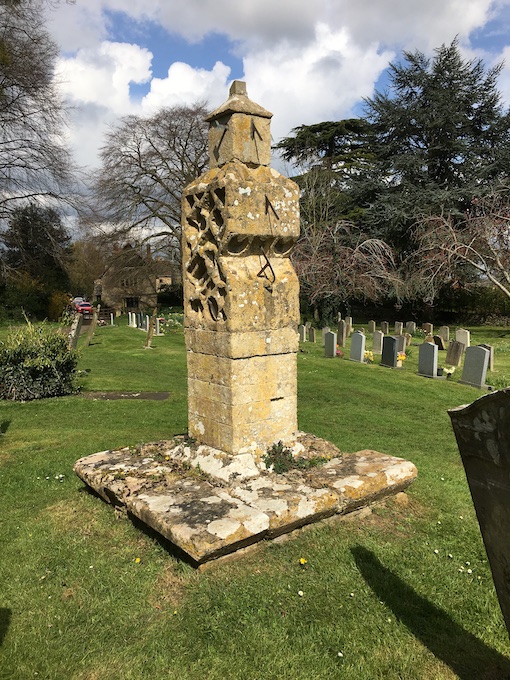
When you’ve visited as many parish churches as I have, you get used to finding odd things in churchyards, from bee shelters to bone holes. Sundials come fairly low on the scale of oddity. Time is after all a familiar religious theme, whether in terms of knowing it’s time for divine service or in terms of thoughts about human mortality (‘You’ve had your time’) or a person’s best use of their time (‘Redeem thy precious time’). Before the era of church clocks with faces everyone could see, marking time was a matter of bells to call one to church (or to indicate that the solemn moment of the elevation of the Host at Mass had arrived. Or it was a matter of sundials. But these sundials in the churchyard at Elmley Castle are exceptional. There are two, and each has many separate dials, facing in different directions, and set in different ways, in part to catch the sun at different times, and in part for reasons that experts on sundials may know much better than I.

No one seems certain about the date of thee dials, although there’s a consensus that they are 16th or 17th century. Some writers link the dials to the visit of Elizabeth I to the village in 1550, when she may have consulted them. The decorative carving, making up an unusual concatenation of moldings, is not incompatible with these dates. Whenever they were made, they are much worn and in spite of the restoration of the gnomons in the 20th century, some of those have already disappeared again, as if the dials seem determined to remind us of the relentlessness of the passing time they are designed to mark.

One dial bears the coat of arms of the Savage family, lords of the manor from the mid-16th century on, in the form in which it appears on a monument inside the church to William Savage, his son Giles and Giles’s wife Catherine, who died in 1616, 1631 and 1674 respectively. It’s likely that the dials were made in the time of the Savages, and owe something to their culture and scholarship, or of that of the vicar in charge of the parish in that period. Someone in the village was certainly a sundial enthusiast, probably someone who had knowledge of and interest in the science of telling the time when clocks were generally inaccurate and the sun, even in England, was the most reliable source of time we had. Like a rich man with a Rolex or a Breitling Chronograph today, they wanted the best, and no trouble was spared.


Saturday, August 27, 2016

Coningsby, Lincolnshire


About time

I must have been only about 7 or 8 years old when I first saw the tower of Coningsby church. My father pointed through the windscreen as we approached the village, telling me that I had to take a look at this clock: there was something unusual about it. I noticed at once its extra-large size. At about 16 feet across it was easily the biggest clock face I’d seen. But it seemed to be telling the wrong time. It took me a minute to work out that it has just one hand, an hour hand, so half past nine in the photograph above looks at first glance like twelve minutes to four.

With a really big clock face a single hand doesn’t work badly. When you look closely, you can see that the face is marked in quarters of an hour, with a red diamond at each half hour, so with practice you can read the time to within a few minutes. And to make a face like this you don’t need any complicated metalwork or carpentry – it’s just painted on to the stone of the wall: a good sign-writer could do it. The mechanism of the clock must be simpler too – and is apparently 17th century so has stood the test of time. Hats off to the clock-maker…and to the people who climb 35 steps to the winding mechanism every day to wind the clock and keep it going. Time well spent.

Sunday, July 5, 2009

Ruardean, Gloucestershire


The nick of time

Some of the greatest pleasures are the unexpected ones. I went to Ruardean in search of a Norman carving above the church doorway. But before I got near the church itself I was struck by this inscription, which is on the inside of the small lychgate that forms the entrance to the churchyard. The sun lit up the lychgate’s stone wall as I looked at it and, since the resulting photograph is very contrasty, here’s the text for the sake of clarity and ease of reading:
Redeeme thy precious Time which steals So fast away
and in gods Hous forgiveness Ask, and for Salvation Pray.
May ye 10th 1743
James Mutlow & Hendrey Heane, Churchwardens

I don’t know where these words come from, but they are similar to those of Bishop Ken’s morning hymn, which he wrote in the late-17th century but redrafted later, so that there are several different wordings, one of which includes the lines
Thy precious time misspent, redeem,
Each present day thy last esteem.

Ken’s hymn was widely circulated in A Manual of Prayers (1709) and so would no doubt have been a familiar part of the religious landscape when this variation on the theme of redeeming time was carved. The words also look as if they would do for a sundial, and I felt it was appropriate somehow for the setting evening sun to bathe them in warmth in my photograph.

The other thing that caught my eye, of course, is the style in which the letters are cut, with the plain forms now and then garnished with something capricious and different – the capital T of ‘Time’ and P of ‘Pray’. And the final s of ‘churchwardens’ looks like a determined effort not to be broken by the last straw – the word might have been made to fit if the corner had not chipped off the stone. In the nick of time, as it were, the carver decided to stick the ‘s’ on top of the ‘n’. And call it a day.

Wednesday, April 1, 2009

Bromyard, Herefordshire


April foolery

This clock was designed by Michael N. Oxenham and made by Robert Race. It was put up to commemorate the Millennium and I prefer it to some of the more grandiose and overblown structures that were erected at that time. It makes a pleasant distraction on the front of a timber-framed building, now a gallery, in the square in the Herefordshire town of Bromyard, a place full of interest, to which I hope to return. Meanwhile I shall savour this unusual way of making a mark and marking the time.