Showing posts with label Anstey. Show all posts
Friday, May 13, 2016
Anstey, Hertfordshire
Fishy (1)
My recent visit to Anstey in Hertfordshire has already yielded one post, about the unusual lychgate at the entrance to the churchyard. One of the other surprises of the place was inside the church – this striking carved font, which probably dates to the very late 12th century or early 13th century.* The carving portrays a quartet of mermen with tails that divide in two and curl upwards so that the mermen can grasp the ends in their hands. This form of divided tail is quite common in medieval depictions of mermaids, but I don’t remember having seen mermen like this before, although apparently there’s a similar font in St Peter’s church in Cambridge, which I visited a very long time ago.
Mermaids are altogether rather more common in medieval art than their male counterparts. Often shown carrying mirrors and combs, they were symbols of vanity and were also seen as posing a danger to sailors.† So there are mermaids in roof bosses, in woodcarvings, and in the water through which St Christopher wades bearing the Christ child as he goes, in many a medieval wall painting.
Mermen didn’t carry such a heavy moral message and don’t appear to have been portrayed so often. They seem an odd choice for a font, where the decoration more often shows the sacraments, or a scene of Baptism, or simply abstract patterns or tracery. Perhaps some contrast is being implied between the wild creatures that dwell in the open ocean and the protected and sanctified bowl of the font, which will be filled with holy water.
Be that as it may, the mermen of Anstey, with their bold, if rather simple carving, make the font stand out.
- - - - -
*This is the date range given on the excellent Corpus of Romanesque Sculpture in Britain and Ireland website; the writers base their estimate on the style of the carving.
†There seems to have been some confusion between mermaids and the sirens of classical myth too.
Friday, April 8, 2016
Anstey, Hertfordshire
Dual-purpose
I really enjoyed my visit to the church at Anstey, which took place as the ringers were at work before a wedding, making it memorable sonically as well as visually and historically. But even before I got inside and started to look at the wonderful font, medieval graffiti, and other delights, the interest had started – right at the entrance to the churchyard.
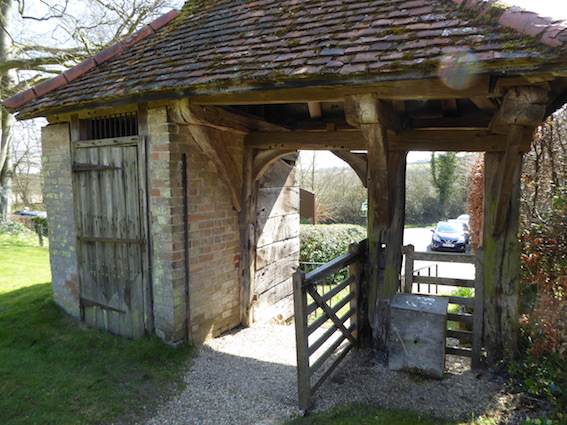
This lychgate, said to be 15th-century or even older in its original form, is a timber-framed structure with a beautiful red-tiled gabletted roof, set on a gently rising footpath and framed by banks of grass dotted with primroses. So far, so marvellous. But what’s the bit walled in with flint and brickwork on the right-hand side? Once you’re through the gate, things become clear – it’s the village lock-up! It’s rather utilitarian from the other side, but no doubt served its purpose. The lock-up or “cage” was added to the lychgate in 1831 and kept drunks and other minor malefactors off the streets until, apparently, the beginning of the 20th century.
I’ve not come across a lock-up combined with a lychgate before. No doubt my readers will supply me with other examples, if any exist. For such are the pleasures of blogging: sharing your enthusiasms and learning about one’s readers’ enthusiasms too.
I really enjoyed my visit to the church at Anstey, which took place as the ringers were at work before a wedding, making it memorable sonically as well as visually and historically. But even before I got inside and started to look at the wonderful font, medieval graffiti, and other delights, the interest had started – right at the entrance to the churchyard.
This lychgate, said to be 15th-century or even older in its original form, is a timber-framed structure with a beautiful red-tiled gabletted roof, set on a gently rising footpath and framed by banks of grass dotted with primroses. So far, so marvellous. But what’s the bit walled in with flint and brickwork on the right-hand side? Once you’re through the gate, things become clear – it’s the village lock-up! It’s rather utilitarian from the other side, but no doubt served its purpose. The lock-up or “cage” was added to the lychgate in 1831 and kept drunks and other minor malefactors off the streets until, apparently, the beginning of the 20th century.
I’ve not come across a lock-up combined with a lychgate before. No doubt my readers will supply me with other examples, if any exist. For such are the pleasures of blogging: sharing your enthusiasms and learning about one’s readers’ enthusiasms too.
Subscribe to:
Comments (Atom)