A touch of the baroque, 2
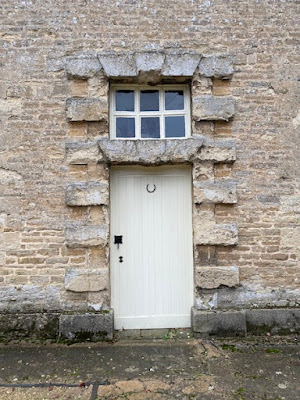
My second photograph from Rousham shows a doorway in the stable block* near the house. The stable block has a central pediment under which is a tall, narrow round-headed arch; blind windows and minimal capitals abound, giving the whole facade a heavy appearance that is relieved to a certain extent by an octagonal turret capped with an ogee cupola. The smaller doorways like the one in my picture have Gibbs surrounds – alternating long and short blocks with the long ones protruding – plus heavy lintels with prominent keystones.
Gibbs surrounds can look very refined on Georgian townhouses in London or Stamford, where they will have smoothly finished blocks. Here the effect is more rustic, because of the roughness of the stone, the simple plank door, and the plain window above. That, perhaps, is not inappropriate for a service building of a great house, and other evidence of good upkeep (such as the pristine paintwork here) makes me feel sure that the estate is keeping an eye on the stonework – this place is as well looked after as the very fancy chickens and cockerels that cluck and crow in the yard. In all it’s not, I’d say, a bad sight to greet the eye as one drives under the adjacent arch to park and emerges, ticket in hand, to enjoy a masterpiece of English landscape gardening.
- - - - -
* It’s ‘almost certainly by Kent’, Pevsner opines.
Showing posts with label Gibbs. Show all posts
Saturday, January 22, 2022
Sunday, December 22, 2019
Worcester
In Worcester the other day, I paused briefly as the afternoon sun went down, moved out of collision range of passing Christmas shoppers, and spent a few moments admiring the impressive array of buildings on the city’s main street. It’s a row of varied structures including a house, a couple of banks, a church, and a hotel, and positioned as it is in the centre of the city it’s surprisingly easy to walk past, dodge other pedestrians most of whom are heading resolutely for the shops, and not give any of it a second glance.
But, as regular readers will know, it’s one of the points of this blog to linger over architecture that’s most often unregarded or taken for granted. So what have we got here? First, in the foreground, my photograph shows half of an early-18th century brick building that I take to have been built as a house. This shows the decorative grace that Georgian classicism can achieve – acanthus keystones above the windows, swags below, neat quoins and cornice, and a finely detailed Ionic doorway. Next to it is a former bank, designed in the Edwardian baroque style by Charles Heathcote of Manchester in 1906. Although smaller than its neighbours, it manages to be very grand, its Portland stone frontage oozing telling details like those columns on the upper floor, the circular window above the doorway, and the iron balcony on the side wall, as if to enable the manager to look down on the hoi polloi below and calculate their credit ratings by eye before they even reach the front door.
Beyond that building is the other bank, dating to 1861–2. Its detailing is a little more restrained than that of its smaller neighbour, more Renaissance palace than baroque, as Pevsner observes. It was built for the Worcester City and County Bank as their headquarters, and this local business fittingly chose a local architect, E. W. Elmslie, who made such a mark on Malvern.
Next in line is St Nicholas Church, now, like the first bank, given over to eating and drinking. The architect of this building of the 1730s is not known but Pevsner tells us that the landmark tower is taken from a design by James Gibbs, one he did but rejected for the church of St Mary Le Strand in London. Its recessed stages culminate in an octagonal cupola with a delicate circular columned lantern at the top. At ground level this striking tower is set off by tall Doric pilasters and a pediment and the whole thing is a grand climax to this part of the street. Its stone catches the sun beautifully too, as it did on the cold winter’s afternoon when I took the photograph.
Visible beyond the church is part of a brick building, also warmed by the sun and partly striped with pale Doulton terracotta. This is a long block, originally housing the Hop Market and Commercial Hotel, built in two stages between 1899 and 1907. The visible end is the later part of the structure and has a striking open lantern topped with another small dome on the street corner, a colourful counterpart to the tower of St Nicholas.
Each of these buildings provides much to take in for anyone with the time to stand and stare. But even the casual passer-by can appreciate how well they work together: a coming together of periods, building materials, and styles that both enlivens a city street and gives it a sense of grandeur. It’s one of those bits of a provincial city not at all where time has stood still but where something of the quality attainable by local architects and builders has been preserved. We should be grateful for that.
Wednesday, August 3, 2011
St Martin's Lane and Trafalgar Square, London

A new view (1)
For many years I worked in London’s Covent Garden, and day after day I passed Trafalgar Square and the Georgian church of St Martin in the Fields on my way to and from the office. I’d always admired St Martin’s, which is one of the most influential churches in the history of English architecture. It was created in the 1720s by James Gibbs, who in his design tackled headlong the question of how to build a church with both a columned classical portico and a steeple. These two elements, the one Greek or Roman, the other English, didn’t rightly belong together, and Gibbs combined them by simply sticking one behind and above the other. It ought not to work, having a tower emerging out of the top of a Roman portico like this, but it does, somehow, or we are so used to St Martin’s, and the many churches built in imitation of it, that we don’t see any incongruity any more. And the whole thing is now a London landmark, its steeple – with its square tower and octagonal spire and its marvellous rhythm of arches and circles – dominating its corner of the great square.
Having admired this church for years, I’d never photographed it, partly because there seemed to be no adequate viewpoint. Too near, and you can’t get it in the frame; farther away and you end up with a picture full of red buses and dashing pedestrians. Then the other week I was coming out of the National Gallery and at the top of the gallery steps spotted this view, which encompasses the whole façade without letting the buses spoil one’s view of the architecture. Finally I appreciate the National Gallery for something other than the paintings.
Friday, June 19, 2009
Devizes, Wiltshire

House of healing
This is one of the many beautiful buildings on the Market Place in Devizes, a town whose architecture – houses, churches, inns, halls, brewery – is some of the best in the region. It’s called Parnella House, was built in around 1740, and in the early-19th century was home to a surgeon, a man called W. Clare. The façade is an interesting ragbag of elements in which a pair of bays with Venetian windows are sandwiched between the formality of that ground-floor colonnade and the tiny triangular pediment at the top. An eventful frontage, then, and one which holds its own amongst the many minor architectural gems in this large market place.

And as if all that wasn’t enough, the façade also accommodates a statue of the Greek god of medicine, Asclepius (or Aesculapius, to give the Latin form of his name) above the doorway. The usual symbols of Asclepius are a pair of snakes twisted around a staff, although he sometimes also has attributes such as pine cones, or a she-goat and a dog (commemorating one myth of his upbringing that tells how he was abandoned as a baby and how a nanny goat suckled him while a dog protected him). This Asclepius carries a scroll and has one snake, curled around what looks like a young tree trunk.
There’s something rustic and not too sophisticated about this statue, exemplified in the way the god’s head seems to be propping up the keystone in the crisply cut Gibbs surround that frames his image. It’s a classical subject, but the classics were just there, part of people’s background, and Asclepius could look like you or me or a farmer from the local fields. It’s good to see him still here.
Subscribe to:
Posts (Atom)
