Showing posts with label brown. Show all posts

Saturday, March 28, 2015

Derby


When brick works

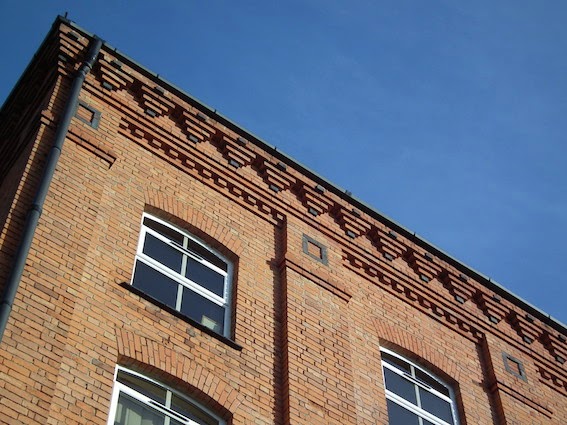
Just a short distance away from the ghost sign I noticed in my previous post is this building. I know a number of my regular readers appreciate a bit of brickwork, and the top of this structure seemed to fit the bill.

Now an office block, it began as Brown’s Barley Kernels Mill – barley-crushing being part of the brewing process – and was built for W. & G. Brown in the late 1880s. Although many of the more ornate Victorian industrial buildings used different colours of brick quite liberally and some are very plain, there are many that look plain at first glance but repay a second glance that allows you to take in the details. The Barley Kernels Mill is a good example. It shows only slight variations in colour – apart from the dark brick plinth and a very small amount of stone dressing, there are just a handful or two of blue bricks among the expanse of red. But up at the top of the walls, at cornice level, these bricks are handled with great vigour. The dentil course and the uppermost corbelled part with its ‘inverted triangle’ details exploit their material with economy but also, I’d say, considerable style. The brickwork seems designed to work well in good light and I was pleased I came across it when the sun was shining.


Wednesday, September 5, 2012

Brackley, Northamptonshire


A nice slice

A nice slice of brown bread and honey always seems to conjure up for me images of pleasant winter evenings in front of the fire. Comfort food, and, if the bread is wholemeal, nutritious too. In my childhood, Hovis, popular bread that was widely advertised on green and gold signs, seemed to fit the bill.*

The Hovis Bread Flour Company was founded in 1898 to make wholemeal flour, and their name, a shortened form of hominis vis (Latin for 'strength of man') was chosen after a national competition. The company expanded rapidly during the early years of the 20th century and again in the 1920s after the vitamin content of wheatgerm was discovered and publicized. The expansion came in the wake of clever marketing, too. Hovis produced special tins, embossed with the company name, with which bakers could bake loaves made with their flour. They provided branded bags, boxes, and even kitchen bread bins. Wherever they went, British people were reminded of Hovis wholemeal flour.

And then there were the shop signs, green, with gold letters standing out in relief. Their ingenious design ensured that they could be seen and read by passers-by coming from any direction, making them more effective than either a flat sign screwed to the wall or a hanging sign sticking out at right-angles like a pub sign. There are not so many of these signs around now, so I was pleased to find this one, attached to a building in Brackley. Hovis bread is still available and the sign is still doing its job, standing out and doing its bit to convince us that bread made with Hovis flour is outstanding.

- - -

*The virtues of Hovis were imprinted on me well before the famous Ridley Scott commercial, first aired in 1973, another effective piece of marketing. In this curious confection, cobbled steep implausibly picturesque Gold Hill in Shaftesbury stands for a kind of eternal England, curiously underpinned by a speeded up brass-band arrangement ('Hurry up lads, commercial only lasts 40 seconds') of Dvořák's 9th symphony, with its Native American-influenced theme.