Showing posts with label bread. Show all posts

Sunday, April 3, 2022

East Wittering, Sussex


Surprise

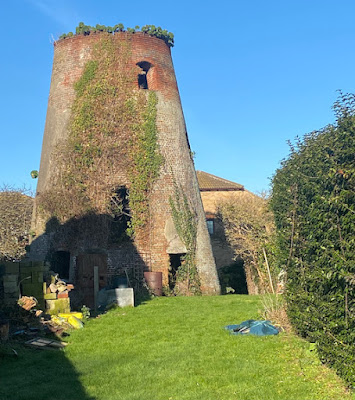
Passing through the Witterings, I was prepared to expect West Wittering to be the interesting one and East Wittering to be the preserve merely of modern houses and shops, hardly worth a glance. But I should know by now that nearly everywhere I go, there’s something to make me pause. So I shouldn’t have been surprised when, among the residential streets and get-rich-quick property developments, this popped up: what’s left of East Wittering windmill.

It doesn’t look much on the face of it:  the sails and cap have gone, the rendering that once covered the brickwork has partly peeled away, the stump of the tower mill sits quietly on a piece of private land. But it’s a reminder that once there were mills everywhere, grinding corn to make bread – watermills where there was a river or stream to power them, windmills where the terrain is open enough for the sails to catch the wind and turn. East Wittering is near the sea and the wind, as I soon discovered, can blow strongly there.

It’s not known how old this structure is – probably 18th century. It is known to have been working for most of the 19th century,* until the sails were removed in 1896. Perhaps it soldiered on under another power source (many windmills had oil engines installed), but it seems to have spent much of the 20th century derelict.† Nowadays the flour for our bread is as likely to be imported as to come from local fields. In many countries today, and in Britain in particular, foods such as bread are part of international trade networks and prices will increase as the effects of the war in Ukraine are felt more widely. This old mill is a timely reminder of how much agriculture, industry and trade have changed.§

- - - - -

* Online sources give 1810 as the date of the first written record of the mill.

† If anyone has further information about the mill’s later history, do please let me know via the ‘comments’ button below.

§ Although Britain imports very little wheat from Uklraine (the UK produces over 80 per cent of the wheat it uses), the war is affecting prices because globally the supply is reduced.

Friday, March 1, 2013

Cheltenham, Gloucestershire


Here comes the Bakerman

After all the recent posts about timber framing, a contrast and a little light relief.

A while back I did a short series of posts about stick-on signs on shop windows. One of these posts showed a sticker in Bromyard for Procea bread, and around the side of the window, only just visible in my photograph, was another Procea sticker showing a character, called the Bakerman, that the company used in their advertising. One reader asked to see more of the Bakerman, but I did not have a more revealing image from the Bromyard shop. Yesterday however, looking on my phone for something else, I remembered that I'd taken this photograph on the way to breakfast (a rare but cherished treat, the full English) in Cheltenham. So here is the loaf-bearing Bakerman, standing out against the yellow background that Procea used to catch the eye. Short he may be, but his loaf is large.

Can the Bakerman really have been here since the 1970s, when the brand was bought by Spillers? If so, his survival is a bit of good fortune, although not as accidental perhaps as the collection of reflections in my rapid-fire photograph – a little of Cheltenham's Regency architecture, plus a 1960s block abutting it (itself an architectural leftover from the heyday of Procea), a curvaceous street lamp, and the other Procea sign on the opposite side of the doorway. All caught in a moment as my mind was briefly distracted from thoughts of bacon, egg, mushrooms, and toast.

Wednesday, September 5, 2012

Brackley, Northamptonshire


A nice slice

A nice slice of brown bread and honey always seems to conjure up for me images of pleasant winter evenings in front of the fire. Comfort food, and, if the bread is wholemeal, nutritious too. In my childhood, Hovis, popular bread that was widely advertised on green and gold signs, seemed to fit the bill.*

The Hovis Bread Flour Company was founded in 1898 to make wholemeal flour, and their name, a shortened form of hominis vis (Latin for 'strength of man') was chosen after a national competition. The company expanded rapidly during the early years of the 20th century and again in the 1920s after the vitamin content of wheatgerm was discovered and publicized. The expansion came in the wake of clever marketing, too. Hovis produced special tins, embossed with the company name, with which bakers could bake loaves made with their flour. They provided branded bags, boxes, and even kitchen bread bins. Wherever they went, British people were reminded of Hovis wholemeal flour.

And then there were the shop signs, green, with gold letters standing out in relief. Their ingenious design ensured that they could be seen and read by passers-by coming from any direction, making them more effective than either a flat sign screwed to the wall or a hanging sign sticking out at right-angles like a pub sign. There are not so many of these signs around now, so I was pleased to find this one, attached to a building in Brackley. Hovis bread is still available and the sign is still doing its job, standing out and doing its bit to convince us that bread made with Hovis flour is outstanding.

- - -

*The virtues of Hovis were imprinted on me well before the famous Ridley Scott commercial, first aired in 1973, another effective piece of marketing. In this curious confection, cobbled steep implausibly picturesque Gold Hill in Shaftesbury stands for a kind of eternal England, curiously underpinned by a speeded up brass-band arrangement ('Hurry up lads, commercial only lasts 40 seconds') of Dvořák's 9th symphony, with its Native American-influenced theme.

Wednesday, June 27, 2012

Bromyard, Herefordshire

 
Stick-ons: 2

Another trawl through my archives threw up this window sign from Bromyard. The photograph is a few years old, so I’m not sure if the sign is still there. When I took the picture it was already time someone took this damp and dilapidated building in hand, though of course I hope that if they did, they managed to restore the flaking “BREAD” sign and perhaps even preserve the blue and yellow Procea one in the window.

Procea bread began in New Zealand as Procera and was sold a lot in Britain, where the name was changed to Procea, until the company was bought by Spillers in the 1970s. Procea was advertised a lot in the 1950s, when the use of a kind of informal script lettering for the brand name became common. This sign is later – the script seems to have got thinner and slightly more refined as the years went on. The name was often accompanied by a slogan, of which there were many. Brown bread was fortified with wheat protein: “The meat of the wheat”. The stuff was so good that it was a case of “Once tasted, never wasted”. “Procea Brown is so much Better it deserves a capital B.” “You never have a stale loaf problem when Procea’s your daily bread.” And so on.

Customers were exhorted to “Buy it where you see the Procea Bakerman”. That’s him, just visible on the side of the window in my picture. There must have been thousands of Bakerman stickers on bakers’ windows in Britain in the 1950s, 60s, and 70s. Now they are few and far between.