Showing posts with label judges' lodgings. Show all posts
Wednesday, January 11, 2023
Taunton, Somerset
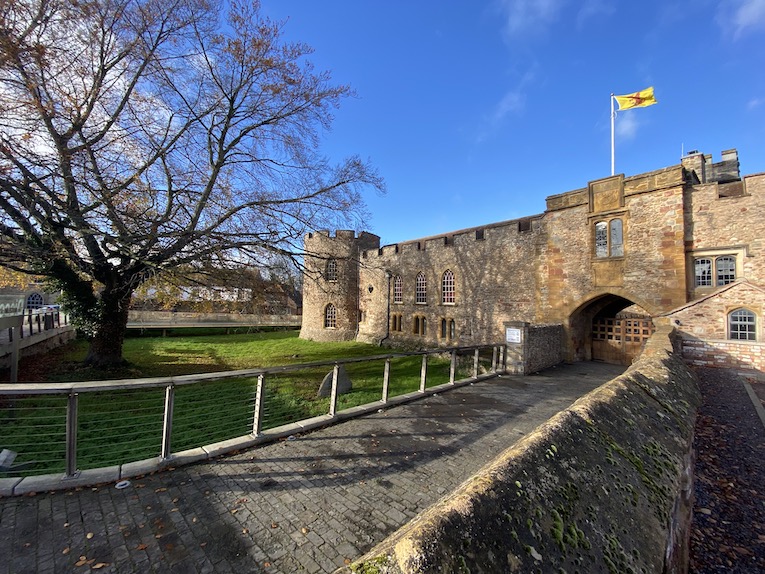
Light thrown on the familiar
A brief stop in Taunton on my way deeper into southern Somerset a while ago saw the south facade of the castle bathed in sunlight. I took time to pause for a few minutes and take in some of the details. The gatehouse, accessed by a bridge over a dry moat, still boasts work of the 13th or 14th centuries, when the castle belonged to the bishops of Winchester. It was apparently more a centre for running the large estates of the diocese than a military fortress, although later, in the mid-15th century, it was strong enough to be worth besieging, and later still its garrison put an end to the uprising of Perkin Warbeck against Henry VII. Henry’s coat of arms can still be (just) made out at the top, above those of Bishop Langton over the archway. The upper part of the gatehouse dates to a remodelling of the late-15th century.
What we can see from here of the rest of the building looks the way it does thanks to another set of alterations, this time between the 1790s and c. 1816, when Sir Benjamin Hammet (a banker, building contractor and MP for Taunton) rebuilt parts of the structure to accommodate Assize Courts and judges’ lodgings. The facing of the wall and the pointed windows are from Hammet’s time; the smaller mullioned windows downstairs are later still.
One hopes that the judges appreciated the efforts made on their behalf, with well-lit upgraded accommodation very close to the courts where they worked when the Assizes were in session. Those who were not judges but also needed somewhere to stay had a choice of two gothic-style inns that are still there, very close by but out of my photograph. These are still impressive but much altered compared to the castle, so for now at least, I’ll let this building have its place in the sun.
Monday, September 21, 2015
Nottingham
As your lordship pleases
Eyes that look along High Pavement in the middle of Nottingham are naturally drawn to this imposing classical frontage, with pediment, pilasters, short Doric columns on the ground floor and some of the tallest sash windows you could wish for. It’s strong Greek Revival stuff. Redolent of the way in which architects of the early-19th century could use the plainest of classical details to make a facade that stands out, it has imposing proportions – and it is far from bland or boring.
So whatever is it? Some sort of Assembly Room? A gentleman’s club? No. It’s a house, which has a history going back to the late Middle Ages but was remodelled in 1833, specifically as judges’ lodgings (there are law courts in the Shire Hall, on the opposite side of the street). The unusual proportions are at least in part due to the fact that this front was attached to an older building. The big room behind the enormous sash windows is the judges’ dining room, where they could eat in grandeur. The architect was Henry Moses Wood, a prominent Nottingham figure, active as a banker as well as the designer of numerous buildings in Derbyshire and Notts. I find it difficult to dissociate this severely grand frontage from the image, summoned up by the writer John Mortimer, who put it into the mouth of his immortal character Horace Rumpole, of members of the judiciary passing death sentences and then retiring to their lodgings to enjoy muffins. Traditional and severe as it is, though, this facade makes use of what in 1833 was modern technology. Those columns on the ground floor are made of cast iron, like some similar ones in London I wrote about long ago in a post called Kicked a Building Lately?
Walk a couple of yards along the street, immediately to the left of my first photograph, and you find the rest of the frontage, done in another kind of Regency architecture. It’s still classical and most of the front is very plain, with rows of sash windows and a deep cornice, but the centrepiece is very different from the formality of the front of the dining room. This is a more delicate style, with a curving balcony and a door with a rather feminine fanlight like something Robert Adam might have designed. The balcony is held up on brackets with stylised leaf decoration, the balcony has elegant ironwork that might be at home in Brighton. And the iron overthrow with its fitting for a lamp is another impressive bit of the blacksmith’s art, all scrolls and flowers and buds. This facade too is part of the judges’ lodgings and its combination with the dining-room part makes for a rather split architectural personality. But the fact that both are classical helps them live together peacefully, revealing the versatility of the classical style.
- - -
Note The right-hand part with the big windows dates to Wood’s remodelling of 1833. Authorities are rather imprecise about the left-hand part. It looks Regency too, and feels like a different phase, but also looks too late to be from an earlier remodelling of the building in 1742.
Subscribe to:
Posts (Atom)

