Showing posts with label Taunton. Show all posts
Wednesday, January 11, 2023
Taunton, Somerset
Light thrown on the familiar
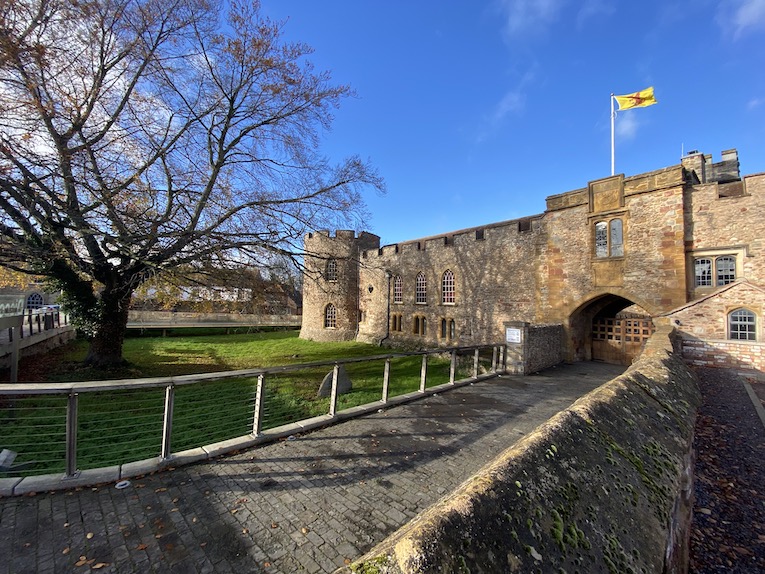
A brief stop in Taunton on my way deeper into southern Somerset a while ago saw the south facade of the castle bathed in sunlight. I took time to pause for a few minutes and take in some of the details. The gatehouse, accessed by a bridge over a dry moat, still boasts work of the 13th or 14th centuries, when the castle belonged to the bishops of Winchester. It was apparently more a centre for running the large estates of the diocese than a military fortress, although later, in the mid-15th century, it was strong enough to be worth besieging, and later still its garrison put an end to the uprising of Perkin Warbeck against Henry VII. Henry’s coat of arms can still be (just) made out at the top, above those of Bishop Langton over the archway. The upper part of the gatehouse dates to a remodelling of the late-15th century.
What we can see from here of the rest of the building looks the way it does thanks to another set of alterations, this time between the 1790s and c. 1816, when Sir Benjamin Hammet (a banker, building contractor and MP for Taunton) rebuilt parts of the structure to accommodate Assize Courts and judges’ lodgings. The facing of the wall and the pointed windows are from Hammet’s time; the smaller mullioned windows downstairs are later still.
One hopes that the judges appreciated the efforts made on their behalf, with well-lit upgraded accommodation very close to the courts where they worked when the Assizes were in session. Those who were not judges but also needed somewhere to stay had a choice of two gothic-style inns that are still there, very close by but out of my photograph. These are still impressive but much altered compared to the castle, so for now at least, I’ll let this building have its place in the sun.
Wednesday, November 14, 2018
Taunton, Somerset
Georgian Art Deco
Here is something I have little to say about – with the exception of single a observation. This Post Office in Taunton was built in 1911 in the neo-Georgian style (red brick with stone dressings on the upper floors, stone on the ground floor) then popular for Post Offices. I have noticed before how this style was popular in the early-20th century, and seemed to work well.
But look at the letterforms used on the identifying 'Post Office' sign above the door. Cut carefully into the stone, the letters look nothing if not Art Deco – those elongated letters popular on shop fronts in the 1920s. I am thinking of the Fs and Es with cross bars near the top of the letter, the enlarged bowl of the P, the slightly forward-sloping S. Is the lettering later than the rest of the building, or unusually forward-looking? I really don't know, but I like the way the two things work together – and how they made me pause and ponder as I walked along the street.
Wednesday, February 18, 2015
Taunton, Somerset
Tangled up in film
Some people who know Taunton much better than I were surprised when I expressed admiration for the former cinema, originally the Gaumont Palace, a building of 1931–2 by W. T. Benslyn now given over to bingo. It’s a rather large mass of a building, in the solid Art Deco mode of many cinemas. Benslyn was something of a specialist in this kind of building and had been assistant to Robert Atkinson, designer of truly remarkable Art Deco foyer in the former Daily Express building in London’s Fleet Street, so he was absorbed in both Deco and decoration.
What attracted me in Taunton was precisely a bit of decoration: this sculpture, apparently called Love and Life Entangled in Film. Life, naked and female, raises an arm towards Love, a winged Cupid. The visual structure of the piece is provided by the figures – the curves made by Life’s body and both characters’ limbs. The counterpoint to this are the curling loops of celluloid and the flowing waves of Life’s hair. The combination produces a beautifully poised composition, although it needs some strong sunlight to make the relief stand out against the rather dull brick of the rest of the building and to help us pick out the details. Although parts of the carving (Love’s face, for example) are rather worn, the piece is still worth a good look.
I was pleased to see that the relief is signed. The name of the artist, Newbury Abbot Trent, specialist in the contrasting arts of cinema and war memorial sculpture, is one I’ve noticed on cinemas before. The theme of a female body entwined with film seems to have been a favourite. No doubt cinema proprietors thought such sirens would be effective advertising, a good image of the allure of film in the years between the world wars. Looking back now, they certainly seem to sum up the glamour of the cinema in those times. I’ve noticed three such sculptures recently – one in Oxford, this one in Taunton, and one in Cheltenham. The first is still a cinema, the second a bingo hall, and the third has been demolished. Where they survive, then, Trent’s reliefs are a valuable link with their age.
- - -
Please remember to click on the image to enlarge it.
Subscribe to:
Posts (Atom)

