Showing posts with label court. Show all posts

Wednesday, January 11, 2023

Taunton, Somerset


Light thrown on the familiar

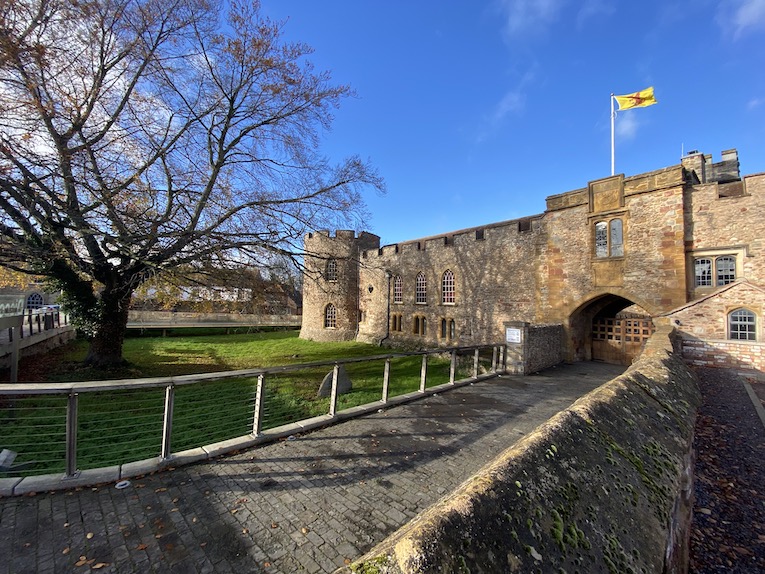
A brief stop in Taunton on my way deeper into southern Somerset a while ago saw the south facade of the castle bathed in sunlight. I took time to pause for a few minutes and take in some of the details. The gatehouse, accessed by a bridge over a dry moat, still boasts work of the 13th or 14th centuries, when the castle belonged to the bishops of Winchester. It was apparently more a centre for running the large estates of the diocese than a military fortress, although later, in the mid-15th century, it was strong enough to be worth besieging, and later still its garrison put an end to the uprising of Perkin Warbeck against Henry VII. Henry’s coat of arms can still be (just) made out at the top, above those of Bishop Langton over the archway. The upper part of the gatehouse dates to a remodelling of the late-15th century.

What we can see from here of the rest of the building looks the way it does thanks to another set of alterations, this time between the 1790s and c. 1816, when Sir Benjamin Hammet (a banker, building contractor and MP for Taunton) rebuilt parts of the structure to accommodate Assize Courts and judges’ lodgings. The facing of the wall and the pointed windows are from Hammet’s time; the smaller mullioned windows downstairs are later still.

One hopes that the judges appreciated the efforts made on their behalf, with well-lit upgraded accommodation very close to the courts where they worked when the Assizes were in session. Those who were not judges but also needed somewhere to stay had a choice of two gothic-style inns that are still there, very close by but out of my photograph. These are still impressive but much altered compared to the castle, so for now at least, I’ll let this building have its place in the sun.

Thursday, October 27, 2022

Kemerton, Worcestershire


Distant prospects

One of the themes of this blog is the pleasure to be gained from unexpected architectural encounters – those views of buildings that one glimpses from the road while going from A to B – and so much the better if there’s the opportunity to stop and take a closer or longer look. There’s something especially rewarding about chancing upon something in one’s local patch, a notable building that’s only visible from a road or footpath that one doesn’t normally use. I often pass through the village of Kemerton, in Worcestershire, and even occasionally stop there for a coffee on a quiet morning, but the other day I made a detour, little more than driving around three sides of a rectangle of roads to return in the direction I’d come. It was then that I caught sight of the house in my photograph.

One field separates Kemerton Court from the rural road I was driving along. Even from a moving car I could make out a building that looked special, and it wasn’t long before I returned, walked up the same road, and had a longer look. I saw a Cotswold stone front of the early-18th century, apparently very well built, mostly of ashlar. The window surrounds are quite plain – the keystones are small and not especially showy – and the doorway has a triangular pediment with Doric or Tuscan pilasters running down from its ends. Plain it may be, but the articulation of the frontage is quite sophisticated – notice how the central bay and the pairs of outer bays are set slightly forward of the rest, to give some visual interest, while the round-topped window and the little circular window above it emphasise the central bay. The finials on the parapet (which resemble either egg cups or acorns according to how you see them) and the survival of the small panes in the windows are pleasing touches. There’s also an eye-catching contrast of curves, with the string course below the round window going one way and the curves in the parapet going the other. It’s this kind of contrast that shows the influence of the baroque style on whoever it was who designed this facade. The architect is not known – Smith of Warwick and Thomas White of Worcester are possible candidates.

This facade fronts an older house of the 16th century, and following the road round to the rear of the house reveals a less symmetrical structure. Looking from the road was all I was going to do, though, as Kemerton Court is a private house and not open to the public. I’m grateful, though, that its satisfying west front could be seen, at arm’s length as it were, just one green field away.

Monday, July 2, 2018

East Norton, Leicestershire


Ello, ello

‘I know you’ll like this,’ said Mr Ashley, pointing to the word ‘POLICE’ above the door. And, in spite of the rain, before you could say ‘Ello, ello,’ I was out of the car and taking photographs. I was attracted immediately by the beautifully arranged glazing bars that make a pattern of elongated hexagons, diamonds and triangles across each of the five front windows. And to the simple lettering of the sign, cut in stone. And to the peculiar stepped pediment above the door that frames the sign. Not to mention the careful detailing of the brickwork.

As I was taking all this in, the owner of this former police station, now house, emerged. She explained that she and her husband were restoring the house, and that he was busy removing generations of paint from the glazing bars. If you click on the picture and look very closely, you might be able to see that those on the bottom left window, and the left-hand casement of the top right window, have already been done. The difference is remarkable. I’ve written before about the way in which layers of paint, added over decades or even centuries, can blur the detail of friezes and other ornate details. It was the same with these glazing bars, but now it’s being put right. It’s a long job, but it must be rewarding to see the windows emerging crisp and clean.
The owner also told me that the house dates to around 1850, and that the neighbouring building was put up in the later 19th century as a court house. So it has the plainer brickwork and sash windows of the Victorian era, whereas the old police station has the ornate glazing* and fancy detailing that are much more typical of the pre-Victorian period – but with the addition of the rather heavy stepped pediment which looks to me more like a nod to the heavier style then coming in. Altogether a winning combination to come across on a rainy morning. Thank you, Mr A.

- - - - -

* I associate this sort of filigree glazing with the Picturesque movement of the late-18th and early-19th centuries, when it adorned many a charming cottage. But it’s also sometimes used to give a uniform and decorative feel to more workaday cottages built by aristocrats to house their staff, and an online source attributes this police station to a 19th-century Lord Berners. A uniform glazing pattern can give a group of hoses, or a whole village, a distinctive appearance – a phenomenon I’ve noticed, for example, here.

Wednesday, October 6, 2010

Little Malvern, Worcestershire


Across the fields
A way to the south of Great Malvern – famous for its grand medieval church, its spa, and its clusters of Victorian villas – lies Little Malvern. This is the site of a Benedictine priory founded in the 12th century, and what remains of its church – tower, chancel, and ruined transept – catches the eye and the sun as one looks across the fields towards the wooded slopes beyond. It’s a mixture of Norman and late medieval architecture, having had a makeover in the 1480s when monasticism in England had little more than 50 years before succumbing to the ravages of Henry VIII’s opportunistic reformation.

Next to the church were the usual domestic buildings, and part of these form the heart of Little Malvern Court, the partly timber-framed house to the left of the church. This too is of a mixture of periods, with a monastic core of the 14th century that includes the magnificent prior’s hall, plus later additions and modifications. The building was restored and extended by Joseph Hansom in 1859–60. It’s no accident that the Catholic architect Hansom was chosen. Since the 16th century the Court has been home to the Beringtons, a Catholic family.

In the Middle Ages, the church tower must have been a welcome landmark to the monks returning from work in the fields or from journeys farther afield as they crossed the neighbouring plain. It’s wonderful that it remains a landmark today, with its neighbouring house testimony to more than 800 years of continuous use.