Showing posts with label photograph. Show all posts

Wednesday, September 17, 2014

Malmesbury, Wiltshire


What we see, and when we see it

Standing next to a friend who’s a professional photographer, I know he’s aware of everything that’s going on in front of him – and quite a bit that’s happening behind, too. The wind is blowing this way, which means that in a minute the clouds will part and the sun will shine. It’s worth waiting, even if you're backed into a prickly bush to get the right viewpoint. When it comes, the sun will shine over there, setting this door surround into rich and picturesque shadow while making the paintwork of the door shine beguilingly. There’s a telephone wire over there, so we’ll move a little to the left so that it doesn’t form a distraction in the frame. On the other hand, there’s a woman in a red polka-dot dress up the road: in a minute she’ll walk into shot and her dress will make that green door glow all the more as she passes it. The pulse increases. Sun, shadow, door, dress, all in perfect alignment. The decisive moment. The Leica makes its barely audible click. And on we go to the next shot.

Naturally I try to learn from this example, but it’s slow going. I am still apt to make the beginner’s mistake of concentrating too closely on the main subject, to the exclusion of all else, and ignoring intrusive distractions at the edges of the frame. Of course, back in the studio (formerly the darkroom) even the professional photographer discovers unexpected things lurking in the shadows or on the edges, as the film Blow Up showed.

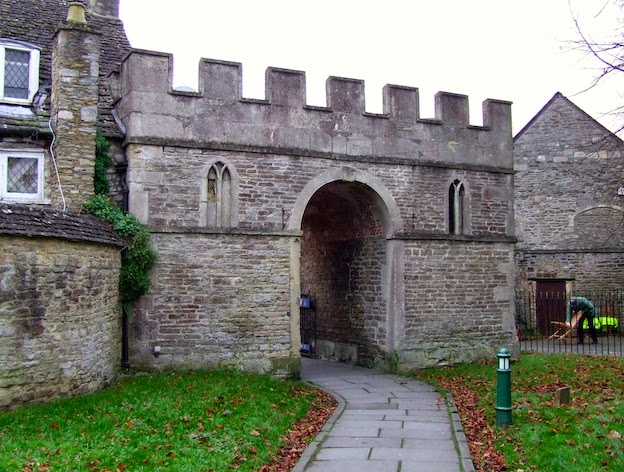
Not, I’m glad to say, that I’ve ever discovered anything as sinister as the corpse that the David Hemmings character in Blow Up discovers when he starts enlarging his prints. But even so, odd things crop up. One freezing afternoon in Malmesbury, my thoughts frankly on finding a warming cup of coffee or getting back in the car, I couldn’t resist defying the bitter wind and pointing the camera at this Gothic gateway, leading into the abbey churchyard. A bit of Georgian semi-gothic, with Y-tracery in the windows but a semicircular archway: a picturesque mishmash, in fact. Very satisfactory. Click. When I got home I saw, in the right-hand side of the frame, on this bone-chilling day, a chap erecting a folding chair. It really is remarkable what you see in photographs.

Monday, September 8, 2014

Portland Place, London


The essence of place

‘Who,’ people sometimes ask me, ‘is your favourite photographer?’ Maybe Eugène Atget, with his photographs of Paris, hailed as pioneering works of documentary but with an atmospheric stillness that helps them transcend that label. Or Henri Cartier-Bresson with his decisive moments. Or Walker Evans, especially his images of run-down buildings, usually empty of people but full of their former presence. But great as all these are, I keep a special place for British photographer Edwin Smith, whose work I’ve loved for years.

Much of Smith’s work was architectural, and was commissioned to illustrate books on subjects such as parish churches, cottages and farmhouses. Smith’s wife Olive Cook often wrote the text and publishers Thames and Hudson ensured that Smith’s images got the airing they deserved. His work was in other places, too, from Vogue to the Shell Guides. And yet Smith, who worked between the 1930s and 1960s, is not that well known today – his photography seems to have been overshadowed by the contrasting kinds of work (street photography, different modes of documentary) that came along in the 1960s and 1970s. All to the good, then, that the RIBA, who hold Smith’s vast archive (20,000 prints, 60,000 negatives), have put on an exhibition of his photographs.

Ordinary Beauty: The Photography of Edwin Smith looks good in the RIBA’s new architecture gallery at 66, Portland Place. It embraces his early commissioned work (some fashion shots, portraits, wonderful photographs of the circus), but is soon on to the typical stuff, the images of places and buildings that he made from the 1950s onwards, using old large- and medium-format cameras and black and white film. They reveal his obvious virtues and talents – a flair for composition, an eye for detail, a penchant for capturing the way shafts of sunlight illuminate things and make us look anew.

More important, though, is Smith’s genius for showing us the essence of a place. Similar qualities to those that I try to hold up for examination and comment on this blog – the texture of stone and its regional variations, the differing qualities of walls and fences, the lettering on an old Irish shop front, or the regional variations of roofing (slate, stone, tile…) – fascinated Smith. And above all the unregarded details that summon up a place and seem to paint a portrait of it. How typical, for example, that Smith should turn his back on the lovely Georgian box pews in a church like Didmarton and produce a photograph of the transept with its wooden stair. Likewise how moving that he should photograph, as well, no doubt, as the statuary and garden buildings at Rousham, some nettles growing through the slats of a bench – they make a beguiling pattern of leaf and timber.

For Smith, this portrayal of places was the heart of the matter. It was the kind of thing, he felt, that we needed, if we were to save things from the planners. In the 1950s, when Britain was being rebuilt after World War II, such bits of local distinctiveness and traditional craftsmanship were vanishing, fast. A raft of movements and publications, from the Victorian Society to Pevsner’s Buildings of England books, were coming along in the 1950s to put the case for preservation. Smith was there, alongside them, with his bellows cameras. Robert Elwall, author of the excellent book Evocations of Place: The Photography of Edwin Smith, put it well:

‘The recurring themes of Edwin Smith’s work – a concern for the fragility of the environment, both natural and man-made; an acute appreciation of the need to combat cultural homogenisation by safeguarding regional diversity; and, above all, a conviction that architecture should be rooted in time and place – are as pressing today as when Smith first framed them in his elegantly precise compositions.’

That message is tied up, not just with the great compositions, but also with the telling details. Often, these are human traces – washing on a line, farm equipment in a barn, a milk bottle on the table in Furlongs, Peggy Angus’s house in Sussex – traces of people who, apparently, have just walked out of shot. They’re humble traces – ‘Ordinary Beauty’ indeed – but full of significance, and they produce an effect that’s not dissimilar to that in some of Eugène Atget’s Parisian photographs: a generosity, a lost past captured, a haunting presence hinted at, a gentle but revealing light. Atget’s was the one photographic influence Smith would admit to. I can see why.


Top photograph: Edwin Smith, Great Coxwell Barn, Berkshire
Lower photograph: Edwin Smith, Didmarton, Gloucestershire
Note: These images are taken from books. Readers should refer to original prints – in the exhibition and in the RIBA Library – to appreciate the true quality of the work. Smith's photographs are
© Edwin Smith / RIBA Library Photographs Collection


Ordinary Beauty: The Photography of Edwin Smith is at the Architecture Gallery, RIBA, 66 Portland Place, London W1, from 10 September to 6 December 2014.
Thursday, December 17, 2009

Bishopsgate, London


Stop and research

My photograph shows part of the façade of the Bishopsgate Institute in London. This building, opened in 1895, provides educational facilities including courses and a library and was but one of many institutes set up in this period by charities and communities to fulfil cultural and educational aims – in the words of the Institute’s website, ‘for the benefit of the public to promote lectures, exhibitions, and otherwise the advancement of literature, science and the fine arts’. The Institute is fortunate to be housed a stunner of a building, one of three major buildings in London (the others are the Whitechapel Art Gallery and South London’s excellent Horniman Museum) designed by the great turn-of-the-century architect Charles Harrison Townsend.

Townsend’s work, as is widely acknowledged, combines wonderfully the traditional values of the Arts and Crafts movement with the decorative flair of Art Nouveau. That decorative element is shown in the ornament on the Bishopsgate façade, created by architectural sculptor William Aumonier. There is an additional influence on Townsend’s style (noticed by the authors of the revised Pevsner volume on the City of London) – the work of the great American architects of the late-19th century, especially Henry Hobson Richardson. That generous entrance arch is a very Richardsonian touch.

I especially wanted to share the decoration on this building, but standing on the opposite side of Bishopsgate pointing my camera at it reminded me of something else. Back in 2004, when Peter Ashley and I were doing preliminary work on The English Buildings Book (see right), I asked Peter to take a photograph of the striking police station up the street from the Institute. This simple, but perhaps naïve, request led Peter into a long and rather sticky ‘conversation’ with the police: ‘You nearly got me arrested,’ he said to me the next day.

This all came back to me the other day when I read in the paper complaints by photographers who had been stopped and questioned for photographing apparently much less sensitive buildings in London (for example, St Paul’s Cathedral, another Wren church, a fish and chip shop, and 30 St Mary Axe, aka the Gherkin). It made me think that the authorities are taking things rather too far if photographers – professional or amateur – cannot stand outside a building in London and aim their camera at it without being questioned and, in some cases, required to delete from their memory cards the images they have made.

Don’t get me wrong. I’m well aware that the police need to go about their business, and part of that business includes measures to combat terrorism. As someone who knew one of the victims of the London bombings of July 2005 this is very much in my mind. But we also need to preserve the freedoms that terrorists would take away from us, and one of those freedoms, a significant one I’d argue, is to be able to stop, and look, and take photographs of our glorious built environment – and disseminate the resulting images and the fruits of our research for educational and cultural purposes. The founders of the Bishopsgate Institute would, I hope, have agreed with that.