Showing posts with label Malmesbury. Show all posts

Thursday, March 2, 2017

Malmesbury, Wiltshire


A rare flourish

As I was looking at my picture of the street sign in Louth in my previous post, it occurred to me that a while back I’d seen another good cast-iron sign, probably of similar vintage. Now where was it? Casting my mind back a couple of years I found it in a file of photographs of Malmesbury, and I instantly realised what struck me about it.

Yes. Not just the letters but the decoration – the beadwork, as it were, around the edge and the wonderful flourish at either end. That flourish is a version of the palmette motif used widely in Classical decoration, and so is a thoroughly architectural kind of decoration. Back when it was made (in the 19th century I suppose) this detail must have set the sign apart from the plainer ones in other towns. Now signs like this must be really rare.

Looking again at my pictures I was at first rather disappointed with the lettering. It seemed a bit thin and tentative after the bold Egyptian letters of Louth. Then I examined the detail (below) closely and liked what I saw much more. The letters are actually well formed and stand out clearly from the background. They’d do a better job if the sign was cleaned of its rust and repainted. Maybe that has been done by now. I must return and see.

Thursday, January 1, 2015

Revisits


A top ten of 2014

Before we advance into a new year of architectural encounters, it occurred to me to take a look at what my readers have found most interesting during the last year – or which of my 2014 posts, at any rate, have been viewed the most. I have compiled a top ten, and they are a mixed bunch indeed, featuring mostly modest buildings such as prefabs, a shop front, some almshouses, and a public lavatory. They also include some memorable architectural details and a couple of reviews (of the recent exhibition of Edwin Smith’s photographs and the reprint of Nairn’s London). Miscellaneous as they are, they seem to represent a reasonable if partial cross-section of my interests and, I hope, those of my readers to.

They are:

Far from ordinary: the story of prefabs in Catford, south London, notable examples of the glory of the ordinary.

A sort of Jacobethan: a whimsical but interesting bit of pseudo-Jacobean detail in Northampton. God, or the Devil as they say these days (and well they might in these unMiesian contexts), is in the details.

Hygienic high-style: a terrific Art Deco shopfront in Ashby de la Zouch, showing that Deco can be about restraint as well as showing off.

The essence of place: the stand-out exhibition of the photographs of Edwin Smith (closed now, but it’s still worth reading about this photographic master).

What we see, and when we see it: a meditation in Malmesbury about how photography often reveals what we don’t see.

Fifty years on: a personal memory of some almshouses in Louth and the architecture of James Fowler.

Old orders changing: an unusual classical order in Clifton (pictured above).

The ladies, vanishing: a memorable cinema in Cheltenham, which is no more.

Being moved in London: a review of my favourite book about London, which has recently been reprinted.

From the sun to the stars: a cast-iron public lavatory in Bath.

Happy New Year to you all.

Wednesday, September 17, 2014

Malmesbury, Wiltshire


What we see, and when we see it

Standing next to a friend who’s a professional photographer, I know he’s aware of everything that’s going on in front of him – and quite a bit that’s happening behind, too. The wind is blowing this way, which means that in a minute the clouds will part and the sun will shine. It’s worth waiting, even if you're backed into a prickly bush to get the right viewpoint. When it comes, the sun will shine over there, setting this door surround into rich and picturesque shadow while making the paintwork of the door shine beguilingly. There’s a telephone wire over there, so we’ll move a little to the left so that it doesn’t form a distraction in the frame. On the other hand, there’s a woman in a red polka-dot dress up the road: in a minute she’ll walk into shot and her dress will make that green door glow all the more as she passes it. The pulse increases. Sun, shadow, door, dress, all in perfect alignment. The decisive moment. The Leica makes its barely audible click. And on we go to the next shot.

Naturally I try to learn from this example, but it’s slow going. I am still apt to make the beginner’s mistake of concentrating too closely on the main subject, to the exclusion of all else, and ignoring intrusive distractions at the edges of the frame. Of course, back in the studio (formerly the darkroom) even the professional photographer discovers unexpected things lurking in the shadows or on the edges, as the film Blow Up showed.

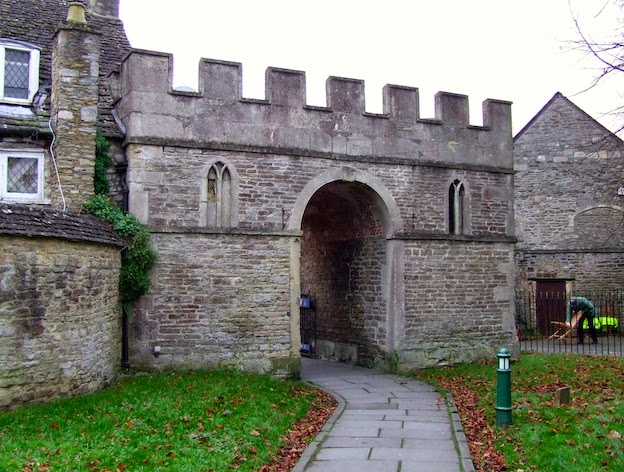
Not, I’m glad to say, that I’ve ever discovered anything as sinister as the corpse that the David Hemmings character in Blow Up discovers when he starts enlarging his prints. But even so, odd things crop up. One freezing afternoon in Malmesbury, my thoughts frankly on finding a warming cup of coffee or getting back in the car, I couldn’t resist defying the bitter wind and pointing the camera at this Gothic gateway, leading into the abbey churchyard. A bit of Georgian semi-gothic, with Y-tracery in the windows but a semicircular archway: a picturesque mishmash, in fact. Very satisfactory. Click. When I got home I saw, in the right-hand side of the frame, on this bone-chilling day, a chap erecting a folding chair. It really is remarkable what you see in photographs.

Friday, August 8, 2014

Malmesbury, WIltshire


Garlands

In the centre of Malmesbury, very near the medieval abbey, is a late-18th century stone house, a building of three storeys, with sash windows arranged symmetrically around a central front door. There's a very plain cornice and a pitched, stone slated roof. The windows have ashlar dressings but the rest of the masonry is rubble and was once limewashed. Apparently the building was originally a 'mill house', which I take to mean the house occupied by a miller; the building also incorporates workers' cottages at the rear.

The stand-out feature is above the door canopy: this carved stone panel, probably early-19th century, with a female mask flanked by festoons of leaves, fruit, and flowers, tied together with ribbon-like bands. I find some of the fruit and flowers difficult to identify, but there certainly seem to be oak leaves and acorns in the mix. I wonder how long this panel has been there. There seem to be iron clamps near the upper corners, securing it to the wall, so presumably it is not built into the masonry. Addition or no, it's still a pleasant, civilized decoration for an otherwise rather severe facade.

Friday, June 6, 2014

Malmesbury, Wiltshire


Now and then

The entrance to Malmesbury Abbey contains some of the most celebrated Romanesque sculpture in England but, in this blog’s spirit of searching out the unregarded, I’m featuring today not the great carvings in the porch, but one of the bosses from the ceiling in the church itself. I’m not claiming greatness for this carving, just suggesting that bosses can give pleasure if we take the time look at them – armed perhaps with what their medieval creators could not have imagined, a pair of binoculars or a camera with a telephoto lens.

This boss, then, is not a great piece of carving, but has some nice touches, such as the swirling hair and flanking leaves, to compensate for the rather small mouth and lack of modelling around the chin. I don’t know who it portrays – some say that it represents Margaret of France, second wife of Edward I. Margaret died in 1307 and the vault is early-14th century, so that’s a possibility. She was not formally crowned, so the carving’s lack of a crown doesn’t mean it cannot portray her.

The other interesting feature of the boss is the colour. I believe this was added during a restoration in the 1920s, but the yellow and terracotta shades and the gilding are probably not too far from the medieval colouring. However the overall effect is more modern somehow. Is it the blushing cheeks? Or the use of flesh tones that make it look as if the subject has naked shoulders? Whatever the case, the carving is now an interesting hybrid, part of the evolving and transforming history of the building that contains it.

Wednesday, February 18, 2009

Malmesbury, Wiltshire


A costly piece of work

Many English market towns have a cross to act as a marker of the market place, and sometimes this cross is an elaborate structure offering shelter too. Cities such as Salisbury and Chichester have big crosses like this, and so does the Wiltshire market town of Malmesbury. Malmesbury’s market cross is a really fancy octagonal stone structure, encrusted with carving, and the Tudor writer John Leland described it as ‘a right costly piece of work’. For me it’s certainly the most outstanding structure in the town apart from the terrific Norman abbey.

Although the cross is a popular shelter and meeting place for local people, probably most visitors to the town, hot-footing it to the abbey or the shops, only give the structure a rapid glance. That’s a pity because the carving repays a closer look. As well as the truly top-notch Gothic detailing – pinnacles, crockets, and that dazzling structure at the top – there are some marvellous grotesques. These are small versions of the grotesques (often referred to as gargoyles) on medieval churches, and make up a small rogues’ gallery of medieval humour. The spitting image of the Middle Ages.