Showing posts with label Catford. Show all posts
Saturday, July 15, 2017
Shugborough, Staffordshire, and more
Retrospective (3): Feline tales
It has been said à propos of social media that, having invented the most sophisticated form of communication yet devised by humankind, we use it for sharing pictures of cats. I offer no apologies, though, for this short selection of cat posts, offered as my third retrospective to celebrate a decade of this blog. These, after all, are architectural cats, and the image of the feline form, used as an embellishment on or near buildings, says something about our fascination with these intriguing, beautiful, and sometimes infuriating creatures.* My handful of posts contains cats from the mid-18th to the late-20th century, but which show artistic influences stretching back thousands of years. And that is proof enough that not just our relationship with cats but also our artistic engagement with them is far, far older than the internet.
A sea-going cat in Staffordshire
A church cat in the Cotswolds
A museum mouser in Hereford
A landmark cat in...Catford
The Egyptian-style cats of Mornington Crescent
A ginger tom in Thaxted.
- - - - -
* The novelist Raymond Chandler referred to his cat Taki as his 'secretary' because whenever Chandler tried to write anything, the creature would drape itself over his notepad or sit on the copy he wanted to revise. I have had this experience with a cat myself and have found it beguiling and maddening by turns.
Thursday, January 1, 2015
Revisits
A top ten of 2014
Before we advance into a new year of architectural encounters, it occurred to me to take a look at what my readers have found most interesting during the last year – or which of my 2014 posts, at any rate, have been viewed the most. I have compiled a top ten, and they are a mixed bunch indeed, featuring mostly modest buildings such as prefabs, a shop front, some almshouses, and a public lavatory. They also include some memorable architectural details and a couple of reviews (of the recent exhibition of Edwin Smith’s photographs and the reprint of Nairn’s London). Miscellaneous as they are, they seem to represent a reasonable if partial cross-section of my interests and, I hope, those of my readers to.
They are:
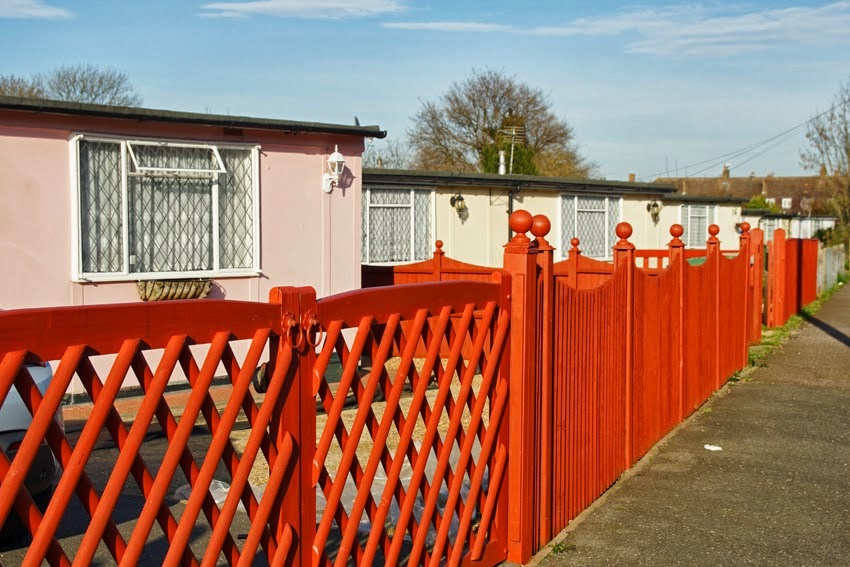
Far from ordinary: the story of prefabs in Catford, south London, notable examples of the glory of the ordinary.
A sort of Jacobethan: a whimsical but interesting bit of pseudo-Jacobean detail in Northampton. God, or the Devil as they say these days (and well they might in these unMiesian contexts), is in the details.
Hygienic high-style: a terrific Art Deco shopfront in Ashby de la Zouch, showing that Deco can be about restraint as well as showing off.
The essence of place: the stand-out exhibition of the photographs of Edwin Smith (closed now, but it’s still worth reading about this photographic master).
What we see, and when we see it: a meditation in Malmesbury about how photography often reveals what we don’t see.
Fifty years on: a personal memory of some almshouses in Louth and the architecture of James Fowler.
Old orders changing: an unusual classical order in Clifton (pictured above).
The ladies, vanishing: a memorable cinema in Cheltenham, which is no more.
Being moved in London: a review of my favourite book about London, which has recently been reprinted.
From the sun to the stars: a cast-iron public lavatory in Bath.
Happy New Year to you all.
Sunday, March 23, 2014
Catford, London
Far from ordinary
‘The glory of the ordinary’ was one reader’s comment on this blog and its subject matter, especially the parts of it that concern themselves with shacks, corrugated iron barns, battered factories, and other unregarded delights. But I didn’t always pay attention to this kind of architectural ordinariness – extraordinary buildings, from English cathedrals to Italian palazzi, once seemed more worthwhile, and years ago, when I lived not far from southeast London’s Excalibur prefab estate, I didn’t look at the place very closely, pausing only to be amused by the Arthurian street names (Ector Road, Pelinore Road) and to notice the similarities between the prefabs that lined these streets and the ones I remembered not far from where I lived as a child. There had always been prefabs around, ‘war prefabs’ as my parents and their friends called them, built en masse to relieve the housing shortage (and to give the suddenly underemployed aircraft industry something to do) after World War II.
Back in the 1960s, when I was a boy, the thing that my parents said about these prefabs were that they were meant to be temporary dwellings, with a life of ten years or so, and that the little houses had done well to last twice that time already. Now, 60 or more years after their construction, there are very few of these prefabs left: most have been demolished to make way for more modern housing, often at a higher density to take advantage of today’s high city land values.
So prefabs are no longer ordinary. The Excalibur Estate is now the only surviving prefab estate left, and is itself threatened with demolition. English Heritage have listed a handful of the prefabs (and the estate’s curious prefabricated church), but the council want to pull down the other 180 prefabs and replace them with a larger number of more modern dwellings. My feelings about this are mixed. On the one hand, London needs more good social housing and the prefabs would prove costly to preserve. On the other, the prefabs are a unique bit of social and architectural history. The residents, when polled, voted for demolition and redevelopment, by a narrow margin of 56 to 44 per cent.
The estate was built in 1945–6, and consists of prefabricated Uni-Seco bungalows, which have a timber frame supporting panels of asbestos cement. There are metal-framed windows and roofs with a very gentle pitch that look flat. The Uni-Seco was one of 13 different types of prefab built in Britain in the 1940s under the government’s Temporary Housing Programme, which eventually saw some 150,000 prefabs built to help relieve the housing shortage. More would have been built, but the prefabs (whether in wood, aluminium, concrete, or asbestos cement – there were examples of all these forms of construction) were actually quite costly to produce, so traditional, permanent, brick-built houses eventually prevailed.
Most residents liked their prefabs, not least because they came with modern features such as fully equipped bathrooms, indoor lavatories, and fitted kitchens with hot and cold water and something that most British houses lacked in 1948: a refrigerator. This was the kind of specification that many Brits could only dream of in the post-war period and the buildings, with their almost-flat roofs, white walls, and large windows, looked modern too. If they cared about such things, the original tenants might have reflected that at last their were getting a bit of the modern design that had been such a hit in Europe. But the generous gardens were probably just as important to them.
And there, for now, they stand, their chivalric street names (actually a continuation of a theme used to name streets in a neighbouring estate) evoking both post-war patriotism and 21st-century defiance. In this age of austerity, these far-from ordinary little buildings are worth a thought and, it seems to me, some admiration too.
- - -
With thanks to Caroline, of the excellent blog Caroline’s Miscellany, for the pictures. Her own piece on the Excalibur Estate is well worth reading.
There is an ongoing project to record the history of prefabs here.
The best books on prefabs are Greg Stevenson, Palaces for the People (Batsford, 2003) and Brenda Vale, Prefabs: A History of the UK Temporary Housing Programme (E & F N Spon, 1995)
Sunday, July 14, 2013
Rushey Green, London
We are amused
'Give us more architectural cats,' requests a friend, in the wake of Shugborough's classical maritime mouser and Fairford's ecclesiastical feline. This is not, I suspect, quite what she had in mind. But the Catford Cat, a fibreglass sculpture poised above the entrance to a small shopping centre opposite the green in this southeast London town centre has long been a treasured landmark. The shopping centre was built in the early 1970s to designs by the Owen Luder partnership, which had also produced the more architecturally famous office block Eros House nearby. Owen Luder and his brilliant architectural partner Rodney Gordon, who did most of the actual designing, were Brutalists. The cat is a surprising prelude to a Brutalist building and has elicited responses that range from, 'What could they have been thinking of?' to 'Why not?'
It's my imagination of course, but in my mind's ear I can hear the discussion in the meeting when the architect came up with idea.
'Catford. It's a bit anonymous. And the place is rather, well, stiff these days.* It needs an identity. What better than a gigantic statue of a cat? Right over the entrance to the shopping centre.'
'A gigantic cat? Come on.'
'Yes. The place needs a bit of softening up. But not too soft. Not a Persian or a Siamese. A street cat. Black and white. After all, the area is a bit of a mixture of…'
'All right, all right. And how do you propose to get a whacking great sculpture up there and support it?'
'Easy. We're not talking the Burghers of Calais. Make it out of fibreglass. And we could call the parade of small shops Catford Mews.'
However the original decision was made, the Catford Cat, reaching down from its lofty perch to take a swipe at the pigeons and pedestrians on the pavement below, has been a familiar and well loved landmark on Rushey Green for around 40 years. And for all those who say that Catford, the butt of comedians from Billy Cononlly to Doon Mackichan, deserves such kitsch, there are as many who smile fondly as they pass by, and even a few who, making a pause for thought, reflect that such an outsize dose of humour wouldn't be likely in the glassed-over, gated-in, hyped-up malls of more recent vintage, and that the Catford Cat is not altogether a bad thing.
- - - -
* Ian Nairn, revered architectural critic (see foot of right-hand column), had said in his book Nairn's London that the main street of Catford had been given some much-needed 'stiffening up' by Owen Luder's Brutalist Eros House.
Subscribe to:
Posts (Atom)