Showing posts with label Fairford. Show all posts

Sunday, March 4, 2018

Fairford, Gloucestershire


Fashion and craftsmanship

The snow has come down and put a halt, for now, to architectural exploration. Here’s a memory of another year’s snow, just visible lingering in Fairford, on Gloucestershire’s and the Cotswolds’ eastern edge. This house is just to the north of Fairford’s great church and was built as the lodge at the entrance of Fairford Park, a notable house that was demolished in 1957. Fairford Park was a 17th-century house but was modified later and had interiors of 1789 by Soane. It’s a sad loss, although one or two elements from the interiors were recycled elsewhere – the staircase, for example, ended up at Corsham Court, in Wiltshire.

This lodge is dated by Pevsner to c. 1800, just after the Soane alterations to the main house. It was the Gothic windows at the front that caught my eye – and that was the point of them. Back in the early 1800s builders were still putting up traditional Cotswold houses with rectangular, often stone-mullioned windows. But if you wanted something to stand out, pointed Gothic windows with intersecting tracery were just the thing. So this is a striking facade for a building that’s meant to be recognisable, to announce the entrance gate to the Park. There’s also a bay window at the side, with a different glazing pattern – this multi-aspect bay clearly helped the occupant keep an eye on the comings and goings through the gate.

So the pointed windows help to make the house a landmark, as does the lovely Cotswold-stone-tiled hipped roof, rising to a single chimney. These hipped roofs are not the most common type on the Cotswolds, where most houses have gabled roofs, but they’re delightful, with their great cascades of stone slates. These slates are large at the bottom, progressively smaller as you go up. Their production and fitting was one of the great accomplishments of the traditional Cotswold builders, and a reminder that, for all its fashionable ‘look at me’ character, this house is also a repository of craftsmanship and skill.

Saturday, July 15, 2017

Shugborough, Staffordshire, and more


Retrospective (3): Feline tales

It has been said à propos of social media that, having invented the most sophisticated form of communication yet devised by humankind, we use it for sharing pictures of cats. I offer no apologies, though, for this short selection of cat posts, offered as my third retrospective to celebrate a decade of this blog. These, after all, are architectural cats, and the image of the feline form, used as an embellishment on or near buildings, says something about our fascination with these intriguing, beautiful, and sometimes infuriating creatures.* My handful of posts contains cats from the mid-18th to the late-20th century, but which show artistic influences stretching back thousands of years. And that is proof enough that not just our relationship with cats but also our artistic engagement with them is far, far older than the internet.

A sea-going cat in Staffordshire

A church cat in the Cotswolds

A museum mouser in Hereford

A landmark cat in...Catford

The Egyptian-style cats of Mornington Crescent

A ginger tom in Thaxted.

- - - - -
* The novelist Raymond Chandler referred to his cat Taki as his 'secretary' because whenever Chandler tried to write anything, the creature would drape itself over his notepad or sit on the copy he wanted to revise. I have had this experience with a cat myself and have found it beguiling and maddening by turns.

Thursday, April 5, 2012

Fairford, Gloucestershire


Focal point

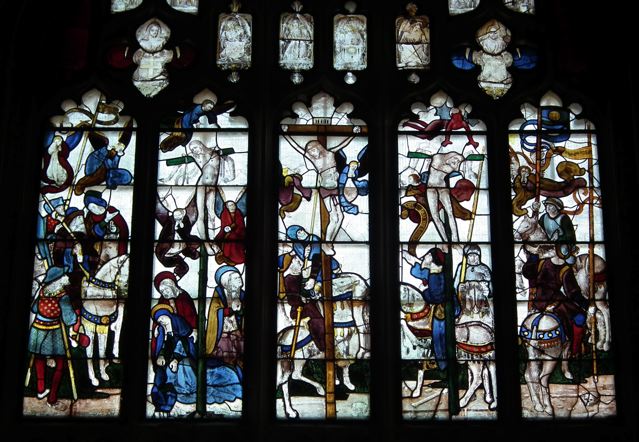
This stained glass window comes from Fairford church in Gloucestershire, a building that was rebuilt between about 1490 and 1510. The set of windows here is the most complete ensemble of late-medieval windows in any English parish church and is probably from the workshop of Barnard Flower, who worked on such high-profile projects as Henry VII’s Chapel in Westminster Abbey and the chapel of King’s College, Cambridge. These windows are among the glories of English art.

Jesus is shown in the central panel. The Roman centurion (called Longinus in some traditions) pierces his side with his spear, an incident described in the Gospel of John, who records that both blood and water flowed from Christ’s side. There is no trace now of blood and water (symbolic among other things of Jesus’ humanity and deity, and of his sacrifice and baptism) in the image in the window – the point of the spear seems to be entering the flesh, though, and perhaps the blood and the water have been lost to time.

In the panel to the left of the centre is the first thief, who is repentant, and on whom an angel looks down. At the base of his cross is the Virgin Mary, supported by Mary the wife of Clopas. Mary Magdalen, with her long hair and pot of ointment, is with them, and gazes at the figure of Jesus. In the panel to the right of the centre is the second, unrepentant, thief, who is accompanied by a devil, a figure with red skin (the devils in the Last Judgement window at Fairford are also red) and grayish, bat-like wings, hovering above the thief’s head. More Roman soldiers occupy the outer panels, and the bearded gesticulating figure on horseback in the left-hand panel is Pontius Pilate (another lower panel, not shown in my photograph, depicts him washing his hands).

There is one other important figure in this window, the foot soldier with the red hose on the bottom left, who is made to stand out with his patterned and brightly coloured clothes. Like many other figures in the window, his gaze is directed straight at Christ. Unlike the others, his collar bears an inscription: ‘IO SAVELE’, which is likely to be a shortened form of Sir John Savile, an associate of King Henry VII. His naming and his position suggest that he was the donor of the windows. His was a noble gift.

This beautiful window is a lovely example of the stained-glass-maker’s art at the point in history where, in England, the Middle Ages are waning and the Renaissance is arriving at last. It combines the traditional rich colours of medieval glass (the blues of Mary’s dress, the deep reds of the some of the solders’ garments, and so on) with sensitive drawing of the faces and lively poses. From the pointing Pilate to the hovering devil, from the observant soldiers to the caring Maries, there is a lot of life in this scene of execution. There is also a careful focus on the main figure, with the pointing hands, the spear, Savile’s gaze, and even the tilt of the flanking crosses, leading our eye towards Jesus. This is also, of course, the church’s east window, in the prime position above the altar, so the architecture and layout of the church draws us to this focal point in the building and the Christian story.

Friday, November 12, 2010

Fairford, Gloucestershire


‘Get a cat’

Time for a break from the parade of shops currently occupying my mind. So, a little feline diversion...

In his book Mani: Travels in the Southern Peloponnese, Patrick Leigh Fermor tells an old story about a Greek sea captain. Troubled by the number of rats on his boat, the seaman calls in a priest to perform the ceremony for casting our vermin. Chants, censing and asperging ensue, and the priest takes his fee, ensuring the man he’ll have no more trouble now, the rites have never failed. ‘”But there’s just one point,” he said. “What’s that, Father?” The priest stooped his bearded head to the seaman’s ear and whispered: “Get a cat.” Since then the phrase “getting a cat” means, in maritime circles, making surety doubly sure.’

Often, of course, the process of ‘getting’ a cat is rather passive. A cat arrives, and if the humans are welcoming enough, the cat stays. Something like this probably happened in 1963, when a tabby adopted the verger of Fairford church and his wife. Tiddles stayed, became the church cat, and attracted the affection of visitors, who come to Fairford to admire the stunning late-medieval stained glass, and of parishioners, on whose laps she sat during services. No doubt her mousing skills were not much used. But the parishioners of Fairford were doubly sure. And when Tiddles died in 1980, this stone, carved by Peter Juggins, was erected near the south porch. Requiescat.