Showing posts with label moat. Show all posts

Thursday, August 1, 2024

Lower Brockhampton, Herefordshire


Good manors

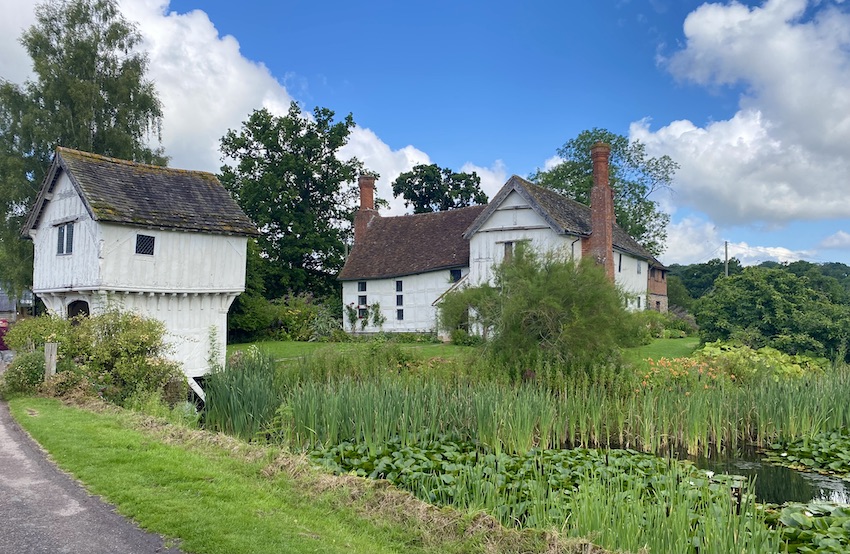
The other day the Resident Wise Woman and I visited the Brockhampton estate, the National Trust property near Bromyard in Herefordshire, to look at the delightful 15th- and 16th-century timber-framed manor house. Few late-medieval houses are as picturesque or enjoy such a beautiful setting, as this one. It’s not a large building by manor house standards, but it’s full of interest. From the outside, the house is almost completely surrounded by a moat lush with plants. The moat must originally have completely surrounded the house, but now, just beyond the point where the gatehouse bridges the water, the moat ends. It would never have been able to withstand much of an attack, since the wooden gatehouse would have been easy for an enemy to take. But the watery barrier and gatehouse did presumably form a barrier to burglars. Perhaps more importantly, moats and gatehouses were marks of lordship, rather like the battlements sometimes seen on stone manor houses that were never intended to withstand a siege. A moat, in other words, was a status symbol.

The left-hand part of the main house contains the double-height hall, the heart of any medieval dwelling. To its right is a cross-wing, which would have contained a private room (known as the solar) for the owners on the upper floor, with service rooms below. In the 17th century the service wing was extended to the rear in a mixture of materials – stone below, timber frame with brick infill above. This extension is just visible in my photograph. Other modifications include the two substantial brick chimneys, also dating to the 17th century,.

How to furnish and display an old house is a recurrent question for custodians such as the National Trust. Sometimes there’s an obvious heyday, as with a great house like Hardwick Hall, where the story of its remarkable and charismatic builder, Elizabeth, Countess of Shrewsbury (aka Bess of Hardwick), demands to be told. Sometimes the emphasis is more likely to fall on a later period in a house that evolved over centuries. In the case of Lower Brockhampton, the decision has been made to make different rooms evoke different periods in the long history of the house. The historical spread extends from a 17th-century bedroom, through the Georgian and Victorian periods, to a living room arranged as it was in the 1950s, when the last private owners stayed on as tenants after giving the estate to the Trust. To my mind the success of this is mixed, but it does bring to our attention some of the people who have lived at Brockhampton. Particularly poignant are a room furnished as the bedroom of a young man about to set off for the trenches of World War I and, in another room, a 20th-century owner’s diary, open at a page where he records news from Europe of the gathering storm that would result in World War II – a protest to the League of Nations about Germany’s remilitarisation of the Rhineland is noted. It’s an obvious point, but it doesn’t hurt to be reminded that old houses of beauty and architectural interest could not exist without people, and that without some of those people some of us might very well not be here.

Tuesday, March 12, 2024

Hereford


Over the moat

This is house is another recent discovery for me in a city I thought I knew. It’s called The Fosse, ‘fosse’, meaning ditch, because it was built near the moat of Hereford Castle, itself now long gone. From the outside, at least, it’s a stunning house of 1825, attributed to the architect Sir Robert Smirke. Smirke is best known as a neoclassicist, but he was highly versatile, just as happy with Gothic or Tudor revival, and apparently comfortable whether designing a grand house or a railway station, a prison or the British Museum.

The Fosse has elements of Jacobean (the chimney stacks, the parapet with its circles, the ogee roof to the little tower). The entrance arch has a Roman feel to it. The fancy glazing bars and the conservatory are very much of their time – as, taken as a whole, is the entire mixture. There’s a lot going on architecturally, then, but the building hangs together visually, and that’s what drew me to it and drew my admiration.

Researching the house in reference books and online I came across a rather sad story about a woman who lived there, Eunice Parker, and her love for a young man called Lawrence (Larry) Wilmot, who went off to fight in World War I. He returned, but traumatized by his experience of the war – he was gassed and lost three brothers in the conflict. Apparently he was unable to marry; Eunice did not marry either and lived what must have been a sad life in The Fosse, dying in 1979. War leaves a long shadow.

Tuesday, March 6, 2012

Birtsmorton, Worcestershire


History and harmony

If you said the words “romantic moated manor house” a building like Birtsmorton Court might well come to mind. A structure that has evolved over seven or eight centuries, this beautiful house is made up of a mixture of timber-framed, stone, and brick wings, all different but wonderfully harmonious, set in quiet countryside, and partly shaded by trees. Birtsmorton may have been begun in 13th century, but in the 15th it was bought by one John Nanfan, who rebuilt most of it. In subsequent centuries, the house was home to various landed families (including relatives of Richard Hakluyt, the writer on exploration, and the family of William Huskisson, the statesman who was the first person to be killed by a railway train) and several of these later occupants made substantial alterations to the building, producing the delightful hotchpotch that remains today.

My photograph shows the view from the south, where there are buildings of various periods in different materials. On the right, the house is stone below, timber-framed with brick infill between the timbers above; this timber-work is a replacement of 1929–30 of earlier work that had been destroyed by fire. On the left is a contrasting brick wing built in the 18th century, with sash windows. Between these two parts is a mixture of various dates, with a pair of timber-framed bays, some stone walls, and tall brick chimneys.

It would take a long time to unpick the complex architectural history that produced this rich and diverse collection of walls, gables, roofs, and chimneys. Even for someone with expertise in the archaeology of buildings it would be a challenge, and one would need to have the run of the place for some considerable time. As Birtsmorton is still a private house, archaeologists are not likely to be unpicking it any time soon. Even if its detailed history is hard to decipher, though, its visual harmony is intact, and a thing to marvel at.

* * *

The house is available for events such as weddings, and there’s more information about it here.

Saturday, August 16, 2008

Wells, Somerset

I have lived in houses with mice, watched swallows nest under neighbours’ eaves, and fretted about martens in roof spaces. I’ve found wasps’ nests in attics, heard tales of badgers undermining foundations, and once lived in a house where there was a fox’s earth beneath the garden shed. In a country house I’ve visited, bats (members of a protected species) fluttered around the upper floors, the owners nonchalantly ignoring the daily fly-past.

Animals have a way of colonizing our spaces. We’re not always pleased about this of course. Few of us take kindly to the common furniture beetle or his other timber-destroying cousins. And some owners of buildings go to great lengths to prevent birds landing on ledges and dropping droppings on the masonry. But there are more benign animal visitors to our buildings. Take the bishop’s palace at Wells. Perhaps the most outstanding bishop’s residence in England, it dates from the 13th century, and is surrounded by a set of outer walls from the 14th century that are in turn surrounded by a moat fed by one of the wells of Wells, around the back. This moat is remarkable for its occupants, for swans have lived here for many long generations. The current pair have managed to produce a very healthy family of eight cygnets this year, and they have gathered by the gatehouse bridge because someone, just out of shot, has begun to throw bits of bread into the water for them to eat.

This bounty means that these elegant creatures are not doing what Wells swans are supposed to do. Around the corner there is a metal chain attached to the palace wall, its lower end comfortably within beak’s range. At the other end of the chain is a bell. The swans of Wells know if they ring this bell someone will be summoned, bearing swan-food. Bell ringing. It’s hungry work, as any campanologist will tell you.


The bell-ringer at work