Showing posts with label modern architecture. Show all posts

Sunday, May 22, 2022

Winchelsea Beach, Sussex


Boxes by the sea

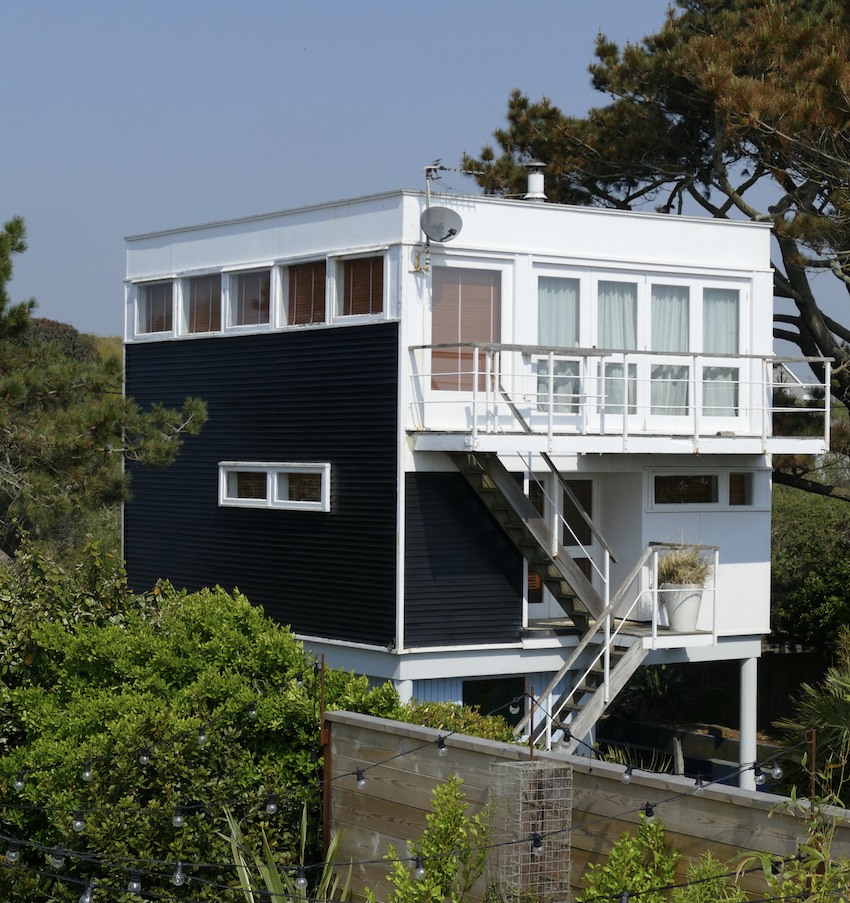
Not far from the railway carriage bungalow in my previous post, I admired a number of houses that displayed very different but equally distinctive designs. One, a large white box, struck me as something out of the UK television programme ‘Grand Designs’. My host and guide to this bit of coast immediately told me that that was exactly what it was. It was built in 2004 by Tom Watkins, former manager of the Pet Shop Boys and featured in that very programme. Only a couple of doors along from that one is the house in my photograph, a far smaller box, this time a box on legs.

Curiously, this more modest building called to me in a way that the more recent white box did not. Maybe exactly because it’s more modest. Perhaps also because it intrigued me with its demonstration of so many of Le Corbusier’s ‘Five Points of Architecture’. In the interwar period, Le Corbusier was a proponent of these five features: building the house on columns, which he called pilotis; strip windows; roof terraces or roof gardens; the ‘free facade’, meaning a facade that puts features like doors and windows where they work best, not where they need to be because of the constraints of structure or convention; and a ‘free plan’, in other words a floor plan that allows a flexible use of space not a plan that was drawn up to some standard predetermined idea of what should go where. Looking at this house from the outside, it certainly seemed to conform to several of the points – although one could only determine the plan by going inside.

So was this, unlike its recent neighbour, a genuine 1930s, Bauhaus period house, or a later recreation? Again, later, I was told – but from the 1950s or 60s rather than the noughties. While most 1950s builders were putting up buildings that looked less ‘modern’ (pitched roofs, brick walls, more restrained ‘modern’ elements), a few people still adhered to the old 1930s ways, as much because of what they looked like as anything else. Boxes like this, with flat roofs and many windows, can take a lot of maintenance to keep them weather-tight and pleasant to live in, but some think this is a price worth paying. After all, the sea views and balconies must come into their own in good weather. Even putting the main structure on stilts, in the light of recent coastal floods (and no doubt more to come), makes new sense of Le Corbusier’s love of pilotis. Maybe we’re not done with the 1930s quite yet.

Saturday, October 10, 2020

Coventry, Warwickshire


1950s dinosaur?

I was struck a couple of weeks ago by an article in Apollo magazine by Otto Saumarez Smith about Coventry’s city centre. Coventry, as many readers will know, was bombed with more than usual Nazi ferocity in November 1940. The post-war rebuilding programme renewed the city centre, the heart of which was an extended shopping precinct carefully aligned with a view of the spire of the old cathedral. The new centre was built in the mid-century modern style, and Saumarez Smith makes a spirited defence not just of its architecture but also of its thoughtful planning and of the works of art (sculptures, murals, and so on) that were placed around the site. The writer laments the fact that Coventry is embarking on a plan to demolish tracts of the city centre and replace them with ‘banal retail’ development.

I have a lot of sympathy for this view, although I know it will not be shared by all my readers. The post-war buildings were not perfect – one problem with the shopping precinct, for example, was the lack of footfall on the upper levels (a familiar issue in precincts and malls), an issue partly addressed by ramps in the Lower Precinct. But the precinct was far better than many later malls, and we are at a time in history when we need to reconsider town centre design. The high-street retail business is changing under the twin pressures of online and out-of-town shopping. And of course now there’s another problem: coronavirus. Suddenly old-fashioned streets and open precincts and squares like those of Coventry (once criticised as ‘windswept’) seem airy and attractive. One thing that improved the city’s 1940s and 1950s buildings – and that still enhances them – is the quality of public art that I’ve already mentioned.

A favourite of mine is a long tile mural, designed by the architect and illustrator Gordon Cullen, which originally lined one of the Lower Precinct’s ramps. The mural illustrates Coventry’s history (and prehistory), from the dinosaurs to the 1950s, featuring trades and professions (ribbon-making, bicycle manufacture), the old cathedral, some of the city’s surviving Georgian houses, and modern buildings including the new cathedral. Sadly the mural was damaged in the 1970s (it lost a lot of the section depicting medieval Coventry) and has been relocated in a less prominent position. But it’s still worth seeking out. Taking a look will reveal something that is more interesting and admirable than the ‘1950s dinosaur’ that Coventry is sometimes said to be.

- - - - -

There’s more of the mural on the cover a book about Coventry here, and a photograph of a concrete mural by William Mitchell, from one of my earlier posts, is here. Bull Yard, the site of the William Mitchell mural, is, alas, scheduled for demolition.

Thursday, June 27, 2019

From Berlin to Britain


Alan Powers, Bauhaus Goes West: Modern Art and Design in Britain and America
Published by Thames & Hudson


This year marks the 100th anniversary of the foundation of the Bauhaus, the influential German school of design that began in Weimar before moving to Dessau and finally to Berlin. The school nurtured so many artists, designers, and architects who were pivotal to the modern movement during the 20th century. Walter Gropius, Marcel Breuer, and László Moholy-Nagy were all at the Bauhaus: Gropius was its founder; Breuer was a student and then a teacher there; Moholy taught the famous foundation course, as well as heading the metal workshop. All three spent time in Britain after the institution closed under pressure from the Nazis in 1933. Other less well known Bauhäusler came to Britain too, a small host of people such as teacher and textile artist Margaret Leischner and Otto Neurath, an associate of many Bauhaus people, who created the important ‘picture-language’ system called Isotype. All these, and many more, appear in Alan Powers’ Bauhaus Goes West, a highly informative and readable study of the school’s influence on British art and design.

The British work of each of the ‘greats’ (Gropius, Breuer, Moholy-Nagy) merits its own chapter, and these chapters throw up fascinating insights. We see Gropius building in timber and brick, in contrast to his more famous works in concrete; we learn of Breuer’s insistence that modernism need not be ‘cold’ or ‘mechanistic’, we find Moholy at work on a model of a future city for the film Things to Come. And we learn about the networks sustaining the modernists. An example is the various ventures of Jack Pritchard who was behind a company manufacturing plywood furniture and the now-famous Isokon flats in Lawn Road, North London, designed by Wells Coates but also involving Breuer. Indded Pritchard was pivotal in the British careers of Gropius, Breuer, and Moholy.

All this is fascinating, but perhaps still more so are Powers’ general chapters. One of these, ‘Elective Affinities: England and Germany’ outlines the relationship between the two countries in terms of design. It shows how British interest in modernism and modernist ideas predates the Bauhaus émigrés, tracing links between Britain and such architects as Erich Mendelsohn and Bruno Taut, and noticing items with modernist elements being exhibited– carved reliefs by Eric Gill, textiles by Phyllis Baron, Dorothy Larcher, and Enid Marx, to name but a few. As businessman and social reformer Harry Peach (who himself visited the Bauhaus at Dessau) said of Britain in 1927, ‘we had a modern movement’.

So Britain was fertile soil for the Bauhaus designers when they arrived, a point shown in another general chapter, ‘The People With No Taste: English Modernism in the 1930s’. This chapter title is of course ironic. Powers shows that there was plenty of taste around, and much of it involved appreciating modern design. It was possible, as Paul Nash famously said, both to ‘Go modern’ and to ‘Be British’. A host of examples – some starting before the Bauhäusler arrived, some under the émigrés’ influence – shows British modernism alive and kicking. Powers covers both the endeavours that showed people ready to appreciate modernism – the efforts of Nikolaus Pevsner, the Council for Art and Industry, the magazine Circle – and the actual products of the designers – from innovative light fittings to revolutionary school buildings.

For anyone looking for an introduction to this aspect of British modernist architecture and design, this book is an excellent place to start. For someone keen to refresh and sharpen their knowledge of the Bauhaus and its influence in Britain, Bauhaus Goes West is likewise truly enlightening.

Friday, December 1, 2017

Plans and people


Richard Rogers with Richard Brown, A Place for All People
Published by Canongate Books

My next pre-Christmas review is an account of life, works, and beliefs by one of our foremost architects...

We tend to think of famous architects in terms of their most high-profile projects. Richard Rogers, one of the pre-eminent architects of his generation, brings to mind instantly major buildings like the Pompidou Centre in Paris and the Lloyd’s Building in London. But there is much more to him than that, and this book – part memoir, part architectural inside story, part manifesto – tells the stories not just of these but also of many less well known designs, from his early houses to more recent social housing projects. All these have fascinating aspects, and it’s one of the pleasures of reading this book to discover more about familiar and unfamiliar buildings alike – what drove the designs, the thinking behind them, how they got built.

The book is revealing, as one would expect, on the architect’s formative experiences.His closeness to Italy is key – his Italian parents and cousin, the architect Ernesto Rogers, his admiration of Italian piazzas, his love of Florence, his work with Renzo Piano. There is also the formative influence of innovative architects in Britain, such as Peter Cook and Cedric Price, and in America, where his first experience of New York and his time at Yale are described. But history and historic architecture are important too, whether it’s the achingly beautiful piazza in Siena or the work of great Victorian engineers like Brunel or Paxton.

Then there’s the work. Rogers’ account of the various crises involved in getting the Pompidou Centre designed and built, and the controversies that surrounded Lloyd’s, are vividly told: it’s worth reading the book for these alone. A major theme is the development of adaptable buildings, and of lightweight structures, from the early Reliance Controls building near Swindon to the Millennium Dome, aka O2.

Another important leitmotif is public space. Rogers loves lively public spaces, especially those Italian squares. He not only promotes public space when he can, but actively encourages it and builds it into his plans – the piazza next to the Pompidou Centre is a key part of the design and Rogers and Piano’s was the only scheme for the site that provided this facility. He is exercised, quite rightly I think, by the poor provision of public space in some British cities and the erosion of this space as it gets sold off to private owners who let the public in on their own conditions. And he is particularly engaged by the spaces in capital cities. He believes that every Parliament should have a public space next to it for people to demonstrate ion, and finds it an embarrassment that Britain’s government sought to banish demonstrators from London’s Parliament Square.

A Place for All People, this book is called, and people are at its heart. Star that he is, Rogers is constantly at pains to credit his partners, co-designers, and engineers (he’s worked with some of the best of those), and to build up a picture of some of the ways in which a large architectural practice works. People’s importance to him is not just about socialising in the River Café or enjoying big family get-togethers in his enviable London house. People are at the core of what he does and understanding that offers a way of understanding Rogers and his remarkable buildings.