Showing posts with label Avoncroft. Show all posts

Thursday, September 5, 2019

Avoncroft, Worcestershire


Plain, simple, and solid

Before I leave the subject of telephone boxes, a recent visit to the excellent Avoncroft outdoor museum in Worcestershire reminded me that I have never featured an example of the first standard telephone kiosk, the design that became known as the K1. This is in part because K1s are rare: the survivors are mostly in museums – and they are baffling because there are variations in the design from one box to another.

Before the 1920s, telephone boxes were not standardised at all. Telephone services were provided by various local companies, who adopted their own designs for kiosks. But in 1912 the General Post Office took over most of these companies (Hull in Yorkshire was a notable exception*) and soon looked for a standard design. Kiosk No 1 (later known simply as the K1), a plain, simple, solid box on a square plan with a pyramidal roof, was the result, and was introduced in 1923. Some K1s were made of wood and some had concrete walls, metal glazing bars, and a wooden door. Some of the variations in appearance were linked with this difference in materials – the concrete boxes, for example, have a different pattern of glazing. Some were also given a roof sign saying ‘Public telephone’, which concealed the top of the pyramid roof and its finial.

This example at Avoncroft, part of the National Telephone Kiosk Collection,† which is housed there, is a concrete K1, painted in the combination of grey and red that was usual at the time. The design was simple, but not much liked visually. At Eastbourne, the local authority even insisted that the boxes on the sea front should have thatched roofs! K1s were therefore superseded when a design competition of 1924 produced Sir Giles Gilbert Scott’s popular K2 design, which is most people’s favourite telephone box. We have to be grateful to Avoncroft for giving less illustrious but historically important kiosks a home.§

- - - - -

* My mother, who was born in Hull, told me with a certain puzzled pride that the telephone system in her home town was run by an independent company, and that the telephone boxes on Hull’s streets were painted cream, to mark this difference. They still are. Yorkshire: another country, it sometimes feels like, and in one corner of it they do things differently there.

† K1s, ‘Vermillion giants’, AA boxes, even a lovely Morris Minor telephone engineer’s van – they have it all in the National Telephone Kiosk Collection.

§ I am indebted to Gavin Stamp, Telephone Boxes (Chatto & Windus, 1989) for information about the history of these useful, interesting, and tiny buildings.

Saturday, June 3, 2017

Avoncroft, Worcestershire


Taking its toll

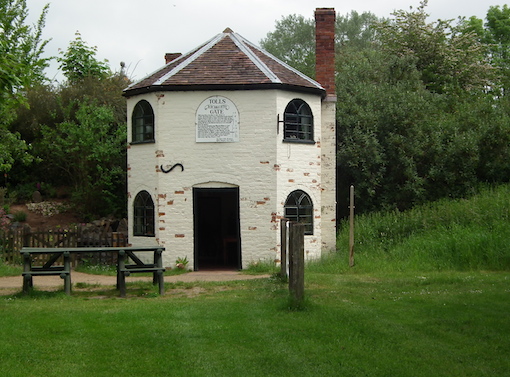
Thinking about the bridge house at Cookham in the previous post reminded me not only of the numerous toll houses I’ve seen by the sides of main roads up and down England but also, specifically, of one at the Avoncroft Museum. This little building was rescued in around 1985 and was resited at the museum, where it has a pleasant leafy site. It was originally built in 1822 at Little Malvern, Worcestershire, for the collection of tolls by the Upton upon Severn Turnpike Trust. Back in the 19th century, anyone wanting to travel along this particular stretch of road in a landau had to fork out sixpence in the old money, but if you brought only your horse, the charge was ‘a penny-ha’penny’, or 1.5 of the old pence.

The house takes the usual polygonal form of these turnpike houses, and although it’s quite a plain brick building, it has the fancy Gothic glazing that was fashionable in the early-19th century. It no longer stands by a roadside, but the people at Avoncroft have put up a gate outside, to give an impression of the original set-up, with passersby stopping at the gate to pay their money before being allowed to pass through on to the turnpike road.
The joy of places like Avoncroft is that they restore the insides of their buildings, and visitors can go inside to look at the spartan but charming interior: a living room and scullery downstairs and two bedrooms above. The ground floor has quarry tiles, an iron range for cooking and heating, and very basic pine furniture. Upstairs there is an iron bedstead, a wooden child’s cradle, and a chest of drawers. Under the bed is the necessary chamber pot. The house had an earth closet in the garden, and when the building moved to Avoncroft, that came too. The life of another era? Maybe, but I remember in the 1960s that my grandparents got by with the same sanitary arrangements in their remote Lincolnshire cottage. Places like Avoncroft remind us that the remote past is not as remote as it seems.

Friday, September 6, 2013

Bromsgrove, Worcestershire


What goes round…

Once upon a time we all sent lots of letters. Often we'd run out of postage stamps and the Post Office and shops would be closed, but we'd still want to get the letter in the mail. So there were stamp machines. You stuck a penny (or a higher value coin) in the slot, and a stamp, or a book of stamps, popped out, and you could send your letter on its way. Stamp machines were found in the walls of Post Offices, next to mail boxes, or set into the side of a special kind of stretched phone box, like this one: the K4 telephone kiosk introduced in 1927 as a sort of Post Office in miniature. An enlarged version of the much-loved red telephone box designed by Gilbert Scott, the K4 was sometimes known as the vermillion giant.
Comparatively few of these giants were made (I think about 50), supplementing the thousands of wall-mounted stamp machines outside Post Offices. This rare survivor is at Avoncroft, which houses the National Collection of telephone boxes. Both K4s and stamp machines disappeared when the price of stamps began to make coin-in-the-slot vending impracticable – when stamps increased in cost and the standard stamps weren't priced in convenient multiples of £1. At the same time email was replacing real mail in many cases, further accelerating the demise of stamp machines. And it was a similar story with other kinds of coin-in-the-slot vending. The only time I usually put a coin in a slot theses days is to pay for parking.  With the rise of the mobile phone, many standard red phone boxes in Britain (the ones without stamp machines and mail boxes) have disappeared too, although there are worthy efforts to preserve them. So, once-loved pieces of street furniture become less useful (or less generally useful), and die out or acquire new uses.

And yet. Automatic payment systems are on the rise. Supermarkets are getting us used to scanning our own groceries and paying for them with our plastic cards, without (in theory) the intervention of supermarket staff. I have very mixed feelings about this, but it's happening and we have to deal with it. Maybe a new building type will emerge to handle some as yet unthought-of automatic transaction. I hope it will be as elegant a solution as the red phone box, and its slightly cumbersome, but still impressive, cousin, the vermillion giant.

Wednesday, August 8, 2012

Bromsgrove, Worcestershire


Knocks and scrapes

Before we leave behind the subject of the red telephone box – admirably preserved and given a new use by the Henry Moore Foundation, as noted in the previous post – here's another red box picture from a few weeks ago. As more and more of these boxes disappear under the rising tide of mobile phones, it is more and more unusual to see the little groups of telephone boxes that used to be common in British towns and cities. One place where these boxes are preserved is at the excellent Avoncroft Museum, near Bromsgrove in Worcestershire. As well as a fine collection of rescued and relocated old buildings from the Midlands, Avoncroft is home to the National Telephone Kiosk Collection. Here are four K6 boxes, gathered together in the museum's phone box area.

It's good to see them well looked after (so many roadside boxes look rather dishevelled these days), their paintwork shining and red. When Scott designed the original K2 box, the slightly taller predecessor of these 1935 K6s, he intended them to be painted silver outside and "greeny-blue" inside, but it's hard now to imagine them any other colour than red.*

The vehicle is a Morris Minor Van of the type used by telephone engineers in the 1950s and for years afterwards. The Royal Mail used similar vans painted red, but the telephone engineers' vans were green and had black rubber front wings. According to the Morris Minor Owners' Club, Royal Mail red vans were allocated to specific drivers, who were trusted to look after "their" vehicles. The green engineers' vans were driven by many different drivers, who, it is said, were thought less likely to be careful with their transport. Hence the rubber wings, which were proof against at least some knocks and scrapes.

I'm pleased that at least a few red telephone boxes, and this van, are being protected from knocks and scrapes by the good people at Avoncroft.

* * *

* Unless you come from Hull in Yorskshire, where the telephone boxes were installed by the local council and painted cream.