Showing posts with label Gothic revival. Show all posts

Wednesday, January 28, 2026

Wilmcote, Warwickshire


Beauty of holiness

My interest provoked by hints in Pevsner that the church at Wilmcote might be eccentric or beautiful or possibly both, I crossed the road opposite Mary Arden’s Farm, walked back to the main street, and walked along the usefully named Church Road. There I found a small Gothic Revival church of c. 1840 designed by Harvey Eginton. The kind of Gothic chosen by the architect is Early English, the first phase of Gothic on these islands, sometimes chosen by early Victorians as representing the ‘purest’ form of the style with its simple lancet windows and plain but elegant deeply moulded arches.

On entering, though, it was clear that something unusual was up. This church is very highly decorated inside with wall paintings, lavishly supplied with statues of saints and of the Crucifixion, and altogether rather ornate – far from plain and simple, in fact. This was indeed one of the first churches to be built and decorated under the influence of the Tractarians, that group of clergymen and scholars (many originally based in Oxford and Cambridge), who believed that a church should be highly embellished, that the clergy should wear colourful robes, and that such ritual accompaniments as incense should be used. Worship in ‘the beauty of holiness’* was the aim, in sharp contrast to the plain style of the previous few generations. The person behind this aspect of St Andrew’s, Wilmcote was the Rev. Edward Bowes Knottesford Fortescue, a keen Tractarian who knew many of the movement’s leaders. However, it’s said that a later clergyman, the Rev. F W Doxat, may have been responsible for some parts of the decorative scheme.

The chancel glows in green and gold, its walls painted with stylised flowers and leaves. The decoration, if overwhelming, also does an excellent job of defining the chancel as the most sacred space. The nave is much darker, but when one’s eye adjusts, its possible to make out very different wall decoration: a series of paintings, mainly monochrome compositions showing saints, scenes from the life of Christ, and religious texts. Close examination reveals that these are actually done on panels that have been attached to the walls – in fact, they are on sheets of zinc, a material I don’t recall seeing used for church murals before. I’d been led to this church by the description in Pevsner’s Warwickshire volume in the Buildings of England series, and I’m indebted to the book for the information it contains. But it did not prepare me for the amazement I experienced inside. Such surprises are what keep me looking – and recording here what I find.

- - - - -

* This phrase is a rewording of the verse in Acts 2:4, describing the scene at Pentecost. The King James Bible gives, ‘And they were all filled with the Holy Ghost…’. For an excellent account of this change in Victorian worship and architecture, see William Whyte, Unlocking the Church, which I reviewed here.

Tuesday, September 2, 2025

Fretherne, Gloucestershire

A class act

Visiting Arlingham the other say (see my recent post here) reminded me of an occasion maybe eight or ten years ago when the Resident Wise Woman, our son and I celebrated my birthday with an excellent lunch at The Old Passage, an outstanding fish restaurant (it closed after covid, alas!) by the River Severn not far from the village. On the way home we stopped at the church of St Mary, Fretherne, which was on our route. My memory of the visit comes back to me through a haze of good food and wine, but we were all mightily impressed by this glorious building, packed with stunning craftsmanship – stone sculpture, woodcarving, painting, tiling, metalwork. To me, there’s something hard and cold about many Victorian churches – the architecture may be very correct Gothic, but the result lacks the irregularities, winning oddities and rough surfaces that make many older churches so delightful. Now and again, however, I find a church that turns these ideas inside out. Such a building is St Mary’s, Fretherne.

From the outside it’s dominated by a wonderful crocketed spire, upward-pointing pinnacles, and steeply pitched roofs. The two-tone stonework is a mixture of toffee-coloured Stinchcombe sandstone and Bath stone dressings, the latter lending itself well to window tracery, carved detail, crockets and other ornaments. Most of these details are exuberant imitations of the architecture of the 14th-century as reimagined by the local architect Francis Niblett in 1846–47. Niblett is not well known outside Gloucestershire. He was the younger son of the owner of Haresfield Court, a few miles to the east of Fretherne, and did quite a lot of church and other work in the county. Fretherne, where he had a sympathetic patron in the upper-class clergyman the Rev. Sir William Lionel Darell, is his masterpiece. Niblett was a dedicated follower of the work of A. W. N. Pugin, who advocated ornate 14th-century Gothic as the style in which to embody ‘the beauty of holiness’. These were also the ideas that the influential clergy of Oxford and Cambridge were behind: out with Classicism (the style of paganism) and in with Gothic (the style of catholic Christianity*); out with the old spartan preaching churches of the 18th century, in with beautiful buildings that were fit for the sacraments and could move you to prayer.

Inside St Mary’s there is beauty everywhere you look. The intricately carved pulpit and font cover; the painted organ case and pipes; corbels and brackets carved with foliage or with angels playing musical instruments; colourful Minton floor tiles; a reredos dripping with miniature arches and shafts and framing a pyrographic picture of the Supper at Emmaus done by a local clergyman; a painstakingly painted and stencilled roof; elaborate hinged metal grilles that allow doors to be left open for ventilation; innumerable details meaning that there’s always something to see that you’ve missed before. This is a very special building.

For all this high-Victorian glory, the place certainly does not feel stuffy. The parish has embraced the eco-church movement. There is community planting in the churchyard – cherry tomatoes were on offer when I was there and parts of God’s acre are kept wild. And amongst the wildness the crocketed lines of Niblett’s beautiful spire rise above the yew trees, thrown into relief by the sunshine and leading the eye upwards to the clouds and the patches of deep blue in the summer sky.

- - - - -

*By ‘catholic’, the Anglican campaigners of the 1830s onwards meant true to the doctrines of the ancient, undivided Christian church. They believed the Church of England to be a truly ‘catholic’ church.

Angel mural, Fretherne church, Gloucestershire

Tuesday, August 3, 2021

Battlefield, Shropshire


More tiles, Maw tiles

In the great transformation in church buildings that took place during the 19th century, a key element was the revival of medieval architecture, especially Gothic architecture. Although Gothic buildings had been erected in every century since the end of the Middle Ages,* the Gothic churches of the mid- to late-Victorian periods were Gothic in more thoroughgoing and self-conscious ways. The style became part of the movement to make churches more visually attractive, more moving, more full of symbolic meaning, more redolent of what members of the high-church Oxford movement referred to as the ‘beauty of holiness’. Central to this was the encouragement of church art – carving, metalworking, mural painting, and ceramic tiles. Architects and designers studied the tiles in medieval churches like the ones in my previous post about Buildwas abbey, and copied them or designed similar ones.

Among the companies that made these tiles, combining different coloured clays ands glazes to often beautiful effect, were Minton, Godwin, Craven Dunhill and Maw. Maw and Company started in Worcester but moved to Benthall in Shropshire (not far from Ironbridge) in 1852 and were soon one of the biggest tile-makers.† Maw’s made many of the tiles laid when the church at Battlefield near Shrewsbury (originally built after the Battle of Shrewsbury in 1403), was restored – indeed virtually rebuilt – in 1861. It had originally been a grand collegiate church in the fields, very near to the site where the battle was fought during the Wars of the Roses. Now its 19th-century wooden roof timbers, carved stalls, stained glass, and tiled floors give it the atmosphere of a grand Victorian college chapel.

These tiled floors combine secular and religious symbolism – coats of arms of numerous English kings, motifs such as crosses, and heraldic symbols of the Corbet family, one of whose homes was in a nearby castle (now vanished) and who paid for the church’s restoration. The tiles in my photograph feature charming squirrels, not just a favourite of those who like English mammals but also one of the Corbets’ heraldic beasts. A squirrel forms the family crest – the beast at the top of the coat of arms, just above the shield. Here on the floor of the Corbet chapel in the church at Battlefield, squirrels sport in quartets, occupying roundels made up of four tiles. This use of four tiles to make a roundel was a medieval trick, and the little crosses in the corners of the tiles and the cross-like motifs that abound in this floor were also drawn from medieval sources.

If the imagery has a distinctly medieval feel to it, the crispness of the tiles, their deep colours, and the hard, complete surfaces make them unmistakably Victorian. So does another feature that we do not usually see in medieval work – the name of the tiles’ makers, ‘MAW’, in beautiful ornate lettering, the ends of the cross strokes of the ‘M’ and ‘W’ elegantly looped, the strokes terminating in not a bifurcated but a trifurcated shape, and the ends of the word filled out with curlicues. The company’s pride in their work is understable, I think. Our Victorian predecessors, painstaking and brilliant when they were given scope to shine, deserve to be remembered.

- - - - -

* For convenience, I take the Middle Ages to end in 1500. Another date used is 1485, when the Wars of the Roses ended and the first Tudor king, Henry VII, began his reign.

† With Maw and Company at Benthall and Craven Dunhill in nearby Jackfield, the encaustic tile industry was strong in Shropshire. Craven Dunhill still make tiles in their works at Jackfield, where the factory and the adjacent tile museum can be visited. The museum is a cornucopia of tile history and visual delight.

Saturday, June 3, 2017

Avoncroft, Worcestershire


Taking its toll

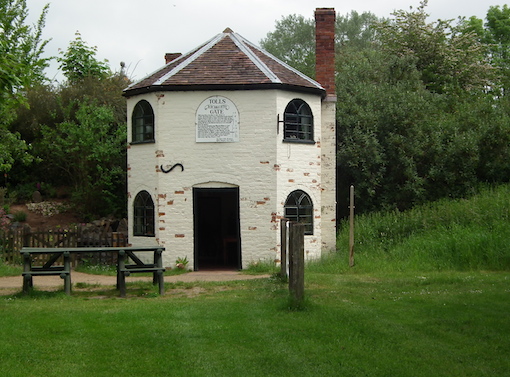
Thinking about the bridge house at Cookham in the previous post reminded me not only of the numerous toll houses I’ve seen by the sides of main roads up and down England but also, specifically, of one at the Avoncroft Museum. This little building was rescued in around 1985 and was resited at the museum, where it has a pleasant leafy site. It was originally built in 1822 at Little Malvern, Worcestershire, for the collection of tolls by the Upton upon Severn Turnpike Trust. Back in the 19th century, anyone wanting to travel along this particular stretch of road in a landau had to fork out sixpence in the old money, but if you brought only your horse, the charge was ‘a penny-ha’penny’, or 1.5 of the old pence.

The house takes the usual polygonal form of these turnpike houses, and although it’s quite a plain brick building, it has the fancy Gothic glazing that was fashionable in the early-19th century. It no longer stands by a roadside, but the people at Avoncroft have put up a gate outside, to give an impression of the original set-up, with passersby stopping at the gate to pay their money before being allowed to pass through on to the turnpike road.
The joy of places like Avoncroft is that they restore the insides of their buildings, and visitors can go inside to look at the spartan but charming interior: a living room and scullery downstairs and two bedrooms above. The ground floor has quarry tiles, an iron range for cooking and heating, and very basic pine furniture. Upstairs there is an iron bedstead, a wooden child’s cradle, and a chest of drawers. Under the bed is the necessary chamber pot. The house had an earth closet in the garden, and when the building moved to Avoncroft, that came too. The life of another era? Maybe, but I remember in the 1960s that my grandparents got by with the same sanitary arrangements in their remote Lincolnshire cottage. Places like Avoncroft remind us that the remote past is not as remote as it seems.

Friday, February 24, 2017

Haugham, Lincolnshire


Homage

Not far from the A16 in Lincolnshire is the small village of Haugham.* It’s a place that means something to me because, long ago, before I was so much as thought of, my newly married parents lived there. The view from their house took in the village church and it was impressed upon me, when my parents reminisced to me about their early years, that the spire of this church was special because it had been built in imitation of the great and graceful spire at Louth, the local market town (where my mother had worked before she was married), and Louth, as we all knew, had and has a very special spire.

Well, it’s true. All Saints’ Haugham was built between 1837 and 1840 to designs by George Willoughby§ at the behest of (and with funds provided by) the vicar, George Ascough Chaplin.¶ It’s very small, this church, and modestly constructed of brick with cement render. But the spire is similar to the one at Louth in its overall outline – the large pinnacles, linked by buttresses to the crocketed spire, together with the generous window on the upper storey certainly create a similar impression. It’s not a direct copy, but is certainly a homage.

The setting is outstanding. The church is in the middle of a field, approached by a green lane. In my parents’ time, rabbits jumped around the field, entertaining my mother as she took breaks from housework and remembered her young years working in an office in Louth, in the shadow of the greater church whose design the one at Haugham echoes. Such is the stuff of memory.†

- - - - -

* Pronounced ‘Haffum’.

§ Some give the architect as W A Nicholson; Pevsner attributes the building to Willoughby (a Louth architect), saying that he may possibly been have assisted by Nicholson. 

¶ The Chaplins were local landowners and some members served as MPs in Lincolnshire. They certainly were landowners at both Haugham and nearby Tathwell in the 19th century, but I don’t know whether George Ascough Chaplin was squarson or if he was a benefice-holding younger son of this illustrious family.

† All Saints, Haugham, is now in the care of the Churches Conservation Trust. There is more about the church here.

Tuesday, August 14, 2012

Ross-on-Wye, Herefordshire


Goth-on-Wye

Ross on Wye is a favourite town of mine, boasting as it does two important characteristics of a town as far as I am concerned: a supply of interesting buildings and a good secondhand bookshop. I've been buying books at Ross Old Books for years and there are also occasional bargains to be had in the market. The town is beautifully set on a rise above the Wye and from the 1770s this beauty was famous due to writers such as William Gilpin, who celebrated the scenery of the Wye as a charitable example of the Picturesque. By the 1830s many visited the town as a base for boat trips on the river and the large white ornately bargeboarded Royal Hotel was built to accommodate the tourists.

The round tower in my picture looks like something from the age of chivalry, but was actually built in the 1830s as part of the setting for this hotel. Flanked by walls incorporating a blocked pointed arch, it looks from a distance like part of some medieval fortifications: town walls, perhaps, to protect the inhabitants of Ross from the marauding Welsh. But when you get near the tower, you can see that the battlements on top are tiny – they're meant simply to afford the building the right chivalric-looking silhouette. The windows, though authentically pointed, are too large for a fortified tower. So this is a tower meant to look good from a distance, as visitors drew close to the town from the valley, and as a kind of marker to lead people to the hotel, which is the other side of the greenery on the right-hand side of my photograph. A beacon for the approaching traveller, in the 1830s, and in 2012, whether that traveller is in search of scenery or books.

Friday, April 20, 2012

Leicester


Built to last

Just along Granby Street from the Turkey Café described in the previous post is this large Victorian bank. It’s such a show stopper of a building that I couldn’t photograph it all (there are more pictures of it here). The Victorians liked to build big, imposing banks, and employed all sorts of styles for them from solid classical, through ornate Italian Renaissance revival, to the Gothic employed here. Now empty, formerly a branch of the Midland Bank and HSBC, this 1870s building was originally the head office of the Leicestershire Banking Company. Its designer was Joseph Goddard, who, like Wakerley of the Turkey Café, was a prominent Leicester architect. In fact several generations of the Goddard family have practiced architecture in Leicester. Goddard originally intended to design the bank in the classical style, but his clients wanted something different from the classical National Provincial Bank up the street, so he went for this red-brick Gothic, with trimmings of stone and terracotta.

The part of the building shown in my photograph is the banking hall. Its dominating features are the tall Gothic windows – I left a passing pedestrian in the picture so that you can see just how tall they are. I especially like the way Goddard used pale Portland stone to contrast with the brick – the stripy arches are an effective touch, as is the mix of stone and terracotta at cornice level above them. Slender shafts flanking the windows, decorative terracotta panels, and little bands and rosettes of carved stone provide plenty to entertain the passer-by. It’s a building full of Victorian confidence, soaring above the modern shops that surround it on this street in the centre of Leicester and speaking of the city’s prosperity when the hosiery, textile, and engineering industries were at their height – a time when bankers and their architects built to last.