At the apothecary’s, 1
While the Resident Wise Woman dived into the Old Apothecary Shop on Matlock Bath’s North Parade, her brain switching automatically to present-buying mode, I stood in awe looking at the shop front and the interior fittings.*
Although this street of shops was first built in 1835, it was made over just after 1900, and the then resident apothecary, Alfred Newton, oversaw the installation of a new shop window and the outstanding shelves, drawers, and counters inside. This was just the kind of interior that would have suited the fashionable pharmacist in the early-1900s. One would expect to see big glass carboys full of coloured liquids on the top shelves, packets of patent medicines in the display cabinets below, and equipment such as pestles, mortars, and accurate balances on the counter. There must have been perfumes too, precious phials and bottles displayed securely in the glass-fronted cabinet: the word ‘perfumery’ still marks it out in carved wooden letters of an ornate and Art Nouveau style.
Such shop interiors are rare survivors, the sort of thing one is as likely to see in a place like the Black Country Living Museum as in a real, working high street. It’s remarkable to find this one, among neighbouring emporia selling beach balls and ice cream, still used for goods related to the ones first sold here.† A multiple pleasure, for social historians, architectural historians, and shoppers alike.
- - - - -
* This is not the first time I have been indebted to the Resident Wise Woman for leading me into a shop of architectural or historical interest; I am forever grateful.
† Matlock Bath’s ‘retail offer’, as they say these days, seems, for an inland town, remarkably skewed towards businesses that are generally seen at the seaside. There are amusement arcades and candyfloss too.
Showing posts with label Derbyshire. Show all posts
Wednesday, September 28, 2022
Saturday, September 24, 2022
High Peak Junction, Derbyshire
Modest monument
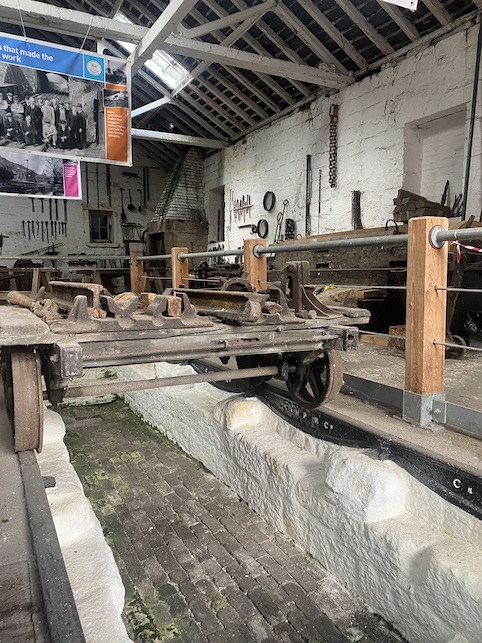
A highlight of our recent visit to Cromford was a stroll along the Cromford Canal, taking in canalside views of nature and architecture, listening to (but failing to identify) birdsong, passing the pump house in my previous post, and ending up at High Peak Junction, about a mile from the wharf at Cromford where we started. High Peak Junction provided tea in the shadow of a modest but fascinating building, one of the earliest railway workshops in the world. It’s not much to look at from outside – a small cluster of stone sheds with pitched roofs, festooned with signage that ranges from notices with historical and visitor information to some authentic-looking painted wooden railway signs.
Inside, things get more interesting, with the original inspection pit, engineers’ tools in abundance, a still-working forge, and side rooms for the engineers and railway clerks. Online descriptions of an untouched ‘time capsule’, coupled with period photographs, are a little misleading – there’s a health and safety fence around the inspection pit and a number of large information banners hang from the iron and timber roof trusses. But the place is still packed with interest and objects to linger over, from the files, hammers and anvils of the blacksmith, to metalworkers’ drills, oil tanks, and the London Midland Scottish railwayana in the side rooms. There’s much here to delight the railway specialist and to intrigue the visitor with a more casual interest.
This workshop dates back to 1825–30, which is very early indeed in the history of railways. So early indeed that the first railway items to be looked after here were wagons and rails – there were no locomotives here then, and trains were pulled by horses. Later, when steam engines arrived here in 1833, the entrance to the workshop had to be modified to accommodate their tall funnels. The ’shop was still in use in 1967, when the line closed, and it’s said* that many of the tools that still remain were made in the forge in this very building. So in this sense, the term ‘time capsule’ is spot on.
- - - - -
* I’ve drawn in this post on the account of the workshops here. Workshop interior: original inspection pit (and forge with tools in the background); modern heath and safety fence.
Wednesday, September 21, 2022
Lea Bridge, Derbyshire
Keeping the water flowing
The Cromford Canal was begun in the 1790s with the ultimate aim of linking Cromford with Manchester, giving a route to a market for the area’s mineral resources. Limestone and the lime produced from it were lucrative potential exports from the area. In addition, Richard Arkwright saw that he might use water transport to service his mills and backed the project, helping the progress of the necessary bill through Parliament and selling part of his garden at Cromford to allow a wharf to be constructed.
In the 1840s, the canal hit a problem. It had filled with water removed from lead mines in the area, but as the miners continued to remove the lead, they dug deeper and opened new underground channels to drain away the water, which no longer flowed into the canal, leaving boats stranded. The answer was a pump to remove water from the River Derwent to keep the canal topped up. But the river provided only a finite amount of water, some of which was itself used by the area’s industry. To stop the river too becoming dry, restrictions were imposed on taking water from the Derwent: water could only be pumped out for the canal between 8 pm on Saturdays and the same time on Sundays, when the local factories were not working. So they needed a pump with an unusually high capacity, to make best use of the time allowed.
Leawood Pump House, which they built to house the pump, is visually impressive. It is constructed of well worked gritstone, with chamfered ashlar quoins, classical windows, and pediment. The chimney is 95 feet high and also of stone, with a cap of cast iron. Inside is the original steam engine, built by Graham and Company of Elsecar, near Rotherham. It’s a big, single-action beam engine, still in working order, and can run at 7 strokes per minute, lifting about 4 tons of water at each stroke. This means it can shift a huge volume of water very quickly, so that the canal company could take the water they needed during the time they were given to do so. The pump house was successful, and the engine ran regularly for almost a century, until 1944 when the canal closed. It is still run occasionally, when visitors can experience the sheer power of steam. When I passed by, all was quiet, but the power of the architecture was clear to see.
Thursday, September 8, 2022
Matlock Bath, Derbyshire
Postcard from Switzerland
Arriving at Matlock Bath, I parked in the ‘overspill’ area of the full station car park and waded through mud in this summer of drought, to get out of it.* This found us almost on the doorstep of the railway station, set, like the rest of the place, amongst the wooded slopes of the River Derwent’s gorge. Scenery, fresh air, and healing water brought people here in increasing numbers form the 1770s onwards, and the numbers grew yet again when the railway arrived in 1849. Today, after a period of closure (1967 to 1972), the railway is back, and seems to bring many people in, to add to the crowds coming, like us, in cars and clogging up the car park.
When they expanded the station in the 1870s, the railway company built a Swiss-cottage style station to go with the setting, known to some as ‘Little Switzerland’. For the Victorians of Matlock Bath, the term ‘Swiss cottage’ meant a timber-framed building with patterned brick infill between the timbers, eaves with a big overhang, and wooden brackets. An added touch is a Midland Railway speciality: iron framed windows with striking lozenge-shaped panes. The result is an eye-catcher, to traveller and platform-gazer alike.†
Inside, the station was quiet, but was serving tea and cakes, giving us further excuses to linger. In between sips of my tea, I looked up and took the photograph of the roof, below. A very satisfying start to a short visit that produced still more interest.
- - - - -
*It was only muddy in the overspill area; the rest of the car park is tarmac-covered and civilised.
† Timber-framed stations in a cottage-orné manner, similar to this but in a different, more ‘old-English’ style, are also to be seen at places such as Woburn Sands and Fenny Stratford on the Marston Vale line in Buckinghamshire and Bedfordshire.
Monday, September 5, 2022
Cromford, Derbyshire
A bit of a shambles
To begin with, I hardly glanced at the small low terrace of tiny shops, most of them seemingly unoccupied, that runs along the northern side of the market place in Cromford. Big stone blocks filling in the gaps between low doors and rather small windows, plus a space above that seemed rather too large for a shop sign, all below a hipped roof of slate. Even so, the design of this unregarded building seemed un usual, and I wondered… Then I saw a brief account of these buildings and gave them another glance, because I learned that they’re actually – in origin at least – Georgian. This is a tiny Georgian shambles, in other words a row of small shops running near or along the edge of a market place, usually originally occupied by people such as butchers.* They came about when market traders, needing more permanent premises than a temporary stall, built shops either on the site of their old pitch or nearby.
These must have arrived in Cromford during the heyday of Arkwright’s mill, when the town was growing and there would have been a ready market for food such as meat that could not be grown or raised at home. Sadly, they have now seen better days. Nearly every window is different from its neighbours, suggesting that most are replacements.§ Likewise the doors, some of which are boarded up or even, like the one in the foreground of my photograph, replaced with masonry. My picture is not very good – I had to shoot at a an angle to avoid a row of parked cars and vans that would have virtually hidden the shops from view. But it gives one an idea of what’s here†…and perhaps of the potential that could be unlocked if the building were restored.
- - - - -
* Usually butchers, although fishing ports sometimes have ‘fish shambles’, and Dublin has a Fishamble Street on the site of a former fish market.
To begin with, I hardly glanced at the small low terrace of tiny shops, most of them seemingly unoccupied, that runs along the northern side of the market place in Cromford. Big stone blocks filling in the gaps between low doors and rather small windows, plus a space above that seemed rather too large for a shop sign, all below a hipped roof of slate. Even so, the design of this unregarded building seemed un usual, and I wondered… Then I saw a brief account of these buildings and gave them another glance, because I learned that they’re actually – in origin at least – Georgian. This is a tiny Georgian shambles, in other words a row of small shops running near or along the edge of a market place, usually originally occupied by people such as butchers.* They came about when market traders, needing more permanent premises than a temporary stall, built shops either on the site of their old pitch or nearby.
These must have arrived in Cromford during the heyday of Arkwright’s mill, when the town was growing and there would have been a ready market for food such as meat that could not be grown or raised at home. Sadly, they have now seen better days. Nearly every window is different from its neighbours, suggesting that most are replacements.§ Likewise the doors, some of which are boarded up or even, like the one in the foreground of my photograph, replaced with masonry. My picture is not very good – I had to shoot at a an angle to avoid a row of parked cars and vans that would have virtually hidden the shops from view. But it gives one an idea of what’s here†…and perhaps of the potential that could be unlocked if the building were restored.
- - - - -
* Usually butchers, although fishing ports sometimes have ‘fish shambles’, and Dublin has a Fishamble Street on the site of a former fish market.
§ Although the small panes in some of the windows, especially the two on the left, do suggest an early date.
† There was once another row at the other side of the market place.
Thursday, September 1, 2022
Cromford, Derbyshire
Mill town, pig town
The idea that a factory town need consist simply of rows of small, unsanitary houses accommodating the workforce of a vast textile mill is belied in Cromford. The attractive workers’ houses in my previous post showed by their upper-floor workshops that not everyone worked in the mill. But structures nearby point in addition to activities still further from the industrial. Pig-keeping was familiar to farm workers in villages, but Cromford too has its share of pigsties, urban porcine dwellings near the backs of workers’ houses very close to the middle of the town. There are allotments and barns not far away, signalling that growing or raising your own food was something available to at least some of Cromford’s population.
Pigsties like this one are almost as substantially built as the nearby houses and have lasted well. They’re not used now, but in the 18th and 19th centuries would have provided a very welcome supplement to the basic working-class diet, especially as the pig will yield products such as bacon that can be cured so that it will keep for some time. When, a young newly married woman in rural Lincolnshire, my mother kept a pig for a few years, she welcomed the rich bounty – not just the various joints of pork, but also bacon, chops, sausages, pork pies, and recherché local delicacies such haslet.
I’m not pretending that life for Richard Arkwright’s employees and their families wasn’t hard. Much of their lives would have been spent in the mill, while other family members might have worked at home at a loom or toiled in garden or smallholding, or in the endless round of ‘women’s work’ that running even a small 18th- or 19th-century home entailed. But it wasn’t all ‘dark satanic mills’ for everyone, as this modest structure confirms.
Monday, August 29, 2022
Cromford, Derbyshire
What about the workers?
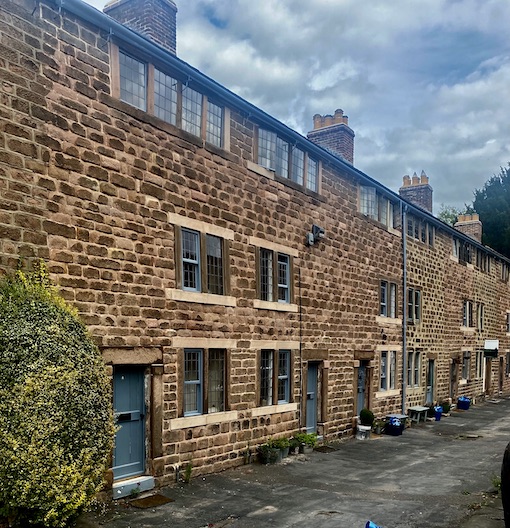
A recent visit to Cromford, a place famous for the cotton-spinning mills of Richard Arkwright, the earliest of which many call the first factory, found me drawn to the smaller buildings as well as to Arkwright’s vast premises. Ever since I first heard about Arkwright (probably in school history lessons a very long time ago), I was impressed that he built decent housing for his workers. I’d wondered how true this was, and what the evidence was for the assertion, so here is some evidence, on the ground and still in use. This is part of a row of houses in Cromford’s North Street, among the first houses that Arkwright built in the town.
The row is built of local gritstone, with substantial stone lintels over the doors and windows. The effect is solid and rather plain at first glance. But looking a little closer, it’s possible to make out details that show these dwellings to be a cut above the norm of workers’ housing in 1776, when they were built. The original inhabitants would certainly have appreciated the sturdy construction. But they would also have picked up on subtler things – the fact, for example, that the stones that make up the door jambs are topped and tailed with blocks that give the impression of Classical capitals and bases, the sort of elaboration you might see on a farmhouse or gentry house. The windows are a mix of leaded-light casements and vertical sashes, and those sashes, too, were something of a preserve of the middle classes in the 18th century in Derbyshire.*
Another notable feature of the houses is the top storey, with a row of windows for each house. The upper room behind the windows was a workroom, designed so that some members of the family could work at home (typically as weavers), while others worked at Arkwright’s mill, which was in the business of spinning yarn using machinery powered by large water wheels. As there were not enough local workers to run Arkwright’s mill (later mills), good, practical housing would have helped attract workers from further afield. Today, I’m sure such period houses must similarly be attractive to prospective residents, and pictures of them certainly motivated me to seek them out, down a quiet side street, secluded but not far from the mill or the shops.
- - - - -
* I’m indebted for these remarks about the social implications of this way of building to the Derwent Valley Mills Partnership’s useful guide, The Derwent Valley Mills and their Communities (2011).
Saturday, March 26, 2022
Chesterfield, Derbyshire
The way to do it
The Punch Bowl in Chesterfield is a pub, like the White Horse, Chichester in my last post, that uses coloured glass in its decoration. It was built by Chesterfield Brewery in 1931, in a period when street alterations led to a number of new buildings in the town centre. Quite a few of these are half-timbered and the Punch Bowl has a large timber-framed window and gable above its stone ground floor.
But the coloured glazing in a couple of the windows was what really caught my eye. My favourite is this pub sign in glass, a depiction of the traditional glove puppet Mr Punch lying inside a shallow bowl, a personification of the pub name that I’ve seen on the painted signs of other pubs called the Punch Bowl, although I’ve not seen the image done in glass elsewhere. In this window, Punch’s protruding nose and chin, his pointed hat, and his legs and feet are all discernible. Legs and feet are unusual in a glove puppet – the ‘glove’ that conceals the puppeteer’s hand usually renders them irrelevant or inconvenient. Punch always has legs, however, and they hang in front of the glove and if the puppeteer is skilful, he or she can make Punch wave them around in suggestive or amusing ways. Colour and the varying textures of variopus kinds of glass distinguish the different parts of the image. It would be even more striking if there was a strong light behind it – perhaps this was the intended effect when the building was lit up at night.
As more and more pubs close, or modernise away their old decor and character, pub glass gradually disappears. But there are still numerous examples of both coloured and engraved glass in the windows of pubs and former pubs. I hope building owners don’t trash it all – what’s left enlivens our streetscapes, enhances pub interiors, and reminds us of a time when pubs were brasher and often more colourful than they are today. Cheers!
Friday, June 8, 2018
Chesterfield, Derbyshire
The sunset of an empire
My recent trip to Sheffield took me past Chesterfield in Derbyshire, where I stopped for a break and to look at the twisted church spire, a famous sight that I’d not seen for about 40 years. Naturally, I had a walk round the centre of the town. Naturally I found a few things I was not expecting. One of these was a superbly preserved former Lipton’s grocery shop with most of its internal tiles and fittings still intact. I’ve not seen a better preserved Lipton’s than this – and the architectural historian Kathryn A. Morrison, who knows as much about the history of shops as anyone, thinks there is none that compares to it.*
The structure of the original shop front is still there, but with new signage and some damage to the tiling. But the interior is where it gets really good. One side has a counter with a tiled front bearing legends such as ‘Lipton’s Pickles’ and ‘Cooked Meats’, all in beautiful curly green lettering of probably c. 1910. The walls behind the counter are tiled in green and white too. This was the side of the shop where the fresh produce was sold – eggs, butter, cheese, bacon, and so on. On the other side is a panelled wooden counter with a range of shelves behind, for the tea, coffee, and stuff in bottles and jars. These shelves, still used for jams, preserves, lemon curds and other delights by the baker’s who occupy the shop today, are beautifully made in dark wood and topped with a tiled panel with a slogan that shoots from the hip: ‘The business of which the sun never sets.’ Yes, Lipton’s was the biggest chain grocer in the UK† and had imperial ambitions, for the British empire was, back then, the one ‘on which the sun never sets’.
Yes, Lipton’s were big, once. They were still a large concern in the mid-20th century and I remember their branches from when I was young. But they never had the really large shops of their old rivals Sainsbury’s or brash new, pile-it-high-sell-it-cheap Tesco’s. They were eventually bought up and shops either rebranded or sold off. The name had gone by the 1980s. The people who work in the baker’s in the former Lipton’s in Chesterfield and proud of their shop: they keep it spotless, welcomed me when I asked if I could take photographs, and run what looks like a successful business – the place was full when I was there and I was diving and dodging to avoid getting in people’s way. It was in every way a pleasing sight.
- - - - -
* For more about Lipton’s, see Kathryn Morrison’s site, here.
† Lipton’s, Sainsbury’s, International Stores, Home & Colonial: these were the big British chain grocers of the 19th and early-20th centuries, before the supermarket era.
Monday, June 4, 2018
Woodville, Debyshire
For sore eyes
I’d always fancied visiting Swadlincote – just because of the name, I admit. And because of the bizarre entry on the place in Henry Thorold’s 1972 Shell Guide to Derbyshire. This piece is mostly an extended quotation from René Cutforth’s book Order to View, which describes the ugliness of the place, which, he says, is in a district made up of ‘a loose assemblage of gigantic holes in the ground, some of them half a mile across, where clay was dug’ for various potteries. Cutforth opines, ‘It was so ugly it made you laugh.’ Woodville, which adjoins Swadlincote, is tarred with the same brush. Surely, I thought, it can’t be quite as bad as he says – not now at any rate.*
In truth, when I passed through the other day the weather was so gloomy I couldn’t possibly comment. It wasn’t the day for stopping and looking around, so I pressed on. But I did see one sight that made me resolve to return: the 1930s Clock Garage, which sits at a roundabout on the A511 at Woodville. What I could see through the gloom impressed me.† As the weather was too poor to take a decent photograph, I share one from the public domain, to give you an idea of the Art Deco glory of this building. The white walls, flat roof line, curving corner towers, glass bricks, and sans serif lettering are just the thing one thinks of when someone utters the phrase ‘Art Deco garage’. This is a structure almost up there with long-lamented 1930s landmarks such as Golly’s Garage, a lovely design with flat roof and strip windows once in London’s Cromwell Road, and Collier Filling Station, Sheldon, Birmingham (1936, by Harry Wheedon, circular, with a tall mast).§ The Clock Garage is just as much of its time as these, and one half expects to see someone standing outside dusting an Alvis Speed 20...or at least a Jowett 8. Clearly, the building’s paintwork and rendering could do with some attention, but it’s good that this place is still there and still serving a useful purpose not to dissimilar from what it was built for, when the motor car was for most a luxury and the idea of travelling on the open road, even in the industrial area that so amused Mr Cutforth, still held a measure of glamour.
- - - - -
* Cutforth’s book was published in 1962, but is a volume of reminiscences. Cutforth (b. 1909) was born in Woodville, so the description must refer to a time a few decades before the 1960s.
† What I didn’t see was that there seems to be a bottle kiln behind this building. Its top is just visible behind the left-hand part of the garage in the photograph.
§ For more about such joys, it is work seeking out Julian Holder and Steven Parissien (eds.) The Architecture of British Transport in the Twentieth Century (Yale, 2004) and Alastair Forsyth, Buildings for the Age (HMSO, 1982).
Photograph by Anthony Parkes, shared under this Creative Commons licence.
Wednesday, November 10, 2010
Melbourne, Derbyshire

Tracing history
The High Street renews itself all the time. Old shops get makeovers, new businesses come along, and with each change a fresh signboard goes up. Sometimes, though, it’s just the sign that’s changed, or a coat of paint that’s added. And if that’s the case, part of the old shop front stays to tell us something about the history of the building. I like the way fragments of old decoration, bits of moulding, a pane of glass high up in a window, can drop quiet hints about a shop’s previous occupants. Tiles, among the most durable of decorations, sometimes linger in this way, and here are a couple of neighbouring examples in Melbourne, Derbyshire.
I don’t know exactly when these shop fronts were tiled, but I’d guess in the Edwardian period – the designs seem to bear that influence of Art Nouveau that I often saw in the tiled surrounds of Edwardian fireplaces when I lived in London. Back in the early-20th century, firms such as Minton and Doulton were producing millions of tiles that brought a bit of colour – and a sense of hygiene – to the High Street. Butchers, dairies, grocers, and fishmongers were among their most enthusiastic customers. They liked the bright, easy-care surfaces, which were often continued inside the shop.
On many early shops there was often a blurring of the boundary between inside and outside. Butchers, for example, would hang meat on rails in front of the window, and both butchers and fishmongers had opening shop windows, enabling customers to see the goods or talk to the proprietor without even stepping inside. The right-hand shop in the picture has an opening sash window, and probably once sold meat or fish.
Few High Streets have complete surviving Edwardian shops like the ones lovingly reconstructed in the BBC’s Turn Back Time series. But in many towns there are fragments like these strips of tiling, which afford colourful glimpses of the history of the High Street.
* * *
For readers interested in Melbourne, there's a post about its wonderful Norman church, here.
For more on tiled shop fronts, see a post about a street in Cheltenham, here.
Wednesday, December 12, 2007
Melbourne, Derbyshire

Regular readers of this blog will remember the post a couple of weeks back about the parish church at Elkstone, Gloucestershire, an attractive small church in the Norman style of the 12th century. Here’s another Norman church, but on an altogether larger scale. This is a church planned like a cathedral. There’s a grand west front with twin towers and a large entrance portal. Inside, the nave is lined by round piers and semi-circular arches, high above which are yet more arches – and all on a scale you’d normally expect in a church in a much more important town or city. The imposing effect of the architecture is enhanced with plenty of carving too – zigzags around the arches, together with a plainer moulding that gives the design a more restrained look than Elkstone. The tops of the piers have capitals with crosses, scrolls, and other designs. Elsewhere there are some interesting animal carvings, all from the 12th century.
Why did this place have such an imposing church? Apparently the place was an outpost of the bishops of Carlisle, who used to come down to south Derbyshire when the going got tough in their northern bishopric on the border with Scotland. And so visitors to Melbourne get a pleasant surprise. The church is tucked away down a side street and most people don’t find it unless they’ve come to see Melbourne Hall, the local big house, which is nearby. Those who do stumble on it discover one of the gems of English building.
Subscribe to:
Posts (Atom)