The edge of the world
On the far western edge of Herefordshire, up in the hills that dominate the border between England and Wales, lie the ruins of Craswall Priory, one of the most remote of English monasteries and the highest above sea level. Not easy to find, the ruins are on private land (which the owners open to the public) and in the Middle of Ages the place would have felt even more remote than it does today. The occupants were members of the Order of Grandmont, also known in France as the Bonshommes. They were highly austere (they were silent, ate very simple food, wore coarse habits, based their rule closely on the Gospels) and described themselves as hermits – not in the sense that they lived alone, but because seclusion from ‘the world’ was very important to them. This lonely place must have suited them.
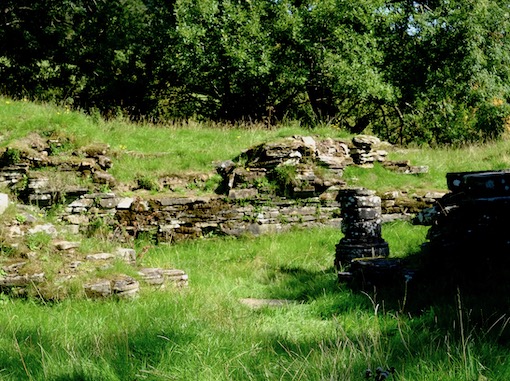
The ruins today are fragmentary but fascinating and atmospheric. The rounded walls of the church’s apsidal east end are visible, as are some of the walls of the chapter house and bits of foundation and wall of other monastic buildings. Everything is on a small scale – Grandmontine communities were limited in size. Most of the extant walling looks fragile, with gaps rather than mortar between many of the stones. Grass and other flora is establishing itself in the masonry. Yet there are signs of former splendour. ‘Look! Architecture!’ I cried, as I caught sight of the remains of the chapter house, shown in my photograph. The moulded base of a circular pier (one of two that would have held up a vaulted ceiling) and quite an ornate set of mouldings at the bottom of the chapter house’s doorway were what caught my attention. They look 13th century, which ties in with the priory’s foundation in around 1225.
As one of only three Grandmontine priories in England, Craswall’s ruling or mother church was in France, where the order was founded. As such it was known as an ‘alien priory’ and English kings, suspicious of the influence of (and even spies from) enemy countries, made several efforts to remove or ‘suppress’ religious houses of this kind. Most alien priories had gone by 1414, but Craswall managed to survive until 1462. The buildings must, then, have been gradually deteriorating for well over 500 years. What is left is fragile indeed, and looks as if it needs some serious conservation work. One hopes that this will be possible – without totally losing the feeling of unkempt remoteness which is one of the things that makes the place so special.
- - - - -
There is more on Craswall Priory here.
Long ago I did a post about conservation work at Wigmore Castle, which wonderfully maintains the balance between building and environmental conservation.


