Wednesday, October 11, 2017

Lincoln


Untroubled waters

This is one of those architectural miniatures I particularly like. It’s St Mary’s conduit house, built in the 16th century to provide a source of clean water for the people of Lincoln. It’s said to have been built partly out of fragments of from a chantry in an old friary that was dissolved, during the depredations imposed by Henry VIII on the country religious houses, in 1530. By incorporating them into the walls of the conduit house (connected to a network of supply pipes begun by the friars) a few years after the dissolution, the builders gave a new life to bits of tracery and blind arcading, plus some corbels, niches, arch heads, and other bits and pieces.

They also provided an invaluable service to local people. The conduit and others in the city carried on supplying water until 1906, although not the conduit house did not remain in exactly the same positron – it was moved away from the street into St Mary’s churchyard in 1864. When mains water was laid on at the beginning of the 20th century, the supply from the conduits was trusted more than the piped water. I seem to remember that there was widespread suspicion of piped water in the Victorian period, with London water sellers hawking water from bowsers with the cry ‘Pure water! None of your pipe sludge!’ And no wonder, given the disease carried by infected water supplies in the early days. In Lincoln, confidence in the old conduits continued during the  1904–5 typhoid epidemic, so perhaps this attractive facility saved some lives too.

Sunday, October 8, 2017

Potterhanworth, Lincolnshire


Bits of history

To Lincolnshire, in search of the Resident Wise Woman’s ancestors. Our journey took us to Potterhanworth, southeast of Lincoln, where her grandmother Betsy was brought up and went to the village school. We took with us the Betsy’s typescript memoirs of her early life in this Lincolnshire village with her grandparents* – her grandfather (the RWW’s great great grandfather), the wonderfully named John George Pepperdine Salter¶ was the first stationmaster at Potterhanworth station. We found the old station house, where they lived, and visited the village school, whose head was very happy with the gift of a copy of the memoirs and rewarded us, quite unexpectedly, with the sight of their author’s name in the school register, inscribed in a copperplate hand in 1901.

The most remarkable building in Potterhanworth is this water tower (now converted to a house). I can’t remember when I last saw such an impressive one in a village. It was built in 1903 with funds provided by Christ’s Hospital (a Lincoln charity with a lasting link to the village); the coat of arms of Richard Smith, founder of Christ’s Hospital in Lincoln are on the side of the turret. As well as supplying water (which it did until the 1970s), the building was a useful public meeting place – the Parish Council and Men’s Institute met in the rooms in the brick tower that supports the enormous tank. Now it’s a substantial house with an unusual history in a place that means a lot to those close to me, and now to me too. 

- - -

* So we are talking about a person born in the Victorian period brought up by her grandparents, who were old enough to remember the early years of Victoria’s reign – a long historical vista.


¶ I have a great fondness for names like this, in which it’s unclear where the forename ends and the surname beings; compare the writer Patrick Leigh Fermor and the photographic pioneer William Henry Fox Talbot. 

Tuesday, October 3, 2017

Lincoln


First post

Just inside the entrance to the Museum of Lincolnshire Life in Lincoln is this post box. It was made in 1856 at the Handyside foundry in Derby and installed the following year at Gosberton Bank near Spalding. In 1969 is was moved to the museum, as an example of a very early type of post box – from the time before there was an accepted standard design. A number of the early post box designs were octagonal like this one and like the Penfold, of which a number survive. The Lincoln example, ten years earlier than the Penfold, is rarer still and almost as striking.

With its vertical slot and octagonal shape, it looks quite unlike modern cylindrical boxes and as the red finish wash’t standardised until later, it might originally have been a different colour too. But many features – the royal monogram, the panel showing collection times, and the words ‘Post Office’ are all similar to those on the boxes we use today.

I don’t often feature here items from museums, but there are so few opportunities to see these early boxes on the street that I didn’t want to let this one slip by. And there’s a twist. Although it’s in a museum, this post box is still in use, and visitors are encouraged to post their letters in it – this is Lincolnshire’s oldest working post box. As the first post box appeared on the British mainland in 1853,* it is also one of the oldest in the country. Mr Handyside did the Post Office proud.

- - - - -

*The Channel Islands got them the year before.

Thursday, September 28, 2017

Farmington, Gloucestershire


Well shod

When it comes to exploring churches, sometimes the fun starts before you even get to the building.

Pausing by the churchyard wall in the Cotswold village of Farmington, you see this: a gate made up of 90-odd horseshoes, artfully arranged. Horseshoe gates are not unusual. I suppose they’re a pragmatic example of recycling – with the added attraction, for the superstitious user, that horseshoes are supposed to bring good luck. But what struck me with this example was that the horsehoes had been arranged architecturally. What I mean is that the central motif, a quatrefoil made up of four horseshoes, is a  piece of architectural ornament, and one often used in medieval churches. I have noticed quatrefoils before, on church fonts, church walls, church windows. The quatrefoil, you might say, is a way of making a horseshoe gate into a fitting entrance to a churchyard.

Or you might just say that it’s a winning bit of fun.

Friday, September 22, 2017

Great Bourton, Oxfordshire


Multitasking

Here’s an unusual and striking combination of functions. At Great Bourton in Oxfordshire the architect William White (great nephew of the naturalist Gilbert White of Selborne) was called in to do an almost complete rebuild of the parish church. Instead of making the tower part of the church building, he built a detached bell tower – and combined it with the lychgate that forms the entrance to the churchyard.

It’s a stand-out feature and really makes a mark in the village street, forming a landmark next to the pub, and making a very dramatic entrance point to the churchyard. The stonework is very plain (look at those austere lancet windows), but it doesn’t need to be fancy: the rich orangey colour of the local stone is attractive in itself. And up above at the top of the tower comes the unusual feature: the bell chamber is an open framework structure of oak, dominated by sweeping arches and a very steeply pitched roof.

The bells must sound out loud and clear from this tower calling people away from their pints in the traditional way. Even if they don’t heed the call and return to their drinks, they have something special to look at. Your good health!

Friday, September 15, 2017

Bristol


Sledgehammered

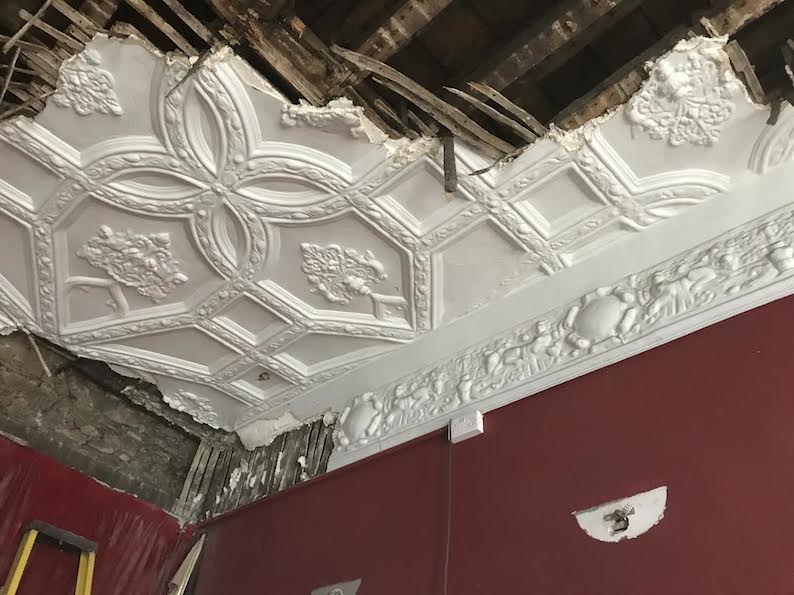
I was saddened to read about the demolition of a Jacobean plaster ceiling in a building in Bristol the other day. This beautiful piece of craftsmanship, which was neatly 400 years old, was in a building in Small Street which had been a bar and which a developer is converting into student flats. The removal of the ceiling was quite legal, but an application had been made to protect the building by listing it and the destruction of the plasterwork was carried out before the listings officers from Historic England had been able to inspect the building and carry out their assessment.

This sort of thing is not unusual. My mind went back to one of the most famous cases, the Firestone factory in West London, which was bulldozered over a Bank Holiday weekend in 1980, hours before a listing was due to come into force. The Bristol case is different – even if they’d had the chance to look at it, the inspectors may have decided not to list the building – but just as deplorable: 400 years of history gone with a few strokes of the sledgehammer.

There is a way of making pre-emptive demolition more difficult: introducing interim protection of buildings while the listings assessment takes place. Such a system already operates in Wales and in the opinion of many it’s time it did in England too. A petition, supported by groups such as the C20 Society, has been started to urge the government to bring in such a measure. I’d encourage readers who can do so to sign the petition here.

- - - - -

The picture above comes from the SAVE Britain's Heritage website, where there is more about the ceiling here

Monday, September 11, 2017

Walpole St Peter, Norfolk


It does something to me

A regular reader of the English Buildings blog, or someone glancing at the tag cloud in the right-hand column, would realise quickly that churches are a major interest of mine. I visit churches a lot, and I seem to blog about a church at least once a month. Many things draw me to churches – sometimes it’s their long history, sometimes their architecture, sometimes specific objects or works of art they contain, sometimes what I can only call their atmosphere.

The atmosphere I most eagerly savour is the kind that is summoned up by centuries of accumulated history. It’s what I find, typically, in small isolated country churches that have not been over-restored – churches like Inglesham in Wiltshire, to give just one favourite example. There’s something else I get from churches like that, and it’s signalled perhaps by the world ‘isolated’. In a world that contains, in my opinion, far too much noise, a church can be an almost silent place. I find quietude helpful, even restorative, and value the combination of quiet and atmosphere* found in some old churches enough make a special journey to find it.

But there’s another thing that sometimes happens in churches that is the opposite of silence, and can be equally nourishing: the sudden unexpected performance of music. I have been surprised by music in churches quite a few times, and it has always made my visit memorable. This is not, or not usually, run of the mill organ practice – though I have been captivated by that too (one organ piece I heard, in Gloucester cathedral, stayed in my head for years before I discovered what it was). What I mean is rehearsals for special musical events. From time to time I have come across a trio playing Mendelssohn, a choir singing Handel, a bizarre duet for organ and violin, a Schubert impromptu on the piano, and an unidentified baroque cantata – all of these in old churches. All have given me pleasure, in part because these ad hoc performances have been a total surprise.

It’s not just about church acoustics, which can vary quite a bit. In one of our more beautiful cathedrals I can remember a choral rehearsal in which it took me a few minutes to grasp the fact that the words the choir were singing were English ones – the reverberation was playing havoc with the singers’ diction. After a while the conductor dropped her arms in despair, bringing everyone to a halt, and wailed desperately,’I need to hear the altos!’ Often, though, church acoustics are crystal clear. The setting, conducive to worship, is also likely to be apt for the kind of attention that good, unamplified music demands. And in a small church one can get very close to the performers, lending great immediacy to the proceedings.

At Walpole St Peter in Norfolk, the church offers many of the things I most enjoy – airy, late-medieval architecture with repeating patterns of window tracery, impressive woodwork including screens and pews with carved poppyheads and other details, clear glass that lets the sun bathe the interior with light and warmth. But it was music that was in my mind even before I walked past the notice reminding me to remove the pattens from my feet¶ and pushed open the door. I have a recording of a fine Bach concert by the English Baroque Soloists and Monteverdi Choir under John Eliot Gardiner that was made in this glorious 15th-century church. How wonderful it would be, I thought, if someone’s playing Bach in here. Imagine my surprise as I opened the door to hear not ‘Wachet auf’ or ‘Jesu, meine Freude’ but a woman singing Cole Porter. There followed a long selection from the American songbook, most of it beautifully sung, a rehearsal for a concert later the same day. The person minding the singers was quite happy for me to wander around, so I tiptoed quietly, admiring the window tracery and the woodwork, and savouring the way the sunlight coming through the clear glass windows illuminated pews and carvings, to the accompaniment of ‘Night and Day’, ‘You’re the Top’, and ‘You Do Something to Me’.

And the whole experience did do something to me, and I was very grateful. I did not resent losing a few minutes’ silence for some good music-making. Music and silence, apparent opposites, are not so far apart after all. There have been whole books written about silence, but perhaps the best thing I’ve read about the subject is the shortest and most laconic, the exhortation of Alfred Brendel, master interpreter of the Viennese piano classics† and revelatory writer about music. He told us simply to remember the anagram: LISTEN = SILENT.§

- - - - -

* Compare Philip Larkin, ‘Church Going’: ‘It pleases me to stand in silence here’.

¶ A notice left over from the 19th century, at least: ‘It is requested that all persons will take off their Pattens at the Church Door’.

† Now retired from the concert platform, but his recordings remain.

§ Alfred Brendel, A Pianist’s A – Z (Faber & Faber, 2013)