Showing posts with label Tudor architecture. Show all posts

Sunday, July 6, 2025

Elsdon, Northumberland

Refuge

During the centuries up to c. 1600, the borders of England and Scotland were subject to regular bouts of raiding. Gangs from either side would cross the border and launch plundering attacks on locals, stealing valuables (and especially livestock) or extorting money. This activity was known as reiving, and the border reivers were much feared. They were ruthless and violent, and potential victims did their best to protect their families, their belongings, and their animals. So life in this region was tough, especially in the 16th century when the attacks were at their height. After 1603, when James VI of Scotland also became ruler of England as James I, concerted efforts were made to reduce reiving and punish the gang leaders.

Meanwhile, one common defensive strategy among local landlords, lairds or clergy was to build a tower-house, known in this area as a pele tower. Pele towers had thick walls and few, small windows; access to the towers was difficult because their whole point was to keep people out. The ground floor chamber was often barrel vaulted in stone, to make the upper chamber more secure and to reduce the risk of fire. Another feature was an iron fire basket high up on the exterior, so that the residents could signal that they were being attacked.

Many pele towers survive on either side of the border. Most have been adapted, with the addition of larger windows and better access. Many are now part of another building, such as a larger house built by a later owner. This is the case with the pele tower at Elsdon, with its added big ground-floor window and large adjoining house. It was built as a vicar’s pele in the early-15th century and has walls that are 2.6 m thick and a vaulted ceiling to the ground floor.* Originally it had four storeys, although today there are just three. In the 1820s the current two-storey house was built beside the tower and the enlarged building remained as the local rectory until 1960. The extended building stands as a marker of how the homes of the clergy (and indeed many other members of the middle and upper classes) changed over the centuries between the 15th and the 19th century, from a few small, dark rooms to a comfortable house with plenty of light and many fireplaces. Today the building is in private ownership and is not open to the public, although a notice on the garden wall invites visitors to step a couple of paces inside the gate to see the exterior of the tower.

- - - - -

* Much of the surviving stonework, however, may come from a 16th-century rebuilding.

Tuesday, August 9, 2022

Worcester

Surprise, surprise!

Walking along Friar Street in Worcester, we were drawn to a timber-framed building opposite Greyfriars by a sign advertising second hand books. Greyfriars is an impressive timber-framed medieval merchant’s house on a site close to a medieval Franciscan friary and is now owned by the National Trust. Into the building opposite we went, to discover that the National Trust has installed a shop here, convenient for visitors to its property across the street.

Although on this occasion there seemed to be nothing for me in the stock of books on display, I was pleased I entered the building because of the chance to see two panels of painted wall in an upstairs room – I had no idea they were there. These roughly square patches of scrolling stems have probably faded a good deal, but they still give the lie to a common assumption – that houses a few centuries ago had rather dull interiors with just a few sticks of furniture to enliven the living space. Of course, there would have been huge variation in the quality and quantity of decoration. This is building, now number 14 Friar Street, was once part of a larger house, its other half now comprising the neighbouring number 16. It was the substantial residence of someone with some disposable income – an artisan, or merchant, perhaps.

The paintwork was discovered when the building was restored in 1956, and a proud if somewhat intrusive inscription records this fact. However, knowledge of painted decoration has built up since the 1950s and authorities now think the date is more likely to be 16th century; for another example of 16th-century wall painting (still more elaborate than this), see a post I did about a room in Ledbury, here. Apparently, the Worcester building was home in the early part of that century to one John Watters, ‘paynter’, and may have been built for him in c. 1526. The owner’s trade opens up the interesting possibility that he may have done the decoration himself. Back then it would have been admired but hardly exceptional. He’d probably be surprised to know how much it is cherished now. 

Monday, December 13, 2021

Moreton Corbet, Shropshire


Gorgeous and stately

Looking at this end-on view of the ruin of Moreton Corbet Castle’s south range, you’d not think it was a castle at all, in the strict medieval sense . The same would be true of a view across the fields taking in what is left of the long south front of which my photograph above shows one corner. What is here are clearly the remains of an Elizabethan country house, and one of some grandeur. It was built by Robert Corbet at the end of the 16th century, who was extending the work done by his father, Sir Andrew, who had begun to transform the structure of his family’s ancestral medieval castle.

Sir Andrew turned his castle into a more fashionable residence by building new rooms against the old curtain wall. Ruins of these are still seen on the other half of the site, to the left of the building in my photograph. Sir Andrew died in 1578, and Robert was more radical, adding this new south range to create what Camden called a ‘gorgeous and stately house’. Its curvy gables, classical pilasters and large, rectangular mullioned windows will be familiar to anyone who’s seen more famous houses of this period – Blickling in Norfolk, for example has similar gables and windows; so does Montacute in Somerset.

So this is high-status building, and the amount of effort and expense involved in its construction is confirmed by the details, especially the pilasters and attached columns, together with the friezes they support (photograph below). These feature a variety of roundels, bits of strapwork, and carved animals of various kinds, some from the standard repertoire of the time (decorative flourishes influenced, like the house’s gables, by contemporary Flemish architecture), but also the heraldic beasts of the Corbet family.

Why is this marvel of late-Tudor architecture now a ruin? During the English Civcil Wars there was much fighting around the house (which was then occupied by Sir Vincent Corbet, who was on the royalist side). As a result, the house was badly damaged, and although the family continued to live in it, they abandoned it in the 18th century. There were plans to build a new house on the site but these came to nothing and the building was left to decay. It is a magnificent, if tantalising, ruin.


Wednesday, March 11, 2015

Northleach, Gloucestershire


Blink and you’ll miss it

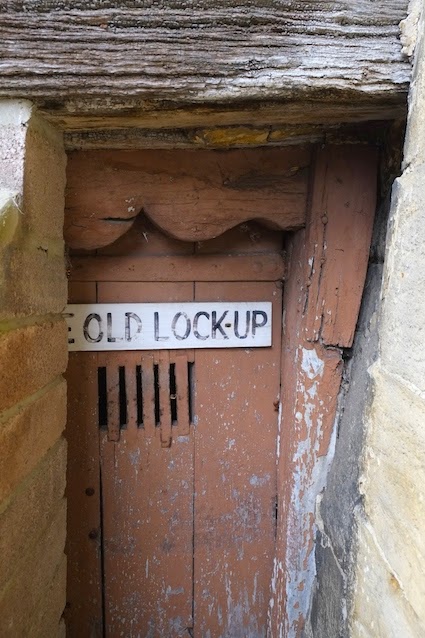
It’s easy to miss, this. Right in the centre of the small town of Northleach, in shady a corner of the Market Place in a spot shielded by other buildings, is a small brown door. The building to which is gives admittance has been propped up with an ungraceful pier of concrete blocks, so that the doorway is seriously obstructed – only about two-thirds of it is visible, and anyone of broader-than-average beam attempting to get in might have to try to enter sideways.

Tiny as this entrance is, what it is remains clear from the sign and the bars on the door. It’s the door to a town lock-up, which contains a cell about eight feet square. It’s not one of the classical free-standing lock-up structures with a stone roof that I’ve noticed before.* It’s a room adjoining the neighbouring building on the Market Place. It may be 17th or 18th century, but I could’t find out when it fell out of use. Northleach acquired a large prison, the House of Correction, just outside the town in 1789–91, but this small cell in the town centre might well have been retained after then to lock up drunks and rowdies overnight.

With its doorway partly obstructed, the cell can’t be usable for anything very much nowadays. But with its bars and its distinctive lintel, the curves of which seem to belie the utilitarian strength of the rest of the structure, it catches the eye. It would be good to think that the far-from-ideal propping could be replaced and that the building could find a use, but meanwhile one has to be grateful that a bit of history has survived.

- - - -

With thanks to Emma Bradford for pointing out this building to me.  

*Other lock-ups I’ve posted about include: Wheatley, Shrewton, Breedon on the Hill, and Bisley.

Thursday, October 18, 2012

East Bergholt, Suffolk


 Postcards from England: 3. Five bells, one cage

Some time back, I posted about an unusual wooden belfry at Brookland in Kent. Here's another unusual way of housing bells, the bell cage in the churchyard at East Bergholt, Suffolk. There was a project to build a stone bell tower on the western end of this church in the 1520s, but for some reason it stalled before the walls had got very high. It is said that Cardinal Wolsey had promised to help with the funding, but he fell from grace before the work was completed. So in 1531 a wooden structure was erected in the churchyard to house the bells, originally, it's said, to the east of the churchyard, although it was moved in the 17th century to a different position, because a neighbour objected to the noise of the bells.

It's a wooden structure, with boarding covering the lower walls and a lattice of wood running around the upper part, so that the sound of the bells can be heard clearly. Inside there is a very sturdy wooden framework on which the five bells are hung. As the bells are housed at ground level, there are no ropes or wheels, and the bells are rung by the ringers pushing the wooden headstocks of the bells. It must be hard work as this is said to be the heaviest ring of five bells in use in England. It's also a highly skilled business, and there is much more information about the bells and how they work here.

The bell cage was originally intended as a temporary measure. No doubt the people of East Bergholt hoped that they would raise money to complete the tower. But they never did, and this wonderful bit of carpentry has proved its worth over more than 480 years.

Monday, September 5, 2011

Compton Wynyates, Warwickshire


A Spaniard in the works

I recently spent a day bumbling around Warwickshire wondering if I could see the wonderful country house at Compton Wynyates from the public roads or public footpaths that surround it. Years ago this house was open to the public and I remember being enchanted by its forest of raspberry brick Tudor chimneys, Gothic windows, and gables. I seem to remember that the house could be seen from the nearby road, but its owners, who no longer open their home, now guard their privacy with trees, putting a spanner in my works.

So I had to be content, for now at least, with some interesting neighbouring structures, such as Compton Pike. My first sight of this curious landscape feature was a glimpse of the very top just beyond the crest of a hill. Walking along the edge of the field reveals an elongated pyramid of local ironstone, topped with a ball finial.

Compton Pike was probably put up in the 16th century as a signalling beacon – an iron hook protruded from the finial, and this supported a flaming lantern. It may have been used in 1588 as part of the chain of beacons that warned of the arrival of the Spanish Armada. It has remained ever since as a landmark and an obstacle to farm workers with combine harvesters, one of whom was about to negotiate it when I took this picture before bumbling on with my search.

Saturday, February 26, 2011

Sunningwell, Berkshire*


Classicism, Tudor-style

St Leonard’s church, Sunningwell, is a small parish church mostly built in the medieval period and restored by the Victorians. It has one extraordinary feature: this seven-sided porch at the west end, added to the church just after 1550. I’ve no idea why the porch should have seven sides, although the number seven is a widespread one in Christian symbolism, from the seven days of the rcreation to the seven last words of Jesus on the cross. The porch is interesting not only because of its seven-sided form, but also because of its mixture of architectural styles – it’s half-Gothic and half-Classical.

This strange stylistic mix is very much of its time, the second half of the 16th century. In this period, rural buildings were still using the Gothic style of the previous century, with its pointed arches and cusped window openings, though the pointed arches had got flatter (as in the doorway here) and the windows were sometimes rectangular rather than pointed. More adventurous builders, though, were learning about the Classical style of ancient Greece and Rome – but their Tudor Classicism is often an insular affair, in which the standard designs of columns and capitals aren’t in quite the right proportions (there is often the addition of decidedly unclassical ornament, too).

At Sunningwell, the columns are of the Ionic order, the one with the spiral volute decoration, but the spirals here are much smaller than on Greek or Roman buildings. And whereas Ionic columns are usually fluted, these are plain. So these details represent a rustic form of Classicism, but they’re still remarkable – Sunningwell may be the first English parish church to have Classical columns supporting part of its fabric.

The reason for this unusual stylistic adventure in a rural church is that the porch was paid for by a man of great learning and international connections. John Jewel, scholar of Corpus Christi College, Oxford, theologian, apologist of the Anglican church, and eventually Bishop of Salisbury, began his church career as rector of Sunningwell in the 1550s. His learning no doubt influenced the design of the porch, setting a trend in architecture in the unlikely setting of a quiet English village.

*I'm using the traditional county divisions here, as does Pevsner's Buildings of England series. Postally, the village is in Oxfordshire.

Sunday, May 2, 2010

Stanway, Gloucestershire


Jack and Percy

Yes, those of you who saw my previous post about the notices will probably have guessed that it was Jack in the Green who arrived yesterday, May Day, to mark the season with Morris dancing and other celebrations. There’s a photograph of Jack below, walking through Winchombe on his way to morning coffee. He appeared together with a group who make it their business around these parts to mark the stages of the year, an enterprise I admire greatly. This weekend of celebrations had an additional and unexpected pleasure, which provided a surprising link with another English building. During the afternoon of 1 May, Gwilym Davies gave a fascinating talk about some of the area’s traditional songs. The talk centred on the colourful figure of the Australian composer Percy Grainger, who was famous not only for writing his own music and for arranging (or ‘dishing up’, as he put it) the music of others in new, fresh forms, but also for travelling around collecting folk songs, which he might then ‘dish up’ in their turn. Grainger both wrote these songs down and recorded them on his wax-cylinder phonograph, still new technology in the early 1900s. Some of these songs would be quite lost today if Grainger (or colleagues such as Ralph Vaughan Williams) had not captured them on paper or wax.

In 1907, Grainger came to Gloucestershire and stayed at Stanway House, then the home of Lady Elcho, who threw interesting and rather arty house parties where one might come across the likes of J M Barrie or John Singer Sargent. Grainger travelled a few miles down the road to Winchcombe, where he visited the town’s workhouse and recorded several of the inmates singing their favourite songs. It was fascinating to hear some of Grainger’s recordings, crackly and indistinct but moving nonetheless, and to imagine him and his friends at Stanway, this golden house of the 16th and 17th centuries with its Cotswold stone gables and giant five-sided bay window. At Stanway there is also a terrific gatehouse of the 1630s, visible to the right of the photograph. And a medieval barn. And a cricket pavilion built for J M Barrie. And a water garden with the world's tallest gravity-fed fountain. I like to think of Percy Grainger performing one of his favourite tricks, hurling a tennis ball into the air over a house, and running round the back to catch it. But the tall gables of Stanway House would probably have defeated him.

Jack in the Green, Winchcombe