Relic of the Arts and Crafts movement
St Nicholas’s, Saintbury, is a medieval church sitting high up in the Gloucestershire Cotswolds. As well as its medieval architecture, which includes a spire, unusual in the region, it’s known for its beautiful setting and some interesting 17th-century wall inscriptions. In spite of all this I’d not visited it before – on one occasion, I found the building closed because some restoration work was underway; one two others I couldn’t park nearby. It seemed the moment to try again. This time I found a space in the tiny parking area near the churchyard, left a note in the windscreen to explain where I was in case anyone needed me to move, and climbed the steps towards the church and its welcoming north door.
As usual when looking at a medieval church, my eye was caught by a few things I wasn’t expecting: some pleasant early-19th century pews with Gothic carving, a beautiful medieval font with an 18th-century cover (a potential subject for another post), a mysterious stone panel carved with flowers and crossed bones. There was also evidence that this church had been touched by the Arts and Crafts movement. In 1902 the church was restored by the Arts and Crafts architects Arthur S Flower and Guy Dawber, who worked widely in the Cotswolds.
Saintbury is not far from Chipping Campden, a cradle of the Arts and Crafts and home to the Guild of Handicraft led by architect and designer Charles Robert Ashbee. Ashbee also worked at Saintbury, reroofing the building and adding some gilded bosses and designing a fine chandelier, which is now on display at the admirable small Court Barn Museum in Chipping Campden. Ashbee’s follower Alec Miller carved the relief figure on Saintbury’s north door, shown in my photograph. Miller studied at the Glasgow School of Art and when he left in 1902, came to Campden to join the Guild of Handicraft. He taught his art in Campden and carved this small figure of St Nicholas in 1911. It’s a 20th-century version of the carvings of dedicatory saints (common in the Middle Ages), most of which were destroyed during the Reformation.* Nicholas is dressed as a bishop (his see was Myra in Lycia, on the southern coast of Turkey) and holds his crozier and his symbol, a ship in full sail, indicating that he is patron saint of sailors and those who travel by sea. The carving is unassuming but crisply executed and it’s a delightful touch, an indication of the dedication of the church and a reminder of both how important the Arts and Crafts movement was in the northern Cotswolds in the early 20th century and how the movement’s artists and architects saw themselves as working in a tradition stretching right back to the Middle Ages.
- - - - -
* A figure of the dedicatory saint was often on display in the chancel.
Showing posts with label door. Show all posts
Thursday, May 15, 2025
Wednesday, May 17, 2023
Leominster, Herefordshire
Wine, offline
On one of my past visits to Leominster I noticed a glazed shop door containing a pane of glass etched with the name of the Leominster News, a defunct local newspaper. When I wrote about the door I lamented the passing of local newspapers, victims of a market in decline as readers have moved to online news services. The internet of course is a rich source of information and for well over 25 years I for one have been using it – and for the last 15 years or so I’ve also been contributing to it, via this blog among other ways. And yet, as I said back in 2021, I believe something has been lost through the decline of print media, and the local press especially – local newspapers once provided a valuable service for local communities.
Something similar could be said for a host of local small businesses. I was reminded of this the other day when passing through Leominster once more and noticing another piece of etched glass, this time on a shop in the High Street, once the premises of E. V. Gunnell, wine merchant. What a lovely design. The lettering is stylish, with exaggerated variations in the stroke widths and some sharp, pointed serifs. I’d guess it’s very late 19th century. The name sits within a panel with sides that curve outwards towards the edges of the glass, looping around the border of the pane in a triangular form. Standard, stylized foliage forms contribute more decoration above and below the name. There would be nothing exceptional about any of this in the late-Victorian period. The glazier would show the client a catalogue of samples with fancy lettering, foliate ornament, and so on, and would order the glass from a specialist manufacture, who would produce it to the required dimensions. But it shows a tendency to take pains with architectural detail and craftsmanship that’s in short supply on the High Street today.
It’s not just about design and craftsmanship, though. The supply of wines, spirits, and ales was once a local affair. The wine merchant was someone you’d get to know, and who would get to know their customers and their likes and dislikes. A shop like this would be as important a part of the local High Street as the butcher, baker, and grocer. Not many businesses like this survive these days. The selling of wine has become the preserve of supermarkets and, increasingly, of online wine merchants. On the face of it, wine seems an unlikely product to buy online. It’s stored in fragile bottles and the bottles and their contents are heavy, making packing a challenge and shipping costly. But it has caught on, both because of the huge potential range of stock and the economies of scale that come from buying and storing in bulk. And so, local wine merchants go the way of so many other small retail businesses, from fishmongers to ironmongers.
Like so many of us, I am part of this problem. I shop in supermarkets, and buy things online. I’ve even bought wine online from time to time. But part of me looks at this door and laments the disappearance of these local connections. Mr Gunnell – his name turns out to have been Edward – cared enough about presenting his goods and his business effectively to commission this lovely door glazing. What a shame we can’t see the rest of his shop front, with his name at the top and a tempting display in the window to entice us to sample his wines, spirits, ales and porters – for such, according to Kelly’s Directory, was the range of his stock.. A glance at the 1879 directory for Herefordshire reveals he lived in the town and served as one of its aldermen. He was part of the community. But hope is not lost. There is still a wine merchant in Leominster’s High Street. We should buy things locally when we can if we value such local assets.
On one of my past visits to Leominster I noticed a glazed shop door containing a pane of glass etched with the name of the Leominster News, a defunct local newspaper. When I wrote about the door I lamented the passing of local newspapers, victims of a market in decline as readers have moved to online news services. The internet of course is a rich source of information and for well over 25 years I for one have been using it – and for the last 15 years or so I’ve also been contributing to it, via this blog among other ways. And yet, as I said back in 2021, I believe something has been lost through the decline of print media, and the local press especially – local newspapers once provided a valuable service for local communities.
Something similar could be said for a host of local small businesses. I was reminded of this the other day when passing through Leominster once more and noticing another piece of etched glass, this time on a shop in the High Street, once the premises of E. V. Gunnell, wine merchant. What a lovely design. The lettering is stylish, with exaggerated variations in the stroke widths and some sharp, pointed serifs. I’d guess it’s very late 19th century. The name sits within a panel with sides that curve outwards towards the edges of the glass, looping around the border of the pane in a triangular form. Standard, stylized foliage forms contribute more decoration above and below the name. There would be nothing exceptional about any of this in the late-Victorian period. The glazier would show the client a catalogue of samples with fancy lettering, foliate ornament, and so on, and would order the glass from a specialist manufacture, who would produce it to the required dimensions. But it shows a tendency to take pains with architectural detail and craftsmanship that’s in short supply on the High Street today.
It’s not just about design and craftsmanship, though. The supply of wines, spirits, and ales was once a local affair. The wine merchant was someone you’d get to know, and who would get to know their customers and their likes and dislikes. A shop like this would be as important a part of the local High Street as the butcher, baker, and grocer. Not many businesses like this survive these days. The selling of wine has become the preserve of supermarkets and, increasingly, of online wine merchants. On the face of it, wine seems an unlikely product to buy online. It’s stored in fragile bottles and the bottles and their contents are heavy, making packing a challenge and shipping costly. But it has caught on, both because of the huge potential range of stock and the economies of scale that come from buying and storing in bulk. And so, local wine merchants go the way of so many other small retail businesses, from fishmongers to ironmongers.
Like so many of us, I am part of this problem. I shop in supermarkets, and buy things online. I’ve even bought wine online from time to time. But part of me looks at this door and laments the disappearance of these local connections. Mr Gunnell – his name turns out to have been Edward – cared enough about presenting his goods and his business effectively to commission this lovely door glazing. What a shame we can’t see the rest of his shop front, with his name at the top and a tempting display in the window to entice us to sample his wines, spirits, ales and porters – for such, according to Kelly’s Directory, was the range of his stock.. A glance at the 1879 directory for Herefordshire reveals he lived in the town and served as one of its aldermen. He was part of the community. But hope is not lost. There is still a wine merchant in Leominster’s High Street. We should buy things locally when we can if we value such local assets.
Labels:
door,
glass,
Gunnell,
Herefordshire,
Leominster,
shop,
Victorian,
wine
Friday, November 12, 2021
Leominster, Herefordshire
Incidental pleasures, 2: Old news
The things we have lost. In the increasing list of things that have vanished or are vanishing as the world becomes ever more reliant on digital media, communications, commerce, and the rest are local newspapers. Long ago, when I was growing up, my parents took a national newspaper in the morning and a local newspaper in the evening. There were lots of national papers to choose from, but there was also a choice of locals – not just our town’s own paper, but one from the neighbouring city too. Even small towns had a newspaper of their own, containing a mix of local news plus advertisements, announcements of births, marriages and deaths, the results of the local sports matches, and announcements for forthcoming meetings of every local group from the Young Farmers club to the Literary and Philosophical Society. Most of these publications have gone, some completely, others to some sort of online presence.
Often, they’ve vanished without trace. Occasionally there are small, fragile traces, like this door (now belonging to a shop), glazed with engraved glass bearing the words ‘Leominster News’. That, plus another nearby, is such a trace of what was once The Leominster News and North West Herefordshire and Radnorshire Advertiser, a paper that covered not just the Herefordshire hinterland of this small market town but also the neighbouring Welsh border county of Radnorshire (itself another thing long gone, having been absorbed in the 1970s into the large county of Powys*).
This kind of engraved glass is the sort of thing I associate mostly with pubs – used for windows advertising a local ale or the availability of ports and sherries.† But it works just as well for a printing or newspaper office. Both would have doors that were beacons for people, and engraved glass with a light behind it was a good on-street advertisement. In the evening, through such doors local reporters would rush with their latest copy about a council meeting or some unexpected police report that simply had to be squeezed in somewhere. Out in the early hours of the morning would come weary printers, pleased to have got the latest edition printed and sent on its way in waiting vans to take the news to Herefordshire apple growers and Radnorshire sheep farmers. Later in the day, in would go members of the public wanting to place an ad or insert an announcement. Such places were at the heart of the community, and the light behind a door like this a sight that would be taken for granted.
From a little research online, this newspaper was around in the late-19th century and still going during World War II. How much longer did the light behind the door bring to mind the light shed on people’s breakfast or tea tables and the illumination brought by local news? Just the incidental pleasure of an old sign now, but back then, an essential part of life.
- - - - -
* The name lives on, though, to denote the district of Radnorshire, the ‘Radnorshire part’ of Powys.
† There is much about engraved, embossed and other ornamental glass in Mark Girouard’s excellent Victorian Pubs (Studio Vista, 1975; Yale UP, 1984).
Tuesday, July 21, 2020
Jordans, Buckinghamshire
Sneck
Sneck? Sneck: noun. A latch on a door or window (chiefly Scottish and northern English).*
When I was a small boy, I went each summer with my parents to see my grandparents in rural Lincolnshire. Where we lived, the doors had conventional knobs that you turned, but in my grandparents’ tiny house, in the middle of a field in the marshy area between Louth and the sea, the internal doors had latches like the one above. This particular example was photographed in a house in Jordans, Buckinghamshire, but it was in Lincolnshire that I first saw these latches, with on one side of the door a handle and thumb plate that opened the latch when pressed, and on the other side a downward-curving lever that you raised to unfasten the door.
I found that I didn’t need to be shown how to use this ingenious device. When someone (my grandmother?) said to me: ‘Open the door – you grandad’s coming in with two buckets of coal – can you reach the sneck?’ I instinctively knew what was meant and what to do; I didn’t need anyone to tell me that a northern word for door latch was being used. Another word was added to my four-year-old vocabulary, soon to be extended further by such terms as ‘copper’ (the tank where water for washing was heated), ‘dyke’ (the big ditches that drained the fields hereabouts – they looked like rivers to me), and ‘plum bread’ (fruit loaf, which I liked and still do). Soon I would discover (from my Lincolnshire farming relatives) that the ‘crew’ was a yard where cattle were kept, and that ‘beasts’ were not just any animals but very specifically cattle, especially beef cattle, and what’s more that in Lincolnshire the word ‘beasts’ had two syllables (‘BEE-usts’). I was getting an early lesson in local distinctiveness.
We’ve become more aware of door fastenings in the last few months. Do they need sanitizing? Yes, they very likely do. As a recent article in Apollo makes clear, they have been the concern of designers and architects for centuries. Whether it’s fancy porcelain Victorian door knobs, curvaceous Art Nouveau latches, or the sleekest modernist versions in stainless steel, designers have always produced the door furniture that’s required, items, as Pevsner would have said, that reflect the Zeitgeist. The latch in my photograph, with its heart-shapes, is reminiscent of the work of the great Arts and Crafts architect C. F. A. Voysey, but really it’s just a pleasant version of the old-fashioned sneck. Such a design may not look as sleek as a ‘less is more’ doorknob by Mies or Gropius, but it’s just as efficient, and rather simpler. It works, is easy to use and understand (literally, easy to grasp), and is virtually unbreakable. Here’s to the sneck.
- - - - -
* Online enquiries have also turned up the term Suffolk latch for this piece of door furniture.
Sunday, April 5, 2020
Dartmouth, Devon
Lionwork
In the list of things I’ve meant to post, for ages, but not got round to, the south doorway of Saint Saviour’s church, Dartmouth, must be near the top. As so often with medieval church doors, it’s the ironwork that stands out. Indeed ‘stands out’ is putting it mildly. This ironwork gets up and roars at you, ‘Look at me! Have you seen the like?’*
What we’re looking at above is the the top half of the door, which shows one of two strap hinges in the shape of stylised heraldic lions. As well as incorporating the working hinges (at the tail end), the lions help tie together the half dozen wooden planks that make up the door. They stand in the branches of a tree, and their extended bodies look heraldic.
This lion’s face is crudely drawn and, frankly, not very leonine, although there are traces of jagged lines, presumably to indicate a mane, incised on the creature’s chest. The tail, doubling back on itself, its thin length ending in a tufted tip, is clearly a lion’s tail, however. Such tails (and the raised front paw) are very much drawn from heraldic convention, witness the three lions passant guardant on the English royal arms.§
The tree the lions stand in has gently curving branches and a few charming notched and serrated leaves. It’s the style of these leaves that suggests to most authorities† that this ironwork is medieval, and probably 15th century. The date on the door, 1631, may indicate when a major repair was carried out. Whatever the date, this ironwork is a terrific example of English craftsmanship producing something satisfying – a strong image that also makes for a strong and effective door.
- - - - -
* Special thanks are due to the Resident Wise Woman, who got busy with her camera while I just stood there in amazement.
§ They’re certainly not literal copies of heraldic lions – there are lots of details that would make a herald send them back to the drawing board – but surely that’s where the inspiration came from.
† Such as the inspector who wrote the listing text for the building, and the most recent edition of the Pevsner volume for Devon.
Wednesday, March 22, 2017
St John's Wood, London
‘I try the door of where I used to live’
For me, that’s one of the most haunting lines in ‘Dockery and Son’, a poem by Philip Larkin, in which the poet describes how he returns to the university where he studied* and talks to one of the tutors about a near-contemporary he hardly remembers. The poem is famous for being about Larkin’s repudiation of parenthood: the barely-remembered Dockery has a son; Larkin has no children, and prefers it that way. But it’s also about going back to a place that once meant a lot to you and is now somehow remote.
In the middle of these half-memories comes this moment: ‘I try the door of where I used to live’. It turns out to be locked, this door, but the line brings one up short: what sort of nerve has Larkin got, trying people’s doors? Well, one has to remember that this is an Oxford college he’s visiting, and such places sometimes have semi-public doors that let one into buildings, beyond which are the more private doors that lead to students’ rooms. It would be quite in order to try such an outer door.†
But perhaps the jolt that the line gives me is about more than this. It’s also, I think, about the awkwardness of going back to a once familiar place, the discomfort I at least feel when that sense of familiarity is combined with a feeling of distance. In St John’s Wood the other day, walking along a street where I lived briefly over 30 years ago (or more accurately, where I was taking advantage of a friend’s hospitality and sleeping on his floor while I found somewhere permanent), I felt a similar remoteness. It was partly the time gap, partly that this bit of London is even more the preserve of the very rich than when I lived there. Even then, the person living opposite drove a Ferrari. You’d not be walking around trying doors here. These premises are probably alarmed, and so would other passers-by be, if they saw you taking a chance with a door knob.
And in any case I couldn’t try my old door because the entire house was cordoned off: the builders were in, long-term. Instead I contented myself with looking at some of the Regency ironwork a few doors along. The Greek key pattern on the upright (1830s probably, or thereabouts) particularly appealed to me. And the memory of those high windows, that let in so much light, and up beyond them ‘the deep blue air, that shows nothing , and is nowhere, and is endless’.§
- - - -
*For Larkin, this was St John’s College, Oxford.
†The older rooms in my own college also had individual outer doors, which you closed if you didn’t want to be disturbed. It would have been forgivable, just, to try such a door, but impolite then to try the inner one. Another explanation of Larkin’s apparent chutzpah is that his visit is in the vacation and the room is likely to be unoccupied.
§Philip Larkin, ‘High Windows’. The poem ‘Dockery and Son’ first appeared in The Whitsun Weddings; ‘High Windows’ was published in the volume also called High Windows.
Wednesday, July 1, 2015
Long Melford, Suffolk
In the shade
During the recent hot days I've seen quite a few cottages swathed in roses. These in Long Melford made me pause as I made my way towards the church. I was struck by the way that the house is painted almost the same colour as the flowers so that the profuse blooms stand out more in space than in hue. Except that when you look closely, the flowers display a variety of pink shades.
Shade cast by the roses drew my eye down to the doorways below. Here what struck me were the gates fitted to each entrance, like the bottom halves of stable doors. Please bear with my ignorance: are they dog gates, to keep animals in (or out) when the main door is opened for ventilation? Or are they intended to keep small children indoors? And why not just have stable doors? Perhaps my readers can throw some light on the subject.
Friday, April 3, 2015
Crewkerne, Somerset
Not out of the woods yet
Some of my readers noticed that my previous post, about the tiny doors that have appeared in tree trunks in a wood in Somerset, was written on April 1st. I thought its unusual subject and slightly tongue-in-cheek tone were appropriate for April Fools' Day. However, the most remarkable thing about the story is that, in substance at least, it's true. There are tiny doors in the wood (though no doubt full-size humans put them there), and they have been proliferating, and those who look after the woodland are indeed putting their feet down. Should my readers be in any doubt, there are accounts – pre-April 1st accounts – of the business in reputable British organs such as The Guardian and (if you prefer) The Telegraph, and on the BBC website too. Only in England...
Normal blogging service will be resumed as soon as possible.
Some of my readers noticed that my previous post, about the tiny doors that have appeared in tree trunks in a wood in Somerset, was written on April 1st. I thought its unusual subject and slightly tongue-in-cheek tone were appropriate for April Fools' Day. However, the most remarkable thing about the story is that, in substance at least, it's true. There are tiny doors in the wood (though no doubt full-size humans put them there), and they have been proliferating, and those who look after the woodland are indeed putting their feet down. Should my readers be in any doubt, there are accounts – pre-April 1st accounts – of the business in reputable British organs such as The Guardian and (if you prefer) The Telegraph, and on the BBC website too. Only in England...
Normal blogging service will be resumed as soon as possible.
Wednesday, March 11, 2015
Northleach, Gloucestershire
Blink and you’ll miss it
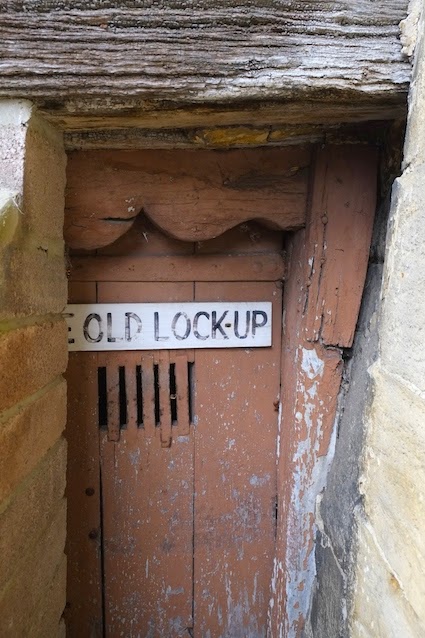
It’s easy to miss, this. Right in the centre of the small town of Northleach, in shady a corner of the Market Place in a spot shielded by other buildings, is a small brown door. The building to which is gives admittance has been propped up with an ungraceful pier of concrete blocks, so that the doorway is seriously obstructed – only about two-thirds of it is visible, and anyone of broader-than-average beam attempting to get in might have to try to enter sideways.
Tiny as this entrance is, what it is remains clear from the sign and the bars on the door. It’s the door to a town lock-up, which contains a cell about eight feet square. It’s not one of the classical free-standing lock-up structures with a stone roof that I’ve noticed before.* It’s a room adjoining the neighbouring building on the Market Place. It may be 17th or 18th century, but I could’t find out when it fell out of use. Northleach acquired a large prison, the House of Correction, just outside the town in 1789–91, but this small cell in the town centre might well have been retained after then to lock up drunks and rowdies overnight.
With its doorway partly obstructed, the cell can’t be usable for anything very much nowadays. But with its bars and its distinctive lintel, the curves of which seem to belie the utilitarian strength of the rest of the structure, it catches the eye. It would be good to think that the far-from-ideal propping could be replaced and that the building could find a use, but meanwhile one has to be grateful that a bit of history has survived.
- - - -
With thanks to Emma Bradford for pointing out this building to me.
*Other lock-ups I’ve posted about include: Wheatley, Shrewton, Breedon on the Hill, and Bisley.
Wednesday, April 24, 2013
Buckland, Berkshire*
Fit for purpose
I'm continuously humbled and astounded by the beauties to be found in English churches, especially those that are off the tourist trail and off the radar of all but the most assiduous and specialised art historians. Buckland, in the marshy area not far from Faringdon, is a case in point. You could spend a day or more in this building, which has evolved steadily over the centuries and incorporates the work of artists and craftworkers from every period from Norman to Victorian, and still not see everything. For now, I'll limit myself to a couple of details from either end of this vast historical span.
The first you see before you even get properly inside the building. This door dates to the 12th century, making its simple ironwork among the earliest one is likely to find. The metal has been cut quite crudely, but the broad horizontals, the great rounded forms, and the more tightly circling scrolls with which they terminate have been made with a certainty of purpose that no doubt made them as easy to admire in the Middle Ages as they are today. This ironwork has been fulfilling that purpose – multiple purposes rather, to provide hinges, to bind together and reinforce the timbers of the door, and to decorate its surface – for some 800 years. Standing near the beginning of a long craft tradition, it deserves to be far better known than it is.
- - -
*Buckland is now in Oxfordshire, but I use the traditional English counties because they reflect the usage in Pevsner's invaluable Buildings of England books – and because I like them.
Saturday, January 28, 2012
Inglesham, Wiltshire

Perceptions of the doors (2)
The door of 78, Derngate, subject of the previous post, is a very arresting example of the way in which a door can act as a symbol of the building to which it gives entry, signalling what we can expect inside. Here’s another door, at the tiny parish church of Inglesham in Wiltshire. Although my photograph shows only part of it, even this few square feet of timber and couple of bits of ironmongery speak volumes.
Inglesham is an isolated medieval country church, wholly unspoiled by the kind of 19th-century restoration that affected so many English churches. As I explained in an earlier post, the preservation of this church was in large part due to William Morris, who lived not far away at Kelmscott and supported the building’s sensitive conservation. Thanks to Morris, the building retains its patina of age and reads as an architectural palimpsest, containing as it does stonework and woodwork of a range of periods between the Saxon and the Jacobean, plus a variety of fragments of wall paintings, sometimes overlapping and fading into one another, to create an interior that is both fascinating and moving.
The door signals the sensitivity with which this church has been preserved. According to the principles of the SPAB, of which Morris was co-founder, when a repair is necessary, a minimum of the old fabric is removed and the new material is fitted to the old, not the other way around; in addition, there should not be any attempt at disguising the new material by fake ‘antiquing’ or distressing. These principles seem to have been followed with the woodwork of this door – just a sliver of weak or rotting wood has been taken away and a narrow fillet of timber inserted. It’s clear that it’s more recent, but that doesn’t matter – the difference helps make the history of the fabric clear.
At some point the door also needed a new handle. Again, the principle is, don’t fake a medieval handle, use something that’s modern, but works. That’s not a call for a piece of Bauhaus-inspired door furniture on a medieval door, though this handle has a simplicity and economy and kindness to the hand that Gropius and his Bauhausers would have admired. It’s just a bent strip of metal, but it’s elegant and it works. I wonder when it was fitted on the door? In Morris’s time? Later, perhaps, given the screw fixing? I don’t know. It’s timeless, and efficient, and makes a minimum impact on the ancient timber of the door. It remains true, too, to the spirit of tactful conservation that this wonderful building embodies.
Note This church is cared for by the Churches Conservation Trust.

St John the Baptist, Inglesham, exterior
Tuesday, January 24, 2012
Northampton

Perceptions of the doors (1)
Doors and doorways can tell you quite a lot about a building, or about the people who live there. I’m rather fond of my own front door, a lump of well seasoned oak that’s very old indeed – considerably older than the house to which it gives entry, in fact. And I like some of my friends’ doors, too, not only because of their design but also because they seem to symbolize the smiles and welcomes that I know are waiting when they’re opened – a pale wooden door in Oxfordshire, broad and inviting next to a narrow window that reveals two retreating cats and the owner’s vibrant abstract paintings; a glass door in a whole wall of glass in the Cotswolds, where the welcoming waves and grins can be seen well before you enter; a 19th-century Gothic front door leading straight into a room full of books. It doesn’t always work like this of course, but a door can be a powerful symbol of both house and owners.
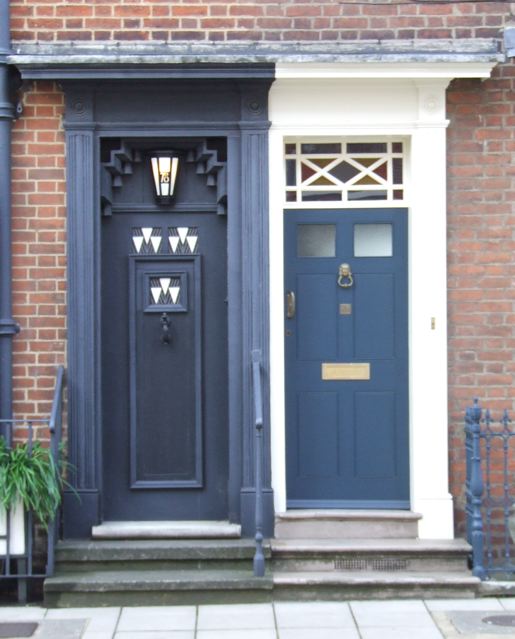
So what are we to make of these two doors in an unassuming terrace of early-19th century houses in Northampton? On the right, there's an original-looking door with its neat stained-glass window above, circa 1815. On the left, a doorway and door transformed, that seem to invite us into another universe, a place in which architecture and design are so far from the mainstream that it’s hard to give it a label. It seems to belong to no movement, exemplify no style, attract no label. Which is fitting, since this doorway belongs to a house that bears the fingerprints of the architect Charles Rennie Mackintosh. It’s the doorway to 78, Derngate, the only house in England with an interior (and a door) designed by the Scottish master, whose work draws on Art Nouveau and on the Viennese Secession (of which he was a long-distance member), but is uniquely his own.
Mackintosh made over this house in 1916–19 for W J Bassett-Lowke, retailer and manufacturer of toys, especially model railways, when Bassett-Lowke got married. It’s not a big building, and this compact terraced house is very modest for the owner of an expanding company that already had at least one shop in London. But inside, the entire interior was redesigned – a dazzling black and gold living room full of Mackintosh’s trademark grid patterns and a surprisingly stripy guest room, anticipating op art, are among the highlights. So this unusual door is a fitting prelude to an unusual house, home to a man who did not want to show off with a mansion, but who cared about architecture and design – and wanted people to know it.
* * *
There are pictures of the interior of 78, Derngate here, plus lots of information about the house, and visiting times. It opens after the winter break on 1 February.
Thursday, April 8, 2010
Eaton Bray, Bedfordshire
Masters of iron and stone
Curving and recurving across the door of St Mary’s church at Eaton Bray is some of the most remarkable ironwork from the Middle Ages, a series of intricate scrolls that date from the middle of the 13th century. Structurally, they help to bind together the timbers of the door; they are also like a signpost telling visitors that they are in for something special here.

When you open the door you find the nave and aisles separated by two beautiful arcades. The one in the picture is the more ornate of the two. It is of a similar date to the ironwork on the door and shows the kind of workmanship you’d expect to find in a cathedral rather than a medium-sized parish church in a Bedforshire village. There’s great refinement here. The arches are made up of deeply cut roll mouldings – eleven rolls in all around each arch. Each pier is given extra richness with the addition of eight slender shafts– and there’s an extra trick, in that some of the shafts, such as those around the pier in the foreground, are just slightly detached from their pier, to give additional shadow and depth. Each pier is topped with a capital carved with stylized foliage in a design known as ‘stiff leaf’, a motif that represented high sophistication in around 1240 when this row of arches was built.
English parish churches have an endless capacity to surprise and give pleasure, but often the pleasure comes from homespun, vernacular design. Here it’s more sophisticated work in the style that has been known since the 19th century as Early English Gothic. The breathtaking quality is perhaps to do with the fact that the church had been given to the Augustine abbey of Merton in Surrey the previous century. The unknown mason they employed produced a design of power and grace that still stands out, more than 700 years on.
Subscribe to:
Posts (Atom)