Saturday, March 19, 2022

Othery, Somerset

Confusion

If I’d been a member of what was called in my youth the Boy Scouts, perhaps I’d be more mindful of their once much quoted motto: ‘Be prepared’. As it is, I am quite capable of being unprepared to the extent of not putting the relevant volume of Pevsner’s Buildings of England series in the car when I set off on a trip. I made this very omission when going to Somerset the other day. The trip was not concerned primarily with observing or exploring buildings, but wherever I go, architectural observation is inclined to take over, and so it was when, with time on my hands, I stopped to look at the church in the village of Othery, set on the Somerset levels. The building, at least, didn’t seen difficult to grasp: a cruciform church with a tall central tower, not as flashy as many in Somerset but with attractive openings in the upper stage where the bells are and below that some statues in niches – Christ enthrones and Saint Mary, Saint John, and Saint Michael, to whom the church is dedicated.

But when I got inside, the furnishing got me baffled. Other church contains a striking collection of wooden benches with carved ends. Carved bench ends are speciality in Somerset. Some churches have outstanding ones, dating from the 14th to the 16th centuries, carved with depictions of symbols, animals, plants, saints, even satirical depictions. Anyone who likes church woodwork should visit Somerset.* Othery has some excellent bench ends, but they struck me as varying somewhat in style. Some looked medieval, some exhibited a certain formality or treatment of details that made me wonder if they were Victorian reproductions. Some were carved with vigour and had slight and not disagreeable roughnesses of surface, some were much smoother. In the end I abandoned speculation and enjoyed the carving for the visual feast it offered – multiple portrayals of foliage, tracery, curious beasts, King David playing his harp, grapes on the vine, a saint or two. The latter include more than one depiction of St Michael the Archangel dispatching the devil, who takes the shape of a dragon.

Back home, with the Pevsner Somerset: South and West volume in front of me, I read: ‘BENCHES. A confusing collection because of the interventions of the antiquary William Stradling of Cholton Polden in 1848–50. Some are C15–C16…Many are Victorian…by William Halliday, Stradling’s carpenter. Stradling copied originals, including some with small figures (St. Margaret, St Michael) that seem of separate provenance.’ In other words the church contains original medieval carvings by at least two differing and distinguishable hands, as well as Victorian ones by Stradling. An article in the useful essay collection, Pews, Benches & Chairs† agrees, and points to the image of St Michael in my photograph above as one of the medieval originals (there’s a contrasting Victorian one, below, with a much more detailed, scalier dragon). There’s just enough detail in the medieval one: the saint’s angelic form standing astride the creature’s back, the dragon’s neck curving upwards to suggest that it still has life in it, but not much strength, the canopy with its crocketed finials topping the image and filling the available space above. It’s a slightly naïve bit of work, but there’s still much to like about it. What I take to be the later version is much more artful.The devil is part dragon (with a tail that curves beautifully) and part human (with torso, head, and arms). The saint’s sword is poised; his wings fill the space above artfully; much work has been put into capturing the drapery of his clothes. There’s a lot of action in this carving. I wouldn’t want to express a preference for one over the other. It’s good that the church has them both.

- - - - -

* See, for example, an earlier post, here, about bench ends at Brent Knoll.

† Trevor Cooper and Sarah Brown (eds), Pews, Benches & Chairs (Ecclesiological Society, 2011)


Monday, March 14, 2022

Weald and Downland Museum, Sussex


Drying not dying

A building like this has a very special effect on me. It’s large, but in a way it’s insubstantial because there are no walls: just oak posts and a roof of tiles. It provides a lot of shelter from the rain – but for what, or whom? The answer takes us back to 1733, when it was built in Petersfield, Hampshire. It’s a shelter for stacking newly moulded bricks, so that the clay could dry and harden before the bricks were taken to the kiln for firing. Bricks in this raw state are known in the trade as ‘green bricks’, although their colour at that stage would be the hue of the clay of which they’re made. And the story of this building’s use takes us back to the 18th century, not just because of the date of this particular example, but also because by the 19th century, hand-made bricks were starting to die out, to be replaced by mechanically made bricks, which could be produced in vast numbers and at speed.

This brick-drying shed at the Weald and Downland Museum was reconstructed on this site in 1988. Hand-made bricks did not completely die out in the 19th century. The one in Petersfield carried on until World War II, there still being demand for good quality hand-made bricks in contexts where the locality or building requires something with the look and texture of traditional local brickwork. Petersfield itself has many Georgian and later buildings that it would be sacrilege to repair or add to using hard-edged, standard-issue mass-produced bricks from somewhere outside the region; so the demand continues. But some traditional brickworks could not compete with the cheap prices of the big producers, while others closed during the war because the blackout demanded their open-topped kilns, burning through the night, showed no light. That was the case with the one at Petersfield.

About 80 feet long, the drying shelter is big enough for the brick-maker to set up his bench at one end, so he could shape the bricks, one by one, before an assistant (often a family member in the old days) could stack them nearby. Today, the museum uses the bulk of the space for an exhibition about brickwork, surely a good use for this modest but large-scale structure that stands among the other working buildings, from the carpenter’s ’shop to the pug mill, on the site at West Dean, which for my money is one of the best collections of vernacular buildings anywhere.

Thursday, March 10, 2022

Weald and Downland Museum, Sussex


Wooden buildings for woodworkers

The UK is fortunate to have several open-air museums that preserve old buildings, usually structures that have been dismantled and re-erected on the museum site, that would otherwise have been demolished. Some of these museums have large collections of dozens of buildings, gradually amassed and preserved over decades, and one of the best, in my opinion, is the Weald and Downland Living Museum, a few miles from Chichester in West Sussex, which preserves many buildings form Southeast England – mainly Sussex, Kent, and Surrey. They do an excellent job, and should be supported and visited now they are open again after the various lockdowns and restrictions that we’ve been living through.

Following on from my previous post about a plumber’s workshop, here are two more small working buildings from the Weald and Downland. The larger of the two is a joiner’s workshop originally from Witley, Surrey and the smaller structure is a carpenter’s ’shop, from Windlesham in the same county. Both have the generous glazing typical of such working buildings and they’re both made mainly of wood and built more for practicality than looks.

The carpenter’s ’shop belonged to a Mr Dale, who like many in his time traded as both a carpenter and an undertaker. It was reconstructed on the museum site in 1980, but I don’t know how old it is – the museum’s website doesn’t give a date, so perhaps its age is unknown. It’s very simple, with a wood-framed structure covered with boards and tarred to protect it from the weather. Mostly the carpenter’s materials and finished work came in and out of the door although there’s a small opening above the central window, through which he could insert and remove his ladders.

Inside, the tools left in the ‘shop when it was finally vacated are preserved. Saws and large drill bits hang from the roof beams; chisels, bradawls, and other smaller tools stand in racks; planes wait on the bench. There are pots and bottles of liquid, perhaps preservative oils. When it was still a workspace, there might have been a pot of glue on the go too. You could move in here and start working with wood, with only a few additions if you were able to work with traditional hand tools alone.

It’s very atmospheric and reminds me how accurate some of the 20th-century depictions are of such carpenters’ ’shops. I’m thinking particularly of the one by Edward Bawden in the King Penguin book Life in an English Village, which I blogged about here, mentioning my father’s boyhood memories of another carpenter’s workshop in rural Lincolnshire. Even the humble buildings need celebrating, something I try to do on this blog, and something open-air museums like the Weald and Downland do brilliantly.

Saturday, March 5, 2022

Weald and Downland Museum, Sussex


Call in the plumbers

These days when something goes wrong with a tap, or there’s a leaky pipe, or a ballcock, we call in the plumber. Plumbing is one of those trades that has been with us since ancient times and form the Romans to the early-20th century, water was carried in lead pipes. So plumbers were skilled in the working of lead – they could make lead pipes, mend them, install them. And they also got involved in trades in which lead was used – in glazing, for example, when panes of glass were set within strips of lead, as in the ‘leaded lights’ we still talk about when discussing windows in some churches or old houses. That’s what ‘plumber’ means (coming from the Latin plumbum, lead), a person who works with lead.

So here’s the plumber’s workshop at the Weald and Downland Open Air Museum. It’s a wooden building with large windows to provide plenty of natural light, and fitted with generous work benches. It was probably built in the late 1880s and was originally sited in Newick, East Sussex. It belonged to the long-established firm of W. R. Fuller, who were plumbers and decorators, another two trades often combined, and came to the Weald and Downland Museum after it was dismantled in 1985. It’s just the kind of building that’s at home in an open-air museum, and like some of the best working buildings that end up preserved, it came with a large selection of tools – for cutting lead, measuring it, and for forming and bending pipe. The museum has a large collection of artefacts used in various building-related trades. Many of these are in storage, but it’s good that some of them can be displayed, to give visitors an idea of how tradesmen worked.

And we need such an idea, because plumbing changed radically in the 20th century. When scientists realised that lead pipes could be harmful to human health, there was a changeover to pipes made of other materials, from copper to plastic. The trade changed, and workshops like this became a thing of the past. There must have been thousands of such workshops; now leadworking is a specialist craft, restricted to areas like the decorative leadwork sometimes seen on rainwater goods, and the repair of windows that have leadwork, so plumders’ workshops of this kind must be rare as hen’s teeth. Thanks to the Weald and Downland Museum, one at least has been preserved to throw light on a bit of a much-changed building trade.

Monday, February 14, 2022

Petersfield, Hampshire

Reading matters

Even though I no longer use them very much (having more than enough books of my own to read) I am very much in favour of public libraries. It’s partly that I’m thankful for the way my local library helped me when I was a boy hungry for knowledge growing up in a household with few books. There all the books were. There seemed to be books about everything, and all the classics of English literature (and other literatures). And it was all free. Paradise.

Today, arguably, it’s different. Everything’s online, isn’t it? Well, no. And anyway not everyone has access to a computer. And not everyone knows how to find information. And for all kinds of good reasons many people still prefer to read a novel in a real volume with paper pages. One of my nieces worked for a while in a small branch library here in the Cotswolds and was amazed how many people needed her help to find things out – everything from the biographical details of an English poet to how to apply for a council tax rebate. ‘I’m a social worker, too, apparently,’ she told me. Libraries are still essential.

But what did people do before 1850, when the British Parliament passed an act enabling local authorities to levy a rate to pay for public libraries? Here’s one answer. They went to privately run libraries, which were owned by local businesses (or, less commonly, by private organisations such as the still wonderful London Library, where you pay to be a member, as I did when I lived in London).

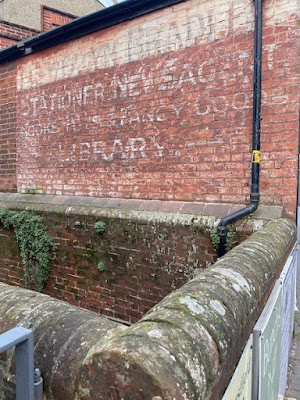
Most towns did not have a vast bibliographical treasure house like the London Library but they often had a private library run perhaps by a local stationer, where they could pay to borrow books. Boots the chemist had libraries in their large shops, too. And many of these privately run libraries survived well into the. last century because people liked them and they might have different books form those at the local public library. Here’s a ghost sign in Petersfield, advertising a local stationery business owned by one Llewelyn Bradley. Alongside the writing materials and newspapers there were also reading materials that you could borrow. Bradley was born in 1877 and probably sold up in the 1930s, after which the business – still with its library – was known as Austin’s.* An online source refers to a picture of c. 1955 but after that the trail goes cold, so I don’t know how long it survived. But there it was, another bit of history for which we have to thank a ghost sign, which, on the building at least, is the only bit of reading matter now offered hereabouts. No doubt the people of Petersfield were thankful for it, while it lasted.

- - - - -

* Austin’s, with its books, toys and ‘fancy goods’, is said to have been the inspiration for the children’s book The Little Wooden Horse, by Ursula Moray Williams.


Thursday, February 10, 2022

Gloucester


Not too distant

‘Decay is a kind of progress’, says Dorothy in Alan Bennett’s hilarious and thoughtful play People. It’s a play with an old building in it, and it’s one I often think about. That particular line comes into my mind mind sometimes when I look at ghost signs, those now-redundant bits of advertising that hang on, flaking but evocative, to walls in our cities. They’re bits of the past in the form of hand-painted lettering and they evoke past businesses and past times. As the paint grows less distinct and wears at the edges, they’re more evocative somehow, and oddly attractive – ‘pleasing decay’ as John Piper called it.

Something happens, though when, like Dorothy in the play, one reaches a certain age. You realise that the signs were advertising companies, brands, and products that are part of your own history. Here’s a personal example. I can remember Boselli’s ice cream van visiting streets in Cheltenham in the 1970s, when I was a teenager. No doubt the van was even more familiar in nearby Gloucester, where Boselli’s were based. The company vanished from my view at some point in the 1980s, by which time in any case, I’d moved away, first to university, then to London.

But there Boselli’s were, for a while, in my past. Better than nationally known brands like Wall’s (also made in Gloucester, as it happened). And now here’s their sign, now a familiar landmark for me as I drive past on a route near the city centre. And the sign is starting to decay, the background going, the lettering a bit frayed around the edges. And I’m its contemporary. It’s something that makes me pause, that’s all.

Meanwhile, I’m pleased to be reminded of Boselli’s, and pleased that ghost signs are not all for the great universal brands that we all know – Bovril, Hovis bread, Bass beer, Boot’s the chemist – but also for those small local businesses that can come back to life in the minds of locals who pass them. They’re messages from the past, and we should notice them while we can.

Sunday, February 6, 2022

Wotton-under-Edge, Gloucestershire


Past times

Here in the UK as the 70th anniversary of Queen Elizabeth II’s accession to the throne is being marked, I thought perhaps, as I do like a public clock, it was time to post this timepiece commemorating a past jubilee. Nowadays public clocks are almost superfluous – we all carry time around with us, displayed on watches,* mobile phones, and so on, and rarely have to look up to find out what time it is when we’re walking along the street. But such features as Victorian or early-20th century clocks, if of little practical use to most people, can be something that makes an old building special, and they can be highly informative about past times and values.

So here’s a clock of 1897, on the Tolsey, a former market building, in the Gloucestershire town of Wotton-under-Edge. The clock was installed to celebrate the Diamond Jubilee of Queen Victoria in 1897. Its clear faces with Roman numerals are looking good after a restoration in 2015, and the gilded scrolls, fleurs de lys, and dates, not to mention the portrait of the queen herself and the flags with which the clock is surmounted, are still standing proud and catching the eye.

In its symbols, traditional face, and use of gilding, this clock is as typical of its era as an angular, monochrome timepiece would be of the Art Deco period, or a smart watch is today. It’s unlikely that a rash of clocks will appear on our streets to celebrate Queen Elizabeth’s Platinum Jubilee. But I hope those who are keen to mark such events can think of something as beautiful, useful and well made as this clock was when it was bolted on to the brick upper wall of the Tolsey in 1897.

- - - - -

* Men’s pocket watches were first mass produced in the second quarter of the 19th century; wrist watches, at first worn almost exclusively by women, were produced in quantity at around the same time or slightly later. Widespread wrist watch-wearing by men began in the military and became generally common after World War I.