Showing posts with label prefab. Show all posts
Wednesday, March 26, 2014
Brockworth, Gloucestershire
The future, once
Here’s another prefab, a different design from the ones in my previous post. It’s one of a kind that I remember seeing when I was a child, and which recalls a particularly distinctive vision of times to come.
The Welsh politician Neil Kinnock spent his childhood living in a prefab in South Wales, and is on record as saying of the experience that it was like living in the future, and that his home produced an abiding impression of cleanliness and newness. Many residents who moved into prefabs in the years after World War II felt something similar. ‘We felt that we were part of something new and exciting,’ said one, quoted in Greg Stevenson’s Palaces for the People. A colleague of mine who as a child had a prefab-dwelling friend said something similar: travelling from his home to the friend’s prefab was like entering the space age.
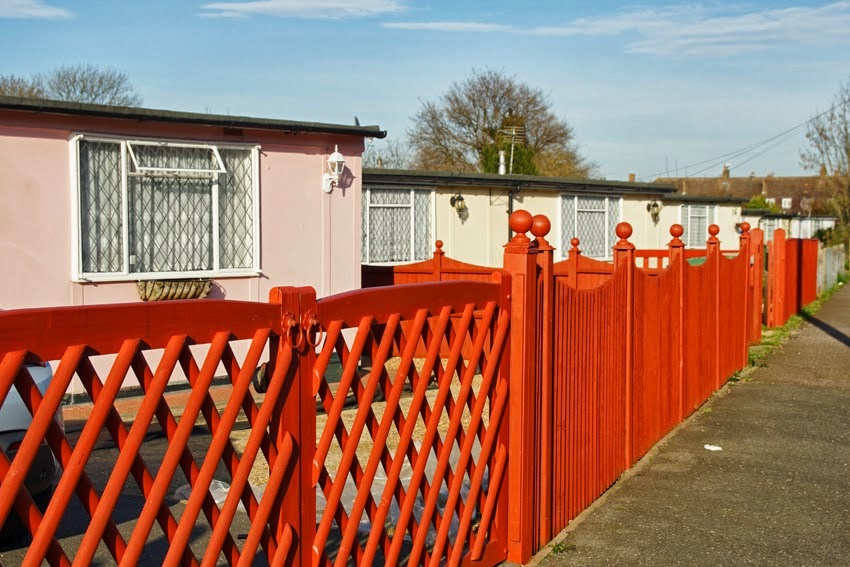
The prefab in my picture is one of those on the Gloucestershire estate that my colleague was referring to. It’s one of a kind known as the BL8 Aluminium Bungalow, a design produced by the Hawksley Company, which was set up by Gloster Aircraft Company and based in nearby Hucclecote. These BL8s had wall and roof panels made of Duralamin, an aluminium alloy used in aircraft production. The windows have steel frames and inside the buildings had, I think, fitted kitchens and bathrooms that were similar to those in the other prefab types and that so impressed people with their modernity. Modern, that is, for the time – BL8 were made in the late 1940s and early 1950s, so were not part of the Temporary Housing Programme that brought the other prefabs into being immediately after the war. Indeed, they were seen as a higher-spec design and were intended to be longer-lasting.
These aluminium prefabs survive in a few places (there are apparently some in Letchworth, which I’ve not seen), but here in Brockworth nearly all of them have in recent years been clad in more conventional materials, so that brick walls and tiled roofs make them look less industrial and more like conventional bungalows. The example in my picture is one of a very few that retain their original outside walls, roofs, and window frames, although there’s a new door. I remember similar prefabs from my own childhood, which was long enough ago for the painted metal walls to look shiny and for the neat rows of little bungalows to give just that sense of difference and modernity that others noticed.
Sunday, March 23, 2014
Catford, London
Far from ordinary
‘The glory of the ordinary’ was one reader’s comment on this blog and its subject matter, especially the parts of it that concern themselves with shacks, corrugated iron barns, battered factories, and other unregarded delights. But I didn’t always pay attention to this kind of architectural ordinariness – extraordinary buildings, from English cathedrals to Italian palazzi, once seemed more worthwhile, and years ago, when I lived not far from southeast London’s Excalibur prefab estate, I didn’t look at the place very closely, pausing only to be amused by the Arthurian street names (Ector Road, Pelinore Road) and to notice the similarities between the prefabs that lined these streets and the ones I remembered not far from where I lived as a child. There had always been prefabs around, ‘war prefabs’ as my parents and their friends called them, built en masse to relieve the housing shortage (and to give the suddenly underemployed aircraft industry something to do) after World War II.
Back in the 1960s, when I was a boy, the thing that my parents said about these prefabs were that they were meant to be temporary dwellings, with a life of ten years or so, and that the little houses had done well to last twice that time already. Now, 60 or more years after their construction, there are very few of these prefabs left: most have been demolished to make way for more modern housing, often at a higher density to take advantage of today’s high city land values.
So prefabs are no longer ordinary. The Excalibur Estate is now the only surviving prefab estate left, and is itself threatened with demolition. English Heritage have listed a handful of the prefabs (and the estate’s curious prefabricated church), but the council want to pull down the other 180 prefabs and replace them with a larger number of more modern dwellings. My feelings about this are mixed. On the one hand, London needs more good social housing and the prefabs would prove costly to preserve. On the other, the prefabs are a unique bit of social and architectural history. The residents, when polled, voted for demolition and redevelopment, by a narrow margin of 56 to 44 per cent.
The estate was built in 1945–6, and consists of prefabricated Uni-Seco bungalows, which have a timber frame supporting panels of asbestos cement. There are metal-framed windows and roofs with a very gentle pitch that look flat. The Uni-Seco was one of 13 different types of prefab built in Britain in the 1940s under the government’s Temporary Housing Programme, which eventually saw some 150,000 prefabs built to help relieve the housing shortage. More would have been built, but the prefabs (whether in wood, aluminium, concrete, or asbestos cement – there were examples of all these forms of construction) were actually quite costly to produce, so traditional, permanent, brick-built houses eventually prevailed.
Most residents liked their prefabs, not least because they came with modern features such as fully equipped bathrooms, indoor lavatories, and fitted kitchens with hot and cold water and something that most British houses lacked in 1948: a refrigerator. This was the kind of specification that many Brits could only dream of in the post-war period and the buildings, with their almost-flat roofs, white walls, and large windows, looked modern too. If they cared about such things, the original tenants might have reflected that at last their were getting a bit of the modern design that had been such a hit in Europe. But the generous gardens were probably just as important to them.
And there, for now, they stand, their chivalric street names (actually a continuation of a theme used to name streets in a neighbouring estate) evoking both post-war patriotism and 21st-century defiance. In this age of austerity, these far-from ordinary little buildings are worth a thought and, it seems to me, some admiration too.
- - -
With thanks to Caroline, of the excellent blog Caroline’s Miscellany, for the pictures. Her own piece on the Excalibur Estate is well worth reading.
There is an ongoing project to record the history of prefabs here.
The best books on prefabs are Greg Stevenson, Palaces for the People (Batsford, 2003) and Brenda Vale, Prefabs: A History of the UK Temporary Housing Programme (E & F N Spon, 1995)
Saturday, July 7, 2007
Spa Buildings, Tenbury Wells
You’d have to go a long way to find anything like this, the Spa Buildings in the middle of the small Worcestershire town of Tenbury Wells, which became a spa when saline springs were discovered in 1839. The 1862 design, by James Cranston of Birmingham, isn’t much like any other building – it’s a mixture of false-half-timber and greenhouse, with a bit of Victorian brickwork thrown in, all making a bizarre cocktail that contemporaries called ‘Chinese Gothic’.
The big clue is in the word ‘greenhouse’. Cranston had been working on some glasshouses and got the idea of adapting greenhouse structure to a building for people. Out went the glass panes and in came steel roofing sheets and wall panels, to make one of the world’s first prefabricated buildings. The system was flexible enough to produce a pair of halls, a bath complex, and an octagonal tower to house the well with its pumps, which dispensed 20 gallons of mineral water per hour.
Like later prefabs, the Tenbury Spa Buildings were probably not intended to last that long. And they certainly never caught the admiration of the architectural powers-that-be. Nikolaus Pevser, in the Worcestershire volume of his Buildings of England series, described them as ‘much like Gothicky or Chinesey fair stuff, i.e. without seriousness or taste’. The people of Tenbury thought better of their unusual spa, though, and restored it at the end of the 20th century. With galvanized roof panels and a strengthened structure, the building is now better than ever.
Subscribe to:
Posts (Atom)