Showing posts with label Stuart architecture. Show all posts

Wednesday, November 5, 2025

Cotehele, Cornwall

The beauties of imperfection

Modern window glass is almost perfectly flat, flatter than any pancake. It also has few if any internal imperfections, making it perfectly transparent, and it can be manufactured in large pieces, making sizeable uninterrupted shop windows possible. Old glass, especially pre-19th century glass, is full of imperfections and generally came in quite small pieces. It was often made by blowing a cylinder of glass, which the glass-blower then cut along one side and flattened out to make a sheet. Another method was to spin a mass of molten glass, producing a disc, which the glass-maker then cut up into small usable sections. Windows from the stained-glass one in medieval churches to the small panes in Tudor or Georgian windows, are glazed with glass made by hand in these ways.

Most of the time, people don’t notice the imperfections in old glass windows. But if you look closely you’ll see that their surfaces have a pleasant and characterful unevenness – which also distorts slightly what we see through them. The ancient house of Cotehele in Cornwall was built in the Tudor period; the interiors were modified in the 17th century and the building remains Tudor and Jacobean in character. Many of its windows retain their early glazing. You can see how, in my photograph, the imperfections – a series of curved and linear unevennesses or more random patterns – can be made out by looking at the shadows they cast on nearby walls and window reveals. These effects vary according to the light’s direction and intensity, but are wonderfully clear in the photograph that I took on a recent October afternoon.

The architectural character of a building is often very obvious, but sometimes reveals itself in subtle ways, catching us by surprise when a particular feature, like this window, has its time in the sun.


Saturday, November 1, 2025

Cotehele, Cornwall

An ancient place

Cotehele is one of the most romantically beautiful houses in the care of the National Trust.* It was built by three generations of the Edgcumbe family during the Tudor period† and its interiors were upgraded in the 1650s. However, in 1547–53, when Cotehele was still unfinished, the family built another dwelling, Mount Edgcumbe House, about 12 miles away.§ Mount Edgcumbe became their main home, Cotehele was second in importance. Mount Edgcumbe was remodelled in the 18th century and its old, now unfashionable furnishings, were moved to Cotehele, where they have been ever since. As a result, Cotehele gives the impression of a rambling Tudor and Jacobean house, full of tapestries, oak furniture and four-poster beds, a perfect and apparently untouched upper-class country house of its period.

In fact there were later alterations, notably in 1862, when Cotehele became the home of the Victorian owner’s widowed mother. But these were done in harmony with the Tudor fabric. The right-hand end of the east range (lower photograph), dates to 1862, but you’d hardly know. It’s a house of local granite walls and chimneys, a mixture of tiny windows and large mullioned ones, of courtyards and towers. It covers a large footprint with architecture on a modest scale – there are no grand entrances or big architectural gestures. Even the towers are low-rise and only the hall has a high ceiling. The setting – terraced gardens, a steeply sloping valley garden, old orchards – is perfect. Inside and out, the place is uniquely atmospheric.

Cotehele seems a world apart from modernity or business, let alone industry. But it’s near the River Tamar, once a great highway for Devon and Cornwall, the counties of which it forms the border. The varied fruits of market gardening and mining were not far away. Perhaps that story will be the subject of another post.

- - - - -

* The house passed to the Trust in 1947. They do, it seems to me, a fine job in looking after it and presenting it to the public. Electric light is kept to a minimum, which presumably helps preserve the contents and enhances the atmosphere. The volunteers who stand in each room are particularly enthusiastic and helpful in answering queries. There’s information, but nothing is over-interpreted. I’m indebted to the Trust’s guidebook for details about the house’s history.

† Specifically 1485–c. 1560

§ I’m not sure why they built this second house so close. More research is needed.
Cotehele, the east range, with 19th-century addition at the far end

Friday, October 17, 2025

Hull, East Yorkshire

Artisans at work

At the time of my visit to Hull in the summer, there was building work going at the Wilberforce House Museum, making photography difficult. So I honed in on a detail of the entrance, excluding as many distracting objects as possible, to give an idea of the extraordinary architecture of this house of the 1660s. It was built for a merchant called Hugh Lister, later became the official residence of the Governor and Deputy Governor of Hull, and still later, in 1730–1832, was owned by the Wilberforces, the family of the celebrated anti-slavery campaigner.*

The elaborate architectural style is known as Artisan Mannerism, a fashion created not by architects but by stonemasons and bricklayers, drawing on pattern books of classical architecture (some of which were produced in the Netherlands and France, where the merchant Lister had spent time on business) but disposing the decorative features in unconventional and naïve ways. Popular elements and motifs included curvy Dutch gables, exaggerated mouldings, unconventional arrangements of pediments and other details, and a disregard for the conventions of proportion. Although they disregard many traditional rules or guidelines of Classical architecture, Artisan Mannerist buildings can still have much vigour and charm.

A glance at the entrance of this building will reveal what I mean. Lister’s builder, who was probably a Hull bricklayer called William Catlyn, threw the kitchen sink at his design, incorporating not only round-topped niches on either side of the doorway, but crowning these with triangular pediments, outlined in pale stone. The round-arched doorway is also crowned, not with a triangular pediment but with a stone moulding that breaks into a semi-circle, topped with a carved feature a bit like a plinth or bracket for a statue, above which is no statue but a window lighting the next floor up. Elsewhere on the facade, ornamental stones bearing various geometrical carvings (here a diamond, there a square), are inserted. The undecorated runs of brickwork are laid with deep horizontal bands every half-dozen courses, to give the effect of rustication.

It’s a matter of taste whether one regards this effect as a provincial offence to Classical taste or a rich mélange. I belong to the latter camp, and can find much to like in the energetic effect produced by a local worker who was happy to pick up some motifs and run with them. Hull would be a poorer place without such a display.

- - - - -

* William Wilberforce (1759–1833) was a hero of my childhood, partly because my mother came from Hull, where he was born, and partly because he was one of the people championed at my primary school. History in those days was often taught as a succession of great individuals (mostly, but not all, men) who had a major influence on the history of Britain. Such people included the engineer James Watt, the nurse and nursing reformer Florence Nightingale, the social reformer Lord Shaftesbury, and William Wilberforce. These historical stars were seen mainly in terms of specific shining achievements, and any negative aspects were ignored or played down. Wilberforce’s support for socially conservative moves such as limitations on gatherings of more than 50 people, the suspension of the right of habeas corpus, his opposition to trade unions, and his opposition to holding an enquiry about the Peterloo massacre, were quietly ignored. To recognise these views is not to devalue Wilberforce’s abolitionism, but to see the man whole. Neither is it an example of today’s so-called ‘woke’ attitude to history; contemporaries such as William Cobbett pointed these things out in the 19th century; today it’s still vital to realise when one’s heroes are not plaster saints.

Sunday, September 7, 2025

Dunster, Somerset


A web of wood

Having posted about Dunster’s charming and well preserved dovecote the other week, I thought it might be interesting to take a look at the most prominent building in the centre of the village, the striking octagonal Yarn Market. This is, probably, everyone’s favourite building in Dunster. Thousands who have paused here for a moment have taken a photograph of this structure and, with a passing thought that it’s not like any other building* and very much unlike most of the old market buildings that survive (rectangular structures open below and with rooms above) have moved on.

Some will know that it’s a 17th-century building, showing that the wool trade hereabouts continued well beyond the Middle Ages. In fact, it’s an indication of a change in trading conditions. Dunster had been a port with a hinterland stretching across Exmoor, but the sea retreated and a new trading base was established here in the middle of the village. The Yarn Market’s presence is an indication of a significant amount of business and merchants’ need for shelter and security. Its striking shape shows that those 17th-century traders liked the idea of creating a building that could be easily identified and could form something of a landmark.

Anyone who goes inside can see that the octagonal roof required a network of rafters, braces and struts (photograph below); together with the posts that hold up the whole building and the lantern on trhe top, most of the structure is made of wood. The central stone column is a key support, and the whole structure is made more complicated by the generous roof overhang and the dormer windows, necessary to let more light into the space below. This wonderful building gives us an uncommon chance to look inside a roof structure of its period – most roof frameworks are hidden from the public by ceilings, after all. The pleasure I get from it is akin to the pleasure I’ve got from occasional views up into the interiors of church spires. These webs of woodwork required skill, ingenuity and a surprising amount of timber. Hats off to the carpenters who built them, and built them to last.

- - - - -

*Although there is at least one later homage to the Yarn Market, at the Cadbury’s model suburb of Bournville.
Dunster, Yarn Market, central column and roof timbers

Sunday, August 17, 2025

Chastleton, Oxfordshire


A spirit of place and time

I have visited Chastleton House before, but the other week the Resident Wise Woman and I decided that it was time for a revisit, so once again we found ourselves parking in the designated car park and walking along the path across the field and past the dovecote, to arrive in front of one of the most perfect of English Jacobean country house facades. As I’ve shown this front before in a previous post, I want this time to dwell on the interior, its unique contents, and the unusual way in which the National Trust has preserved it all. When the house came to the National Trust in 1991, it was remarkable not just for its architecture of 1607–12, but also for the fact that many of the 17th-century contents were still in place, and nothing substantial had been altered. None of the inhabitants had been rich, so there were no makeovers, and no money for anything but the most basic necessary repairs. The effect was not much different from that described in a Country Life article of 1919: ‘one of those rare things that once seen can never be forgotten…for the retention of its ancient furniture, fittings, pictures, pewter, glass and tapestries…it stands out as a wonderful survival’.*

What the curators at the National Trust saw when they took over in 1991 was something very similar – but with an added element. The house was also testimony to the owners who had hung on, living in the house but doing very little with it. The evidence of their lives was all around them – recent inhabitants had included an art critic and a scientist – the cups and plates they used every day, boxes of chocolates, the books and magazines they read, the glasses they wore while reading them. The place was a time capsule, but evocative of two eras: the early-17th century and the mid-20th. How to preserve this legacy?

The Trust decided not to restore the building to what it might have been like in the Jacobean heyday, but to preserve it very much as it was in 1991 when they took over. They adopted the minimal of alteration, only the most necessary repair, to lay, as Mark Drury put it, ‘as light a hand as possible on Chastleton, to arrest 150 years of progressive decay with an almost imperceptible tightening of the reins’. So no wholesale repainting or regilding of surfaces, just touching up here and there, while retaining the overall feeling of flakiness; no new curtains but gentle repair of what was there; and so on. And in addition, retaining the marks of a life lived in the house – magazines left open on the bed or table; a teapot waiting to be poured; a half-empty decanter, old guidebooks to Oxfordshire and the Cotswolds in a rack near the entrance.

The approach has always been controversial. There are some who believe that a place as beautiful as this deserves a more interventionist approach, to take it some way back towards its 17th-century glory; one good friend of mind calls the Trust’s approach at Chastleton ‘brilliantly wrong’. There are indeed ways of doing this without wholesale restoration and the SPAB and those who follow its tents have established best practice for conservation. But I’m more sympathetic. I love the way the house pays homage to both its original builders and its 20th-century owners. I also admire the way the house’s custodians can keep something so fragile in this precarious state indefinitely. But I’m also aware of the problems of doing this. All conservation is difficult, expensive, and painstaking; keeping this fragile place just so must be even more so. And as I stroll around the house with other visitors, our feet pounding the floor and staircases, our breath changing the humidity, our hands leaving marks on banisters, I realise that I and all the other visitors are ourselves part of the problem, a strain on the building, while also providing funds for its upkeep. And yet at moments, when one is alone in a room, there is an atmosphere, a spirit of place and time, like nowhere else in the world.

- - - - -

* Quoted in The Art Newspaper, 1 December 1991
Chastleton house, teatime tableau


Tuesday, July 9, 2024

Farndon, Cheshire

Small mercy

‘We must be thankful for small mercies,’ my mother would say, keeping her spirits up in the face of what was sometimes a hard life. Perhaps she learned such maxims in the succession of small nonconformist chapels that she attended in her youth, where the architecture – sober, dignified, but often a bit dull – could match the sermons preached within. But now and then a sermon could take off into more exciting realms of eloquence or even passion, and that’s the case too with the architecture of chapels, which can afford much more than sober appreciation.

So it is, I feel, with this example in Farndon. Its name is Chapel House and it was built in the mid-17th century as a house – for a minister, presumably – with a chapel room at the rear. Nowadays it’s a house pure and simple, but the design of its facade is neither entirely pure nor merely simple. What caught my eye of course was that curly gable, with its mixture of concave and convex curves, straight lines and steps. On the east coast of Lincolnshire this sort of thing would elicit comments about trade with the Low Countries influencing the local architecture. Here in Cheshire, there’s not that direct contact, but news travelled, as did pattern books, and someone in Farndon liked this style as much as I do.* The addition of a circular window in the attic, a dentil course across the middle, and an assertive round-headed doorway, and you have a composition that turns heads in a street of small houses. If you want a label for the style of this kind of building, it’s artisan mannerism, a fashion in which builders took motifs from more pretentious buildings (especially ones in places like Haarlem, Antwerp, and French chateaux) that they knew from pattern books and reproduced them, usually in brick.

Villages like Farndon have more spectacular buildings than this – a church, a striking pub, and a medieval bridge across the river that divides England and Wales are the kind of structures that guidebooks will direct the visitor towards. But small mercies like this building are things that also make me thankful.

- - - - -

* Maybe more than one person. There’s at least one other similar gable in this village.

Thursday, May 23, 2024

Snowshill, Gloucestershire

Wolf’s Cove

The other week the Resident Wise Woman and I revisited one of our local Cotswold country houses, Snowshill Manor, a place we had not been to for years. Snowshill, a 16th-century building much altered over the years, is now best known fior the collection it houses, which belonged to the architect-craftsman-artist-collector Charles Paget Wade, who bought the house in 1919. Wade’s collection is so large that it fills every room and spills over every surface. There is one room full of suits of samurai armour, another housing a large collection of musical instruments, one full of weaving equipment and domestic appliances, an attic room containing many bicycles, models of traditional British farm wagons, and perambulators. The theme that unites these apparently random and undoubtedly diverse objects is above all their owner’s passion for craftsmanship in all its forms. Wade would buy broken items and learn how to mend them himself, in the process giving himself a deeper understanding of how they were made. So Snowshill is a three-dimensional portrait of his interests and obsessions. Stepping inside the house, more than any place I know apart perhaps from Sir John Soane’s Museum in London, is like taking a trip inside its owner’s head.

After the frantic plenitude of the house, it’s a relief to step outside into the garden, arranged as a series of courtyards by Wade, taking advice from his friend the great Arts and Crafts architect M. H. Baillie Scott. In a corner of the garden is another Wadeish eccentricity, a model village that he called Wolf’s Cove. Before World War I, Wade lived in Hampstead (he had worked with the architects Parker and Unwin on the garden city at Letchworth and the planning of Hampstead Garden Suburb). While there he had created in his garden one of the earliest outdoor model villages, and when he moved he took its buildings to Snowshill and re-erected them, adding more buildings and turning it into a sea port. Houses cluster around the end of the harbour, straggle up the slope beyond, and there is also a railway and station (invisible in my photograph, it is to the left behind the wall).

J. B. Priestley is his book English Journey (1934) describes visiting the manor and seeing Wolf’s Cove. He calls the village ‘boy’s play on a smashing adult scale, defying all common sense but glorious in its absorption in the exquisitely useless’. Priestley also points out that all the buildings (with the exception of the walls and jetty of the port) are moveable, and are designed to be taken down and put into indoor storage in winter. At the time of Priestley’s visit, Wade was making drawings for a possible castle to overlook the village, but that’s a project that does not seem to have got off the drawing board.

Wade gave up his architectural practice to concentrate on running his house and its eccentric collection, funding his obsessions with a private income, I believe. Making the buildings for his model village must have been a sort of surrogate architecture for him. For modern visitors, leaving the eccentricity of house for the quiet beauty of the garden, it’s one reminder that we have not quite escaped the bizarre magpie world of Charles Paget Wade.

- - - - -

*Wade’s village has a claim to be the first of all miniature villages. This label is usually given to Bekonscot, near Beaconsfield (begun in the 1920s), however, presumably on the grounds that it has always been in the same location and was always a permanent construction, not one designed to be taken indoors in winter. However, if primacy of the idea is important, Wade should be given credit too.


Saturday, January 13, 2024

Hadleigh, Suffolk


Anyone for coffee?

One last post from the fascinating Suffolk town of Hadleigh, before I move on…

Having enjoyed seeing Hadleigh’s church, Deanery Tower, and Market Hall complex, we moved on to the High Street in search of a coffee, and found…the coffee tavern. This is a building of the 1670s and, when one pauses to look at it, it’s a stunner. It’s actually timber-framed, but plastered over so that the framework is not immediately obvious. The upper floor, with its magnificent row of original 17th-century windows, together with the dormered and overhanging roof, are typical of the period. The windows especially are outstanding, featuring arched central lights with elaborate leadwork and a carved head in the middle – high-class woodwork and design reminiscent of the more famous Sparrowe’s House in Ipswich. The cornice and series of dentil-like brackets helping to support the roof are impressive too.

The upper floor overhangs the ground floor slightly, and would originally have overhung more. However, in the 19th century a series of new ground-floor frontages were built under the overhang to create the shop fronts we see today. Did the building originally house shops? It may well have done, given its setting on the Hight Street, but today the structure is usually referred to as the Coffee Tavern. ‘Coffee tavern’ is a term usually used for places of refreshment set up in the late-19th century as part of the temperance movement. In an attempt to reduce the amount of alcohol consumed (drunkenness was said to lead to crime and violence), some groups set up temperance cafés, hotels, and billiard halls. Non-alcoholic drinks were served. All or part of the building was used for this purpose in the late-19th and early-20th centuries. One record from around 1900 describes both a coffee tavern and a printing office on the site. At some point the coffee tavern closed, but among the current occupiers are a printer and a coffee shop. The tradition goes on. We enjoyed both our coffee and the architecture.

Thursday, October 19, 2023

Weobley, Herefordshire

An educational legacy

I’d been to Weobley, one of Herefordshire’s best ‘black and white’ villages, before, but I’d somehow managed to miss the street that contains both the Methodist chapel and this, the Old Grammar School. This was a major omission on my part, for this building alone. It was erected in 1659 to accommodate a grammar school for boys that was founded in the same year by William Crowther, who left in his will not only money to build the school, but enough for an annuity to pay the master’s salary.

The building would have had one large room on the ground floor, where the lessons took place. Upstairs was a dormitory in which the pupils slept (there were 25 of them in the early-18th century), plus rooms for the master. It’s well built, with the vertical timbers set close together (a design known as ‘close-studding’) and plenty of pleasant touches – carved brackets, a couple of decorative heads (see the photograph below), turned shafts in the openings on each side of the porch, and the founder’s coat of arms above the entrance. The quality of the work has led some to suggest the renowned Herefordshire carpenter John Abel as the builder, although this, so far as I know, is speculation.

The building had a long life in educational use, which only came to an end in 1888. At this point it was sold as a house, which it still seems to be. So no more schoolboys intoning Latin declensions, no more the noise of 20-odd pairs of feet making there way upstairs to bed or downstairs to the schoolroom, no longer the experience (novel to us) of lessons in the building made of wood, wattle and daub. Just another timber-framed house of which Weobley can be more than proud.
Detail of carvings above the doorway, Old Grammar School, Weobley


Tuesday, June 20, 2023

Tetbury, Gloucestershire

Continuity and change

If there’s one building in the Cotswold town of Tetbury that is impossible to miss, it’s the Market House, all seven bays of it, with its upper walls of cream-washed stone, its rows of deliciously plump Tuscan columns, its large clocks, and its bell turret. It was originally built in 1655 as a market for wool and yarn, the main products of the Cotswold Hills in those days, as for centuries before. The building has changed somewhat over the years. It was enlarged in the 18th century and some of the building’s more ornamental features actually date from a remodelling in the early-19th century. The triangular pediments with their clock faces, the hipped roof, and the bell turret all date to 1816–17. At some stage the Market House also acquired the metal dolphins that are displayed on brackets all the way along each of the long walls. These creatures come from the town’s coat of arms and making a pleasant decorative feature that baffles some visitors.

So a building that looks as if it has been here, virtually unchanged, for about 370 years has actually been altered as needs and fashions have changed, reflecting different needs and the wish to make the structure more up to date, or more prestigious. Over the years and at different times it has housed council meetings, law courts, a lock-up for criminals, markets of various kinds, and the town’s fire engine. And its life goes on. Goods are still sold in the sheltered area behind the columns – when I took this photograph, it was rugs and baskets being sold – and the building is hired out for markets, events, and parties. It’s still an important asset to the town, then, though perhaps not as crucial to its economy as in Tetbury’s 17th and 18th-century heyday. If the town today is as much about tourism and shopping as it is about agriculture, the Market Hall still provides a handsome focus for these activities.

Tuesday, December 13, 2022

Southwold, Suffolk

Going Dutch

We didn’t get the chance to go inside Southwold Museum on our recent visit to the town. But I spent a few minutes to admire its modest but lovely exterior, which was built as a house in the late-17th or early-18th century, and was converted to a museum in the 1930s. I have a weakness for this kind of thing: small buildings on which a bit of extra effort has been expended; curvy ‘Dutch’ gables; the combination of brick and pantile; odd-shaped windows.

By 1933, when the building was left to the town on the condition that it was made into a museum, this small house was in a dilapidated state. According to the museum’s website, much of it had to be rebuilt, and the brickwork of the walls does seem to be of various dates. The restorers maintained the overall design of the street front, with windows of the same size, shape and position, although the side windows got longer to give the interior more natural light. Structural strengthening was needed too – the ends of tie rods can be clearly seen on the street front and the side wall.

Today, the building is full of charm. It doesn’t worry me that that Venetian window is oddly proportioned, or that it interrupts the horizontal band of bricks that marks the eaves level. I’m happy that the building is there, and represents a small example of that kind of brick building, Dutch-inspired and curvy-gabled, that can be seen on the east coast of England, notably (for me) in my native county of Lincolnshire. It’s a bit of local distinctiveness that seems entirely right for a local museum. I hope my next visit is not in the winter so that the museum is open and I can look inside.

Thursday, July 7, 2022

Meysey Hampton, Gloucestershire


I am under the weather at the moment, because the 21st-century plague has struck me at last. So here is a reprise of a post from some years ago, showing a church monument to a doctor, who lived at a period when plagues were a constant threat. If you click on the image it should appear in a larger and clearer form...

A practised classicism

According to the way the history of English church architecture is usually written, there were relatively few churches built between the point when Henry VIII dealt his knock-out blow to the old religion by breaking with Rome and the rise of Classical architecture, which, although it had a brief flowering under Inigo Jones in the Jacobean period, really only got going with Wren after the Great Fire of London in 1666. The churches that were built in the years in between these two watersheds are often in a kind of hybrid style that isn't always easy to classify – a mix of Gothic, Classical, and vernacular – that means they're not 'good examples' of any one style, and so they get overlooked or glossed over.

But if there's not much church building, there's certainly a lot of church architecture from this period. How can this be? Because the architecture is not for the living but for the dead: it is the architecture of church monuments. Here's a wonderful example, from the church at Meysey Hampton in Gloucestershire – it's worth clicking on the picture to reveal some of the detail. It's the monument of James Vaulx (c. 1580–1625), a physician, and his two wives, Editha (on his right) and Philipe (a Jacobean Phillippa, presumably, on his left). The portraits of the three are charming – Vaulx in his doctor's gown and pointed beard, resting his arm on a skull and leaning towards his first wife, whose head is slightly inclined, in turn, towards him. Philipe stares ahead, by contrast, looking life in the face. She has no skull and carries a protective pomander: she survived her husband and lived to marry again. I find these figures rather moving and the nuances of pose that the sculptor allowed himself (or was allowed by eldest son Francis who commissioned the monument) very English in their restraint. Below them are tiny images of the children, Editha's twelve (how those women worked at childbirth) and Philipe's four; some, shown in bed, presumably died before their father. Above amongst the pediments at the top of the monument are figures of the virtues. 

And then there is the architecture. Look at the way the sculptor has invoked the panoply of Jacobean classicism – pediments variously shaped, scrolls, composite columns, panels, keystones, cartouches, cherubim with winged heads, niches – to frame and display his subjects. He was able to add colour too, reminding us that even in the supposedly retrained phase of the English church, things were brighter and more vivid than we sometimes think. It all adds up to a grand monument but in a rough-hewn provincial manner. Perhaps this is right for its subject. Vaulx was eminent but didn't make it to the top job of royal physician. When King James asked him how he knew how to heal, the doctor replied that he had learned through his practice. 'Then by my saule thou hast killed money a man,' responded James. 'Thou shalt na'practise on me.' 


Friday, January 28, 2022

Curry Rivel, Somerset

No gauze here

One of my favourite sketches featuring the comedians Peter Cook and Dudley Moore takes place in an art gallery. Among the pair’s most memorable remarks is something Peter Cook says about paintings of naked people in the Renaissance: ‘Of course you don’t get gauze floating around in the air these days like you did in Renaissance times. There was always gauze in the air in those days.’ Meaning that many Renaissance nudes have tastefully placed pieces of diaphanous material draped about those parts of their bodies that might otherwise cause offence, as if the gauze had just floated to rest there by accident. Indeed they do, although in some cases, the gauze was added later, as opinions about what was acceptable in images – particularly images in churches – changed.

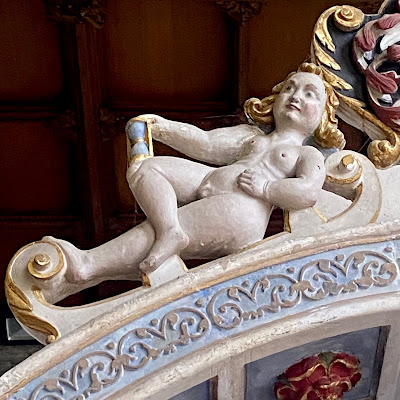
And this was my observation when I looked at the figures on the canopy of the tomb of the brothers Marmaduke and Robert Jennings (died 1625 and 1630) in the church at Curry Rivel, Somerset. There are actually two of these reclining figures, one on each side of the coat of arms that tops the canopy so that they act as informal supporters of the arms. Their real pupose, though, is not heraldic but to hold hourglasses, symbolic of passing time and the end that hastens towards us all.

Many people are surprised or even shocked by such displays of human flesh in church. My grandparents, who would have countenanced no ‘graven images’ of any kind in any chapel where they worshipped, would have looked the other way; some Victorians would have hated such secular and classical excesses; and puritan iconoclasts of a little later in the century when this monument was built would not have liked it, although their destruction seems to have been aimed mainly at images of saints, bishops, and Jesus himself, representations that they considered ‘Popish’. My mind is broader, but that is my point: tastes and ideas change.

And that is one of the best things about so many English churches. Having been there for centuries, they bear the marks of changing tastes. It’s a shame some of those changes have brought destruction, but every remaining fragment, every surviving piece of 17th-century oddity, tells us something about altering and enduring attitudes and about where we have come from. These fragments of our past mark time – as the naked ladies of Curry Rivel are meant to do with their hourglasses – and tell us something about what we have been, and who we are.

Thursday, July 1, 2021

King’s Lynn, Norfolk


Maritime Lynn, 2

As well as the Pilot Office for people managing the shipping in the harbour and its approaches, the other prominent architectural feature of King’s Lynn’s maritime life was the Customs House. This stately classical building is one of the most famous coastal structures in East Anglia. It is well sited right on the northern bank of the inlet called Purfleet Quay. It’s a tall building and its neat wooden turret with cupola attracts attention to it.

Anyone who knows the town centres of England will recognise this building’s architectural ancestry. Its form, with arched lower story, upper floor with large windows, and roof turret, is similar to that of many of the structures that combine the functions of town hall and market that make the centrepiece of many English towns. Its style is proudly Wren-like, like a smaller version of the magnificent town hall at Abingdon. The semi-circular arches, pilasters, hipped roof with dormers, and roof turret are just the kind of thing one sees on late-17th century buildings – both town halls and country houses like Ashdown. This one is not by Wren, but was designed by a local man called Henry Bell, who had clearly absorbed the essence of this style and brought it to his home town when Lynn was still a prominent port. Anyone inclined to think of Lynn as a backwater should think again: the port was a very busy one at this time. Indeed Bell himself was a merchant whose goods went in and out of Lynn harbour; like many architects in the Stuart period, he was an amateur, and picked his commissions carefully. He’d been to Cambridge, and had gone on a grand tour that included time in Holland, where the buildings clearly made an impression on him.

This building was commissioned by Sir John Turner, a local MP, who also served as the town’s mayor and made his money from his business as a wine merchant. This trade was one of the mainstays of Lynn’s harbour, and Turner would have been as aware as anyone of the usefulness of a building in which the local merchants could do business. Hence the structure’s resemblance to a market house. When opened in 1685, the lower floor of the structure (then with open arches) was used as the merchants’ exchange; the upper floor was let to the Collector of Customs; in 1717 the whole building was sold to the Crown and was already known as the Customs House. It remained in the care of HM Customs and Excise until 1989 and when I lasted visited it was used by the local council and housed the Tourist Information Centre. And maybe that’s not totally inappropriate. King’s Lynn no longer gets its main income form its port; tourism is more important to the town today and the Customs House is a perfect architectural signpost and information point for visitors.

Friday, May 7, 2021

Temple Guiting, Gloucestershire


Tradition and the individual

This chunky tower had me scratching my head when I first saw it standing out across the fields. The tower’s position at the church’s west end and its diagonal buttresses are just the sort of thing seen time and time again on Cotswold churches. Usually these towers were added in the 15th century, when the region was prospering from the wool trade. But few of the other details look much like 15th-century Gothic. In particular, the collection of openings – the very plain semi-circular arched doorway, the odd squat pointed window just above it, and the rather more elegant two-light opening near the top – did not seem like typical medieval work. Neither did the very stubby pinnacles with their almost pyramidal finials.*

Seeing it up close, appended to the small church of Temple Guiting in the Cotswolds, it made a little more sense. Temple Guiting was a medieval church: the village name reveals an ancient connection with the order of the Knights Templar, but this is not evident in the architecture and as far as the tower is concerned is a red herring. The history of the tower begins much later. It seems to have been added to the church in the 17th century and is thus an example of the survival of Gothic architecture into a time when Classical styles had become fashionable. This is not at all unusual, especially in rural areas where masons carried on building in a version of the style that had been passed on from master to apprentice, father to son, through the generations. So it’s an eclectic mix of motifs from here and there, and no less charming for that, and for the sense that the structure shows the sort of originality that can emerge when a 17th-century provincial mason blends what he has learned from tradition with the strength of purpose to go his own way.

- - - - -

* Pevsner has a go at this part of the tower, sneering at the ‘clumsy top stage, naive gargoyles and big square pinnacles’. But I don’t mind either the rather bulky pinnacles or the gargoyles – aren’t most rural gargoyles naive, and isn’t this part of what makes them effective visually? 

Friday, February 12, 2021

Ledbury, Herefordshire


TA very much 

This is one of a row of four shops that make up the ground floor of a large timber-framed building in Ledbury, not far from the door canopy in my previous post. The building was once quite a grand town house, built in the 17th century and altered in the 18th. I often wince when I see more recent shop fronts inserted into ancient buildings, sometimes with little or no regard to the structure above. An example in Banbury that I posted a couple of years ago is an example. But times and needs change. Towns evolve, and buildings are altered in turn – I don’t want to pursue a Darwinian metaphor too far but the evolution can enable the building to survive.

And then, looking a little closer, I find that there are actually things to admire in the later additions. The blue and white shop front next door has a good frontage. It’s a hardware store, hard to see architecturally when the shopkeeper’s wares spill out on to the pavement, but the shopkeeper is more interested in making a living than in my impulse to clear gardening equipment or bedding plants out of the way so I can admire the architecture. But, briefly, there’s some unusually shaped panelling and a nice curved console bracket, its flutes picked out in white. A Victorian carpenter must have been pleased with that 150 years ago.

But it’s the shop front next door that my picture shows more fully. It’s plainer, but it’s nicely dentilled. There’s jazzy black and white tiling just visible beneath the doormat by the entrance, and I wonder if those upper panes of glass are the size of the originals (maybe – plate glass got quite large after 1851). The wall of the entrance porch looks as if it has been ‘done’ in faux timber-framing, but even that has its charm and is black and white, to match the building as a whole. More than this, recent owners have made something of the frontage. There’s some pleasant gilded lettering in the lower part of the window and the painted sign up in the fascia is very well made, in attractive serif letters (even if the small numerals in ‘1966’ are a little squashed for my personal taste).

Established 1966: it doesn’t seem that long ago. I can remember 1966. But hang on – if I can remember it, it doesn’t mean it’s recent, I’m sorry to say. A business that has continued for 55 years is something to be proud of these days. Especially when the High Street is expected or obliged to reinvent itself every five minutes and is threatened by online competition, out of town malls, and lockdowns. In summary, the signs both look good and tell us what we want to know – that it’s a fruit and veg shop, that the proprietors’ names are MA and TA Jenkins. I hope they can carry on much longer. TA very much.

Wednesday, November 4, 2020

Burford, Oxfordshire


Bricks come to Burford

For me and everyone else, it has been a year in which travel has been restricted. Like the rest of the British population, I have been in lockdown, or in some voluntary state of semi-lockdown in which I’ve tried to risk unnecessary exposure to Covid-19, or in a state with a little more freedom but still the fear that travelling any distance might take me into an area of the country that is in lockdown or otherwise restricted. One of the compensations for all this has been that it has forced me to focus more closely on buildings that are closer to home. Many of my recent posts reflect this.

I’m fortunate to live not far from an abundance of interesting walls to stare at. Here’s one such interesting wall, one of many in the glorious High Street of Burford, just on the Oxfordshire side of the border with Gloucestershire and near the eastern edge of the Cotswold Hills. Like so many of Burford’s buildings, this one has ancient origins. There’s timber framing of the 16th century (or perhaps even earlier) round the back. But from the street the Bull Inn presents this attractive and arresting brick and stone front.

The date of the frontage must be about 1700 – estimates vary from 1690 to 1715 – during the period when William Tash and his son John were landlords. William Tash took over an inn with a long history. Records of it go back to 1397, although the building was used for a long spell in the 16th century as a butcher’s shop. But in 1610 it was an inn again and later in the century it’s said that Charles II and Nell Gwynne stayed there. By the time the facade was updated, Burford was a prosperous town, a stopping point on the route from Wales to London. The inn’s new frontage helped it stand out.

According to the Bull’s website, it was the only brick building in Burford back then. Even now, nearly all the buildings in this street have fronts of Cotswold stone or timber framing (sometimes rendered) but the Bull mixes stone and brick, with stone used not just on the ground floor but also for the pilasters, keystones and other details above. Those other details add to the building’s eccentricity and, I’d say, charm: very chunky aprons beneath the upper windows and trapezoid stones on the upper corners of the window surrounds. All this, combined with the mix of red and darker bricks makes for a winning result and a real eyecatcher for those with time to stop and look.


Tuesday, September 15, 2020

Stow-on-the-Wold, Gloucestershire


Into the wood

St Edward’s church stands in the middle of the Cotswold market town of Stow-on-the-Wold. It’s medieval and, even though it’s tucked away from the main square – one way in is down a side street, another approach is via an alley – it must be very much visited. I suspect, though, that many visitors don’t notice the doorway in my photograph. That’s because it’s the north door, and the main entrance is through the south door, which is the one you see as you approach the church via the most obvious route. People who don’t walk around a church as well as going inside often miss architectural and scenic treats, and this is both.

The church is very old – parts date back to the 11th or 12th century – but, like most parish churches, it was altered in the medieval period and later. The north porch is said to date form the 17th or 18th century. It’s in the gothic style developed in the Middle Ages, but the way in which the arch is top by a band of little windows is unusual. This kind of window isn’t something I’ve noticed in a church before – maybe it’s a local mason’s invention, maybe there are other examples I have missed. Whichever is the case, it’s pleasant, and must bring useful additional light into the porch.

Many people, however, won’t even notice the architecture. It’s the trees that catch the eye, a pair of yews of considerable age, growing so hard by the arch that they seem part of it. Building and trees seem to be growing together, and one hopes that the slow-growing yew’s roots are not doing too much damage to the building, as it’s an effect I’d be loth to lose.

When I researched this doorway online, I chanced on websites run for Tolkien enthusiasts that compared the doorway to the doors of Durin in The Lord of the Rings. Speculation was rife that the writer had been inspired by the doorway – Stow can be reached from Tolkien’s Oxford home in an hour or so, after all. Well, maybe. I don’t think there’s any hard evidence that the novelist came here, and it would not have been hard for Tolkien to have the idea independently, especially as these doors were made by Dwarves and Elves, and the Elven folk lived in an arboreal world. And the architecture pedant in me wants to point out that Tolkien’s archway is Romanesque and semicircular, while the entrance at Stow is pointed and Gothic. Trees and churches, trees and the sacred and significant: they’re never far apart, although rarely as physically close as here.


Sunday, August 30, 2020

Llanwarne, Herefordshire


Ionically…

The variations on the classical orders of architecture – Doric, Ionic, Corinthian, Composite, Tuscan – are legion. They’ve been the subject of posts on this blog before, but I don’t think I’ve covered a Jacobean variation. This is from a wall monument inside the ruined church at Llanwarne that I featured in my previous post. Maybe some dedicated pursuivant of heraldry could work out whose monument it was from the coats of arms on it. Perhaps it commemorates the person who paid for work on the church in the 17th century, including the south porch – but that’s speculation and in this post I’m concentrating on one small detail of the monument’s design.

Even now the stonework is weathered, the amount of effort expended by the carver is clear, and one focus of that effort was to delineate a variation in the Ionic order that’s very much of its time. Even the shaft is distinctive, with its deep, curving convex mouldings, in contrast to the concave flutes that are more usual on classical columns. There’s additional fine detailing between each moulding that looks as if the sculptor has created a series of miniature flutes topped with tiny roundels. The necking ring above is very deeply moulded, and above it is a band ornamented with tiny hemispheres in groups of five, arranged in a pattern that’s repeated in the capitals above. Between the capital’s spirals is what looks like some egg and dart decoration, but this has worn rather flat. Adjoining the shaft and capital to the right are the rolls and scrolls and flat patterns we now called strapwork, something typical of 17th century English interiors.

In other words, this detail shows an English carver doing what English carvers so often did – taking a classical motif that we associate with ancient Greece or Rome and giving it a character that’s both more local and very much of its time. True, some of the ideas may come from pattern books published in France or the Low Countries, go-to sources for much English Renaissance design. But the effect – vigorous, rural, but showing visual flair – is very English, and shows, as so often, that the orders were an adaptable starting point for craftworkers who’d learned the classical ropes.


Friday, August 14, 2020

Westwell, Oxfordshire


Country classicism

My photograph shows what I saw when peering through the churchyard hedge at Westwell, a small village in West Oxfordshire. My first thought was that this building was substantial enough to be the manor house, but actually it’s the former rectory. The Church of England quite often accommodated its incumbents in houses of this size and pretension between the 17th and early-20th centuries. The clergy were usually second in status to the Lord of the Manor and often had large families and more than one servant, so a big house was not seen as inappropriate. But by the mid-20th century the church was selling off many of its big rectories and housing rectors and vicars in smaller houses that were easier to care for, cheaper to heat, and generally more suited to the needs of a modern family. 

This example was built at the beginning of the 18th century in that simple but satisfying style that I think of as rural classicism – regular rows of mullioned windows, stone quoins, a wooden eaves cornice, and a hipped roof with dormer windows. There’s also a pleasant stone doorway with an open pediment supported by curvaceous consoles. The protruding wing on the right is later – mid-19th century – but in the same style and materials.

The church and most of the tombstones in the churchyard are of similar creamy limestone. Altogether, it’s a pleasing ensemble, one that has plenty of age, but is still a fitting and one hopes comfortable home – for the living and the dead.