Showing posts with label Llanwarne. Show all posts

Sunday, August 30, 2020

Llanwarne, Herefordshire


Ionically…

The variations on the classical orders of architecture – Doric, Ionic, Corinthian, Composite, Tuscan – are legion. They’ve been the subject of posts on this blog before, but I don’t think I’ve covered a Jacobean variation. This is from a wall monument inside the ruined church at Llanwarne that I featured in my previous post. Maybe some dedicated pursuivant of heraldry could work out whose monument it was from the coats of arms on it. Perhaps it commemorates the person who paid for work on the church in the 17th century, including the south porch – but that’s speculation and in this post I’m concentrating on one small detail of the monument’s design.

Even now the stonework is weathered, the amount of effort expended by the carver is clear, and one focus of that effort was to delineate a variation in the Ionic order that’s very much of its time. Even the shaft is distinctive, with its deep, curving convex mouldings, in contrast to the concave flutes that are more usual on classical columns. There’s additional fine detailing between each moulding that looks as if the sculptor has created a series of miniature flutes topped with tiny roundels. The necking ring above is very deeply moulded, and above it is a band ornamented with tiny hemispheres in groups of five, arranged in a pattern that’s repeated in the capitals above. Between the capital’s spirals is what looks like some egg and dart decoration, but this has worn rather flat. Adjoining the shaft and capital to the right are the rolls and scrolls and flat patterns we now called strapwork, something typical of 17th century English interiors.

In other words, this detail shows an English carver doing what English carvers so often did – taking a classical motif that we associate with ancient Greece or Rome and giving it a character that’s both more local and very much of its time. True, some of the ideas may come from pattern books published in France or the Low Countries, go-to sources for much English Renaissance design. But the effect – vigorous, rural, but showing visual flair – is very English, and shows, as so often, that the orders were an adaptable starting point for craftworkers who’d learned the classical ropes.


Thursday, August 27, 2020

Llanwarne, Herefordshire


Floods and fragments

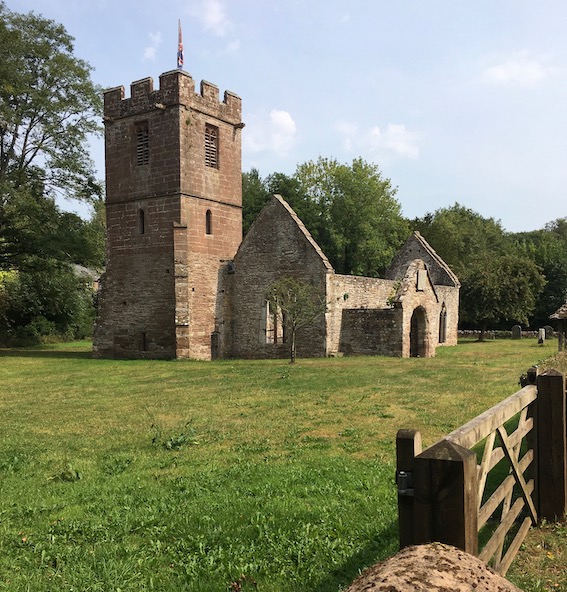
Ruined churches. When I come across one in the countryside I naturally think their ruination has been caused by rural depopulation or population movement. The old church of St John the Baptist at Llanwarne in Herefordshire – a place I was quite unaware of until the other day – was abandoned for another reason. The building, which stands close to a brook, suffered repeated flooding, so in the Victorian period a new church was built on a higher site across the road. The old church still stands, minus its roof, an ornamental and tranquil place in which to contemplate the transience of the works of humankind and the visual qualities of weathered stone.

This building is fragile. Some of the mullions and tracery in the windows seem to be supported by the ironwork that must originally have held panes of glass in place; signs tell us not to climb on the walls. There’s a part of me that likes my ruins unkempt and desolate and productive of the sort of emotions that are summed up in the term ‘Romantic’ and in the useful German word Ruinenlust. That word can be translated as ‘Pleasure of ruins’, which is the title of a fascinating book about ruins by Rose Macaulay. Ruinenlust involves taking pleasure in something that also invokes dread or sadness. The melancholy aspect of ruins like this is obvious enough, but there are delights too – the vistas of trees and sky above and through window openings, the sense of a quiet haven that’s becoming part of nature, the softening effects (so admired by Ruskin) of time on stone.

As you can see from my photographs however, this is not the kind of ruin one sometimes sees slipping rapidly back to nature and surrounded by tall grass and drifts of nettles. It is looked after. The grass is trimmed and the latch on the gate still works. So although I can enjoy the ruin’s fragility, the fluid quality of some of its worn window tracery, the patina of its stonework, I can also appreciate the care and effort of the people who look after buildings like this, cut the grass, thoughtfully provide garden benches, and ensure the structure is stable.

Looking at the church is even more than usual an effort of piecing together the building’s story from a collection of assorted architectural fragments: a nave and arcade of the 13th century; a 14th-century aisle and graceful 14th-century window tracery; a tower of the same century, much the most solid-looking part of the building; a later porch, probably 17th century. Walking around inside an oddity becomes clear. At some point the ground level both inside and outside the building has been raised, so that now some of the window sills are not far from the turf and the capitals of the arcade piers are only a couple of feet from the floor. Why? Is this the effect of accumulated silt from centuries of flooding? One derivation of the name Llanwarne is ‘the church by the swamp’.

The inner doorway of the porch bears fragments of a carved inscription. The difficulty of reading this is demonstrated by the conflicting opinions of a 1931 RCHME survey and Pevsner. Pevsner thinks it’s in Latin. The 1931 account sees in it English words such as ‘[fad]eth – soe doth Man’s. . . . the [h]ouse of God’, as if a message about decay or ruination is trying to get out. Reading a medieval building can be baffling, but bafflement can be pleasurable, and the quiet enjoyment of a peaceful ruin can be too.